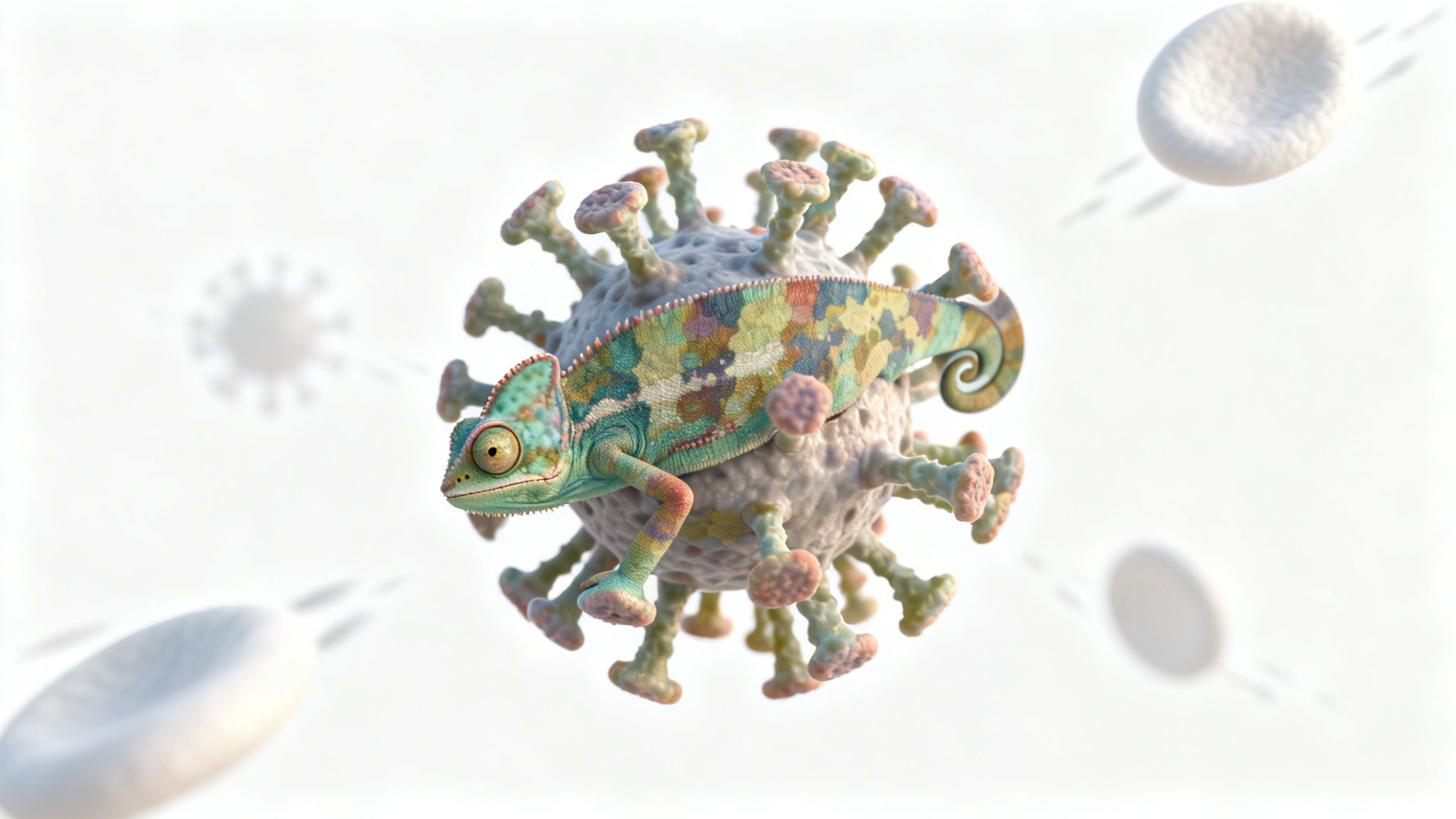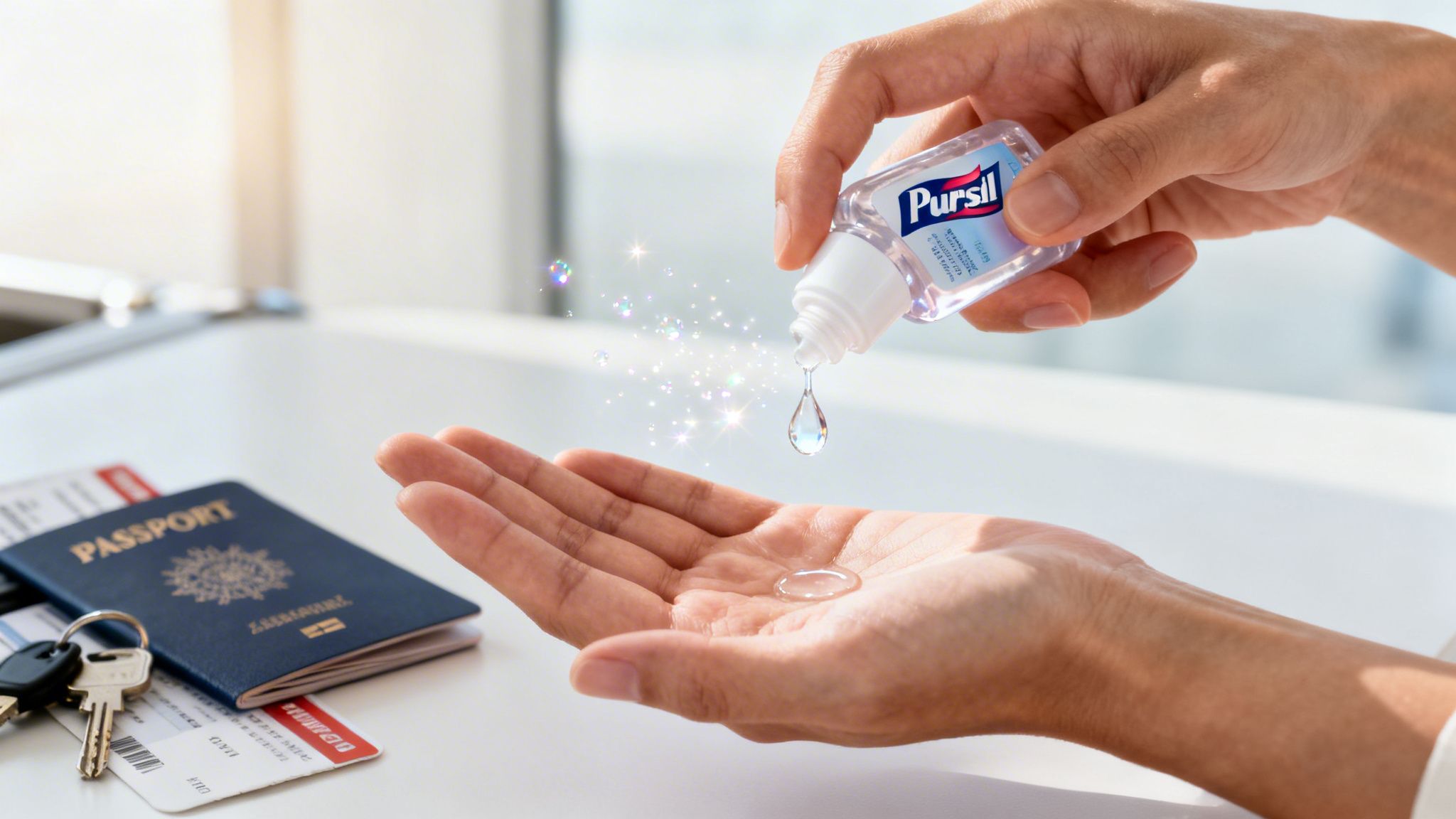
In a world where health threats like Human Immunodeficiency Virus Type 1 (HIV-1) or Influenza A Virus (H1N1) can emerge, a mini Purell hand sanitizer is more than just a little bottle you toss in your bag. It’s a vital piece of your personal defense against viruses. This small but mighty tool plays a huge part in stopping the spread of germs, especially enveloped viruses. Think of it as your own personal health security guard, always on call when soap and water aren't an option.
Your Pocket-Sized Partner in Virus Prevention

The COVID-19 pandemic, caused by SARS-Related Coronavirus 2 (SARS-CoV-2), changed how we think about personal hygiene forever. Suddenly, the simple act of cleaning our hands wasn't just a convenience—it became an essential daily habit. It’s now a first line of defense against the invisible threats we face every day.
In this guide, we'll dive into the science of how a mini Purell works, how effective it is against specific viruses, and the right way to use it to get the most protection. We’ll show you why this tiny bottle has become such an indispensable part of a modern, health-conscious lifestyle.
Why On-the-Go Protection Matters
Let’s be honest—our hands are the main culprits when it comes to spreading germs. We touch countless surfaces all day long: doorknobs, elevator buttons, shopping carts, and subway railings. Each one is a potential hotspot for viruses and bacteria just waiting for a ride.
By simply touching a contaminated surface and then your face, you can transfer pathogens directly to your eyes, nose, or mouth, providing them an easy entry point into your body. This is a common transmission route for viruses like Influenza A (H1N1) and SARS-CoV-2.
Carrying a mini Purell lets you break this chain of transmission instantly. It offers immediate protection right when and where you need it most, long before you can get to a sink. You can learn more about how to protect yourself from viruses in our comprehensive guide.
This small tool is so important because it helps protect not only your own health but also the well-being of those around you. Of course, hand sanitizer is just one player in a complete hygiene game plan. Sanitizing your hands after touching a public handrail is crucial, but it doesn't clean the rail itself. That's where other tools, like disinfecting wipes, are essential for cleaning the very surfaces that spread germs in the first place, ensuring a safer environment.
How Alcohol Sanitizer Actually Neutralizes Viruses
Ever wondered what happens on a microscopic level when you use a mini Purell? The science behind it is surprisingly straightforward. The hero ingredient is ethyl alcohol, which PURELL® Advanced Hand Sanitizer packs at a powerful 70% concentration—well above the minimum recommended for inactivating viruses like Hepatitis B (HBV) and Hepatitis C (HCV).
To understand how it works, you first need to picture what enveloped viruses like Influenza A or SARS-CoV-2 look like up close. Think of them as tiny fortresses protected by a soft, fatty outer wall called a viral envelope. This lipid layer is absolutely critical for the virus's survival and its ability to break into and infect our cells.
The Power of Protein Denaturation
The alcohol in the sanitizer acts like a specialized demolition crew for this fortress. As soon as it comes into contact with the virus, the alcohol molecules get to work dissolving that fatty outer wall. It’s a lot like how soap cuts through grease on a dinner plate, just on a microscopic scale.
This immediate disruption causes the virus’s entire structure to fall apart. The process, known as protein denaturation, effectively scrambles the essential proteins the virus needs to function. Without its protective envelope and internal machinery intact, the virus is neutralized and rendered harmless.
This mechanism is incredibly effective against "enveloped" viruses like Herpes Simplex Virus 1 (HSV-1) and Bovine Viral Diarrhea Virus (BVDV). By destroying their outer lipid layer, alcohol-based sanitizers stop many common pathogens in their tracks before they have a chance to cause infection.
This simple yet powerful action is why a mini Purell hand sanitizer is such a vital tool for staying healthy on the go, especially when you can’t get to a sink.
A Proven Tool in Global Health
The importance of alcohol-based sanitizers was thrown into sharp relief during the COVID-19 pandemic. In 2020, GOJO Industries, the maker of Purell, faced an unprecedented surge in demand as the world sought effective ways to fight the new coronavirus. This boom underscored a key fact: sanitizers with at least 60% ethanol are fantastic at inactivating enveloped viruses like SARS-CoV-2 by ripping apart their lipid membranes.
By the end of 2021, GOJO had ramped up its Purell hand sanitizer production fivefold to meet the new global standard of hygiene. Even today, with those habits firmly in place, the market remains strong, as detailed by Precedence Research.
Of course, sanitizing is just one piece of the puzzle. While a mini Purell neutralizes viruses on your skin after you touch a contaminated doorknob or phone, it doesn't clean the surface itself. That’s where other tools, like disinfecting wipes, come in—they’re essential for cleaning the very surfaces that spread germs in the first place, creating a truly hygienic space.
The Right Way to Use Your Hand Sanitizer
Having a mini Purell is one thing; using it correctly is another. Your sanitizer’s virus-fighting power is only unlocked with the proper technique. A quick, careless splash just won’t cut it.
Making every application count means following a few simple but critical steps. It all starts with using the right amount. Squeeze a dime-sized dollop into the palm of one hand—that's just enough to thoroughly coat both of your hands.
From there, it's all about coverage. A lot of people just rub their palms together and call it a day, but that leaves huge parts of your hands unprotected where germs can hide.
Making Every Rub Count
The goal is to cover every single nook and cranny of your hands and fingers. Imagine you're painting a wall—you wouldn't leave random unpainted patches, right? Your hands need that same complete coverage to ensure germs have nowhere to hide.
This simple checklist will help you build the right habit:
- Palms: Start by rubbing your palms together.
- Back of Hands: Rub the back of each hand with the palm of the other.
- Between Fingers: Interlace your fingers and rub them back and forth.
- Thumbs: Clasp each thumb with your opposite hand and rub in a rotating motion.
- Fingertips: Rub the tips of your fingers against the palm of your opposite hand.
Keep rubbing until your hands are completely dry. This should take about 20 seconds. This "20-second rule" is essential because it gives the alcohol enough contact time to neutralize enveloped viruses effectively.

As you can see, the sanitizer’s alcohol gets in there and breaks down the virus's outer layer, rendering it inactive and harmless.
Sanitizer vs. Soap: When to Choose
While a mini Purell hand sanitizer is incredibly useful, it’s not always the right tool for the job. Sanitizer is perfect for when your hands are generally clean but might have been exposed to germs—like after touching a public doorknob or elevator button.
However, if your hands are visibly dirty, greasy, or have come into contact with certain non-enveloped viruses, hand sanitizer loses a lot of its punch. Dirt and grime create a physical barrier that prevents the alcohol from reaching and destroying the germs underneath.
In these situations, nothing beats good old-fashioned soap and water. You can learn more about this in our guide covering proper hand washing technique to fully round out your hygiene knowledge. Washing with soap physically removes dirt and pathogens from your skin—something sanitizer simply can't do.
What Sanitizer Can (and Can’t) Do for You
To really get the most out of that little bottle of mini Purell hand sanitizer in your pocket, you need to know its strengths and weaknesses. While alcohol-based sanitizers are fantastic at knocking out many of the germs we encounter daily, they aren't a silver bullet for every single virus out there.
Their effectiveness boils down to one simple thing: the virus's architecture.
It all comes down to whether a virus is "enveloped" or "non-enveloped." As we've touched on, enveloped viruses like influenza, Herpes Simplex Virus 2 (HSV-2), and coronaviruses (including SARS-CoV-2) are wrapped in a soft, fatty outer layer. This lipid membrane is their Achilles' heel—the 70% ethyl alcohol in Purell dissolves it on contact, causing the virus to fall apart.
But some viruses are built a lot tougher. And that's where we run into the limits of hand sanitizer.
The Challenge of "Naked" Viruses
Non-enveloped viruses, often called "naked" viruses, don't have that fragile fatty shell. Instead, they're protected by a hard, rugged protein shell called a capsid. Alcohol just doesn't break down this structure very well, making these viruses far more resistant to your average hand sanitizer.
Think of it like this: an enveloped virus is like an egg with a soft, easy-to-crack shell. A non-enveloped virus is more like a golf ball—its hard outer casing can take a serious beating and stay intact.
Common examples of these hardy non-enveloped viruses include:
- Norovirus (Norwalk Virus), the infamous "stomach flu" bug.
- Rhinovirus Type 14 and Rhinovirus Type 39, major culprits behind the common cold.
- Human Rotavirus, a leading cause of severe diarrhea in young children.
- Feline Calicivirus, a surrogate for Norovirus in scientific studies.
Because alcohol isn't very effective against these tough-shelled viruses, sanitizer alone might not be enough to keep you from getting sick if you're exposed. In situations where these germs are a concern, good old-fashioned hand washing with soap and water is the far better option. The friction from scrubbing physically lifts and removes the germs from your skin.
Effectiveness of Alcohol-Based Sanitizer on Different Virus Types
This table shows why alcohol-based sanitizers like Purell are highly effective against certain viruses but less so against others.
| Virus Type | Example Viruses | Outer Layer | Sanitizer Efficacy |
|---|---|---|---|
| Enveloped | Influenza, Coronaviruses (incl. SARS-CoV-2), Herpes, HIV, HBV, HCV | Soft lipid (fatty) membrane | High. The alcohol easily dissolves this layer, destroying the virus. |
| Non-Enveloped | Norovirus, Rhinovirus (common cold), Rotavirus, Feline Calicivirus | Tough protein capsid | Low to Moderate. The alcohol struggles to penetrate this hard shell. |
As you can see, the "naked" non-enveloped viruses are simply harder to kill with alcohol. This is precisely why public health experts, like those at the CDC, emphasize washing with soap and water whenever possible, especially when dealing with bugs like Norovirus.
Don't Forget About Contaminated Surfaces (Fomites)
There's one more crucial limitation to keep in mind: a mini Purell hand sanitizer cleans your hands and only your hands. It does absolutely nothing about the contaminated surfaces you just touched, a concept in the infectious disease world known as fomite transmission.
A fomite is any object—a doorknob, a gas pump handle, a pen—that can pick up germs and pass them on to the next person who touches it.
So, you might be diligent about sanitizing your hands after leaving the grocery store. But what about the shopping cart handle, the keypad on the credit card machine, or your car's door handle? Those surfaces can stay contaminated.
This is why a two-pronged approach is the only way to truly protect yourself. Sanitizing your hands breaks one link in the chain of transmission, but cleaning the surfaces themselves is the other essential half of the strategy. Using disinfecting wipes designed to kill pathogens on objects gives you a much more robust defense, ensuring a truly hygienic environment.
Why Mini Sanitizer Is a Traveler's Best Friend

This is where a mini Purell hand sanitizer really earns its keep—when you're on the move. For frequent flyers and road-trippers, it's a non-negotiable part of the travel kit, providing on-demand protection against viruses like Avian Influenza Virus (H5N1) that may be more prevalent in other regions.
Thankfully, getting your sanitizer through airport security is a breeze. The standard 1 oz and 2 oz mini bottles are well within the TSA’s rules for carry-on liquids. That makes it easy to keep hygiene within arm's reach, even at 30,000 feet.
Building Your Travel Hygiene Routine
Travel throws you into contact with an endless stream of shared surfaces, each one a potential hotspot for germs to hitch a ride. Making your mini sanitizer a key part of your journey is a simple but powerful way to lower your risk.
Just think about all the things you touch on a typical travel day:
- Airport Security: Sanitize your hands right after you’ve handled those security trays.
- In-Flight: Give your hands a good rub before digging into an in-flight meal or snack.
- Public Transit: After grabbing railings on a train, bus, or in a rideshare, a quick pump of sanitizer is a must.
- Hotel Arrival: Use it the moment you walk into your room, before you start touching light switches, the TV remote, and other high-contact items.
By recognizing these high-risk moments, you start building an intuitive hygiene habit. This simple act of sanitizing after touching shared surfaces is one of the best ways to break the chain of transmission and stay healthy on your trip.
Of course, keeping your hands clean is just one piece of the puzzle. For even better protection on your travels, it’s a smart idea to pair your sanitizer use with other key international travel safety tips.
Remember, while a mini Purell is perfect for your skin, it can’t clean the airplane tray table or that hotel room remote. That’s why pairing good hand hygiene with surface disinfection—using something like disinfecting wipes—gives you a much more complete shield against germs in your environment.
Frequently Asked Questions About Hand Sanitizers
Even after you know the science behind them, you probably still have a few practical questions about using that mini Purell hand sanitizer in your pocket. Let's get them answered so you can use it with total confidence.
Does Hand Sanitizer Expire?
Yes, it absolutely does. You’ll find an expiration date printed right on the bottle, which is usually two to three years from when it was made.
The reason is simple: over time, the alcohol that does all the work can slowly evaporate. Eventually, its concentration will dip below the 60% minimum required to effectively kill germs. Using an expired sanitizer is probably better than nothing, but it won’t give you the reliable protection you’re counting on.
Can I Use Sanitizer on Surfaces?
It’s tempting, but it's not a good idea. Hand sanitizer is formulated and tested for one thing: skin.
While the alcohol might have some sanitizing effect, these products aren't designed to disinfect hard surfaces. In fact, they can even damage certain materials. For cleaning objects, always stick with a product made for the job, like an EPA-approved disinfecting wipe, to ensure you are actually killing viruses and not just moving them around.
Is Overusing Hand Sanitizer a Problem?
While being diligent about hygiene is great, going overboard with sanitizer can definitely dry out your skin. It’s all due to that high alcohol content.
To help with this, reputable brands like Purell add moisturizers and skin conditioners to their formulas. If you still notice your hands getting dry, cracked, or irritated, start using a good hand lotion regularly. And remember, whenever soap and water are available, give your hands a proper wash—it's much gentler on your skin in the long run.
Does the Brand of Sanitizer Matter?
The single most important thing to look for is the alcohol concentration. The CDC is very clear on this: a hand sanitizer needs at least 60% ethyl alcohol or 70% isopropyl alcohol to kill most enveloped viruses effectively.
Trusted brands like Purell guarantee their products meet these standards and often formulate them to be less harsh. That said, any brand that meets the CDC's alcohol requirement will get the job done.
And when you're getting ready to fly, staying germ-free is just one part of the puzzle. Knowing the rules for packing liquids is crucial. You can find some great tips on how to get your personal care items ready for your trip by learning more about how to pack toiletries for air travel.