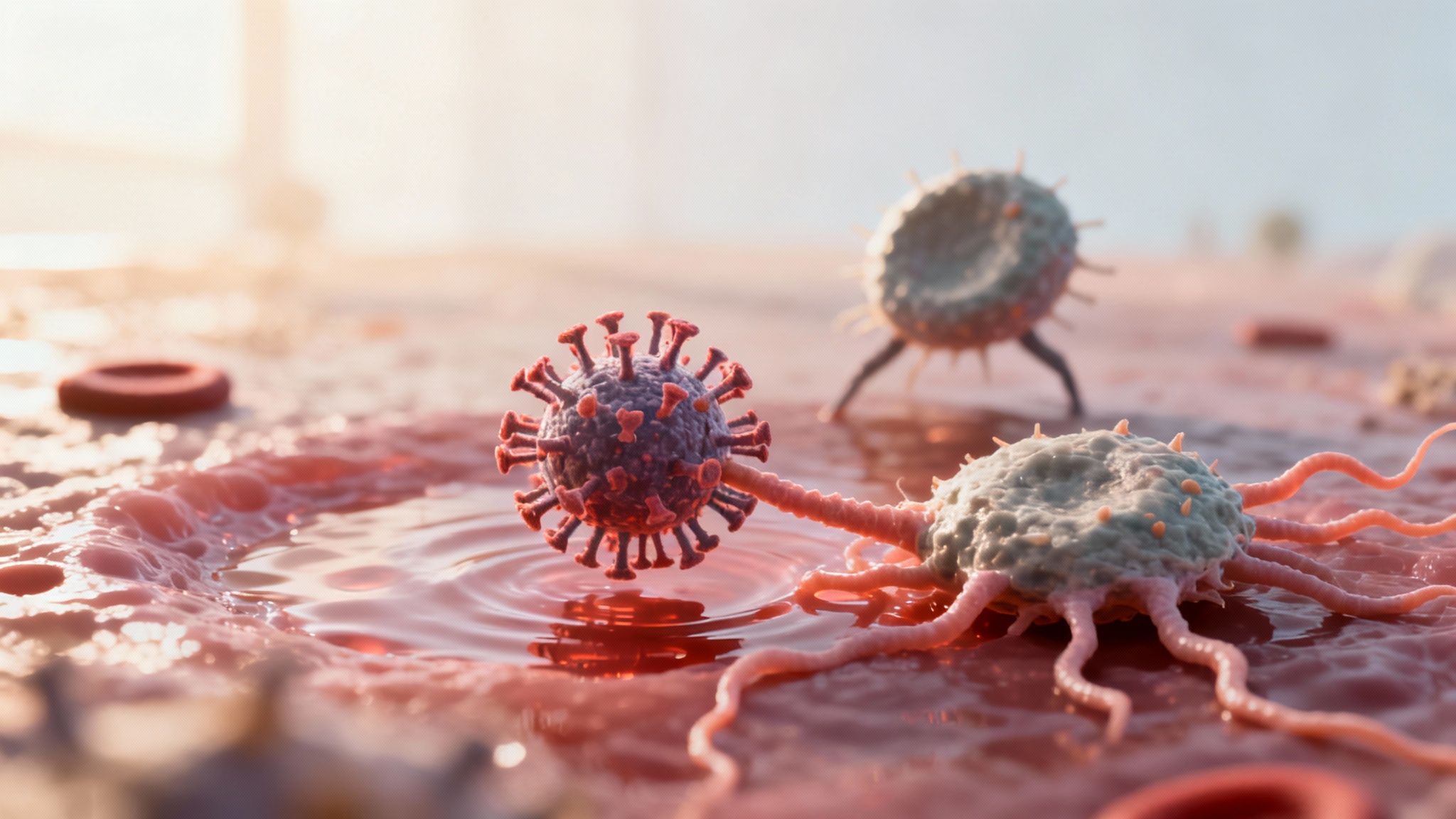
When a virus slips past your body’s outer defenses, an ancient and powerful security system kicks into gear. This isn’t a slow, calculated counter-attack. It’s an immediate, all-hands-on-deck alarm known as the innate immune response.
Think of it as your body's on-call security team. They're the first responders who arrive at the scene within minutes to hours of a breach. They don’t need to know the virus's specific name or its master plan; they just recognize an intruder and get to work. Their main job is containment—to slow the virus down and keep it from running rampant while the more specialized forces get ready.
Your Body's Immediate Defense Against Viruses
Imagine your body as a well-guarded fortress. Most of the time, the walls—your skin and mucous membranes—are more than enough to keep invaders out. But every now and then, a clever virus like Rhinovirus Type 14 or Influenza A Virus (H1N1) finds a crack in the armor, triggering a silent, widespread alarm.
This initial battle unfolds in the first 0 to 96 hours and is absolutely critical. A strong innate response can often stop a virus in its tracks, leaving you with just a mild case of the sniffles. If the virus breaks through this first line of defense, however, the fight escalates, calling in the big guns of your immune system.
The First Responders Arrive
Once a virus gets inside a cell and starts making copies of itself, that infected cell doesn't go down quietly. It sends out chemical distress signals, basically screaming for help.
This summons the first wave of defenders, a crew of immune cells that are experts at fighting threats without any prior experience.
- Macrophages: These are the big eaters of the immune world. They act like cellular janitors, engulfing and digesting viruses, infected cells, and any other debris they find. Think of them as Pac-Man, gobbling up everything that doesn't belong.
- Natural Killer (NK) Cells: If macrophages are the cleanup crew, NK cells are the assassins. They are uniquely skilled at spotting your own cells that have been turned into virus factories. Once they identify a compromised cell, they eliminate it on the spot to stop the virus from spreading.
This initial cellular brawl is what causes many of the familiar symptoms of being sick—inflammation, fever, and body aches are all signs that your immune system is putting up a fierce fight.
Sounding the Chemical Alarm with Interferons
As the cellular battle rages, one of the most brilliant defense strategies unfolds. Infected cells release a powerful set of alarm proteins called interferons.
This chemical S.O.S. doesn't save the cell that sends it, but it acts as a crucial warning to all the healthy cells nearby. It tells them to lock their doors and board up the windows, metaphorically speaking.
In response to the interferon signal, neighboring cells activate their own internal antiviral defenses, making it much harder for the virus to get in and replicate. This creates a sort of biological firewall, slowing the spread of viruses like Hepatitis B Virus (HBV) and SARS-Related Coronavirus 2 (SARS-CoV-2). This buys precious time for the more specialized parts of your immune system to mobilize for a targeted attack.
To better understand these initial defenders, let's break down who they are and what they do.
Key Players in the Initial Immune Response
Here's a quick look at the main cells and molecules that leap into action the moment a virus is detected.
| Component | Primary Function | Analogy |
|---|---|---|
| Macrophages | Engulf and digest viruses and infected cells. | The cleanup crew or Pac-Man of the immune system. |
| Natural Killer (NK) Cells | Identify and destroy virus-infected host cells. | The assassins that take out compromised "zombie" cells. |
| Interferons (IFNs) | Warn neighboring cells to activate antiviral defenses. | An emergency broadcast system or chemical alarm. |
These first responders are the unsung heroes of your immune system. Their rapid, coordinated effort is often the difference between a minor illness and a serious infection, setting the stage for everything that follows.
Assembling the Elite Forces of Your Immune System
While the innate immune response acts like a brute-force security team, it’s also gathering critical intelligence from the battlefield. This information gets passed up the chain to mobilize a far more specialized and powerful division: the adaptive immune response.
Think of it this way: if the innate response is the first alarm and the local police, the adaptive response is the assembly of elite special forces, custom-trained to hunt down one specific enemy. This advanced defense is slower to get going, typically taking several days to fully deploy. But its precision and power are unmatched.
Better yet, it doesn’t just fight the current invasion. It creates a lasting memory of the virus, ensuring that if the same invader ever returns, your body will be ready with a much faster and more devastating counter-attack.
The Intelligence Briefing and Commanders
The whole process kicks off when specialized intelligence-gathering cells, known as antigen-presenting cells (APCs), clean up the mess left by the initial fight. They take pieces of the virus—called antigens—and display them on their surface. It’s like a scout returning from enemy lines with a piece of the invader's uniform to show the army commanders exactly who they're up against.
These APCs then travel to your lymph nodes, the command centers of your immune system, to find a very specific type of cell: a T cell. T cells are the generals of your immune army, and each one is uniquely programmed to recognize just one type of antigen. Once an APC finds a T cell that matches the viral antigen it’s carrying, the adaptive immune response is officially triggered.
This activation is incredibly specific. Your body holds millions of different T cells, each waiting for its unique signal. Only when the right T cell meets the right piece of the virus is the order given to build an army against that specific threat.
Deploying the Specialized Units
Once activated, T cells multiply rapidly and differentiate into two main types of elite soldiers, each with a distinct mission. The maturation of these specialized cells is a complex process, and peptides like Thymosin Alpha 1 can play a crucial role in getting them ready for battle.
- Helper T Cells (CD4+): These are the battlefield coordinators. They don't kill infected cells directly. Instead, they direct and amplify the entire immune attack by releasing chemical signals that rally more immune cells, boost macrophage activity, and give B cells the command to start mass-producing antibodies.
- Cytotoxic T Cells (CD8+): These are the assassins. Helper T cells call the shots, but Cytotoxic T cells do the dirty work. They patrol your body, seeking out your own cells that have been hijacked and turned into virus factories. When they find one, they lock on and destroy it, stopping viral production at its source.
This diagram shows how innate cells, like macrophages, are the first to engage a virus, a critical step that sets the stage for activating the adaptive forces.

This flow from early responders to specialized units highlights how the initial battle isn't just about fighting, but also about gathering the intelligence needed for a highly targeted counter-offensive.
Creating the Smart Missiles
Directed by Helper T cells, another crucial player enters the fray: the B cell. B cells are responsible for producing antibodies, which are essentially tiny, virus-seeking smart missiles. Each antibody is custom-designed to latch onto a specific viral antigen. To get a better handle on how this works, you can learn more about antibodies and their targets in our detailed guide.
Once produced, antibodies flood your bloodstream and tissues, where they carry out several key missions:
- Neutralization: They bind to viruses, physically blocking them from being able to enter healthy cells.
- Tagging for Destruction: They act like bright flags, marking viruses for destruction by macrophages and other hungry immune cells.
This antibody response is vital for clearing viruses that are circulating outside of your cells, like in your blood or on mucosal surfaces. It's also the mechanism behind many diagnostic tests and a primary goal of vaccination.
Building an Immunological Memory
Perhaps the most remarkable feature of the adaptive immune response is its ability to remember. After the virus is defeated, a small number of specialized T and B cells, known as memory cells, stick around. These long-lived cells hold the blueprint for fighting that specific virus.
If you get exposed to the same virus again, these memory cells spring into action immediately. They launch a response so fast and powerful that you might not even realize you were infected.
This is immunological memory, and it's the fundamental principle that makes vaccines so effective. A vaccine simply introduces your immune system to a harmless piece of a virus, allowing it to build a powerful memory without you ever having to suffer through the actual illness.
How Viruses Evade Your Immune Defenses
The immune response to a viral infection is an incredible defense system, but viruses are the ultimate survivors. They’ve developed a whole bag of tricks to hide from, shut down, or simply outrun our body's defenders. This constant evolutionary arms race is precisely why some infections stick around for life and why we need a new flu shot every year.
Think of your immune system as a high-tech security network. Viruses are like master spies, using camouflage, decoys, and direct sabotage to sneak past the alarms and dismantle the response. Their goal is simple: make more copies of themselves and spread before they get caught.

Understanding these escape tactics is critical to figuring out why some viral illnesses are so tough to treat and prevent.
Changing Disguises Through Antigenic Variation
One of the sneakiest ways a virus avoids detection is by changing its appearance. Your adaptive immune system, especially your memory B and T cells, is trained to recognize specific parts of a virus called antigens. If a virus can change what those antigens look like, it becomes a complete stranger to your immune system.
The influenza A virus is the master of this disguise, using two main methods:
- Antigenic Drift: This is a slow and steady process of small mutations in the virus's genes over time. These tiny tweaks alter its surface proteins just enough that the antibodies you made from a previous flu shot or infection don't quite recognize the new version. This process is seen in viruses like Influenza A2/305/57 Virus (H2N2) and is the primary reason we need an updated flu vaccine every season.
- Antigenic Shift: This is a much bigger, more dramatic change. It happens when an influenza virus swaps large chunks of genetic material with another flu virus, often one from an animal like a bird or a pig. This can create a brand-new virus that most of the human population has never seen before, like the Avian Influenza Virus (H5N1), which can lead to a dangerous pandemic.
These constant costume changes are a massive headache for vaccine development. You can dive deeper into this and learn more about antigenic drift in our dedicated article to see exactly how it works.
Hiding from Immune Patrols
Some viruses don't bother running; they just hide where immune cells can't easily find them. This strategy, called latency, is the signature move of the herpesvirus family, which includes viruses that cause cold sores (Herpes Simplex Virus 1, HSV-1) and genital herpes (Herpes Simplex Virus 2, HSV-2).
During latency, the virus tucks its genetic material away inside your own cells—often in long-lasting nerve cells—and goes dormant. In this quiet state, it produces almost no viral proteins, making it practically invisible to the patrolling Cytotoxic T cells that are looking for trouble.
The virus can lie low for years, only to wake up and cause symptoms like cold sores when you're stressed or your immune system is distracted. This ability to "go dark" is why herpesvirus infections are lifelong.
Sabotaging the Immune Communication Network
Why hide when you can fight back? Many viruses take a more direct approach by sabotaging the very systems designed to stop them. They produce proteins that are specifically designed to interfere with the immune system's communication channels.
Here are a few of their favorite sabotage tactics:
- Blocking Interferon Signals: As we've covered, interferons are the emergency flares that warn nearby cells of an invasion. Viruses like Hepatitis C Virus (HCV) and some coronaviruses can pump out proteins that block the interferon signal, essentially cutting the phone lines so the warning never gets delivered.
- Disrupting Antigen Presentation: Human Immunodeficiency Virus Type 1 (HIV-1) is infamous for this. It directly attacks and kills Helper T cells, the "generals" of the adaptive immune response. Other viruses, like cytomegalovirus (CMV), can stop infected cells from showing viral antigens on their surface, cloaking them from killer T cells.
By crippling these core functions, viruses can buy themselves precious time to replicate without resistance. This constant battle of wits at the cellular level is what virology is all about and is a key focus for creating the next generation of antiviral drugs.
The Global Impact of Viral Challenges
The intricate battle between a virus and the immune system doesn't just happen inside one person—it scales up to affect entire populations. When we zoom out from the cellular level to the worldwide stage, the immune response to a viral infection becomes a core driver of public health, shaping everything from local outbreaks to global pandemics.
Think of the microscopic fight inside one person as a single skirmish in a much larger war. When a virus like Influenza A Virus (H1N1) or SARS-Related Coronavirus 2 (SARS-CoV-2) emerges, its global success hinges on its ability to jump from person to person, overcoming our collective immune defenses. The outcome of these countless individual battles is what ultimately determines the path of an epidemic.
From Individual Immunity to Population Health
Factors like geography, international travel, and healthcare access create a complex and uneven playing field for viral transmission. A virus that causes a mild sniffle in one population might be devastating in another with different genetic backgrounds, nutritional statuses, or previous exposures to other viruses.
This is exactly why understanding the immune response is so critical for building effective public health strategies. It helps officials predict which communities might be most vulnerable, how a virus is likely to spread, and what measures are needed to keep people safe. By monitoring these trends, health organizations can deploy resources—from vaccination campaigns to public health advisories—where they're needed most.
In our interconnected world, a localized outbreak can become a global threat in a matter of days. This reality underscores the absolute necessity of global cooperation, surveillance, and rapid-response systems to manage disease spread and protect communities everywhere.
Evolving Threats and Resurging Viruses
The global landscape is constantly shifting, presenting new challenges to our collective immunity. Take Chikungunya virus, for example. In a single recent year, it was responsible for over 445,000 suspected and confirmed cases worldwide and 155 deaths. The Americas bore the heaviest burden, reporting over 228,000 of those suspected cases. The resurgence of diseases like this demonstrates how a virus’s interaction with human immunity evolves across different regions, testing our defenses on a massive scale.
At the same time, environmental factors play a huge role in our overall resilience. For instance, understanding how poor indoor air quality affects health sheds light on how our bodies can become more vulnerable to pathogens. When our baseline health is already compromised, our immune systems have a much harder time mounting a strong defense against viral invaders.
This broader perspective connects the dots between our personal health and global security, showing that our individual immune systems are part of a much larger ecosystem. The simple, preventative steps we take—like washing our hands or using disinfecting wipes on doorknobs—don't just protect us. They contribute to the health of our entire community by reducing the overall viral load in our environment, breaking chains of transmission before they can explode into a public health crisis.
Medical Tools That Support Your Immune System
Now that we've walked through the intricate battle between your immune system and an invading virus, you might be wondering: can we give our bodies a leg up in the fight?
Absolutely. Modern medicine gives us powerful tools that work with our immune system, not against it. We can prepare it for incoming threats and help it fight more effectively when an infection takes hold.
These advancements don't replace your body's natural defenses; they augment them. By understanding the timeline of the immune response to a viral infection, we can train, support, and arm our bodies, turning a potentially dangerous encounter into a manageable one.

This really comes down to two main strategies: preparing the immune system ahead of time with vaccines and supporting it during an active infection with antiviral drugs.
Training Your Immune System With Vaccines
Vaccines are one of the greatest success stories in public health. Think of them as a highly sophisticated training simulation for your adaptive immune system. The goal is to teach your T and B cells how to recognize a specific virus, like influenza or SARS-CoV-2, without you ever having to get sick from the real thing.
A vaccine introduces a harmless piece of the virus (an antigen) or a weakened version of it into your body. Your immune system sees this foreign material, mounts a full adaptive response, and—most importantly—creates a powerful army of memory cells. This is how we build robust immunological memory.
It’s like giving your immune army the enemy's complete playbook before the war even starts. If the real virus ever shows up, your memory cells recognize it instantly and launch a response so swift and strong that the virus is often wiped out before it can cause serious disease.
There are several types of vaccines, but they all share that same goal of creating lasting memory:
- Live-Attenuated Vaccines: These contain a weakened form of the living virus that can't cause disease but is fantastic at triggering a strong, comprehensive immune response. You can learn more by checking out our deep dive into what live-attenuated vaccines are and how they work in our comprehensive guide.
- Inactivated Vaccines: These use a killed version of the virus. It's completely inactive, but its surface antigens are still intact and perfect for training your immune system.
- mRNA Vaccines: This newer technology gives your cells a temporary set of instructions (the mRNA) to build a harmless piece of the virus themselves, like the spike protein of SARS-CoV-2. Your immune system learns to recognize that protein and prepares its defenses accordingly.
Supporting the Fight With Antiviral Treatments
So what happens if you're already sick? While vaccines are for prevention, antiviral treatments are designed to help your immune system during an active infection. These drugs don't typically kill viruses directly. Instead, they interfere with a virus's ability to replicate and spread.
Antivirals are clever—they target very specific steps in a virus's life cycle. For example, some drugs for Human Immunodeficiency Virus Type 1 (HIV-1) or Hepatitis C Virus (HCV) block critical enzymes that the viruses need to make new copies of themselves. Others might prevent the virus from even getting into your cells in the first place.
By slowing down viral replication, these treatments give your immune system a much-needed advantage. They reduce the amount of virus your body has to contend with, which can lessen the severity of the illness and give your T and B cells a better chance to clear the infection for good.
Turning Science into Life-Saving Outcomes
This one-two punch of proactive vaccination and reactive treatment is critical, especially when it comes to protecting vulnerable people. Respiratory Syncytial Virus (RSV) is a perfect example. While outbreak reports have increased due to better detection methods, the case fatality rate has dropped from over 12% in the 1990s to around 1.2% in recent years, likely because of improved clinical management.
However, certain groups—like the elderly or immunosuppressed—still face high mortality rates. These numbers underscore why we need targeted strategies to manage the immune response to viral infection and turn our scientific knowledge into life-saving results. You can read the full research about RSV trends to explore these findings further.
Ultimately, these scientific tools are a powerful complement to our most fundamental form of protection: basic hygiene. Simply reducing your exposure to viruses through handwashing and using disinfecting wipes on surfaces lessens the burden on your immune system from the start. When we combine smart prevention with modern medicine, we create a formidable, multi-layered defense against viral threats.
Putting It All Together: Your Viral Immunity Questions Answered
So, how does all this science play out in real life? Let's tackle some of the most common questions people have about getting sick and fighting off viruses.
How Is Fighting a Virus Different From Fighting Bacteria?
Think of it like this: bacteria are invaders that set up camp outside your city walls (your cells). They're living organisms that can often multiply on their own in your bloodstream or tissues. Your immune system's patrols, like macrophages, can usually find them and attack them directly.
Viruses are sneakier. They aren't really alive on their own; they're more like tiny saboteurs that have to break inside your city's buildings (your cells) to make copies of themselves. This turns the fight into an inside job. Your immune system can't just bomb the whole area—it has to send in specialized black-ops units like Cytotoxic T cells and NK cells to identify and eliminate the specific cells that have been compromised. This is true whether facing a large non-enveloped virus like Human Rotavirus or a small non-enveloped one like Norovirus (Norwalk Virus).
Can I Really "Boost" My Immune System?
"Immune-boosting" is a great marketing term, but it’s not how immunology actually works. Your immune system is a finely tuned orchestra—you don't want to just "boost" the trombones. An overactive or "boosted" immune response can be dangerous, leading to autoimmune disorders where your body starts attacking itself.
The real goal is to support a healthy, balanced immune function. You do this with the boring-but-true basics:
- Consistent Sleep: This is when your body produces and recharges its immune cells. Skimp on sleep, and you're sending your army into battle exhausted.
- Balanced Diet: Good nutrition gives your body the raw materials it needs to build everything from antibodies to T cells.
- Regular Exercise: Moderate activity gets your immune cells circulating, like patrols moving through the body looking for trouble.
- Stress Management: Chronic stress floods your body with hormones that can actively suppress your immune defenses, leaving you vulnerable.
Why Do I Feel Sick After a Flu Shot Sometimes?
It’s a common worry, but it’s biologically impossible for the flu shot to give you the flu. Most flu shots contain an inactivated (killed) virus or just a piece of one. Neither can start an infection.
So what's that tired, achy feeling? That's the feeling of your immune system doing its job! Those mild symptoms—like a low-grade fever or body aches—are signs that your immune cells have recognized the vaccine's components and are mounting a full-scale training exercise. You're feeling the immune response to viral infection, not the infection itself. It's proof the vaccine is working, building the memory cells that will protect you if the real virus ever shows up.
If I've Had a Virus Once, Can I Get It Again?
It all comes down to the virus itself and how good your immunological memory is.
For some viruses, like measles, one and done. A single infection or a full vaccination series usually gives you lifelong immunity. Your memory B and T cells are so good at their jobs that they'll spot and crush any future invasion before you even know it's there.
But other viruses are masters of disguise. Influenza, for example, is constantly changing its coat (its surface proteins). Your memory cells might not recognize the new version, which is why we need a new flu shot every year. Other viruses, like the Human Coronavirus strains that cause the common cold, just don't seem to generate a very long-lasting memory, so you might be susceptible again in a few months or years.
Maintaining a clean environment is a key supportive measure. While your immune system is the ultimate defense, reducing your exposure to viruses on surfaces gives it a better fighting chance. Simple actions, like using disinfecting wipes on high-touch areas, break the chain of transmission and lessen the overall viral load your body has to manage.
Leave a Reply