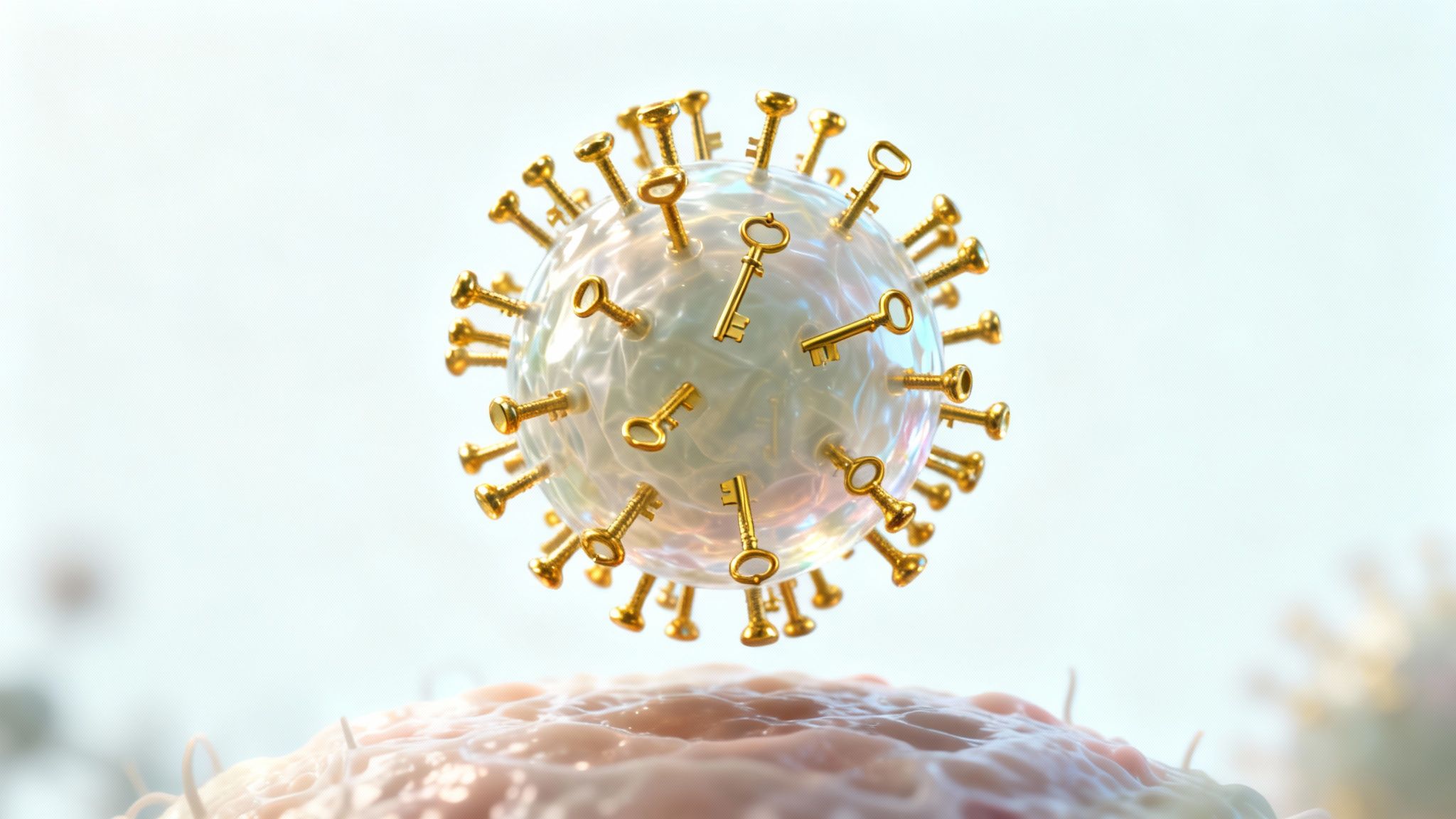
Think of the viral envelope as a disguise—a stolen cloak that some viruses snatch from our own cells on their way out. This fatty outer layer, studded with viral proteins, is a brilliant piece of biological trickery that helps the virus hide from our immune system and break into new, healthy cells.
What Is the Viral Envelope, Exactly?
Imagine a hijacker commandeering a vehicle and then using it as a Trojan horse to get past security. That’s pretty close to what enveloped viruses do. They don’t just build themselves from scratch; they steal a key component from us.
This stolen cloak is a lipid bilayer—a fatty membrane—that the virus rips from one of our cells during its escape. As a newly formed virus prepares to leave its host cell, it pushes against the cell's outer membrane and wraps itself in a small piece. This exit strategy is called “budding.” If you want to dive deeper into how different viral parts come together, our guide on virus structure and function covers all the basics.
The result is a virus particle that looks deceptively familiar to our body, a wolf in sheep's clothing.
A Mix of "Self" and "Invader"
The real genius of the viral envelope is its dual identity. While the fatty membrane itself is made of our cellular material, the virus inserts its own custom-built proteins, called glycoproteins, into it. These proteins poke out from the surface, often forming distinctive spikes.
This clever combination gives the virus two huge advantages:
- A Key to New Doors: The viral glycoproteins are shaped to fit perfectly onto specific receptors on the surface of other cells, acting like a skeleton key to unlock them. This is the critical first step for infection.
- An Invisibility Cloak: Because the outer layer is made from host cell membrane, it helps the virus fly under the radar of our immune system, at least for a while. It looks just "normal" enough to avoid immediate attack.
This stolen disguise is fundamental to the lifecycle of many notorious pathogens. Viruses like Influenza A (H1N1), Human Immunodeficiency Virus Type 1 (HIV-1), Herpes Simplex Virus 1 (HSV-1), and all coronaviruses (including SARS-CoV-2) are enveloped. They absolutely depend on this structure to survive and spread.
But this elegant design has a fatal flaw. That same fatty membrane that makes the envelope so good at its job also makes it incredibly fragile. Outside the body, it’s highly susceptible to drying out, heat, and detergents. This is why something as simple as soap and water is so effective—it literally tears that fatty layer apart, destroying the virus instantly.
How a Virus Hijacks a Cell to Build Its Envelope
The way a virus builds its envelope is a stunning act of biological piracy. It doesn't just assemble parts; it stages a full-blown hostile takeover of a cell’s internal machinery, forcing it to manufacture and wrap new viral particles for their eventual escape.
The virus zeroes in on the cell's own membrane systems—either the outer plasma membrane or internal ones like the endoplasmic reticulum. Before it’s ready to leave, the virus forces the cell to produce viral glycoproteins (the spikes that will eventually stud the envelope) and embed them into these host membranes. Think of it like a saboteur planting tracking devices on a getaway car before the heist even begins.
These viral proteins then act as beacons, signaling where all the other viral components should gather for the breakout.
The Final Step: Budding from the Host Cell
Once the viral genetic material and core proteins (together called the nucleocapsid) are assembled inside the cell, they migrate toward these specially tagged membrane areas. The core then begins to push outward against the membrane in a process known as budding.
This pressure forces the flexible host membrane to wrap around the viral core, forming a bubble that eventually pinches off completely. The virus emerges, cloaked in a stolen piece of the host cell's own skin but now studded with the viral proteins it planted earlier. This brand-new viral envelope is the perfect disguise, a Trojan horse ready to trick the next cell it encounters.
A single infected cell can become an astonishingly productive virus factory. For example, one cell infected with an Influenza A virus can release over 10,000 new enveloped viral particles before it dies, each one ready to continue the chain of infection.
This stolen cloak gives the virus three critical advantages, as the graphic below shows.

The envelope essentially serves as a cloak for disguise, a key for entry, and camouflage to evade the immune system, making it an essential tool for a successful infection.
Different Viruses, Different Exit Strategies
Not all enveloped viruses use the same exit door. Their escape route is determined by where their specific glycoproteins are sent within the host cell. This precision ensures each virus gets wrapped in the right kind of membrane for its particular strategy.
- Influenza A Virus and HIV-1: These viruses tend to insert their glycoproteins directly into the cell’s outer surface (the plasma membrane). They assemble their core just beneath it and bud straight out into the environment, immediately ready to find a new target.
- Herpes Simplex Virus (HSV-1) and Coronaviruses (like SARS-CoV-2): These viruses follow a more complex path. They often bud from internal membranes, like the Golgi apparatus, building their envelope inside the cell. They are then shuttled to the surface in tiny transport bubbles and released in a process called exocytosis.
This intricate dance between virus and host is a central theme in virology. To see how this budding process fits into the bigger picture, you can explore the complete viral replication cycle steps in our detailed guide. Understanding this hijacking mechanism is the first step toward appreciating how vaccines and antiviral drugs are designed to interfere with this critical process—stopping the virus before it can even put on its disguise.
The Envelope's Role in a Successful Viral Attack

A viral envelope is much more than a simple protective layer; it's an active, sophisticated tool built for one purpose: invading a host cell. Its surface is studded with specialized glycoproteins that act like precision-engineered keys, designed to find and lock onto specific receptor molecules on our own cells.
This initial binding, known as attachment, is the critical first handshake between the virus and its next victim. Think of it like a spaceship docking with a space station—it has to be a perfect fit. For viruses like Influenza A, the hemagglutinin (HA) protein grabs onto sialic acid receptors on respiratory cells. For SARS-CoV-2, its famous spike protein binds to ACE2 receptors.
This isn't a random encounter. The "lock-and-key" mechanism determines which cells a virus can infect, a trait we call viral tropism. It’s why Influenza primarily hits the respiratory tract and HIV-1 targets specific immune cells. Their envelope keys only work on certain cellular locks.
Unlocking the Door with Membrane Fusion
Once the virus is securely attached, the envelope pulls off its next trick: breaking and entering. It does this through a dramatic process called membrane fusion, where the virus’s lipid envelope literally merges with the host cell's membrane.
This fusion event is the point of no return. Triggered by the initial binding, the glycoproteins undergo a sudden change in shape, acting like tiny harpoons that pull the two membranes together until they become one. This creates an open doorway, allowing the viral core—carrying its genetic blueprint—to be injected straight into the cell's cytoplasm.
The viral envelope doesn't just knock on the door; it melts into the wall. This fusion process is the ultimate act of cellular trespassing, delivering the virus's malicious payload right where it needs to be to begin replication.
The Invisibility Cloak for Immune Evasion
Beyond its role as a key, the viral envelope also doubles as an incredibly effective invisibility cloak. Because the lipid bilayer is stolen directly from a host cell, it looks deceptively familiar to the immune system. This camouflage helps the virus sneak past the body's patrols without setting off immediate alarms.
This stolen identity gives the virus a crucial head start. It can start replicating and spreading long before the body’s defenses recognize the danger and launch a counter-attack.
But the viral glycoproteins are still foreign, and they eventually trigger an immune response. This is where the virus reveals another trick. Viruses like Influenza A and HIV-1 have glycoproteins that mutate rapidly, constantly changing their shape. This process, called antigenic drift, means antibodies from a previous infection or vaccine might not recognize the new version, allowing the virus to slip by and cause reinfection.
Stability as a Weapon
The structural integrity of the viral envelope is directly linked to its ability to cause infection. A stable envelope keeps its glycoproteins intact and functional until they find a target. In HIV-1, for example, the envelope’s stability is a huge factor in its infectivity and a major headache for vaccine developers.
The virus's native glycoproteins are notoriously fragile and often fall apart at body temperature. This makes it hard for our immune system to create effective, broadly neutralizing antibodies. In fact, for some wild-type HIV-1 strains, the time it takes for 90% of viral particles to become inactivated at 37°C is under 10 minutes.
Through directed evolution studies, researchers have shown that engineering more robust spikes can boost their functional lifespan by over 100-fold, which really drives home how critical stability is for a successful infection. If you want to delve into the scientific findings on HIV envelope stability, the research is fascinating. This constant tug-of-war between viral stability and our immune system is what makes creating lasting antiviral therapies such an ongoing challenge.
Enveloped Versus Non-Enveloped Viruses
Not all viruses play by the same rules. In fact, one of the biggest dividing lines in the viral world is whether a virus has an envelope or not. This single feature splits viruses into two camps with completely different game plans for survival, infection, and transmission.
Think of it this way: an enveloped virus is like an intruder wearing a stolen, flimsy disguise (the envelope), while a non-enveloped virus is like a tiny tank wrapped in a custom-built suit of armor (the capsid). The disguise helps the first one sneak in, but it falls apart easily. The armor, on the other hand, is built to last but makes the second one stand out. This simple difference explains almost everything about how they behave.
The viral envelope itself is just a fatty lipid bilayer, borrowed from a host cell it previously infected. And just like any fatty membrane, it’s surprisingly delicate and can be easily torn apart by heat, dryness, and even a good scrub with soap. This fragility is its Achilles' heel.
The Fragile Nature of Enveloped Viruses
Enveloped viruses—like those that cause Influenza, Herpes Simplex, and COVID-19—are masters of infection once they're inside your body. But outside a host, they're surprisingly wimpy. Their delicate fatty cloak makes them easy targets for basic disinfectants.
Here’s why simple hygiene works so well against them:
- Soap and Water: The fat-loving part of a soap molecule literally digs into the virus's lipid envelope and rips it to shreds, causing the whole thing to disintegrate. It's a surprisingly brutal takedown.
- Alcohol-Based Sanitizers: Hand sanitizers with 60% or more alcohol act as a solvent, dissolving that fatty membrane and leaving the virus unable to infect anything.
- Disinfecting Wipes: Most common wipes contain chemicals designed to break down lipids, making them highly effective at neutralizing these fragile viruses on surfaces.
Because they dry out and fall apart so quickly, enveloped viruses almost always need close contact to spread. They travel through respiratory droplets, blood, or other bodily fluids because they simply don't survive for long on an exposed countertop.
The very thing that helps an enveloped virus sneak into our cells—its fatty, cell-like membrane—is also its greatest weakness. This is exactly why handwashing and surface disinfection are powerful tools in public health; they physically destroy many of the world's most common respiratory and bloodborne viruses.
The Resilient Armor of Non-Enveloped Viruses
On the flip side, you have the non-enveloped, or "naked," viruses. These are the certified tough guys of the viral world. They don't have a flimsy lipid layer. Instead, their genetic material is protected by an incredibly tough protein shell called a capsid. This protein armor makes them ridiculously resilient.
Viruses like Norovirus (the infamous "stomach flu"), Rhinovirus (the common cold), and Human Rotavirus are built to withstand just about anything. They can survive for days or even weeks on surfaces, laugh off many common disinfectants, and even make it through the harsh, acidic environment of your gut. This toughness is why they so often spread through contaminated food, water, or surfaces (fomites).
This difference isn't an accident—it's a product of evolution. Researchers have found a fascinating link between a virus's structure and the type of host it infects. Of the 65 known non-enveloped virus families, a whopping 75% infect hosts with rigid cell walls, like plants and bacteria. Meanwhile, over 80% of viruses that infect animals (which have soft, wall-less cells) are enveloped. The fatty envelope is perfect for fusing with soft animal cell membranes, while a tough capsid is better suited for forcing its way through a hard cell wall. You can dive deeper into this evolutionary connection by checking out the full research on host cell correlation.
This all has very real-world consequences. An alcohol-based sanitizer that works great against Influenza might do very little against the much tougher Norovirus, which often requires a bleach-based disinfectant to be truly eliminated.
To make it even clearer, let's break down the key differences in a table.
Key Differences Between Enveloped and Non-Enveloped Viruses
This table compares the fundamental characteristics of enveloped and non-enveloped viruses, highlighting their structure, stability, and typical transmission routes.
| Characteristic | Enveloped Viruses (e.g., Influenza, HIV-1, SARS-CoV-2) | Non-Enveloped Viruses (e.g., Norovirus, Rhinovirus) |
|---|---|---|
| Outer Layer | Lipid bilayer membrane (envelope) | Rigid protein shell (capsid) |
| Environmental Stability | Fragile; susceptible to heat, drying, and disinfectants. | Very stable; can survive for long periods on surfaces. |
| Resistance to Disinfectants | Low; easily inactivated by soap, alcohol, and disinfecting wipes. | High; resistant to many common disinfectants and sanitizers. |
| Typical Transmission | Close contact, respiratory droplets, blood, bodily fluids. | Fecal-oral route, contaminated surfaces (fomites), food, water. |
| Survival on Surfaces | Short (minutes to hours). | Long (days to weeks). |
Ultimately, knowing whether a virus wears a fragile cloak or a suit of armor is the first step in choosing the right weapon to defeat it. It dictates everything from public health policy and disinfection protocols to how we handle these pathogens safely in a lab.
Famous Viruses That Rely on an Envelope
To really get a handle on the viral envelope, it helps to look at the viruses we already know. This stolen cloak isn't just some random biological feature; it's the main weapon used by many of the biggest threats to human health. When you dig into how their specific envelopes work, you start to see exactly how they operate—and, more importantly, how we can stop them.
The viral envelope is the defining feature for a huge range of pathogens, from the common flu to global pandemics. These viruses, including Influenza A viruses (H1N1, H5N1), Coronaviruses (SARS-CoV-2), and Retroviruses (HIV-1), all depend on this lipid membrane to do their dirty work. That shared weakness makes their envelope proteins a perfect target for our most advanced vaccines and treatments.
The Ever-Changing Influenza A Virus
Influenza is probably the most famous example of an enveloped virus that uses its outer layer to constantly outsmart our immune systems. The flu virus's envelope is studded with two key glycoproteins: hemagglutinin (HA) and neuraminidase (NA). These are the "H" and "N" you hear about in strains like H1N1 or H5N1.
Hemagglutinin acts like a key, latching onto receptors on our respiratory cells to start an infection. Neuraminidase, on the other hand, is the getaway driver; it cuts the new virus particles free from the host cell, allowing them to go infect more cells.
The constant, tiny mutations in the HA and NA proteins are the reason we need a new flu shot every single year. This "antigenic drift" changes the locks just enough that our old antibody "keys" don't work anymore, leaving us open to reinfection.
Coronaviruses and Their Crown of Spikes
The coronavirus family, which includes the notorious SARS-CoV-2 that causes COVID-19, got its name from how it looks under a microscope. "Corona" is Latin for crown, a nod to the prominent halo of spike proteins that stick out from its viral envelope. That spike protein is the master key for all coronaviruses.
For SARS-CoV-2, the spike protein is precision-engineered to bind with incredible efficiency to the ACE2 receptor on human cells. Once it docks, it triggers the fusion of the viral envelope with our cell membrane, dumping its genetic material inside. This single protein is so critical to the virus's success that it became the primary target for the groundbreaking mRNA vaccines. Those vaccines teach our bodies to spot and attack the spike protein, neutralizing the virus before it can even get in the door.
Human Immunodeficiency Virus (HIV-1) and Its Shield
HIV-1, the virus behind AIDS, is another pathogen that's completely reliant on its viral envelope. Its envelope is covered in glycoproteins called gp120 and gp41, which work in tandem to hunt down and infect specific immune cells known as T-helper cells. This targeted attack is what slowly breaks down the immune system.
The HIV-1 envelope is especially sneaky. It's coated in a thick layer of sugar molecules that create a "glycan shield," effectively hiding it from our immune system's antibodies. That, plus the proteins' knack for rapid mutation, makes HIV-1 an incredibly tough nut to crack for vaccine developers. A lot of the research today is focused on figuring out how to get past this shield and attack the more stable parts of the envelope proteins underneath.
Beyond these major players, the viral envelope is central to flaviviruses, a family that includes serious global threats like dengue, Zika, and yellow fever. The surface of these viruses is covered by an envelope glycoprotein called E, which assembles into a raft-like grid of 90 homodimers. This E protein does it all—one part drives membrane fusion while another serves as the main target for our antibodies. You can explore the intricate details of the flavivirus envelope structure to see another fascinating example of this viral weak spot.
By connecting the science of the viral envelope to diseases we all recognize, it becomes crystal clear why understanding this one structure is so vital in our ongoing fight for human health.
Exploiting the Envelope's Weakness for Disinfection

The viral envelope is a brilliant disguise for invading our cells, but this stolen cloak is also the virus's greatest vulnerability. That lipid membrane, the very thing that helps it sneak past our defenses, is incredibly fragile and easy to tear apart.
This isn't just a minor design flaw; it's a true Achilles' heel. And we can exploit it with some pretty basic chemistry.
Simple, everyday tools become powerful weapons against enveloped viruses precisely because they attack this delicate outer layer. This isn't about complex medicine—it's about physically dismantling the virus before it ever gets a chance.
The fatty nature of the viral envelope is the reason why one of the most effective public health measures in history is simply washing your hands with soap and water. It’s a direct chemical assault on the virus’s structural integrity, and why keeping surfaces clean with disinfecting wipes is so critical.
This core vulnerability makes viruses like Influenza, Coronaviruses, and Hepatitis B and C surprisingly easy to neutralize on surfaces outside of a host. Once you understand how this works, hygiene stops being a routine chore and becomes a targeted, strategic defense.
How Common Disinfectants Obliterate the Envelope
The science behind killing an enveloped virus is refreshingly straightforward. The goal is to destroy its fatty outer membrane, causing the entire particle to literally fall apart and become completely harmless.
Three common methods get this job done with remarkable efficiency:
- Soap and Water: Soap molecules are fascinating. One end loves water, while the other end is drawn to fats and lipids. This fat-loving tail wedges itself into the viral envelope, prying it open and dissolving it just like grease in a pan.
- Alcohol-Based Sanitizers: Any product with at least 60% alcohol acts as a powerful solvent. The alcohol breaks down and dissolves the lipid membrane, effectively dismantling the virus’s protective shell and rendering it non-infectious.
- Disinfecting Wipes: Many household wipes are packed with detergents and other chemical agents specifically designed to attack and break down lipids. When you wipe a surface, you are physically shredding any enveloped viruses that might be there, an essential step in preventing transmission in homes and healthcare settings.
This fundamental weakness is what makes controlling the spread of so many common viruses a manageable task. If you're looking for a broader overview, our guide on what kills viruses on surfaces dives deeper into various disinfection methods.
The same principle extends far beyond cleaning supplies and into advanced medicine. Vaccines, like the mRNA shots for COVID-19, train our immune system to recognize and attack the spike proteins embedded in the envelope. Many antiviral drugs are designed to block those same proteins, preventing the virus from using its "keys" to get into our cells in the first place.
By understanding this single structural weakness, we can fight back on every front.
Alright, let's dig into a few common questions that pop up when talking about the viral envelope. Getting these points straight can really solidify your understanding of how these viruses work and, more importantly, how we can stop them.
Why Is Soap So Effective Against Enveloped Viruses?
It’s surprisingly simple: the viral envelope is made of a fatty, lipid membrane. Soap molecules are fascinating little things with two different ends—one that loves water and another that loves fat.
When you wash your hands, that fat-loving end of the soap molecule burrows into the virus's lipid envelope. It literally wedges it apart, causing the whole structure to fall to pieces. The virus can't survive without its envelope, so it's instantly neutralized. This physical demolition is what makes a simple 20-second handwashing one of our most powerful defenses against viruses like influenza and coronaviruses.
Are Enveloped Viruses More Dangerous Than Non-Enveloped Viruses?
Not necessarily. A virus's "danger" level really comes down to the disease it causes, not whether it has an envelope. Sure, some of the viruses we fear most, like HIV-1 and Ebola, are enveloped. But plenty of non-enveloped viruses, like Norovirus (the notorious "stomach flu") and Human Rotavirus, can make you seriously ill.
The real difference is in how they survive and spread. Non-enveloped viruses like Rhinovirus or Feline Calicivirus are often much tougher and can survive for days or weeks on surfaces. Enveloped viruses, on the other hand, are more fragile outside of a host and are much more vulnerable to disinfectants, soap, and even just drying out, making surface cleaning an extremely effective countermeasure.
Do All Viruses Get Their Envelope from the Same Part of the Host Cell?
Nope. Different viruses are specialists, each programmed to "bud" from a specific part of the host cell. The viral proteins act like a GPS, guiding the new virus to the right exit. For instance, viruses like influenza and HIV-1 typically make a run for it by budding directly from the cell's outer surface, called the plasma membrane.
But others take a more complex route. Viruses like herpesviruses (HSV-1, HSV-2) and coronaviruses often snatch their envelopes from internal membranes, like the endoplasmic reticulum or Golgi apparatus—think of them as the cell’s internal factories. They then get packaged up and shipped out in a more elaborate, multi-step process.
This exit strategy is absolutely critical. It ensures the viral envelope has the right mix of proteins and lipids needed to find and infect the next cell. These different assembly pathways are also a huge focus for researchers looking to develop antiviral drugs that can throw a wrench into a specific step of the process.
Leave a Reply