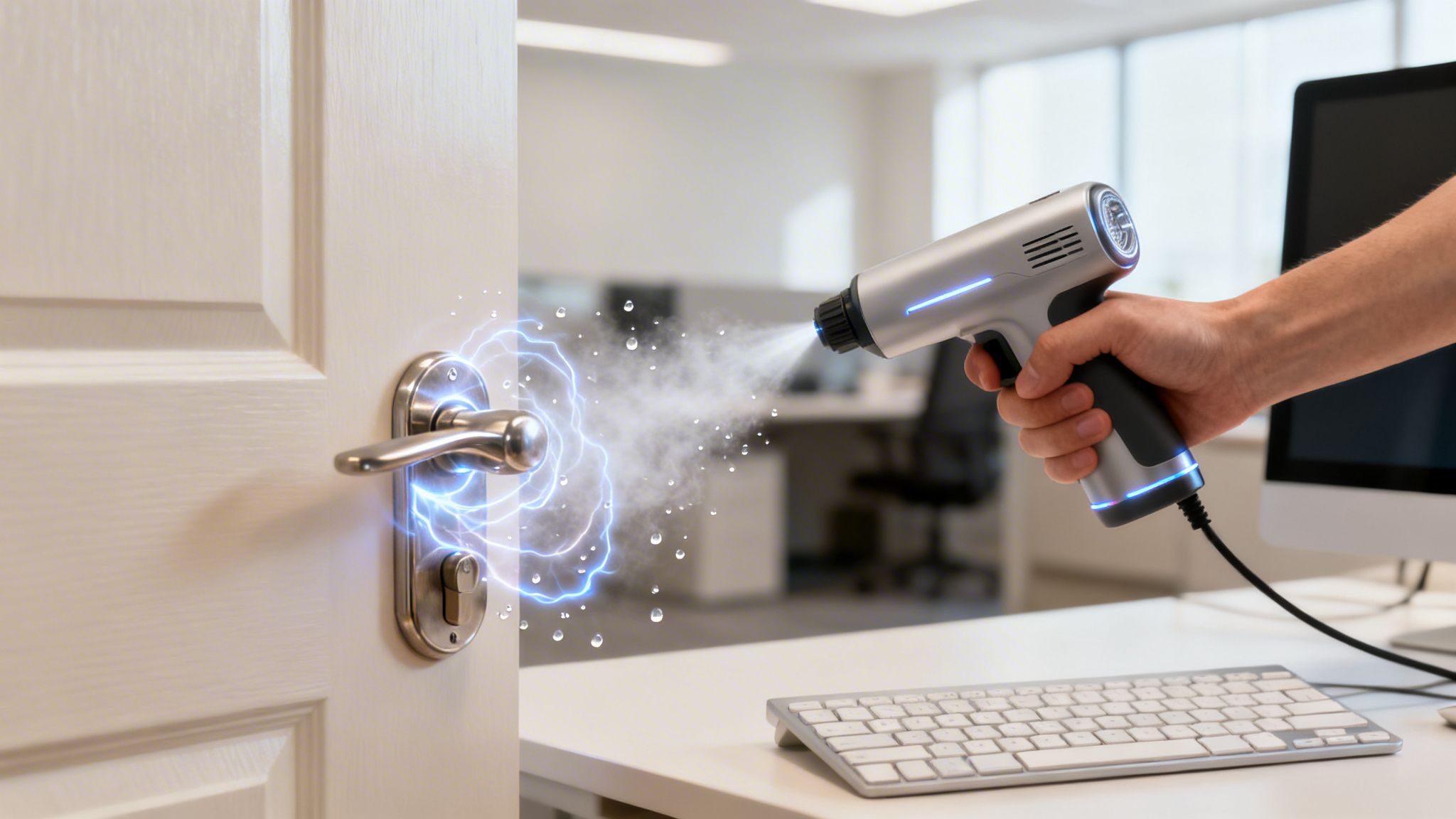
Ever seen a balloon stick to a wall after rubbing it on your hair? That’s static electricity, and it’s the exact same principle that makes electrostatic disinfectant sprayers so effective. This technology puts a positive electrical charge on disinfectant droplets, causing them to hunt down and cling to negatively charged surfaces. The result is a complete, 360-degree wrap-around coverage that traditional cleaning methods, such as manual wiping, just can't match.
What Is an Electrostatic Disinfectant Sprayer?
Think of an electrostatic disinfectant sprayer less like a simple spray bottle and more like a smart delivery system for germ-killers. It’s a device designed to apply disinfectants and other solutions to surfaces with incredible efficiency. By charging the liquid, it creates a fine mist where every single droplet is magnetically drawn to the surfaces in a room.

This technology isn't just about spraying a chemical; it's about making that chemical work harder. The charged particles actually repel each other in the air, preventing them from clumping together and ensuring they spread out for an even coat. As they get close to a target—like a doorknob, keyboard, or desk chair—they are pulled toward it, coating the front, back, and sides all at once. For routine spot cleaning or smaller tasks where a machine isn't needed, having quality disinfecting wipes on hand is a great complement to this technology.
The Wraparound Effect
The biggest advantage of an electrostatic disinfectant sprayer is its signature "wraparound" effect. A normal trigger sprayer or fogger just shoots droplets in a straight line. Gravity takes over, and they settle on top of whatever is in their path. This leaves the undersides and backs of objects completely untouched unless someone takes the time to physically wipe them down.
Electrostatic application blows past this limitation. The charged mist is actively drawn to all sides of an object, creating a uniform film that envelops it. This makes sure that even complex shapes and hard-to-reach spots get the disinfectant contact they need to neutralize hidden pathogens like Influenza A Virus (H1N1) or Norovirus.
This process dramatically improves coverage and cuts down on chemical waste, since more of the disinfectant actually lands on the target instead of just drifting away into the air.
Key Components of the Technology
So, how does it all work? It comes down to a few key parts working together to create that charged, germ-fighting mist.
- The Nozzle: This is where the real action is. As the disinfectant liquid flows through the nozzle, an electrode gives each tiny droplet a powerful positive charge.
- The Disinfectant Solution: You can't just use any chemical. Only specific, approved solutions are formulated to hold an electrical charge and are proven to work against a wide range of pathogens, from Human Coronavirus to Rhinovirus Type 14.
- The Target Surfaces: It turns out that most surfaces in a building—desks, chairs, and electronics—naturally carry a negative or neutral charge. This creates the perfect magnetic attraction for the positively charged mist.
To get the most out of your disinfectant, you need to understand how different nozzles affect the spray pattern. Using a sprayer tip chart can help you pick the perfect tip for the coverage and particle size you need. Ultimately, this approach delivers a far more thorough and reliable way to disinfect entire rooms, hitting all the spots that manual wiping often misses.
How Electrostatic Sprayers Achieve Total Surface Coverage
To really get why an electrostatic disinfectant sprayer works so well, we have to look past the machine itself and into the actual physics. The secret sauce is a principle called electrostatic induction, and it’s what turns a simple cloud of disinfectant into a targeted, germ-killing force.
When the sprayer atomizes the disinfectant, it gives each tiny droplet a positive electrical charge. As this charged mist travels through the air, it heads toward surfaces like desks, chairs, and equipment—most of which have a neutral or negative charge. As the cloud gets close, something really cool happens.
The strong positive charge from the droplets forces the electrons on a neutral surface to shift away. This momentary shift gives the surface an opposite, negative charge, creating an electrical attraction. It’s like turning every object in the room into a magnet for the disinfectant.
The "Wraparound" Effect Explained
This magnetic-like pull is what creates the famous "wraparound" coating. Unlike a trigger sprayer or fogger that just hits whatever is directly in its path, the charged droplets are actively drawn to cover every single side of an object.
Think about spraying a doorknob. With a regular spray bottle, you'd only get the front wet. But the charged mist is pulled to the front, sides, top, bottom, and even the back of the knob all at once. The particles also repel each other in mid-air, which stops them from clumping together and helps them spread out into a perfectly uniform, thin layer over the entire surface.
This isn't just about being efficient; it's a game-changer for killing germs. This complete coverage ensures that every nook and cranny—where tough viruses like non-enveloped Norovirus or enveloped Influenza A (H1N1) might hide—gets the disinfectant it needs to be neutralized.
This process sidesteps the usual problems you see with other methods. You don’t get puddles from using too much liquid, you don’t have missed spots from a sloppy application, and you waste far less chemical.
Microscopic Warfare: Why Uniform Disinfection Matters
On a microscopic level, the fight against viruses is won or lost on contact. A single missed spot can become a safe harbor for pathogens like SARS-CoV-2 or Herpes Simplex Virus 1 (HSV-1), giving them a chance to survive and spread. Electrostatic technology makes sure a consistent film of disinfectant coats the entire target area.
This comprehensive approach is why the technology is catching on so fast. The electrostatic disinfectant sprayer market was valued at US$351.2 million and is expected to hit US$791 million because of this proven efficiency. By giving disinfectant droplets a positive charge, these sprayers get 2-3 times better coverage than you could ever get by hand, effectively making entire rooms hostile territory for pathogens. You can discover more insights about this growing market and its public health impact.
This uniform application allows the disinfectant to do its job right. The key benefits are:
- Total Saturation: Every single square inch of a surface gets coated, even in hard-to-reach cracks and crevices.
- Optimal Dwell Time: The even layer ensures the disinfectant stays wet for its required contact time—a must for killing stubborn viruses like Feline Calicivirus.
- Reduced Human Error: The technology takes the guesswork out of the job, removing the inconsistency that comes with manual wiping.
At the end of the day, the science behind electrostatic sprayers isn't just about covering surfaces. It’s about creating a scientifically-backed, seamless shield of protection that leaves no place for dangerous viruses to hide, raising the bar for environmental safety.
Comparing Disinfection Methods for Complete Protection
When you’re up against viruses like Influenza A (H1N1) or SARS-CoV-2, choosing the right disinfection tool is critical. While a simple wipe-down has its place, it often falls short of the comprehensive coverage needed to truly neutralize threats. Putting different techniques side-by-side shows exactly why an electrostatic disinfectant sprayer has a clear edge.
The real goal isn't just to slop some chemicals around. It's to make sure that disinfectant reaches every single surface where pathogens might be hiding. Traditional methods can easily miss the undersides of desks, the backs of chairs, or the nooks and crannies of equipment. Those gaps are a welcome mat for viruses.
Manual Wiping and Trigger Sprayers
The old-school approach is a spray bottle and a cloth, or even more conveniently, disinfecting wipes. This is fine for spot-cleaning a spill or wiping down a flat countertop. But it’s completely dependent on human effort, which means it’s prone to huge inconsistencies.
Manual wiping is incredibly slow and labor-intensive, making it a nightmare for large areas. Worse, it comes with a high risk of cross-contamination—a single cloth used across multiple surfaces can just as easily spread viruses like Norovirus from one spot to another. Trigger sprayers are a small step up, but they only cover what's directly in their path, leaving most surfaces untouched.
The illustration below shows how electrostatic technology blows past these limitations, with charged droplets actively wrapping around all sides of an object.

As you can see, the charged particles don't just land where they're aimed. They’re pulled toward the entire object, creating a true 360-degree shield of disinfectant.
ULV Foggers
Ultra Low Volume (ULV) foggers look impressive because they can fill a big room with mist very quickly. These machines create a fine, uncharged cloud that eventually settles on horizontal surfaces, thanks to gravity. But while they’re faster than wiping, ULV foggers have their own problems.
The mist from a fogger doesn't actively stick to surfaces. It just falls. This means it almost always misses the sides and undersides of objects, creating the same coverage gaps you get with a basic trigger sprayer. It also leads to uneven application, leaving some areas drenched and others completely dry. That's a big problem when a disinfectant needs to stay wet for a specific dwell time to kill viruses like Rhinovirus Type 39.
For more on keeping the whole environment clean, this Air Duct Cleaning Sanitizing Guide offers some great related insights.
A Comparison of Disinfection Application Methods
To really see the difference, let’s put these methods head-to-head. The table below evaluates each technology based on coverage, efficiency, and the labor required to get the job done right.
| Method | Coverage | Chemical Efficiency | Labor Intensity | Best For |
|---|---|---|---|---|
| Electrostatic Sprayer | Excellent: 360-degree "wraparound" coverage on complex objects. | High: Charged droplets stick to targets, minimizing waste. | Low: Quickly covers large, complex areas with minimal effort. | Comprehensive disinfection of entire rooms, high-touch areas, and complex equipment. |
| Manual Wiping | Poor: Inconsistent, misses spots, and high risk of cross-contamination. | Low: Often results in overuse of chemicals and wasteful drips. | Very High: Slow, physically demanding, and tedious for large spaces. | Quick spot-cleaning of small, flat, easily accessible surfaces. |
| Trigger Sprayer | Poor: Only coats what's in the direct line of spray. | Low: Lots of overspray and chemical drift into the air. | High: Requires constant pumping and is very slow for anything but tiny areas. | Applying a small amount of product to a very specific target. |
| ULV Fogger | Fair: Coats horizontal surfaces but misses vertical sides and undersides. | Moderate: Chemical is lost as mist drifts before settling. | Low: Fast application, but the room must be empty during and after. | Rapidly treating the air and horizontal surfaces in large, open spaces. |
The takeaway here is clear: for situations that demand thorough, reliable disinfection, electrostatic technology is in a class of its own. It combines the speed of fogging with a level of coverage that even the most careful manual wiping can't match, all while using less chemical.
In the end, while every method has a niche, only an electrostatic disinfectant sprayer truly solves the problem of total surface contact. By turning every object into a magnet for germ-killing solution, it closes the dangerous gaps left by other techniques. If you're looking to explore other tools, our guide on choosing the right surface cleaning machine can help you weigh your options.
Real-World Applications in Virus Hotspots
The science behind an electrostatic sprayer is cool, but where the technology really proves its worth is in the real world—in the high-traffic places where stopping viruses is a daily fight. From crowded school hallways to sterile hospital rooms, this is where electrostatic disinfection provides a practical, powerful way to improve safety.
It’s all about getting comprehensive disinfection done quickly and efficiently, making these sprayers a go-to tool for modern public health.

This technology has exploded in popularity, largely driven by the global focus on hygiene. The U.S. Environmental Protection Agency (EPA) reports that a staggering 62% of facilities have now adopted electrostatic sprayers to level up their disinfection game. The financial upside is just as compelling as the health benefits—hotels, for example, have cut their chemical use by 30-40% because the sprayers are so precise.
If you want a deeper look at the numbers, you can discover more about the market's projected 9.3% growth over the next decade.
Defending Healthcare Settings
Hospitals and clinics are ground zero in the battle against germs. An electrostatic disinfectant sprayer is a game-changer here, helping to fight healthcare-associated infections (HAIs) by making sure complex medical gear, bed rails, and entire patient rooms are fully coated with disinfectants that kill nasty viruses like Hepatitis B Virus (HBV) and Human Immunodeficiency Virus Type 1 (HIV-1).
That "wraparound" effect we talked about is especially crucial in a hospital. It ensures that the charged disinfectant mist covers all the awkward shapes of IV poles, wheelchairs, and monitors—all the spots that are a nightmare to disinfect by hand. This 360-degree coverage is key to breaking the chain of infection where patients are most vulnerable. For quick, targeted disinfection of high-touch patient surfaces, staff often supplement this process with high-quality disinfecting wipes.
Creating Safer Educational Environments
Schools, daycares, and universities are petri dishes for viruses like Influenza and Rhinovirus to spread like wildfire. Facility managers rely on electrostatic sprayers to treat whole classrooms in minutes, either between classes or overnight. Every desk, chair, locker, and piece of playground equipment gets coated on all sides—something that would be nearly impossible with traditional spray-and-wipe methods in the same amount of time.
This approach is simply a more reliable way to create healthier learning spaces. It guarantees that every surface a student might touch, from the back of a chair to the leg of a desk, has been treated. This drastically cuts down the environmental viral load and helps keep both students and staff healthy and in school.
This level of thoroughness is just as critical in other shared spaces. You can see similar challenges in our guide on cleaning public bathrooms to protect public health.
Protecting Travelers and the Public
Public transit systems, airports, and gyms are major hubs for spreading viruses. An electrostatic disinfectant sprayer lets staff quickly treat bus seats, handrails, subway cars, and gym equipment between uses. Speed and efficiency are everything here, allowing for minimal downtime while maximizing safety for everyone.
Think about it: transit crews can disinfect an entire bus or train car in just a few minutes, hitting every single grab bar, seatback, and window ledge. In the same way, gyms can offer a much safer environment by treating weights, cardio machines, and locker rooms with a system that covers every angle.
Time and again, this technology has proven itself to be a powerful, evidence-backed tool. By solving the very practical problem of getting complete surface coverage in complex, real-world settings, electrostatic sprayers help build healthier communities. They’re a major leap forward in our ability to control the spread of infectious diseases, from the common cold to much more serious viral threats.
Safety Protocols and Best Practices for Operation
Getting the most out of an electrostatic disinfectant sprayer is about more than just flipping a switch. Like any professional tool, its real power comes from using it correctly and safely. Following the right steps ensures you’re actually knocking out viruses while protecting yourself and others from chemical exposure.

Before you even start, think about personal protection. The fine mist these sprayers create can easily be inhaled or get into your eyes and on your skin. That's why Personal Protective Equipment (PPE) is non-negotiable.
Prioritizing Personal Protective Equipment
Always gear up before you handle disinfectants or turn on the sprayer. This simple barrier between you and the chemicals is your best defense against exposure. Your go-to safety kit should include:
- Gloves: Grab a pair of chemical-resistant gloves to keep disinfectant off your hands when you're filling, spraying, and cleaning the unit.
- Eye Protection: Safety goggles or a full face shield are essential. You do not want these fine droplets splashing into your eyes.
- Respiratory Mask: A proper respirator or mask is crucial for preventing you from breathing in the aerosolized mist. Check the disinfectant label for specific recommendations.
This is the bare minimum for staying safe. For a deeper dive, our guide on how to use Personal Protective Equipment covers the essentials for all sorts of jobs.
Selecting the Right Disinfectant
Not all chemicals are created equal. Using the wrong one can wreck your sprayer, prove useless against viruses, or even create a safety hazard. It is absolutely critical to only use disinfectants that are approved by the EPA (or your local regulatory body) and are specifically labeled as safe for electrostatic sprayers.
Look at the product label to see if it’s effective against the specific viruses you’re worried about, like Influenza A2/305/57 (H2N2) or Human Rotavirus.
The right chemical is the foundation of effective disinfection. An electrostatic sprayer is simply the delivery system; the real work of inactivating viruses is done by a proven, compatible disinfectant. Mismatched chemicals and equipment can render the entire process useless.
Mastering Application and Dwell Time
To get that "wraparound" effect to work its magic, your technique matters. Try to keep a consistent distance from surfaces—usually between two and six feet—and use a steady, sweeping motion. The goal is a thin, even film, not a soaked, dripping mess.
But the single most important part of any disinfection job is dwell time. This is the amount of time a disinfectant needs to stay wet on a surface to actually kill the germs.
- Read the Label: The manufacturer will tell you the required dwell time. It can be anywhere from 30 seconds to 10 minutes.
- Apply Evenly: Make sure the whole surface is visibly wet but not pooling.
- Let It Sit: This is the key. Don't wipe the surface dry. Let the disinfectant do its job and air dry on its own.
If you ignore the dwell time, even the best sprayer in the world won’t be effective. Viruses like Norovirus or Hepatitis C Virus (HCV) need that contact time to be fully inactivated.
Finally, make sure the area has good ventilation. Open windows or turn on an air system to help clear the mist after you’re done. And don’t forget to follow the manufacturer's instructions for routine cleaning to keep your sprayer working safely for the long haul.
What’s Next for Electrostatic Disinfection?
Electrostatic spraying wasn't born in a hospital. Its roots are actually in places like car factories and farm fields, where a perfect, even coat of paint or pesticide was essential. The technology made the leap into public health when global health scares created an urgent need for better, faster, and more complete ways to disinfect large spaces. It quickly became a go-to tool in our modern hygiene playbook.
This explosion in demand pushed the technology forward at a breakneck pace. The adoption numbers tell the story perfectly. Before recent health crises, fewer than 10% of healthcare facilities were using electrostatic sprayers. Today, that figure has jumped to 62%, according to EPA statistics. This boom is fueling a market expected to hit USD 743.49 million by 2034, with some studies showing daily use on public transit can slash surface contamination by up to 50%. You can dig deeper into these market findings to see the full scope of its growth.
Innovations on the Horizon
So, where is this technology headed? The focus is on making it smarter, more efficient, and easier for everyone to use. Manufacturers are rolling out lighter, cordless, and more ergonomic models, which means powerful disinfection is no longer just for large facilities. Small businesses and even homeowners are now able to get their hands on this tech.
The next big leap will likely be integrating smart technology, like sensors and data tracking. Imagine a sprayer that maps its own coverage in real-time, flagging missed spots on a tablet and automatically logging disinfection cycles for compliance reports. This would eliminate the guesswork and ensure a scientifically validated clean, every single time.
Advancements in Sprayer Technology
Engineers and chemists are refining the hardware and the formulas to make them even more effective. A few key areas are seeing major progress.
- Better Battery Life: Longer-lasting, quick-charging batteries are on the way. This means crews can disinfect larger areas like schools or airports without stopping to recharge, a huge win for operational efficiency.
- Smarter Nozzle Engineering: New nozzle designs are giving users much finer control over droplet size. This allows them to tailor the spray for different surfaces and disinfectants, which cuts down on chemical waste and improves compatibility.
- Next-Gen Disinfectants: Chemical companies are busy creating new formulas specifically for electrostatic application. These disinfectants promise faster kill times against a wider range of germs—including tough-to-kill non-enveloped viruses like Human Rotavirus—all while being safer for people and gentler on surfaces.
It's clear the field isn't standing still. As the technology gets smaller, smarter, and more powerful, it will keep changing how we create healthier and safer spaces for years to come.
Got Questions? We’ve Got Answers.
When you're considering a new piece of disinfection tech, it’s natural to have a few questions. Getting a handle on the specifics of electrostatic sprayers is the best way to figure out if they’re the right tool for your space.
Let’s clear up some of the most common questions and give you the straightforward, practical insights you need.
Are Electrostatic Sprayers Safe Around Electronics?
Yes, they are—when you use them the right way. The whole point of the technology is to create an incredibly fine mist that wraps around surfaces without soaking them. This lets you disinfect things like keyboards, office phones, and monitors without worrying about puddles of liquid causing damage.
That said, a good rule of thumb is to avoid spraying directly into open vents or ports on any device. Always give the manufacturer's guide a quick read for any specific advice on treating areas with sensitive electronics.
What Kind of Disinfectant Do I Use?
This is a big one. You can't just pour any old disinfectant into these machines. You absolutely must use a chemical that is not only approved by the EPA but is also explicitly labeled for use in an electrostatic disinfectant sprayer.
Using the wrong chemical is a bad idea for a few reasons. It can gunk up or corrode the sprayer's internal parts, mess with its ability to charge the droplets, and even create a safety hazard.
Always check the disinfectant label for two key things: that it’s compatible with electrostatic equipment and that it’s effective against the specific germs you’re targeting, like Human Coronavirus or Norovirus.
How Is This Different From a Fogger?
The magic is in the electrical charge. A standard ULV (Ultra Low Volume) fogger just pumps out a cloud of fine, neutral droplets. Gravity takes over, and the mist slowly settles on whatever is underneath it—mostly horizontal surfaces. It's a passive approach that often misses the sides and bottoms of objects.
An electrostatic sprayer, on the other hand, gives a positive charge to every single droplet as it leaves the nozzle. Because most surfaces have a neutral or negative charge, the droplets are actively pulled toward them, wrapping around and sticking to all sides. This "wraparound" coverage is something a fogger just can't do, giving you a much more thorough and reliable disinfection.
Does Electrostatic Spraying Replace Regular Cleaning?
Nope. Think of it as the second step in a one-two punch. Disinfection works best on a surface that’s already clean. If you try to spray over a layer of dust, dirt, or grime, that gunk acts like a shield, preventing the disinfectant from ever reaching the viruses and bacteria underneath.
For the best results, you always need to do your normal cleaning first to get rid of any visible soil. This can be done with soap and water or by using disinfecting wipes designed for cleaning and disinfecting in one step. Once the surface is clean, you can apply the electrostatic spray. That two-step process—clean first, then disinfect—is the only way to make sure the chemical can do its job properly.
Leave a Reply