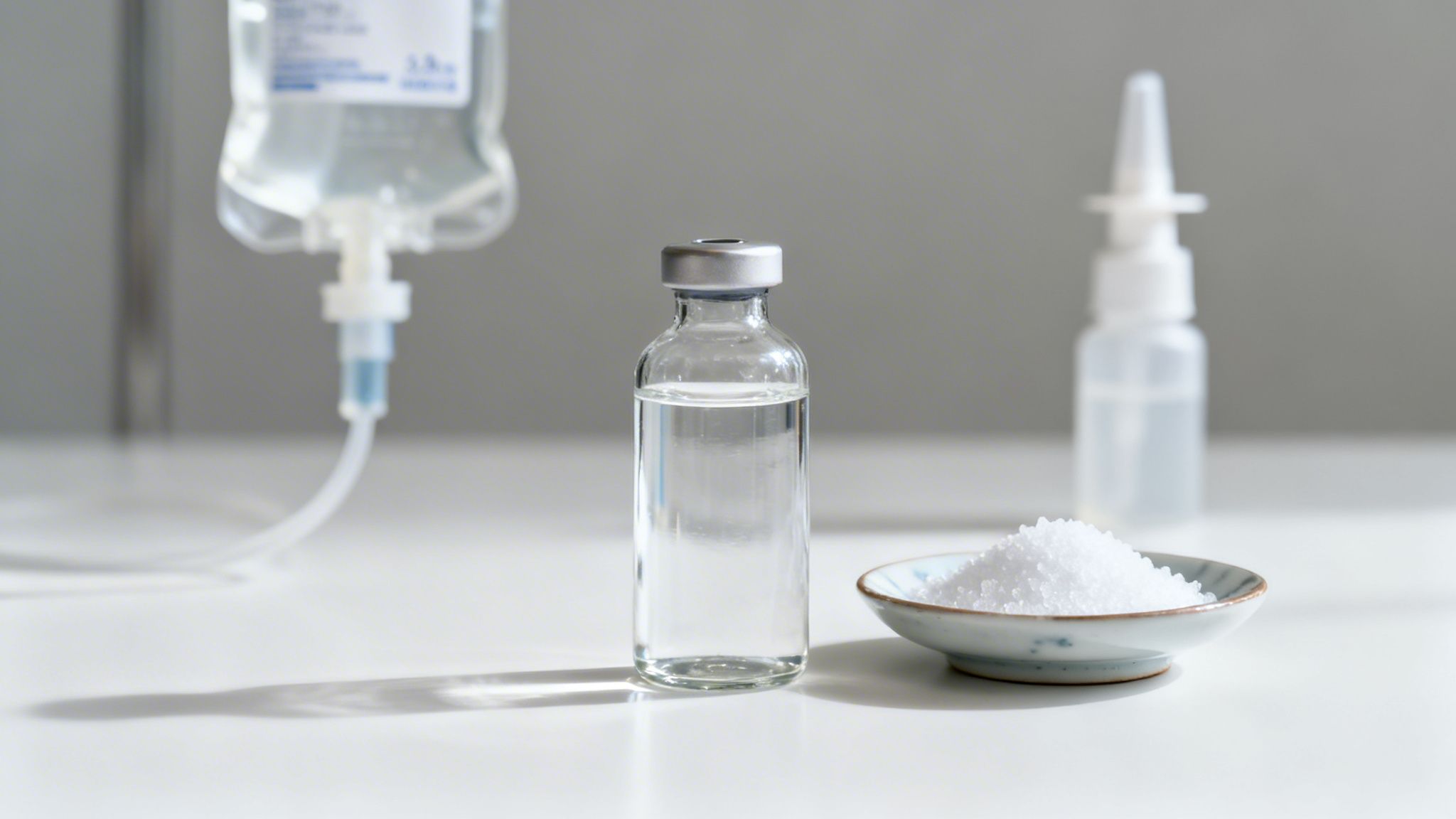
When you hear the term 0.9% saline solution, you might picture a hospital IV bag. And you’d be right—that’s one of its most common uses. But this simple, powerful fluid, often just called "normal saline," is a cornerstone of modern medicine for a reason.
At its most basic, it’s a mixture of two things: sodium chloride (table salt) and purified water. The magic is in the concentration.
The “Just Right” Formula for Your Body
Think of 0.9% saline as a perfectly balanced drink for your body’s cells. It's designed to precisely match the salt concentration found naturally in your blood and other bodily fluids.

This specific composition is called isotonic, which is just a technical way of saying it has the same osmotic pressure as our cells. Because of this balance, it can hydrate and replenish fluids without causing cells to swell up or shrink. It’s a neutral, gentle, and incredibly effective tool.
To help you get a clearer picture, here’s a quick summary of what makes normal saline so useful.
Normal Saline (0.9% NaCl) At a Glance
| Characteristic | Description |
|---|---|
| Composition | 9 grams of sodium chloride per 1 liter of sterile water. |
| Concentration | 0.9% sodium chloride (NaCl). |
| Physiological Property | Isotonic, meaning it has a similar salt concentration to human blood. |
| Primary Function | Rehydration, fluid replacement, and a carrier for delivering IV medications. |
| Common Uses | IV drips, wound cleaning, nasal irrigation, and contact lens rinsing. |
This table highlights just how straightforward the solution is. Its simplicity is truly its greatest strength, allowing for a wide range of safe applications both in clinical settings and at home.
A Long-Standing Pillar of Medicine
First introduced in the late 19th century, normal saline has built an incredible track record for safety and reliability over more than a century of use. It’s so fundamental that the World Health Organization includes it on its List of Essential Medicines.
Beyond simple hydration, it’s a trusted vehicle for delivering medications intravenously and is even used to process blood products—a critical function during viral outbreaks for developing treatments like convalescent plasma for viruses such as SARS-CoV-2.
One key reason for its safety is that medical-grade saline is sterile, which means it’s completely free of any living microorganisms like bacteria or viruses. It's important to understand the difference between sterile and disinfected, as sterility is non-negotiable when a substance is being introduced directly into the body.
The Science Behind Why Saline Works So Well
To really get why 0.9% saline is such a workhorse in medicine, we need to talk about something called isotonicity. It's a scientific term, but the concept is simple: it means the solution has the same concentration of salt as the fluids already inside our bodies, like our blood and tears. This perfect balance is the secret to why it’s so gentle and effective.
Think about watering a delicate houseplant. If you douse it with pure, distilled water (which is hypotonic), the plant's cells will soak up too much water, swell up, and could even burst. But if you used salty ocean water (hypertonic), the opposite would happen—water would get pulled out of the cells, causing them to shrivel up and dehydrate.

A 0.9% saline solution is like the perfect, pH-balanced water for that plant. It gives the cells the hydration they need without shocking the system, letting everything function exactly as it should.
Maintaining Cellular Harmony
This isotonic property is absolutely critical when saline is given through an IV. It replenishes fluid volume throughout the body without causing a sudden, dangerous rush of fluid either into or out of our cells. The water and salt simply move freely across cell membranes, keeping everything in a state of equilibrium.
This stability is a game-changer when treating dehydration from illnesses like the flu, a particularly nasty Norovirus infection, or even severe cases of SARS-CoV-2. When you’re sick with a virus, things like fever, vomiting, and diarrhea can cause you to lose a ton of fluid, throwing your body's delicate electrolyte balance completely out of whack.
Normal saline restores this balance efficiently, supporting organ function and allowing the immune system to focus on fighting the virus without the added stress of cellular imbalance. It works with the body, not against it.
By delivering hydration that mirrors the body's natural internal environment, normal saline helps maintain blood pressure, supports kidney function, and makes sure vital nutrients get transported where they're needed most. This kind of foundational support can be a key factor in helping a patient recover from serious viral infections.
The Role of Osmosis
The scientific principle that governs all of this is osmosis—the movement of water across a semipermeable membrane (like a cell wall) from an area of lower salt concentration to an area of higher concentration.
- In a hypotonic solution (less salt): Water rushes into the cells.
- In a hypertonic solution (more salt): Water is pulled out of the cells.
- In an isotonic solution (like 0.9% saline): There’s no net movement of water, creating a stable, happy environment for cells to thrive.
Because 0.9 saline solution is isotonic, it's a safe and effective way to deliver fluids and medications directly into the bloodstream. It doesn't disrupt how our cells work, making it the ideal medium for rehydration and a reliable carrier for other treatments. This simple scientific harmony is exactly why it remains such an indispensable tool in medicine.
Exploring Common Medical and Home Uses
Beyond the hospital IV stand, 0.9% saline solution is remarkably versatile. It bridges the gap between high-tech clinical care and the simple remedies you might keep in your medicine cabinet. Its isotonic nature—meaning it matches the salt concentration of your body's cells—makes it a safe and effective workhorse in a surprising number of situations.
In a hospital, saline is a true cornerstone of patient care. It's the go-to fluid for intravenous (IV) rehydration, helping people recover from dehydration caused by illnesses like Hepatitis C Virus (HCV), surgery, or an injury. It also acts as a safe, neutral base for powerful IV medications like antibiotics, allowing doctors to dilute and deliver them directly into the bloodstream without shocking the system.
A Staple in Clinical Care
One of its most common but critical jobs is flushing IV lines. A small, quick push of saline through a catheter keeps the line clear of clots or medication residue. This simple step is vital for ensuring that the next dose of medicine can be delivered smoothly and safely.
In essence, normal saline acts as a biological placeholder. It maintains the body’s fluid balance and keeps intravenous pathways open, providing a stable foundation for other medical interventions to work properly.
Its reliability and near-perfect compatibility with the body make it indispensable in almost every hospital department, from the ER to the ICU. For patients who need long-term treatment for viruses like HIV-1, this simple fluid is a quiet, constant part of their daily care.
Practical Applications in Your Home
The usefulness of 0.9% saline solution doesn't stop at the hospital doors. You'll find it in plenty of products designed for everyday health, offering gentle relief for minor issues.
Here are a few of the most frequent ways it's used at home:
- Nasal Decongestion: Saline nasal sprays and rinses are a fantastic first-line defense against stuffiness from colds (like those caused by Rhinovirus Type 14), the flu, or allergies. The solution helps thin out mucus, moisturizes dry nasal passages, and flushes out irritants and even viral particles.
- Wound Cleaning: For minor cuts and scrapes, sterile saline is the gold standard for cleaning a wound. It gently rinses away dirt and bacteria without stinging or damaging the delicate healing tissue, which is a crucial first step in preventing infection.
- Eye Care: Because it’s so similar to your own tears, sterile saline is perfect for rinsing contact lenses. It can also be used to gently flush out an eye if you get a speck of dust or another irritant in it.
- Nebulizer Treatments: Sometimes, a doctor might prescribe saline for use in a nebulizer. This machine turns the liquid into a fine mist you can inhale, which helps loosen mucus deep in the lungs and makes it easier to cough up, a common issue with respiratory viruses like Avian Influenza (H5N1). You can find more on similar approaches in our article exploring natural remedies for flu symptoms.
Whether you're cleaning a scraped knee or easing a stuffy nose, 0.9% saline solution is a safe, affordable, and surprisingly effective tool for any household. Just remember its limits. While it's perfect for cleaning a wound, it isn't a disinfectant. To stop viruses like Norovirus or Influenza from spreading, you still need to follow up by disinfecting the surrounding surfaces with a product designed to kill germs, like an effective disinfecting wipe.
Using Saline Rinses to Manage Viral Symptoms
When you're knocked down by an upper respiratory virus like the flu (Influenza A Virus H1N1) or a common cold, that miserable stuffy-nose feeling is often the worst part. This is where a simple, sterile 0.9% saline solution can be a game-changer. It doesn't kill the virus, but it provides powerful relief through simple mechanics.
Flushing your nasal passages with saline—a practice called nasal irrigation—works on a few levels. First and foremost, it thins out the thick, stubborn mucus that builds up during an infection, making it much easier to clear. That alone can make a huge difference in relieving sinus pressure and stuffiness.
How Saline Helps Your Body Fight Back
Beyond just getting the gunk out, rinsing with a saline solution physically washes away some of the viral particles and allergens clinging to your nasal tissues. This can help lower the local "viral load," giving your immune system a bit more breathing room as it works to fight the infection. The gentle fluid also soothes inflamed nasal passages, which helps reduce swelling and discomfort. In fact, learning how to treat sinus infection at home often starts with the regular use of these exact kinds of saline rinses.
Think of saline not as a cure, but as supportive care. It makes you more comfortable and helps your body's natural defenses work more effectively while your immune system does the heavy lifting against viruses like Human Coronavirus.
This diagram breaks down exactly how a saline rinse helps when you're sick.

As you can see, the core benefits—thinning mucus, easing swelling, and washing away particles—all work together to help you feel better, faster.
A Tool for Comfort, Not a Disinfectant
It’s crucial to have the right expectations for what saline can and can't do. While it’s fantastic for cleaning inside your nose, it is not a disinfectant. Saline will not kill viruses like Herpes Simplex Virus (HSV-1) or bacteria on surfaces.
It's helpful to think of it this way:
- Saline rinses are for cleaning your internal nasal passages to ease symptoms.
- Disinfecting wipes are for cleaning external surfaces in your home—like doorknobs, faucets, and countertops—to kill viruses and stop them from spreading.
Both are essential parts of managing an illness. Using saline for your personal comfort while using effective disinfecting wipes for your home creates a complete strategy for getting through a viral infection. This two-pronged approach helps you feel better while also protecting the people around you from stubborn viruses like Feline Calicivirus or Human Rotavirus.
Comparing Saline to Other IV Fluids
While normal saline is a workhorse in medicine, it's not the only fluid clinicians reach for. In the world of intravenous (IV) treatments, there's a crucial difference between "unbalanced" and "balanced" crystalloid solutions, and picking the right one is a key decision in modern medicine. A 0.9% saline solution falls squarely into the unbalanced category.
Why? Because its chloride concentration is quite a bit higher than what’s normally found in human blood. This isn't a problem for most routine hydration needs, but it can become a real factor in specific critical care situations. When a patient is extremely ill and needs huge volumes of fluid pumped in, the extra chloride from one bag of saline after another can potentially strain the kidneys.
The Rise of Balanced Solutions
To get around this, medical science developed "balanced" fluids, like Lactated Ringer's and Plasma-Lyte. These solutions are engineered to more closely mimic the electrolyte makeup of our own blood plasma. They contain less chloride and add other substances, like lactate or acetate, which the body handily converts into a buffer to help keep our internal pH stable.
This becomes especially important in cases of severe viral infections that spiral into sepsis—a life-threatening condition where the body's over-the-top response to infection from something like Influenza A2/305/57 (H2N2) causes widespread inflammation and organ damage. In those scenarios, a patient might need liters upon liters of IV fluids just to keep their blood pressure up and organs supplied with blood.
The choice of fluid isn't just about giving the body water; it's about actively supporting its delicate internal chemistry. In critical illness, a balanced solution is often the go-to choice to avoid piling extra metabolic stress onto already struggling organs like the kidneys.
What the Evidence Shows
The debate over using a 0.9% saline solution versus balanced fluids has fueled major clinical research, and the evidence suggests that for certain high-risk patients, the choice really does matter. For instance, a landmark 2018 study looked at over 15,000 critically ill adults, many with conditions similar to viral sepsis.
It found that patients who received balanced crystalloids had a lower rate of major adverse kidney events compared to those who got saline. You can explore the findings of this significant study to see just how much fluid choice can impact patient outcomes. This research has led to a noticeable shift in practice, especially inside the intensive care unit (ICU).
Here’s a quick comparison to put it all in perspective:
- Normal Saline (Unbalanced): Higher in chloride. Simple, effective, and a great choice for general hydration.
- Lactated Ringer's (Balanced): Lower in chloride and contains lactate. It’s designed to be a closer match to blood plasma.
Ultimately, there is no single "best" IV fluid that fits every single situation. Normal saline remains a safe, effective, and incredibly common solution for countless medical needs. But for the sickest of the sick, a balanced solution is often preferred to provide vital support while minimizing the potential for complications.
How To Use Saline Safely And Effectively
When you’re dealing with any medical product—even something as common as 0.9% saline solution—safety has to come first. It’s a simple rule, but one that’s incredibly important.
For any situation where saline will touch internal tissues—think nasal irrigation, cleaning a cut, or rinsing contact lenses—you absolutely must use a commercially prepared, sterile saline. This isn't a friendly suggestion; it's a critical safety step.
Using tap water or a poorly made homemade solution is asking for trouble. Tap water isn't sterile and can be home to some nasty microorganisms, like bacteria and even amoebas. If those get into your nasal passages or an open wound, they can cause severe, sometimes life-threatening, infections. You can learn more about why this matters in our guide on medical device sterilization methods.

When Homemade Saline Is (And Isn’t) Safe
So, can you just whip up a batch at home? While it's technically possible to make a basic saline solution, its use cases are extremely limited. You might see recipes from organizations like the World Health Organization for oral rehydration salts, but those are meant for very specific circumstances and are not sterile.
A homemade solution should only ever be used for something simple, like gargling to soothe a sore throat. Anything more invasive is a risk not worth taking.
For any internal application—from flushing IV lines to rinsing your sinuses—relying on professionally manufactured, sterile saline is the only way to guarantee safety and prevent infection. This principle of trusting validated health products is essential for your well-being.
This is especially true in clinical settings where patients may be battling serious illnesses like Hepatitis B Virus (HBV). For patients who need long-term intravenous access, a key part of the chemotherapy port placement procedure involves regularly flushing the port with sterile saline to keep it clear and functional. This routine task underscores just how non-negotiable sterility is.
At the end of the day, while the recipe for 0.9% saline seems straightforward, its medical application demands absolute purity. The small cost of a sterile, store-bought product is nothing compared to the immense risk of a dangerous infection. For at-home care, using sterile saline for internal use and quality disinfecting wipes for external surfaces provides a robust defense against viral threats.
Frequently Asked Questions About Saline Solution
It's easy to get bogged down in the details when you're looking at medical products. Let's clear up some of the most common questions about 0.9% saline solution so you can feel confident about what it is and how it works.
Is Saline Just Regular Saltwater?
Not even close. It's true both are made of salt and water, but the similarities end there. Medical saline is carefully formulated to a specific 0.9% concentration of sodium chloride to match the salt levels in your body. Ocean water, on the other hand, is far saltier and teeming with impurities and microorganisms, making it completely unsafe for any medical use.
Why Is It Called Normal Saline?
The name "normal" is a bit of a historical holdover. Back in the day, scientists believed that a 0.9% concentration was a perfect physiological match for human blood. We now know there are some subtle differences, but the nickname stuck. It’s still the most common term for this standard isotonic solution.
Is It Safe For Children And Babies?
Yes, sterile 0.9% saline solution is widely considered safe and is a staple in pediatric care. You’ll find it in gentle nasal drops and sprays designed to clear up stuffy noses from common colds, which are often caused by viruses like Rhinovirus Type 39. Just make sure you grab a product formulated specifically for children, and when in doubt, a quick call to your pediatrician is always a good idea.
While normal saline is a workhorse fluid, its role in critical care is always being fine-tuned. For example, the massive BaSICS trial looked at over 10,000 ICU patients, comparing 0.9% saline to other balanced fluids. The study found no significant difference in 90-day mortality, which really underscores its solid safety profile while also highlighting why doctors carefully weigh their fluid choices in complex cases. You can read more about these critical care findings to dig into the details.
Can Saline Solution Disinfect Wounds?
Saline is fantastic for cleaning a wound. Flushing a cut or scrape with it is the perfect first step to wash away dirt and debris, which helps prevent infection. But saline itself is not a disinfectant—it doesn't actively kill germs. To kill resilient viruses like Herpes Simplex Virus 2 (HSV-2) on a countertop or doorknob, you need a proper disinfecting wipe designed for that purpose.
Leave a Reply