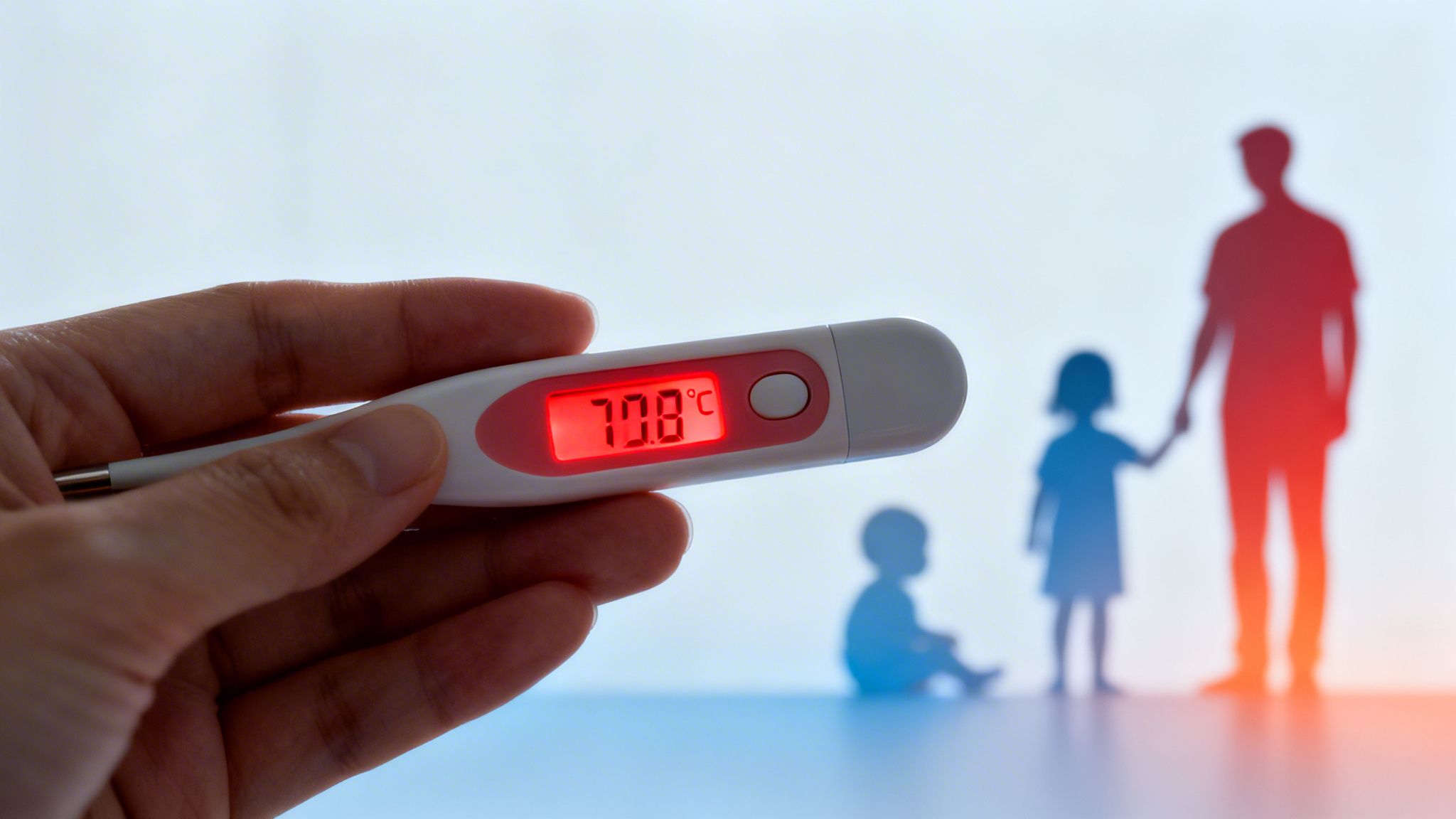
When someone spikes a fever, the first question everyone asks is, "How high is it?" While the number on the thermometer matters, the classic definition of a fever—a body temperature of 100.4°F (38°C) or higher—is just the starting point.
The real story isn't just about that single number. It’s about who has the fever, what other symptoms are showing up, and how long it’s been going on. These clues help determine if it's a common virus, like Influenza A or Norovirus, or something that needs more immediate attention.
What Is a Fever and How Do You Measure It?

It’s helpful to think of a fever not as the illness itself, but as your body’s alarm system blaring. It’s a sign that your immune system has clocked in and is actively fighting off an intruder, whether it’s a flu virus like H1N1, a stomach bug like Rotavirus, or another infection.
Your body is essentially cranking up its internal thermostat. This makes for a pretty hostile environment for viral and bacterial pathogens, slowing down their ability to multiply and spread. It might feel miserable, but a fever is a smart, natural defense mechanism.
Getting an Accurate Temperature Reading
While the official fever line is 100.4°F (38°C), a "normal" temperature isn't a fixed point. It can wander a bit throughout the day, usually somewhere between 97°F and 99°F. A reading of 99.8°F, for example, isn't technically a fever unless other symptoms are tagging along.
Getting a reliable temperature reading is the first critical step, and the best tool for the job really depends on age.
- Rectal Thermometers: For infants and toddlers up to age 3, this is the gold standard. It gives you the most accurate reading of core body temperature, which is essential for the little ones.
- Oral Thermometers: This is a solid, reliable choice for kids over 4 and for adults. The key is making sure the person can hold it under their tongue with their mouth closed for the entire reading.
- Ear (Tympanic) and Forehead (Temporal) Thermometers: These are super fast and convenient, but they come with a catch. They can be less accurate if not used perfectly. A bit of earwax or aiming it slightly off can throw off an ear thermometer, while sweat on the forehead can skew a temporal reading.
Think of a fever as your body's battle cry. The immune system intentionally raises your core temperature to help fight off an infection caused by viruses like Rhinovirus or bacteria, making it one of the most important signals that something is going on inside.
Why the Right Thermometer Matters
With a newborn, there’s no room for error, which is why pediatricians always recommend the rectal method. An inaccurate reading from a forehead scanner could mean missing a serious issue that needs immediate attention.
As kids get older, their overall behavior and other symptoms provide more context, so an oral thermometer is usually more than sufficient. For adults, any method can work as long as you're consistent. This is especially important if you're ever describing symptoms to a healthcare provider, as many professional telephone triage protocols depend on getting accurate data from the start.
To help you sort it out, here’s a quick reference guide.
Quick Guide to Fever Temperatures by Age and Method
This table is a handy shortcut for knowing what temperature qualifies as a fever depending on the person's age and how you measured it. The most accurate methods for each age group are highlighted.
| Age Group | Rectal Temperature | Oral Temperature | Ear/Forehead Temperature | When It Is Considered a Fever |
|---|---|---|---|---|
| 0-3 Months | 100.4°F (38°C) or higher | N/A | Less accurate; consult a doctor | Rectal temp of 100.4°F is an immediate call to the doctor. |
| 3-6 Months | 102°F (38.9°C) or higher | N/A | Check with a doctor before relying on this method | Call the doctor for a rectal temp over 102°F. |
| 6-24 Months | 102°F (38.9°C) or higher | N/A | Can be used, but rectal is still most accurate | Call a doctor if fever lasts more than a day or is over 102°F. |
| 2-17 Years | 102°F (38.9°C) or higher | 100.4°F (38°C) or higher | 100.4°F (38°C) or higher | Concern depends on other symptoms and duration. |
| Adults (18+) | 102°F (38.9°C) or higher | 100.4°F (38°C) or higher | 100.4°F (38°C) or higher | Seek care for a fever over 103°F or one that lasts over 3 days. |
Knowing these specific thresholds is key. A 100-degree fever might be a minor issue for an adult, but it demands a different response in a baby. Understanding these basics gives you the confidence to assess the situation and know what to do next.
When Fever in Newborns and Infants Is an Emergency
While a fever in an older child is usually just a sign their body is fighting off a bug, the rules are completely different for newborns and young infants. For this tiny age group, a fever isn't just a symptom—it's a potential medical emergency that demands immediate attention. There is no “wait and see” approach when a baby this young has a fever.
Why the urgency? It all comes down to their brand-new, inexperienced immune systems. A newborn’s defenses aren't fully equipped to handle serious bacterial or viral infections, such as Herpes Simplex Virus (HSV). Unlike an adult’s body, which can often contain an infection, a newborn’s system can allow germs to spread with frightening speed, leading to dangerous conditions like sepsis or meningitis.
Because they're so vulnerable, any fever in a newborn is treated as a serious threat until a doctor can prove otherwise. This is why the question of when to worry isn't about guesswork—it’s about a single, non-negotiable number.
The Critical Temperature Threshold
For any baby younger than three months old, the magic number is 100.4°F (38°C). If you take a rectal temperature and the thermometer reads 100.4°F or higher, it’s time to act immediately.
This isn't just a suggestion; it's a critical safety guideline. A rectal temperature of 100.4°F or more in a newborn (0-3 months) means you need to call your pediatrician or head to the emergency room right away, even if the baby seems otherwise okay.
It's absolutely essential to use a rectal thermometer for babies this young. It’s the only way to get an accurate core body temperature. Forehead scanners or ear thermometers can be unreliable in infants and might miss a fever that needs urgent medical care. Also, never give fever-reducing medication like acetaminophen unless a doctor specifically tells you to—it can mask symptoms and make it harder for them to figure out what’s wrong.
The main worry is the risk of a serious bacterial infection. While viruses cause many fevers, doctors have to rule out the more dangerous possibilities. A newborn with a fever will almost always need a full medical workup in a hospital to find the source of the infection.
Urgent Warning Signs Beyond Temperature
While the thermometer gives you a clear number, you should also be on high alert for other signs that your baby is unwell. Sometimes, a baby with a serious infection might not even have a high fever but will show other concerning symptoms.
Knowing what to look for can help you give a complete picture to the medical team.
Key Behavioral and Physical Signs:
- Unusual Sleepiness or Lethargy: Your baby is hard to wake up for feedings, seems limp or floppy, or is just way less active than usual.
- Poor Feeding: They refuse to eat, take much less milk than normal, or show no interest in the breast or bottle.
- Constant or Inconsolable Crying: The baby is crying more than you'd expect and can't be soothed. Pay attention if their cry sounds different, too—weak, high-pitched, or strange.
- Trouble Breathing: Look for fast breathing, grunting sounds with each breath, nostrils flaring, or the skin pulling in around the ribs or neck.
- Changes in Skin Color: Their skin looks pale, bluish (especially around the lips or on the hands and feet), or has a new rash.
A new rash along with a fever is particularly concerning. If you see tiny, red or purple pinprick spots that don't fade when you press a glass against them, this could signal a very serious infection and requires immediate emergency care.
Ultimately, your gut feeling as a parent is a powerful tool. If your baby just doesn't seem "right," or if you have any nagging concerns about their health, it's always best to err on the side of caution. Calling your pediatrician is the safest thing you can do. They’ll guide you on what to do next and tell you if your infant needs to be seen right away.
Decoding Fever Red Flags in Children and Toddlers
As kids move out of that fragile newborn stage, how you handle a fever completely changes. It stops being about a specific number on the thermometer and starts being about the whole picture—how your child is acting, feeling, and responding.
A fever of 103°F (39.4°C) might sound terrifying, but if your toddler is still playing, asking for snacks, and drinking fluids, it's often far less concerning than a lower fever in a child who is listless and refusing to drink anything. This is where your role shifts from temperature-taker to detective. You have to look past the reading and pay close attention to their behavior to figure out when a fever is just the immune system doing its job and when you need to worry.
For the youngest babies, though, the number is everything. This infographic lays out the clear, immediate protocol for newborns.

As you can see, any rectal temperature of 100.4°F in a newborn is a direct line to the emergency room. But once they're older, the decision-making process gets more complex and relies on a much wider range of symptoms.
Key Red Flags to Watch For
While your child's behavior is your best guide, some signs are clear indicators that it's time to call the doctor. These red flags suggest something more serious might be at play, like a bacterial infection that needs antibiotics or a more severe virus that requires a professional evaluation.
Keep an eye out for these specific warning signs:
- Fever That Won't Quit: A fever that hangs around for more than three consecutive days without improving is a reason to call. Most viral fevers break in a few days, so a persistent one could mean a secondary infection has taken hold.
- Unresponsive Temperature: You’ve given a proper dose of acetaminophen or ibuprofen, but the fever doesn't budge. Or worse, it drops for a bit but rockets right back up the second the medicine wears off.
- Signs of Dehydration: This is a big one. If your child has very few wet diapers, cries without tears, has a dry mouth, or seems overly sleepy, they need to be seen right away.
- Severe Pain: A splitting headache, intense stomachache, or sharp ear pain that doesn't ease up with over-the-counter pain relievers needs a doctor's attention.
- Stiff Neck: If your child complains of a stiff neck or has trouble moving it, this is a serious symptom that requires immediate medical care.
- A Non-Fading Rash: Many common viruses, like Human Coronavirus, can come with a harmless, blotchy rash. But if you see a rash that doesn't briefly fade or turn white when you press on it (you can use a clear glass for this "glass test"), it can be a sign of a serious bacterial infection like meningitis and is a medical emergency.
Think of these red flags as your child's way of sending an SOS. Their body is signaling that the usual playbook for fighting off a bug isn't working, and it's time to call in professional backup.
Understanding Febrile Seizures
One of the most terrifying things a parent can witness is a febrile seizure. This is a convulsion in a child triggered by a rapid spike in body temperature, usually from an infection. They are most common in children between 6 months and 5 years of age.
During one of these seizures, a child might lose consciousness while their arms and legs shake or jerk uncontrollably. They look absolutely horrifying, but the good news is that most febrile seizures are short (lasting only a few minutes) and generally don't cause any long-term harm or brain damage.
That said, the first time a child has any kind of seizure, they need to be evaluated by a medical professional immediately to rule out more serious causes. Your doctor will want to find the source of the fever and make sure there isn’t another underlying issue at play. Getting a proper diagnosis is crucial for your peace of mind and for knowing what to do if it ever happens again.
When Adults Should Take a Fever Seriously
Most of the time, adults can weather a fever without too much drama. Our immune systems are generally well-equipped to handle it, and a rising temperature is often just a sign that your body is doing its job fighting off an invader like the flu or a common cold virus. But it's a mistake to assume you can just "sweat out" every fever.
In some cases, a fever in an adult is a clear warning that something more serious is going on. Knowing the difference between when to rest and when to seek medical care is crucial. It’s not just about the number on the thermometer—it’s about the entire clinical picture.
The Temperature Threshold That Matters
For a healthy adult, a low-grade fever isn't usually a cause for alarm. The body's immune response, which includes cranking up its internal thermostat, is a normal and highly effective way to deal with pathogens. Most common viral infections, from rhinoviruses to mild cases of SARS-CoV-2, will clear up on their own with time.
But once a fever climbs past a certain point, it becomes a red flag.
A high fever that hits 103°F (39.4°C) or higher in an adult is a clear signal to seek medical advice. This level suggests your body might be struggling to control a more severe infection.
The duration of the fever is another critical piece of the puzzle. A fever from a garden-variety cold or flu usually starts to improve within a couple of days. If you have any fever that sticks around for more than three days without signs of breaking, it's time to call a doctor. A persistent fever could signal that a secondary bacterial infection, like pneumonia, has taken hold and needs a different treatment plan.
Beyond the Thermometer: Symptom Red Flags
The number on the thermometer tells only part of the story. Often, the most important clues come from the other symptoms that show up alongside the fever. These can point to specific, and sometimes dangerous, conditions that need immediate evaluation.
When a fever gets serious, medical professionals start a process of differential diagnosis in clinical practice to figure out the root cause. Giving them a complete list of your symptoms is absolutely vital.
Call a doctor or head to urgent care if a fever is paired with any of the following:
- Severe Headache or Stiff Neck: A new, brutal headache with a fever, especially with a stiff neck or light sensitivity, can be a sign of meningitis—a true medical emergency.
- Chest Pain or Difficulty Breathing: These symptoms could point to a serious lung infection like pneumonia or another heart or lung issue that needs immediate attention.
- Confusion or Mental Changes: Any new confusion, disorientation, or unusual grogginess with a fever is a major red flag and requires emergency care.
- Widespread Rash: While some viruses cause a mild rash, a new, widespread one—especially if it looks like tiny bruises or doesn't fade when you press on it—is an emergency.
- Severe Abdominal Pain: Intense pain in your abdomen, particularly if it's in one specific spot, can signal problems like appendicitis or a serious internal infection.
Special Circumstances That Change the Rules
For some adults, any fever is cause for concern. The normal rules just don't apply if you have an underlying condition that compromises your body's ability to fight infection.
In these situations, a fever that a healthy person would barely notice can become dangerous fast.
You should contact a doctor for any fever if you:
- Have a Weakened Immune System: This includes anyone undergoing chemotherapy, taking immunosuppressant drugs after an organ transplant or for an autoimmune disease, or living with HIV/AIDS.
- Suffer from Chronic Health Conditions: People with conditions like heart disease, diabetes, kidney disease, or COPD are at a higher risk for serious complications from infections.
- Have Recently Traveled: A fever after returning from certain parts of the world could be a sign of a regional illness like malaria or typhoid fever, which requires specific testing and treatment.
In these cases, your body's "alarm system" might not be as loud. A fever needs to be taken seriously right from the start. Don't wait for it to get worse; early medical intervention is key to stopping a minor infection from spiraling into a major health crisis.
Fever in the Context of Travel and Viral Threats
A fever doesn't exist in a vacuum. A temperature of 102°F (38.9°C) after a week with a head cold is one thing; the exact same number after a trip to a tropical region tells a completely different, and far more urgent, story. The context surrounding your fever—especially where you've been—is one of the most important clues in figuring out when to worry.
Your location and recent travel history add critical layers to the diagnostic puzzle. For example, a fever paired with body aches during your local flu season probably points toward influenza. But if you have that same fever right after returning from an area where a virus like Hepatitis B (HBV) is endemic, it’s a major red flag that requires immediate medical evaluation.
This is because many serious infections, both viral and bacterial, are concentrated in specific geographic areas. For healthcare providers, your travel history isn't just a fun fact—it's a key piece of information that helps them narrow down the potential causes of your illness.
The Significance of Geographic Hotspots
Some of the world's most dangerous febrile illnesses are far more common in certain parts of the globe. A fever following travel to regions with Avian Influenza (H5N1) or specific strains of Coronavirus demands swift medical attention. For example, in 2019, there were an estimated 9.2 million typhoid cases and around 110,000 deaths worldwide. The risk isn't spread evenly, with the highest rates found in Southeast Asia, making a fever after travel there particularly concerning. You can read the full analysis on global typhoid patterns from the CDC.
This is exactly why doctors will always ask where you've been. The answer connects your fever to potential exposures that just aren't a concern back home.
A fever is more than just a number; it's a signal. When combined with travel history, that signal becomes a specific message, pointing toward potential exposures to illnesses like dengue, Zika, or other regional viral threats.
Recognizing Systemic Viral Illnesses
Beyond specific travel-related diseases, the general viral landscape also matters. Every winter, viruses like Influenza A (H1N1), RSV, and various coronaviruses make the rounds. A fever in this context is often expected, but it still needs to be watched closely, especially if it comes with severe symptoms like difficulty breathing or intense chest pain.
Certain symptom combinations can also signal a more systemic infection, where a virus is affecting more than just your respiratory tract.
- Sustained High Temperature: A fever that stays stubbornly high and doesn't respond well to fever-reducing medication.
- Widespread Rash: A rash is always a concern, but one that looks like tiny bruises or doesn't fade when you press on it is a serious sign.
- Severe Body Aches: Muscle and joint pain so debilitating it’s out of proportion to a typical cold or flu.
- Unusual Fatigue: Extreme exhaustion that makes it difficult to get out of bed or perform basic daily activities.
Understanding the context of your fever is crucial for protecting your health. Recognizing the difference between a common bug and one of the many emerging infectious diseases is a critical skill. Always tell your doctor about your travel history and stay aware of the viruses circulating in your community to make sure you get the right care at the right time.
How to Manage a Fever and Prevent Spreading Germs

When a fever pops up without any alarming signs, it’s tempting to overreact. Instead, think of it as your body’s built-in heater kicking on to fight off invaders. Most fevers from viruses like Feline Calicivirus or the common cold will settle down on their own—your job is to ease the ride and keep everyone else healthy.
Over-the-counter options such as acetaminophen or ibuprofen can dial down the heat and soothe aches. Always double-check the label for dosing, especially with kids—doses are weight-based, not age-based. And if you’re grabbing a multi-symptom syrup, peek at the ingredients list to avoid doubling up on pain relievers.
Comfort Measures And Stopping The Spread
Even though medicine helps, it’s only half the battle. Simple home remedies and smart habits make a big difference in comfort and containment.
Comfort And Hydration
- Rest: Think of sleep as reinforcement for your immune troops. The more you rest, the more energy your body has to fight the infection.
- Fluids: Fever can sneakily dehydrate you. Sip water, herbal tea, broth, or an electrolyte drink throughout the day.
- Lukewarm Compresses: A gentle, lukewarm sponge bath or a cool cloth on the forehead often brings relief. Steer clear of icy water—you don’t want shivers that push your core temperature even higher.
Since most fevers are caused by contagious viruses, managing the illness is a two-part job: caring for the sick person and protecting everyone else in the household from getting sick next.
Creating A Safer Home Environment
When someone’s under the weather, germs hitch rides on everything they touch—door handles, light switches, even remote controls. Containment is your best friend here.
- Wipe Down High-Touch Areas: Keep disinfecting wipes on hand for doorknobs, phones, tabletops, and bathroom fixtures. This is a crucial step in limiting the spread of resilient viruses like Norovirus.
- Launder Wisely: Wash bedding and towels in hot water and dry on the hottest setting to kill off lingering pathogens.
- Air It Out: A few minutes of fresh air can dilute indoor pathogens. Open windows when possible.
Above all, nothing beats good old hand washing. Thorough scrubbing with soap and water for at least 20 seconds flushes away most respiratory viruses. For step-by-step guidance, check our detailed walk-through on proper hand washing technique.
Should I Alternate Acetaminophen And Ibuprofen For Fever?
Many parents have heard about staggering acetaminophen (Tylenol) and ibuprofen (Advil/Motrin) to bring down a really stubborn fever. While some doctors might suggest it in specific situations, it's definitely not a go-to strategy for every illness.
The biggest risk here is simple human error. It's easy to lose track, give the wrong medication, or give a dose too soon, which can be harmful. Unless your pediatrician has given you a crystal-clear schedule to follow, it’s much safer to stick with one type of medication. If a fever isn't budging or you're getting worried, a quick call to your doctor is always a better bet.
How Long Is Someone With A Fever Contagious?
This really depends on what’s causing the fever in the first place. For most common viruses like the flu, you’re most contagious during the first 3 to 5 days of feeling sick. With other bugs like SARS-CoV-2, you can actually be spreading the virus for a day or two before you even feel a thing.
A good rule of thumb is to assume you're contagious for as long as you have a fever. Most health experts advise staying home until you’ve been completely fever-free for at least 24 hours—and that means without taking any fever-reducing medicine.
That 24-hour mark is a pretty reliable sign that your immune system is finally winning the fight, making you much less likely to pass the germs on to someone else.
Can Teething Cause A Fever In Babies?
This is one of the most persistent myths in all of parenting. While teething can certainly make a baby miserable and fussy, and maybe even raise their temperature by a tiny fraction of a degree, it does not cause a true fever. A real fever is a temperature of 100.4°F (38°C) or higher.
If your teething baby has a genuine fever, there's almost always something else going on. It could be a run-of-the-mill cold, an ear infection, or another virus. Never write off a real fever in a baby as "just teething." It's a signal to look for other symptoms and check in with your pediatrician.
Does A High Fever Cause Brain Damage?
The fear that a high fever will "cook" the brain is a scary thought that keeps a lot of parents up at night. Thankfully, it's largely unfounded. Fevers from infections—even those that spike to 104°F or 105°F (40°C to 40.6°C)—do not cause brain damage.
Think of your body as having a built-in thermostat. When you're sick, that thermostat prevents your temperature from climbing to truly dangerous levels. Brain damage from body heat is incredibly rare and typically only happens with temperatures above 107°F (41.7°C). Those extreme temperatures aren't caused by infections but by external factors, like being trapped in a hot car (heat stroke). The real concerns with a high fever are making sure your child is comfortable and staying hydrated.
Leave a Reply