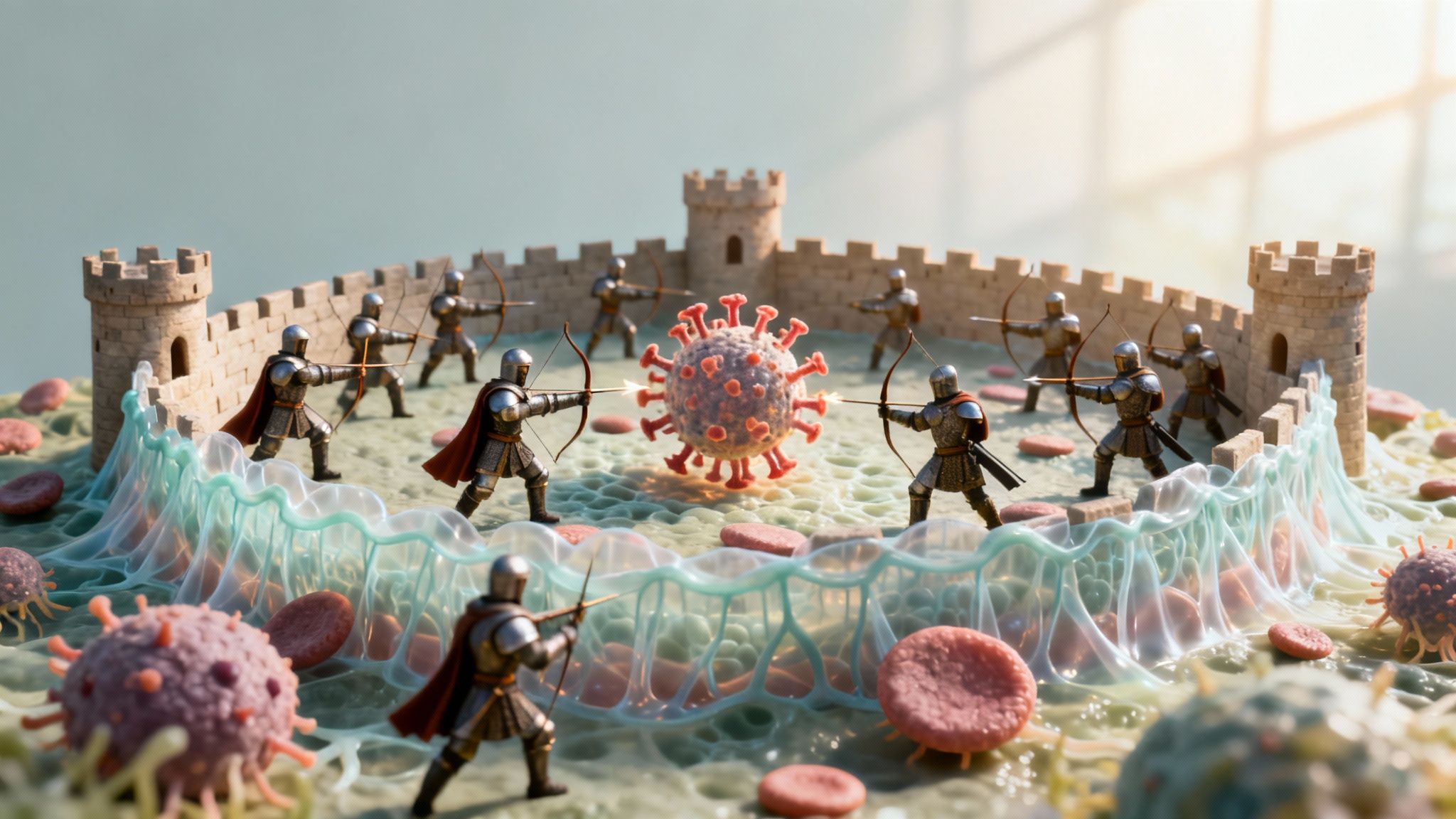
Think of your body as a fortress. Innate immunity is its first line of defense—the high walls, the deep moat, and the ever-vigilant guards patrolling the perimeter. You’re born with this system, and it’s always on, ready to instantly block or attack any foreign invader that tries to get inside.
It’s our immediate, non-specific response to threats, kicking into gear within minutes to hours of an exposure. This isn’t about recognizing a specific enemy, like the Influenza A virus; it’s about identifying and neutralizing any and all unauthorized intruders.
Your Body's Always-On Security System

This powerful system has two primary jobs that work together seamlessly. First, it creates physical and chemical barriers to keep invaders out. Second, if any of those barriers are breached, it launches an immediate, all-out assault to contain the threat.
It’s a pre-programmed strategy that doesn’t need any prior experience with a specific pathogen like Rhinovirus Type 14 or SARS-CoV-2. It just works.
The Two Core Functions of Innate Immunity
This dual-action approach is what makes our innate defenses so effective. It stops the vast majority of potential infections before they can even get a foothold.
Here’s a quick look at how these two core functions operate.
| Function | Description | Example |
|---|---|---|
| Barrier Defense | Physically and chemically blocking pathogens from getting inside the body. | Your skin is a durable wall, while acidic stomach juices destroy germs you might swallow. |
| Rapid Attack | Instantly identifying and attacking any pathogen that gets past the barriers. | Specialized cells swarm and engulf invaders the moment they're detected in your tissues. |
These functions happen automatically, keeping you safe from countless threats every single day. The efficiency is pretty incredible. For instance, innate immune cells called macrophages make up about 5-10% of your white blood cells and can devour millions of bacteria daily to keep you protected.
You can see how these frontline defenders fit into the bigger picture by exploring this detailed diagram of the immune system.
Your First Line of Defense: The Body's Built-In Fortifications

Long before a single immune cell gets the call to fight, your body's built-in barriers are already on duty, working around the clock. These are the physical and chemical walls that stop the overwhelming majority of pathogens—from the common cold (Rhinovirus Type 39) to the stomach bug (Norovirus)—from ever gaining a foothold.
These defenses are proactive, not reactive. They handle countless threats at the perimeter, which dramatically cuts down on the number of battles your internal immune cells have to wage. Think of them as the unsung heroes of your innate immune system.
The Great Wall: Your Skin
Your skin is far more than just a passive covering; it's an active, defensive organ. Imagine it as a vast, multi-layered fortress wall. The outermost layer is made of tightly packed, dead cells, creating a tough shield that’s nearly impenetrable to most microbes.
This physical barrier is also constantly renewing itself. As old cells shed, they take any attached pathogens with them. On top of that, your skin maintains a slightly acidic pH, creating an environment where many bacteria and viruses simply can't survive.
Your skin is your largest organ, providing approximately 2 square meters of surface area that acts as a primary physical barrier. Its effectiveness is a cornerstone of how your innate immunity keeps you healthy day in and day out.
This simple but incredibly effective shield is your most formidable first line of defense against the outside world.
The Sticky Traps Inside Your Body
While skin guards your exterior, a different strategy protects your internal entry points, like your nose, mouth, and lungs. These areas are lined with specialized tissues known as mucous membranes.
These membranes secrete a thick, sticky fluid—mucus—that works like flypaper for pathogens. When you inhale a virus like Influenza A Virus (H1N1) or a Human Coronavirus, it often gets snagged in this mucus before it can ever reach your cells.
But the system doesn't stop there. Tiny, hair-like structures called cilia line your airways, constantly beating in a coordinated, wave-like motion. This action pushes the mucus (and any trapped invaders) up and out of your respiratory system, where you can cough it out or swallow it.
Chemical Warfare in Your Gut and Mouth
Your innate immunity also wages a powerful chemical war. The moment you swallow food or drink, any hitchhiking pathogens face an immediate and hostile reception.
-
Saliva: It's not just for digestion. Your saliva contains potent enzymes like lysozyme, which can tear apart the cell walls of certain bacteria on contact. It’s like a constant rinse cycle for your mouth.
-
Stomach Acid: Any pathogen that makes it past your saliva runs straight into the highly acidic environment of your stomach. With a pH between 1.5 and 3.5, stomach acid is lethal to most microbes, including resilient viruses like Human Rotavirus, effectively sterilizing almost everything you consume.
These physical and chemical barriers are the silent guardians of your health. They’re always active, forming an integrated defense network that neutralizes threats before you ever know a battle was fought.
Meeting the Cellular First Responders
When a virus like Influenza A Virus (H1N1) or Herpes Simplex Virus 1 (HSV-1) gets past your body’s initial defenses, it’s not a quiet intrusion. An elite squad of cellular first responders is instantly dispatched to the scene. This isn’t a slow, calculated mobilization—it’s an immediate, overwhelming show of force designed to contain the threat before it can get a foothold.
These cells are the backbone of your innate immune system, each with a unique role but all working together like a highly trained emergency unit. To really get how innate immunity works so fast, you have to understand who these defenders are and what they do.
The Infantry: First on the Scene
The very first cells to swarm the site of an infection are almost always the Neutrophils. Think of them as the fast-acting infantry of your immune system. They're the most plentiful type of white blood cell, making up a massive 50-70% of your total count, and they’re always circulating in your bloodstream, ready to deploy at a moment's notice.
When an alarm sounds, neutrophils flood the infected tissue. Their mission is brutally simple: find and destroy. They are voracious phagocytes, which means they literally eat bacteria and other pathogens whole. They also unleash a cocktail of powerful antimicrobial chemicals and cast fibrous "nets" to trap microbes, often destroying themselves in the process.
The Heavy-Duty Cleanup Crew
Right behind the initial neutrophil assault come the Macrophages. If neutrophils are the frontline infantry, macrophages are the heavy-duty cleanup and containment crew. The name literally means "big eater," and it’s a perfect description. They are larger, longer-living cells that patrol your tissues, swallowing not just pathogens but also dead cells and other debris.
Their job is much more than just eating, though. They are critical for several reasons:
- Phagocytosis: Like neutrophils, they consume pathogens, but they are more methodical and can devour far more invaders over their long lifespan.
- Waste Removal: They are the battlefield medics and janitors, clearing away the remains of dead cells (including spent neutrophils) and damaged tissue, which is essential for healing to begin.
- Signaling the Alarm: Macrophages release powerful signaling molecules called cytokines that recruit other immune cells and orchestrate the ongoing immune response.
This cleanup function is non-negotiable. By removing all the cellular junk, macrophages help prevent further damage and stop pathogens from finding a place to hide.
The Special Ops Agents
Not all threats are outside invaders. Sometimes, the real danger is a virus that has hijacked one of your own cells, turning it into a factory for making more viruses. This is where Natural Killer (NK) cells come in. Think of them as the special ops agents of your innate immune system, tasked with a very specific mission: find and eliminate compromised or cancerous cells.
Unlike other immune cells that need to recognize a specific foreign particle, NK cells are masters of surveillance. They constantly patrol your body, essentially "checking the ID" of your own cells. If they find a cell that's missing the proper ID—a common trick viruses like Hepatitis B Virus (HBV) use to hide—or is showing signs of stress, the NK cell springs into action.
An NK cell doesn't wait for orders. It has the innate ability to recognize a "compromised" cell and can execute it within minutes. This rapid action prevents a virus from using that cell to replicate and spread.
The Intelligence Officers of Your Immune System
Finally, we meet the Dendritic cells. These are the intelligence officers and master communicators of the immune world. Their main job isn't to kill pathogens directly but to gather intel from the battlefield and deliver it to the next line of defense—the adaptive immune system.
Dendritic cells hang out in tissues that are in contact with the outside world, like your skin and the lining of your nose and lungs. When they encounter a pathogen, they engulf it, break it down into pieces, and carry those pieces to the nearest lymph node. There, they present this "intelligence" to the highly specialized T cells and B cells, which activates the long-term, targeted immune response. They are the critical link that ensures your body not only fights the current infection but also remembers the enemy for the future.
To make these roles even clearer, let's break down the key players in a simple table.
Key Players in the Innate Immune Response
| Cell Type | Primary Function | Analogy |
|---|---|---|
| Neutrophils | Rapidly engulfs and destroys pathogens. | Infantry – The first and most numerous soldiers to arrive at the battle. |
| Macrophages | Engulfs pathogens, cleans up dead cells, and signals other immune cells. | Heavy-Duty Cleanup Crew – Manages the battlefield and calls for reinforcements. |
| Natural Killer (NK) Cells | Identifies and kills virus-infected or cancerous host cells. | Special Ops Agents – Elite assassins targeting threats from within. |
| Dendritic Cells | Gathers intelligence from pathogens and presents it to the adaptive immune system. | Intelligence Officers – The spies and messengers who bridge the gap to the next level of defense. |
This coordinated teamwork is a brilliant example of how innate immunity works, with each cell type playing a distinct yet interconnected role in your body's immediate and powerful defense system.
Sounding the Alarm: How Your Body Detects Invaders
Your innate immune cells are incredibly fast, but how do they actually know what to attack? They don’t have eyes or ears, yet they can instantly tell the difference between a harmless body cell and a dangerous invader like a Human Rotavirus or Rhinovirus Type 14.
The secret is a molecular "friend-or-foe" recognition system that is as brilliant as it is simple.
Your immune cells are hardwired to recognize general patterns that basically scream "invader." Think of these as universal barcodes found on entire classes of pathogens but are completely missing from your own healthy cells. Scientists call these Pathogen-Associated Molecular Patterns, or PAMPs.
For example, many viruses like HIV-1 create unique genetic signatures when they replicate—something you almost never find inside human cells. Your immune system sees this and immediately sounds the alarm. In the same way, certain proteins and sugars on the surface of viruses are instantly flagged as foreign. This system lets your body identify threats without ever having seen that specific virus before.
The Cellular Scanners on Patrol
To spot these foreign barcodes, your immune cells come equipped with their own set of scanners called Pattern Recognition Receptors (PRRs). These receptors are constantly on patrol, searching for PAMPs.
When a PRR on a macrophage or dendritic cell locks onto a PAMP from an invading pathogen, it triggers an immediate and powerful response.
Imagine a security guard's scanner beeping loudly after finding a forbidden item. The reaction inside the cell is similar, just far more dramatic. That single detection event kicks off a chain reaction, alerting the cell that the body's fortress has been breached.
The discovery of PAMPs and PRRs was a monumental leap in understanding immunology. It finally explained how our "primitive" innate system could launch such a precise and rapid defense against a huge range of microbes it had never encountered.
Once that connection is made, the cell’s mission changes in a split second. It goes from quiet surveillance to full-blown emergency mode, getting ready to send out a chemical distress signal to the entire immune system. This is where the real counter-attack begins.
Sounding the Chemical Alarm with Cytokines
After a PRR detects a PAMP, the activated immune cell unleashes a flood of potent signaling molecules called cytokines. If PAMPs are the invader's barcode, then cytokines are the emergency flares and broadcast alerts your body uses to coordinate its defense.
These tiny proteins are the primary language of the immune system. They carry urgent messages to other cells, telling them exactly how to respond to the threat. Different cytokines have different jobs:
- Recruitment Signals: Some cytokines act like a beacon, drawing swarms of neutrophils and macrophages to the precise site of the infection to overwhelm the enemy.
- Activation Signals: Others, like interferons, are tailor-made to fight viruses. They warn neighboring cells to raise their shields, making it much harder for viruses like Influenza A Virus (H1N1) or Hepatitis C Virus (HCV) to replicate and spread.
- Inflammatory Triggers: Many cytokines kick off the process of inflammation, a crucial part of the innate response that contains the threat.
This complex communication network ensures the entire response is swift, coordinated, and strong enough to stop the threat in its tracks.
The diagram below shows the key cellular responders who are summoned by these cytokine signals and their distinct roles in the fight.

This visual highlights how specialized cells, from the engulfing macrophages to the targeted NK cells, each play a unique part in the immediate defense strategy.
Inflammation: The Sign of an Active Battle
The release of cytokines leads directly to inflammation—that familiar redness, heat, swelling, and pain you feel at the site of an infection or injury. It might be uncomfortable, but inflammation is a clear sign your innate immune system is on the job.
Here’s what’s really happening behind the scenes:
- Increased Blood Flow: Cytokines cause nearby blood vessels to widen, rushing more blood—and the immune cells within it—to the area. This is what causes the classic redness and heat.
- Leaky Vessels: The vessel walls also become more permeable, allowing immune cells and fluid to seep into the surrounding tissue to confront the pathogens head-on. This influx of fluid is what causes swelling.
This controlled inflammatory response is absolutely essential. It helps trap the invading pathogens, delivers the cellular reinforcements needed to eliminate them, and kicks off the process of tissue repair. It’s the visible evidence of your innate immunity sounding the alarm and fighting back.
Bridging the Gap to Long-Term Immunity
The innate immune system is incredible at launching a fast and furious attack. It can contain and often crush invaders like the Influenza A Virus (H1N1) or SARS-CoV-2 within hours. But its real genius isn't just in winning the immediate fight—it's in preparing your body for every future run-in with that same enemy.
This is where the innate system becomes the essential link to your adaptive immune system, the specialized, long-term defense force. Without this handoff, your body would never learn to recognize specific pathogens, leaving you stuck fighting the same infection over and over again.
The Intelligence Couriers of Your Immune System
The star players in this transition are the dendritic cells. Think of them as the intelligence officers of the innate world. After swallowing a pathogen on the front lines, a dendritic cell gets a new mission. It packs up and travels from the infection site to one of the body's command centers: the lymph nodes.
On the way, the dendritic cell breaks the invader down into identifiable pieces called antigens. It then displays these fragments on its surface, essentially creating a "most-wanted poster" that shows off the enemy's unique features. This is called antigen presentation, and it's a critical first step.
Presenting the Evidence to Elite Detectives
Your lymph nodes are buzzing with millions of highly specialized adaptive immune cells—the T cells and B cells. These cells are like dormant detectives, each one built to recognize one, and only one, specific antigen. Most will go their entire lives without ever meeting their target.
But when a dendritic cell shows up with a "most-wanted poster" for a virus like Hepatitis B Virus (HBV), it starts searching for the one T cell with a perfectly matching receptor. The moment it finds that match, the adaptive immune system roars to life. That single interaction kicks off a targeted, powerful, and long-lasting defense.
This handoff from the innate to the adaptive system is one of the most crucial events in immunology. It turns a generalized brawl into a strategic campaign designed not just to win the current war, but to ensure lasting peace.
Activating a Tailored and Powerful Response
Once a dendritic cell activates it, the T cell starts multiplying like crazy, creating an army of clones. These T cells then lead the next phase of the attack in a few different ways:
- Helper T Cells: These act as battlefield commanders, sending out cytokine signals to direct and boost other immune cells.
- Killer T Cells: These are specialized assassins that hunt down and eliminate any of your own cells that have been turned into virus-making factories.
At the same time, B cells get the signal to morph into plasma cells. These are antibody-producing powerhouses, churning out millions of Y-shaped proteins custom-built to stick to that specific virus. These antibodies neutralize the invader by blocking it from entering new cells and tagging it for destruction by macrophages. To get the full picture of this coordinated attack, you can explore the entire immune response to a viral infection in our detailed guide.
This whole process—from the dendritic cell’s journey to the flood of targeted antibodies—is how innate immunity sets the stage for a permanent defense. It makes sure that long after the infection is gone, your body is left with memory cells, ready to launch an even faster and stronger counter-attack if that specific virus ever shows up again.
When Your Innate Defenses Go Too Far
An aggressive innate immune response is exactly what you need when facing an immediate threat like the Avian Influenza Virus (H5N1). But this powerful system is a double-edged sword. While its rapid, inflammatory reaction is designed to protect you, a response that never turns off can cause significant harm.
Imagine the alarm bells in a fortress ringing constantly, even after the threat is gone. This is essentially what happens with chronic, low-grade inflammation. A persistently active innate system keeps pumping out inflammatory cytokines, creating a state of continuous, low-level alert that can damage healthy tissues over time.
When the Body Attacks Itself
This kind of dysregulation is a key driver behind autoimmune diseases, where the immune system mistakenly targets and attacks the body's own cells. Instead of fighting off a virus like Herpes Simplex Virus 2 (HSV-2), the immune defenses turn inward, leading to chronic illness.
The connection between viral infections and autoimmune conditions is a growing area of concern. For instance, the Epstein-Barr Virus (EBV), which infects approximately 90% of the global population, is known to ramp up innate immune responses. This overactivation has been linked to autoimmune diseases like Sjögren’s syndrome, where the body attacks its own moisture-producing glands. Globally, autoimmune diseases are on the rise, affecting over 50 million Americans and increasing at about 19.1% annually worldwide. You can explore more of the research linking viral triggers to autoimmune responses.
An extreme example of an overactive immune response is a cytokine storm, a life-threatening condition where the body releases an overwhelming flood of inflammatory signals. To understand this dangerous phenomenon better, you might be interested in our guide on what a cytokine storm is.
A balanced immune system knows not only when to attack but, just as importantly, when to stand down. Chronic inflammation occurs when the "off switch" is broken, leading to sustained, collateral damage to healthy tissues.
This really highlights the critical importance of a well-regulated immune system. Maintaining that balance is key to ensuring your innate defenses protect you without causing unintended harm.
Simple hygiene practices, like using disinfecting wipes to clean surfaces, can help reduce your daily exposure to pathogens like Norovirus (Norwalk Virus) or Human Coronavirus. By lowering the number of threats your body has to fight, you lessen the burden on your immune system, helping it maintain the crucial balance needed for long-term health.
Common Questions About Innate Immunity
To wrap things up, let's tackle some of the most common questions people have about our frontline defenses. Getting these points straight will really solidify your understanding of how this whole system works day in and day out. Remember, this is the part of your immune system that's always on, silently protecting you from countless threats you never even notice.
Answering these questions gives us some practical insight into this incredible biological process.
What Is the Main Difference Between Innate and Adaptive Immunity?
The simplest way to think about it is speed versus specificity.
Your innate immune system is like a rapid-response security team that confronts any and all intruders the moment they show up. It’s the general-purpose defense you’re born with, and it uses a broad strategy to attack anything it recognizes as foreign. It’s fast, but not very precise.
Adaptive immunity, on the other hand, is like calling in a team of specialized detectives. It takes longer to get going, but it creates a highly specific, custom-built attack plan for one particular bad guy. Most importantly, it remembers that invader, which is how you get long-lasting protection from future infections.
Can You Improve Your Innate Immune System?
While the core programming of your innate system is set by your genes, you can absolutely support its operations so it runs at peak efficiency. A healthy lifestyle is the foundation—no surprise there. This means a balanced diet, getting enough sleep, and keeping stress in check.
You can also make its job easier by reducing the number of threats it has to deal with in the first place. Simple hygiene practices, like keeping your hands and common surfaces clean with disinfecting wipes, dramatically lessen the constant burden on your immune system. This frees up its resources to go all-out against more serious threats when they appear.
For those who want to dig into the primary research behind these concepts, understanding how to read scientific papers is a game-changer. It’s a skill that lets you see the data that shapes our knowledge of virology and immunology firsthand.
Why Is Inflammation Part of the Innate Response?
Inflammation is actually a big, flashing sign that your innate immune system is on the job and working exactly as it should.
Those classic signs we all know—redness, swelling, and heat—are the direct results of a well-organized counter-attack. They happen because blood flow to the area increases, rushing immune cells and fluids to the site of an injury or infection to take care of business.
This response helps trap the invaders, clear out damaged cells, and kickstart the healing process. While it can be uncomfortable, this acute inflammatory response is a healthy and essential defense mechanism. It’s your body actively protecting itself.
Leave a Reply