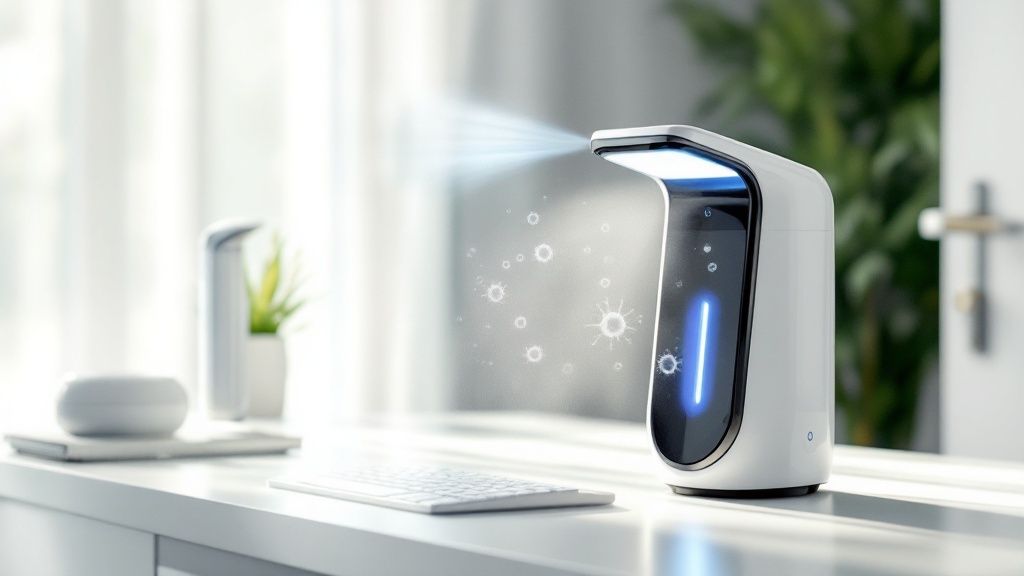
When you hear the term surface cleaning machine, you might picture a simple floor polisher or a vacuum. But today's machines are a whole different beast. Think of them as specialized tools engineered to clean, sanitize, and disinfect surfaces far more effectively than a human with a spray bottle and a cloth ever could.
These devices aren't just about wiping away dirt. They use advanced technologies—like electrostatic charges, UV-C light, or disinfectant fogs—to neutralize the microscopic threats that manual cleaning often leaves behind, such as Influenza A Virus (H1N1), SARS-Related Coronavirus 2 (SARS-CoV-2), and Norovirus.
Understanding the Modern Surface Cleaning Machine

Let's step out of the old janitor's closet and into the modern world of public health. Today's surface cleaning machines are frontline weapons in the fight against invisible enemies like Influenza, Norovirus, and even SARS-CoV-2. These pathogens can cling to countertops, doorknobs, and other high-touch spots long after a surface looks clean.
Imagine trying to weed a huge field by hand. It’s slow, exhausting, and you’re guaranteed to miss some spots. That’s traditional cleaning. A modern disinfection machine is more like a high-tech crop duster—it covers every inch efficiently, reaching nooks and crannies that are nearly impossible to clean by hand. For daily targeted cleaning on high-touch surfaces, disinfecting wipes remain an essential and convenient tool.
Why Advanced Disinfection Is No longer Optional
The need for something better than a simple wipe-down has become painfully obvious, especially in crowded places where germs spread like wildfire. Manual cleaning is a good first step, but it’s prone to human error. An employee in a rush might miss a spot, or the odd shape of a chair might keep a wipe from reaching every crevice.
This is where technology comes in. Modern machines deliver a consistent, reliable application of disinfectant every single time, taking human error out of the equation. This makes them indispensable in places like:
- Healthcare Facilities: To stop the spread of dangerous hospital-acquired infections caused by pathogens like Hepatitis B Virus (HBV) and Hepatitis C Virus (HCV).
- Schools and Daycares: To keep vulnerable kids safe from common bugs like Human Rotavirus and Rhinovirus Type 14.
- Public Transportation: To disinfect the countless shared surfaces on buses, trains, and planes where viruses like Influenza A2/305/57 (H2N2) can linger.
- Offices and Commercial Spaces: To create a healthier environment for employees and customers alike, reducing the transmission of Human Coronavirus.
To give you a quick lay of the land, here’s a snapshot of the technologies we'll be covering.
Modern Disinfection Machines at a Glance
This table provides a quick summary of the primary technologies covered in this guide. Think of it as a cheat sheet to help you understand the core function and best-use scenarios for each type of machine.
| Machine Type | Primary Mechanism | Ideal Application |
|---|---|---|
| Electrostatic Sprayers | Applies a positive charge to disinfectant droplets, causing them to wrap around and cling to surfaces for 360-degree coverage. | Complex objects and high-touch areas like desks, chairs, gym equipment, and healthcare settings. |
| UV-C Devices | Emits short-wavelength ultraviolet light (200-280 nm) that scrambles the DNA and RNA of microorganisms, stopping them from reproducing. | Unoccupied rooms, medical equipment, and air purification systems where direct light exposure is possible. |
| Foggers (ULV/Thermal) | Generates a fine mist or fog of disinfectant that settles on all exposed surfaces in an enclosed space. | Large, open areas like warehouses, gymnasiums, and arenas, or for rapid disinfection after an outbreak. |
Each of these technologies offers a unique set of advantages, and understanding them is the first step toward choosing the right tool for the job. However, for immediate spot cleaning and daily maintenance of frequently touched areas, disinfecting wipes are an invaluable part of any complete hygiene protocol.
A Glimpse into the Core Technologies
In this guide, we'll dive deep into the science behind these machines. You'll learn how electrostatic sprayers use the power of physics to achieve 360-degree coverage, how UV-C light acts as a silent, chemical-free germ-killer, and why foggers are the go-to solution for disinfecting huge spaces in a hurry.
Understanding how long viruses live on surfaces is the key to seeing why these machines are so critical. They don’t just clean; they break the chain of infection at its source.
The growing focus on hygiene is backed by some serious numbers. The global surface cleaning machine market was valued at around $12 billion in 2023 and is projected to hit nearly $19 billion by 2032. This boom is fueled by new tech and a clear, urgent need for better ways to keep our shared spaces safe. You can explore more data on the surface cleaning machine market growth at dataintelo.com.
How Electrostatic Sprayers Supercharge Disinfection

Manual cleaning has a big weakness—it’s only as good as the person doing it. A quick wipe-down can easily miss the underside of a doorknob or the back of a desk chair, leaving a perfect hiding spot for pathogens like Influenza A (H1N1) or Norovirus. This is where an electrostatic sprayer, a smarter type of surface cleaning machine, comes in. It overcomes human error by using a simple physics trick you probably learned in middle school.
Remember rubbing a balloon on your hair and watching it stick to the wall? That static cling is the secret sauce behind electrostatic disinfection. This technology gives disinfectant droplets a positive electrical charge right as they leave the nozzle. The result is a fine, positively charged mist that’s ready to get to work.
Because most surfaces in a room have a neutral or negative charge, these droplets act like tiny magnets. They are actively pulled toward objects instead of just drifting around, making sure the disinfectant actually lands where it’s needed. This powerful attraction is what makes the technology so incredibly effective.
The Magic of 360-Degree Coverage
The real game-changer with an electrostatic sprayer is its ability to provide true, wraparound coverage. If you spray a doorknob with a regular trigger bottle, you’ll coat the front, but what about the back and sides? The charged droplets from an electrostatic sprayer are different—they actively seek out every bit of available surface area.
As the droplets get close to an object, their positive charges push away from each other, forcing them to spread out evenly across the entire surface. Even better, they're drawn to the hidden parts of objects, wrapping around to coat areas that are basically impossible to reach with a cloth. This creates a uniform, 360-degree layer of disinfectant.
This is a huge deal for fighting viruses that hide in tricky spots, like:
- The legs and armrests of office chairs
- The tight spaces between keys on a keyboard
- All the nooks and crannies of gym equipment
- The frames and railings of hospital beds
The idea is simple but powerful. By making sure the disinfectant coats every single side of an object, you dramatically reduce the chance of leaving behind tough pathogens like Feline Calicivirus or Rhinovirus Type 39, which are known for their ability to survive on surfaces.
Where Electrostatic Sprayers Shine
The sheer thoroughness of this surface cleaning machine makes it a must-have in places where complete disinfection isn’t just nice—it’s non-negotiable. For complex spaces, old-school cleaning methods just can’t keep up with its efficiency or its reach.
High-stakes environments that benefit most include:
- Healthcare Facilities: Hospitals and clinics count on electrostatic sprayers to hit every surface in patient rooms, surgical suites, and waiting areas. This helps stop the spread of dangerous pathogens like Hepatitis B Virus (HBV) and SARS-CoV-2. Being able to completely coat medical devices and furniture is a massive advantage.
- Schools and Daycares: In places where viruses like Human Rotavirus can spread like wildfire, these machines can quickly disinfect entire classrooms full of desks, chairs, and toys, creating a safer space for kids to learn and play.
- Public Transportation: Think about all the railings, seats, and handles on buses, trains, and airplanes that thousands of people touch every day. Electrostatic sprayers offer a fast, effective way to disinfect these high-traffic vehicles between trips.
A Powerful Tool, Not a Replacement
While an electrostatic sprayer is an amazing tool for large-scale disinfection, it doesn't mean you can throw out your cleaning cloths. It’s best to think of it as a powerful finishing move in a complete hygiene strategy. For any disinfectant to work its magic, surfaces first need to be wiped clean of physical dirt and grime.
And for daily wipe-downs and quick spills, nothing beats the convenience of a good disinfecting wipe. These are still essential for high-touch spots like light switches, elevator buttons, and shared touchscreens. By combining the deep-disinfecting power of an electrostatic sprayer with the targeted action of manual wipes, any facility can build a rock-solid defense against viruses. This one-two punch ensures that both big surfaces and small, frequently touched spots are consistently clean.
Using Light to Sterilize Without Chemicals

What if you could obliterate viruses without ever touching a surface or using a single drop of chemical disinfectant? That's the promise of ultraviolet-C (UV-C) light, a specific wavelength that acts as a powerful, silent germ-killer. This technology offers a completely different approach in the world of the surface cleaning machine—one that's totally dry and leaves zero residue behind.
Think about how sunlight can fade a colorful poster left in a window over time. UV-C light works in a similar way, but it's far more intense and destructive on a microscopic level. It goes straight for the genetic blueprint—the DNA and RNA—of pathogens like Influenza, Human Coronavirus, and Herpes Simplex Virus 1 (HSV-1). By blasting these microorganisms with high-energy photons, the light scrambles their genetic code, making it impossible for them to multiply and cause an infection.
This process is called ultraviolet germicidal irradiation (UVGI). It doesn't just clean a surface; it sterilizes it by rendering pathogens harmless. It’s a game-changer for terminal cleaning, which is the complete disinfection of a room after use, like in between patients in a hospital.
How Germ-Killing Light Actually Works
Not all UV light is created equal. The UV spectrum has three main types: UV-A, UV-B, and UV-C. You’re probably familiar with UV-A and UV-B—they’re the reason we get sunburns. UV-C, however, has a much shorter wavelength (typically 200-280 nanometers) that our planet's ozone layer almost completely blocks. This very specific wavelength is what gives it its germ-killing superpower.
When UV-C light hits a microorganism, it zips right through the cell wall and gets absorbed by its DNA and RNA. This absorption messes up the genetic code by creating what are known as thymine dimers—think of them as kinks in a zipper. These kinks prevent the enzymes responsible for replication from doing their job, effectively stopping the virus or bacterium dead in its tracks.
The real beauty of this method is its raw, physical attack. Because it physically destroys genetic material, it’s incredibly difficult for microorganisms like SARS-CoV-2 to develop resistance to it, which can sometimes be a problem with chemical disinfectants.
Types of UV-C Disinfection Devices
UV-C technology has been engineered into different kinds of surface cleaning machines, each built for specific jobs and spaces. One thing they all have in common: they are most effective when used in empty rooms because UV-C light can be harmful to human skin and eyes.
You'll typically find them in these forms:
- Mobile UV-C Robots: These are the cool, autonomous units that can roam through a hospital operating room or hotel suite on their own. They stop at different spots to emit a measured dose of UV-C, making sure all exposed surfaces get blasted with light.
- Stationary UV-C Fixtures: Think of these as permanent installations in high-risk zones like labs or sterile processing departments. They’re often mounted on ceilings or walls and can be programmed to run sterilization cycles when no one is around.
- Upper-Room UVGI Systems: These clever devices are designed to clean the air while people are still in the room. They shoot UV-C light upwards, creating a disinfection zone above everyone's heads, and rely on natural air currents to pull pathogens up into the light.
The "Line-of-Sight" Catch
There's one crucial limitation to UV-C: it only works on what it can "see." The light travels in a straight line and can't bend around corners or get through solid objects. This is known as the "line-of-sight" limitation. If a surface is in a shadow, it won't be disinfected.
This means you have to be smart about how you use UV-C technology. It often requires careful positioning, multiple devices, or a combination with other cleaning methods. For example, a common practice is to have staff perform a manual cleaning to wipe away dirt and grime first. Then, a UV-C robot can come in to handle the final, deep sterilization. While UV-C is an incredibly powerful tool for high-stakes cleaning, this limitation shows why you still need a layered approach—disinfecting wipes are still essential for hitting those shadowed spots and high-touch points the light might miss.
Disinfecting Large Spaces with Foggers and Misters
When you’re staring down a huge, open area, you quickly realize that wiping every surface just isn’t going to work. Trying to manually disinfect a gymnasium, warehouse, or conference hall is a losing battle. That's exactly why we have specialized surface cleaning machines like foggers and misters—they’re the go-to tools for public health in large-scale environments.
Think of a fogger as a supercharged aerosol can, built to cover thousands of square feet. These machines spray a fine disinfectant mist that hangs in the air before it settles and evenly coats every exposed surface—from the floors and walls to every chair and piece of equipment. It’s a "touchless" method that ensures even the most awkward, hard-to-reach spots get treated.
This kind of tech is a big deal in the cleaning world. The global market for cleaning products is massive, expected to reach $312.49 billion by 2027. You can dig deeper into the cleaning products market data on coherentmarketinsights.com.
Understanding ULV Foggers
For indoor disinfection, the most common machine you'll see is the Ultra Low Volume (ULV) fogger. ULV foggers are engineered to create incredibly tiny droplets, usually between 5 and 50 microns. To put that in perspective, a single human hair is about 70 microns thick.
Because the droplets are so small and light, they form a "dry" mist that’s almost invisible. This allows the disinfectant to stay suspended in the air longer, giving it more time to circulate and land on more surfaces before evaporating. That's what makes ULV foggers perfect for indoor spaces where you can’t have everything soaked in liquid.
The Role of Fogging in a Disinfection Strategy
Fogging is incredibly useful for hitting the reset button after an outbreak of something nasty like Norovirus or Avian Influenza Virus (H5N1). It can decontaminate an entire room fast, knocking down the viral load on surfaces and helping to break the chain of transmission.
But it's critical to know what fogging doesn't do. It is not a substitute for actual cleaning.
A fogger is a powerful disinfection tool, but it should be seen as the final step in a full hygiene protocol. The disinfectant mist can only kill pathogens on surfaces that are already free of dirt, dust, and grime.
Basically, you have to clean a surface first for the disinfectant to do its job. If there's a layer of dust or dirt, it acts like a shield, and the disinfectant can't reach the viruses hiding underneath.
Complementary Cleaning for Complete Protection
This is why a layered defense is always the best approach. Fogging gives you broad coverage for the whole room, but you still need to manually clean the surfaces people touch all the time. This is where a good old-fashioned disinfecting wipe still shines.
Here’s how they work together:
- Before Fogging: High-touch surfaces like doorknobs, light switches, and countertops need a good wipe-down to get rid of any physical soil.
- Daily Maintenance: In between fogging sessions, disinfecting wipes are perfect for keeping those high-traffic surfaces clean.
- Targeted Response: For a small, sudden spill, a wipe is the quickest and most practical tool for the job.
By combining the wide-area power of a ULV fogger with the targeted precision of manual wiping, you build a much stronger defense against viruses. The fogger takes care of the entire environment, while the wipes give you the constant, focused attention that critical touchpoints need. It's an integrated strategy that leaves no surface, big or small, unprotected.
Choosing the Right Disinfection Technology
Picking the right surface cleaning machine isn’t about finding a single "best" option. It's about finding the best tool for your specific job. Now that we've dug into the science behind electrostatic sprayers, UV-C devices, and foggers, the next step is all about practical application. You have to match the technology to your space, the kinds of surfaces you're dealing with, and how fast you need to get the area back up and running.
This is a critical decision. Making the wrong choice can lead to wasted time, incomplete disinfection, and a dangerous false sense of security. But the right machine? That becomes a powerhouse in your hygiene strategy.
Matching the Machine to Your Mission
Think of it like choosing a vehicle. You wouldn't take a sports car off-roading, and you wouldn’t use a bulldozer to navigate a tight city street. Each of these disinfection technologies is built for a different kind of terrain.
A daycare center is a perfect example. It's filled with oddly shaped plastic toys, small chairs, and tons of little nooks and crannies. This is an ideal environment for an electrostatic sprayer. Its signature wraparound effect makes sure the disinfectant clings to every single surface, neutralizing tough pathogens like Human Rotavirus or Rhinovirus Type 14 that spread like wildfire among kids.
On the other hand, a huge, open warehouse or a school gymnasium presents a completely different challenge. Wiping down every surface by hand—or even with a standard sprayer—would take forever. This is where a ULV fogger shines. It can quickly fill a large, open space with a fine disinfecting mist, settling over massive areas for efficient, broad-spectrum coverage.
The image below gives you a quick performance comparison, showing how different machines balance coverage speed with resource use.

As you can see, something like a floor scrubber can cover a massive area per hour with moderate water use, which is a huge deal for large-scale operations.
Key Factors for Your Decision
To make the right call, you need to weigh a few critical factors. Each one will point you toward the most effective technology for your situation.
- Size and Layout of the Space: Is it a small, cluttered office or a wide-open floor plan? Foggers are built for volume, while electrostatic sprayers are masters of complex, tight spaces.
- Complexity of Surfaces: Are you disinfecting simple, flat countertops, or do you have complex equipment with lots of angles and hidden spots? The more intricate the items, the more an electrostatic sprayer starts to make sense.
- Required Turnaround Time: How quickly does the space need to be safe for people to re-enter? UV-C light requires an empty room but leaves zero residue, allowing for immediate re-entry once the cycle is done. Sprayers and foggers, however, need "dwell time" for the disinfectant to work its magic, plus extra time for surfaces to dry.
- Type of Disinfectant Used: Not every machine plays nicely with every chemical. Some disinfectants, like those using hypochlorous acid, are incredibly effective but might need specific equipment to be dispersed properly. You can explore our guide on hypochlorous acid for cleaning to get a better handle on its benefits.
The global demand for better cleaning tools is booming. The cleaning equipment market was valued at around $37.6 billion in 2020 and is on track to hit $60.1 billion by 2025. This explosion shows just how much we're relying on advanced machinery to keep public spaces safe.
To help you sort through the options, here's a side-by-side look at the core technologies.
Comparison of Disinfection Machine Technologies
This table breaks down the key differences between electrostatic sprayers, UV-C devices, and ULV foggers to help you see where each one excels—and where it falls short.
| Feature | Electrostatic Sprayer | UV-C Device | ULV Fogger/Mister |
|---|---|---|---|
| Coverage Type | 360-degree "wraparound" on objects | Line-of-sight only; ineffective in shadows | Broad, settling mist for large open areas |
| Best For | Complex objects, high-touch points, cluttered rooms | Empty rooms, labs, healthcare settings, air systems | Large open spaces like warehouses, gyms, and factories |
| Turnaround Time | Moderate (requires dwell and drying time) | Fast (immediate re-entry after cycle) | Slowest (requires long dwell and drying/settling time) |
| Residue | Yes, leaves a thin layer of disinfectant | No residue | Yes, leaves a significant amount of disinfectant |
| Safety Concerns | Requires PPE; room must be empty during use | Requires room to be empty; direct exposure is harmful | Requires PPE; room must be empty during use |
| Chemicals | Uses liquid disinfectants (water- or alcohol-based) | Chemical-free; uses light | Uses liquid disinfectants, often water-based |
| Labor Intensity | Moderate; requires active spraying by an operator | Low; automated "set and forget" cycles | Low to moderate; operator sets up and starts the machine |
Each technology has a clear role to play. The trick is understanding these differences so you can deploy the right one for the right situation, ensuring you get the most effective and efficient disinfection possible.
Why Wipes Remain Essential
Even with the most powerful machine in your arsenal, the job isn't done. These technologies are designed for periodic deep cleaning, not the constant, real-time sanitizing that high-touch surfaces demand. Think about it: light switches, elevator buttons, shared keyboards, and door handles are touched dozens, if not hundreds, of times a day.
This is where disinfecting wipes are still absolutely indispensable.
They provide a quick, convenient, and effective way to tackle these critical points of contact as contamination happens. By combining a powerful machine for your big deep cleans with the daily, targeted use of disinfecting wipes, you create a robust, layered defense against viruses. The machine protects the entire environment, while the wipes guard the most frequent transmission points.
Implementing Safe and Effective Cleaning Protocols
Powerful technology demands responsible handling. Getting your hands on an advanced surface cleaning machine is only half the battle; knowing how to use it safely and keep it in good shape is what really delivers consistent, effective results. Following the right protocols protects the operator, extends the life of your equipment, and makes sure the machine is always ready to perform at its peak.
This is about more than just flipping a switch. Each type of machine comes with its own set of non-negotiable safety rules.
When you're operating electrostatic sprayers or ULV foggers, for instance, the right Personal Protective Equipment (PPE) is a must. This usually means gloves, eye protection, and a respirator to keep you from breathing in disinfectant mist, which can easily irritate the respiratory system.
On top of that, any space being treated with these machines needs to be completely empty of people and pets. That fine mist needs time to settle and the disinfectant needs to sit undisturbed to do its job—what’s known as dwell time—without putting anyone at risk.
Operator and Environmental Safety First
The absolute biggest safety rule for UV-C devices is preventing exposure. UV-C light is powerful enough to scramble the DNA of viruses like Hepatitis B Virus (HBV), and it can be just as harmful to human skin and eyes.
Because of this, these machines must only be operated in unoccupied rooms. Many of the newer UV-C robots come equipped with motion sensors and automatic shut-offs as a failsafe, but you can't skip the manual checks. Always double-check that the space is clear.
Here’s the bottom line: no machine can operate safely without a well-trained user. Proper training on your machine’s specific functions, safety features, and emergency procedures is the single most important investment you can make after buying the equipment itself.
A Practical Maintenance Checklist
Just like your car, your disinfection machine needs regular upkeep to run smoothly. A little consistent maintenance goes a long way in preventing costly breakdowns and ensuring it delivers the powerful cleaning you count on. A simple checklist can make all the difference.
- For Electrostatic Sprayers: Regularly check and clean the nozzle to prevent clogs. A blockage can mess up the spray pattern and slash the machine's effectiveness. After every use, be sure to flush the whole system with water to clear out any leftover disinfectant.
- For ULV Foggers: Before you start a job, give the hoses and seals a quick inspection for any cracks or leaks. You'll also want to clean the solution filter every so often to guarantee a consistent flow and prevent strain on the motor.
- For UV-C Devices: The bulbs are the heart of these machines. Keep them clean and free of dust, since any buildup can block the germ-killing light. Most importantly, track the operational hours and replace the bulbs right on schedule with the manufacturer’s recommendations to maintain their disinfecting power.
By building these safety and maintenance steps into your daily routine, you create a disinfection program that’s not just effective, but sustainable. You can dive deeper into the fundamentals in our comprehensive guide to cleaning and disinfecting best practices. This approach ensures you get the most out of your technology while keeping everyone involved safe and sound.
Your Top Questions About Disinfection Tech, Answered
When you're looking into advanced disinfection, a lot of questions pop up. It makes sense. Picking the right surface cleaning machine means knowing the subtle differences between them and, more importantly, understanding where they fit into your overall cleaning plan.
Can One Machine Do It All?
It’s tempting to search for that one magic bullet, but the truth is, there isn't one. Different spaces have different needs.
An electrostatic sprayer is a rockstar at wrapping disinfectant around weirdly shaped objects with 360-degree coverage—think a room full of desks and chairs. But for a massive, wide-open warehouse, a ULV fogger is going to be far more efficient at treating both the air and all those surfaces. No single machine is the best tool for every single job.
It's also important to remember what these machines are for: periodic, deep disinfection. They’re a powerful addition to your cleaning routine, not a replacement for the daily wipe-downs that keep germs at bay.
The smartest strategy is a layered one. You use a powerful machine for the big, deep-cleaning jobs, but you still need things like disinfecting wipes to hit high-touch spots throughout the day. This is how you get continuous protection from nasty bugs like Norovirus and Rhinovirus.
Do These Machines Replace Manual Cleaning?
Not a chance. In fact, they make your manual cleaning even more important.
Here’s why: for any disinfectant to work, it has to physically touch the germs. Dirt, dust, and grime create a shield that protects viruses and bacteria, making your expensive disinfection process useless.
This means you absolutely have to wipe down surfaces to get rid of all that physical soil before you bring in a sprayer, fogger, or UV-C device. It's like waxing a car—you'd never apply a protective coat to a dirty vehicle. You have to clean it first so the final layer can do its job. Disinfecting wipes are perfect for this pre-cleaning step and for keeping things clean between those deep-disinfection cycles.
Leave a Reply