Ever wonder why you can catch the flu this year, even if you had it last year? The answer is a fascinating biological chess match between our immune system and the viruses trying to make us sick.
The virus’s secret weapon in this ongoing battle is a clever trick called antigenic variation. It’s the single biggest reason why achieving lifelong immunity to certain pathogens—from Influenza A to HIV-1—is so incredibly difficult.
Decoding How Viruses Play Hide and Seek
At its heart, antigenic variation is a survival strategy. Viruses like Influenza and SARS-CoV-2 have surface markers called antigens, which our immune system’s antibodies learn to recognize and attack. But what happens when the virus changes those markers?
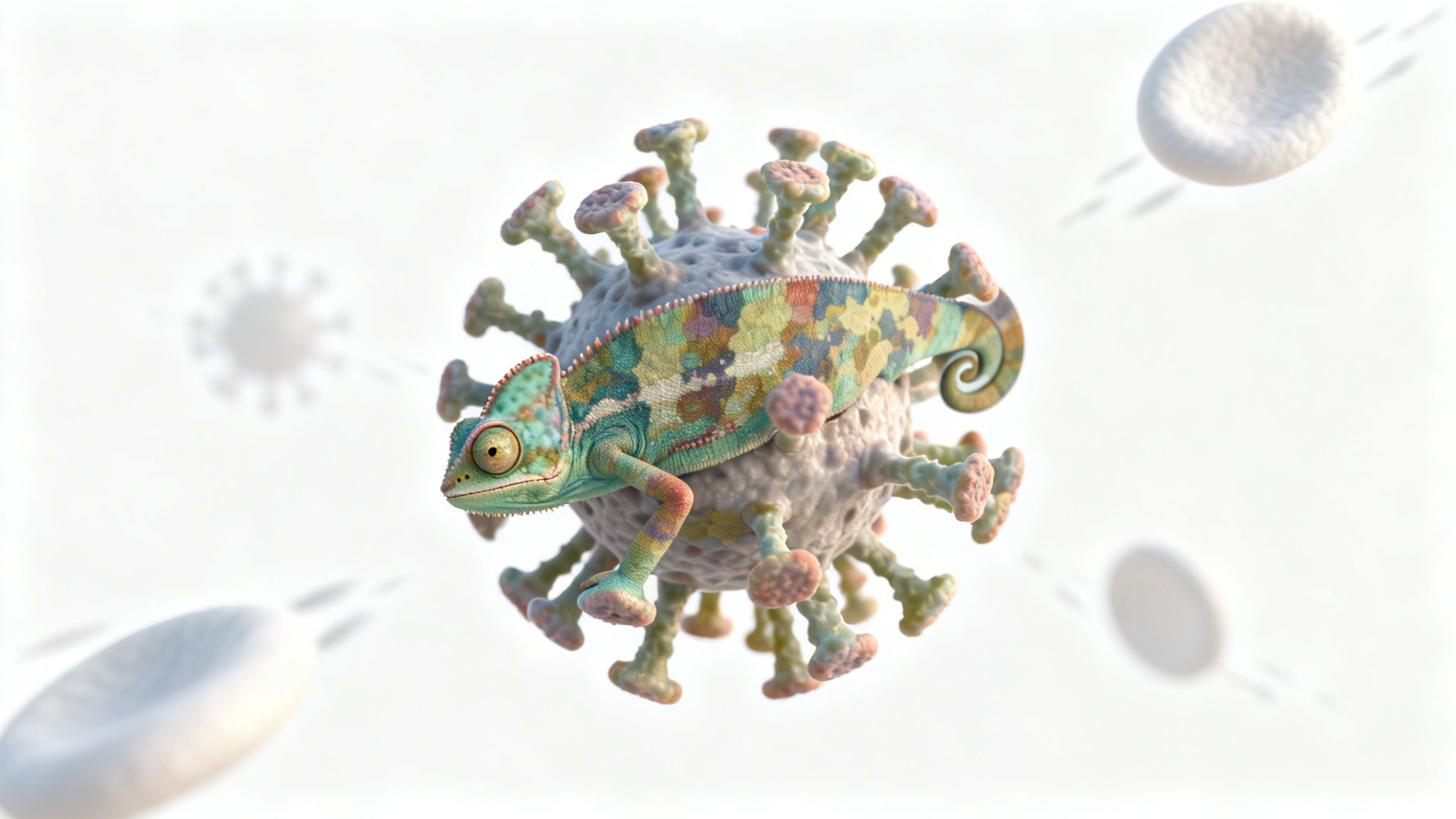
When a pathogen successfully alters its antigens, our immune system's memory becomes useless. It’s like a security system that no longer recognizes a master thief because they’ve changed their disguise—new coat, different hat, altered walk. In a busy environment, where viruses can linger on surfaces, this stealth allows them to spread before our bodies even know what hit them.
The Constant Arms Race
This creates a perpetual arms race. Our bodies work hard to develop highly specific antibodies to fight off an infection. But by the time we’ve built up this defense, the virus may have already changed its appearance, rendering our new weapons obsolete.
This constant evolution has huge implications for public health. It influences everything from how the annual flu shot is formulated to the frustratingly difficult search for vaccines against elusive viruses like HIV-1 and Hepatitis C Virus (HCV).
Antigenic variation isn't just a minor tweak; it's a fundamental strategy that allows pathogens to persist in populations, cause recurrent infections, and sometimes trigger widespread epidemics.
Understanding this concept is the first step to appreciating just how complex and adaptable viruses can be. It explains why:
- Seasonal flu keeps coming back: The influenza virus is the classic example, constantly shifting its antigens and forcing scientists to reformulate the vaccine every single year.
- Some vaccines are so hard to develop: Pathogens like Human Immunodeficiency Virus (HIV-1) and Hepatitis C Virus (HCV) mutate so rapidly, even inside a single person, that they present a constantly moving target.
- New viral variants emerge: The same principle is behind the emergence of new SARS-CoV-2 variants, where changes to the surface proteins can help the virus evade immunity from past infections or vaccines.
In this guide, we’ll unpack the clever mechanics behind this viral shapeshifting, showing you exactly how these microscopic invaders stay one step ahead.
The Master Mechanisms of Viral Disguise
To outsmart our immune system, pathogens have to be masters of disguise. This isn't just a random act; they rely on specific biological tricks to change their surface antigens—the molecular fingerprints our bodies learn to recognize. Understanding these mechanisms is key to seeing how slippery viruses like Influenza, HIV-1, and SARS-CoV-2 always seem to be one step ahead.
Each strategy works a little differently. Some are subtle, like tiny tweaks over time, while others are dramatic, overnight transformations. These genetic escape tactics are what drive viral evolution and create some of the biggest challenges we face in public health today, from personal illness to community outbreaks.
Antigenic Drift: Minor Typos in the Viral Recipe
The most common mechanism is antigenic drift. Think of a virus’s genetic code as a recipe. Every time the virus copies itself, there’s a chance for small, random errors to creep in—like little typos. Most of these mistakes don't matter, but every so often, a typo changes a key "ingredient" in one of its surface proteins.
Even a tiny change can be enough to make the virus just a bit less recognizable to our immune system’s antibodies. As these small changes pile up over time, the virus slowly "drifts" away from the original version our body was trained to fight. This slow and steady process is exactly why we need a new flu shot every year. Want to dive deeper? Check out our guide on what is antigenic drift.
The concept map below breaks down how pathogens use these surface proteins to fly under the immune system's radar.

This visual highlights the direct link between a pathogen's surface proteins and its ability to escape detection—the very heart of antigenic variation.
Antigenic Shift: A Complete Recipe Swap
Then there's the much more dramatic event: antigenic shift. Forget minor typos; this is like swapping out entire recipe books. Antigenic shift happens when two or more different strains of a virus infect the same cell at the same time. Inside that cell, they can shuffle and exchange large chunks of their genetic material.
This genetic reassortment can cook up a brand-new virus with surface antigens that are completely foreign to the human immune system. Because almost nobody has pre-existing immunity to this new threat, antigenic shift can trigger widespread epidemics or even pandemics. The 2009 H1N1 "swine flu" outbreak is a perfect example.
Antigenic drift causes seasonal epidemics, while antigenic shift has the potential to cause global pandemics. The difference lies in the scale and speed of the genetic change.
Other Clever Disguise Tactics
While drift and shift get most of the attention, pathogens have more than two tricks up their sleeves. Here are a couple of other important strategies:
- Gene Conversion: This is like a card player holding a whole deck of "antigen cards" in their genome. When the immune system finally recognizes the card they're playing, the pathogen simply pulls a new gene sequence from its library and pastes it into the active slot. Voila—a brand-new surface protein.
- Phase Variation: This tactic works like a simple on/off switch. A pathogen can turn the expression of certain surface proteins on or off, effectively changing its look by hiding or revealing different antigens at different times.
These molecular strategies aren't just for textbooks. They have huge real-world consequences, shaping everything from how we design vaccines to how we respond when the next new viral threat emerges.
Seeing Antigenic Variation in Action
The biological tricks pathogens use to disguise themselves—like antigenic drift and shift—aren’t just abstract textbook concepts. They're active, real-world strategies fueling everything from the seasonal flu to global health crises. By looking at a few key culprits, we can see exactly how this molecular cat-and-mouse game plays out.

The influenza A virus is the classic example. Its relentless evolution through antigenic drift is the single biggest reason you need a new flu shot every fall. The virus's surface proteins, especially hemagglutinin (HA), are constantly accumulating tiny mutations. These small changes slowly alter their shape, making them just different enough that our immune system's memory from last year doesn't quite recognize this year's version.
Influenza A: The Relentless Shapeshifter
When it comes to influenza, the H3N2 strain is particularly notorious for its rapid-fire evolution. This constant drift keeps public health officials in a perpetual race against the virus, because last year’s immunity offers less and less protection against this year's model.
In fact, antigenic variation is the very engine driving the massive global flu epidemics H3N2 causes each year. Researchers analyzing thousands of viral sequences discovered something fascinating: H3N2 variants don't just linger locally between seasons. Instead, they are constantly reseeded from East and Southeast Asia. This strain evolves antigenically much faster than its cousins, H1N1 or influenza B, which is why it triggers bigger outbreaks with higher attack rates and spreads across the globe more quickly. You can dive deeper into how these viral lineages migrate globally.
This never-ending cycle forces an annual reformulation of the flu vaccine just to keep up, a direct and costly consequence of antigenic variation on global health policy.
HIV-1: The Master of Internal Evasion
Human Immunodeficiency Virus (HIV-1) takes antigenic variation to a whole different level. Instead of a slow, gradual drift across a global population, HIV-1 mutates at a blistering pace within a single infected person.
This rapid evolution creates what's known as a "viral swarm" or quasispecies—a complex, ever-changing mixture of genetically distinct but related viral variants all coexisting in one host. It’s an immense challenge for the immune system, which finds itself constantly playing catch-up with a target that never stays still.
HIV-1's high mutation rate means it can quickly develop resistance to antiretroviral drugs and evade the body's immune responses, making it one of the most difficult viruses to create a vaccine for.
This internal diversity is a primary reason why a single exposure to HIV-1 doesn't result in lasting immunity. It's also why treatment demands a "cocktail" of multiple drugs—to suppress the diverse and ever-shifting viral population from all sides.
Beyond Influenza and HIV
The strategy of changing your coat to fool the immune system is hardly unique. It’s a widespread survival tactic used all across the microbial world.
- SARS-CoV-2: The emergence of variants like Omicron is a perfect, recent example of antigenic drift. Small mutations in its spike protein helped the virus partially sidestep the immunity people had built up from previous infections and vaccinations.
- Hepatitis C Virus (HCV): Much like HIV-1, HCV rapidly mutates within an infected individual, creating a quasispecies that helps it evade the immune system and establish chronic infections.
- Norovirus: This highly contagious virus, a common cause of gastroenteritis, also uses antigenic drift. New strains emerge every few years, leading to widespread outbreaks because prior immunity is no longer effective.
From viruses that cause respiratory illness like Rhinovirus to those causing severe gastrointestinal distress, antigenic variation is a fundamental force of nature. It’s how pathogens ensure their survival, and it’s a constant challenge to our immune defenses.
Why Antigenic Variation Is a Nightmare for Vaccine Design
If our immune systems are so good at creating antibodies to fight off germs, why can’t we make a once-and-done vaccine for something like the flu or HIV-1? The short answer is antigenic variation. This constant shapeshifting turns vaccine development into a frustrating race against a target that just won’t stand still.
Think of it this way: a vaccine works by showing your immune system a "mugshot" of a specific virus, training it to recognize and attack that intruder on sight. But if the intruder dyes their hair, grows a beard, and puts on glasses, that mugshot becomes useless. That's exactly what antigenic variation does—it changes the virus's appearance, letting it slip past our defenses.
The decades-long hunt for a "universal" flu vaccine is the perfect example of this struggle. Scientists are desperately trying to design a vaccine that targets parts of the virus that don't change, but finding those stable targets has been incredibly difficult. Until they succeed, we're stuck in an annual cycle of guessing, predicting, and reformulating.
The Global Neighborhood Watch for Viruses
To keep up with these quick-change artists, a massive global surveillance network is always running in the background. Organizations like the World Health Organization (WHO) run a global influenza program that’s basically a neighborhood watch for viruses.
Labs and scientists all over the world collect samples of circulating flu strains, sequence their genes, and try to predict which variants will cause the most trouble in the upcoming flu season. This intelligence is absolutely critical for deciding which antigens to include in the annual vaccine—a decision made months in advance just to give manufacturers enough time to produce it.
Because viruses are always changing, our strategies must also adapt. This global surveillance network is our best tool for staying one step ahead, but it highlights just how reactive we often have to be.
This annual race also drives home a crucial point about prevention. While vaccines are a public health superstar, their effectiveness can fade as new variants emerge. This makes simple hygiene habits, like consistent hand washing and wiping down surfaces with effective disinfecting wipes, a powerful first line of defense that works no matter which variant is making the rounds.
Finding Stable Targets in a Sea of Change
And this challenge isn't just about viruses. Bacteria like Neisseria meningitidis, which causes meningococcal disease, also use antigenic variation to sneak past our immune systems and vaccines. But there’s a ray of hope from the world of genomics.
Despite the dizzying genetic diversity these bacteria show, researchers have found that only a handful of antigenic variants for key vaccine targets are actually dominant in the real world. This discovery suggests that a smartly designed vaccine, using a mix of the most common variants, could offer broad, long-lasting protection.
In fact, some of these variant combinations have stayed surprisingly stable for decades across different continents. It’s a powerful hint that a well-designed vaccine really could have a global impact. You can read more about these fascinating genomic database findings.
The table below breaks down how these viral and bacterial gymnastics affect our public health strategies.
Impact of Antigenic Variation on Public Health Strategies
Antigenic variation isn't just a scientific curiosity; it has real, tangible effects on how we protect community health. This table summarizes how this constant viral evolution forces us to adapt our strategies across different areas of public health.
| Public Health Area | Challenge Posed by Antigenic Variation | Resulting Strategy or Action |
|---|---|---|
| Vaccine Development | Vaccines targeting specific antigens become ineffective as the pathogen evolves. | Annual vaccine reformulation (e.g., flu), research into universal vaccines targeting stable regions. |
| Immunity and Reinfection | Prior infection may not protect against new variants, leading to repeat illness. | Promoting booster shots and ongoing public health messaging about risk, even for the previously sick. |
| Disease Surveillance | Constant monitoring is needed to track which variants are circulating. | Global surveillance networks (like WHO's) to collect samples, sequence genomes, and predict trends. |
| Diagnostics | Tests designed to detect one variant might miss new ones. | Development of diagnostic tests that target more conserved regions or can detect multiple variants. |
| Everyday Prevention | Vaccine protection can be a moving target, requiring other layers of defense. | Emphasizing non-pharmaceutical interventions like hand washing and surface disinfection. |
Ultimately, this ongoing battle means our public health toolbox can't rely on vaccines alone. A multi-layered approach—combining smart surveillance, adaptable vaccines, and steadfast hygiene—is our best bet for staying ahead of these ever-changing pathogens.
How Animal Viruses Fuel New Human Threats
While antigenic variation keeps familiar viruses like the seasonal flu on a constant merry-go-round, it also has a much darker side: creating entirely new threats. Many of the most dangerous emerging viruses don’t start in humans. Instead, they make a dramatic leap from animal populations in a process called zoonotic spillover.
Think of animal reservoirs, especially birds and pigs, as biological "mixing bowls." In these hosts, different viral strains can meet, mingle, and swap genes. This is exactly where antigenic shift comes into play—an Avian Influenza Virus (H5N1) and a human flu virus could infect the same pig cell, shuffle their genetic material, and spin off a brand-new virus that the human immune system has never seen before.

This isn’t just a hypothetical scenario. It’s exactly what gave us the 2009 H1N1 "swine flu" pandemic. That virus wasn't just a slightly drifted version of an old flu; it was a complex reassortant—a Frankenstein's monster containing genetic bits and pieces from North American swine, Eurasian swine, human, and bird flu viruses.
The Swine Flu Example
Swine influenza A viruses are a perfect, and frankly terrifying, illustration of this global threat. They are masters of antigenic variation, fueled by frequent spillovers from humans, which then evolve within pig herds and split off into distinct regional lineages.
One landmark study showed how H3 antigenic diversity in U.S. swine absolutely exploded after 2010, far outpacing the steadier evolution seen in Europe. This divergence, which led to a mean pairwise distance of 12.6 AU between U.S. and European swine H3 viruses, proves just how differently viruses can evolve in separate livestock systems. You can dig into the specifics in these regional viral diversity findings.
Understanding the link between animal and human health isn't just an academic exercise—it's the foundation of modern pandemic prevention. This interconnectedness is known as the One Health concept.
One Health and Preventing the Next Pandemic
The One Health approach is simple but powerful: it recognizes that the well-being of people is fundamentally tied to the health of animals and our shared environment. Antigenic variation churning away in animal populations is a direct threat to us, constantly generating a supply of potential pandemic pathogens.
To get ahead of this, we need a proactive strategy. It’s not about waiting for the next spillover, but preventing it from happening in the first place. That means:
- Strong Farm Biosecurity: Simple but effective hygiene measures on farms, like disinfecting equipment and limiting contact between different animal species, can slam the door on opportunities for viruses to mix and evolve.
- Global Surveillance: We need boots on the ground, actively monitoring viral strains circulating in animal populations. This gives us an early warning system to spot new threats before they make the leap to humans.
In the end, preventing the next pandemic means looking beyond our own species. By managing viral evolution in animal reservoirs, we can break the chain of transmission and protect global public health from the next threat fueled by antigenic variation.
Common Questions About Viral Evolution
Learning about how viruses constantly change naturally brings up some big questions. Understanding antigenic variation is the key that connects what's happening at a microscopic level to the real-world impact on our lives. Here are some straightforward answers to the most common queries.
What’s the Main Difference Between Antigenic Drift and Shift?
The easiest way to think about it is comparing a small tweak to a complete overhaul.
Antigenic Drift is the slow, steady accumulation of tiny mistakes. As a virus copies itself, it makes small errors in its genetic code. Over time, these little changes add up, altering the virus's surface just enough that our immune system doesn't recognize it anymore. This is why we have a new flu season every year.
Antigenic Shift is a sudden, radical change. This happens when two different viral strains infect the same cell and literally swap huge chunks of their genetic material. The result is a brand-new hybrid virus that no one has any pre-existing immunity to. It's the viral equivalent of smashing two different car engines together to create something totally new—and it's the mechanism that can spark a global pandemic.
Can We Stop Viruses From Changing?
In a word, no. Viral evolution isn't a flaw; it's a fundamental feature of biology. Viruses like influenza and HIV-1 have replication machinery that is naturally error-prone, meaning mutations are an unavoidable part of their life cycle. Their only goal is to survive and spread, and changing their appearance is their best defense.
Trying to stop viruses from mutating would be like trying to stop the ocean's tide. Instead of fighting an unwinnable battle, we focus on adapting to it. We track the changes, update our vaccines, and rely on proven hygiene practices that break the chain of transmission no matter what the virus looks like.
This is why global surveillance is so crucial. We can’t stop the evolution, but by watching it closely, we can try to stay one step ahead.
How Does Antigenic Variation Actually Affect Me?
This complex process has a very direct impact on your health and your daily life.
It's the reason you need a new flu shot every year. The vaccine is updated to match the strains that have drifted the most and are expected to dominate the upcoming season. It’s also why new variants of viruses like SARS-CoV-2 can cause fresh waves of illness, sometimes even in people who were previously infected or vaccinated.
On a practical level, this highlights why good hygiene is a non-negotiable line of defense. A vaccine's protection might wane as a virus changes its disguise, but washing your hands with soap and water or disinfecting a high-touch surface works against any variant. It’s a universal tool that disrupts transmission, regardless of a virus's genetic makeup.
Why Isn’t There a Vaccine for Every Virus?
It’s incredibly difficult to develop a vaccine for a target that’s constantly moving. For some pathogens like HIV-1 and Hepatitis C Virus (HCV), the rate of antigenic variation is so fast and furious that it presents a monumental challenge.
HIV-1, for example, mutates so rapidly inside a single person that it creates what scientists call a "viral swarm"—a diverse population of slightly different variants. A single vaccine simply can't target all of them at once. HCV uses a similar strategy of constant evolution to outrun the immune system and establish a chronic, lifelong infection. These viruses are true masters of disguise, and until we can find a way to target a stable, unchanging part of them, a broadly effective vaccine remains one of science's most sought-after goals.