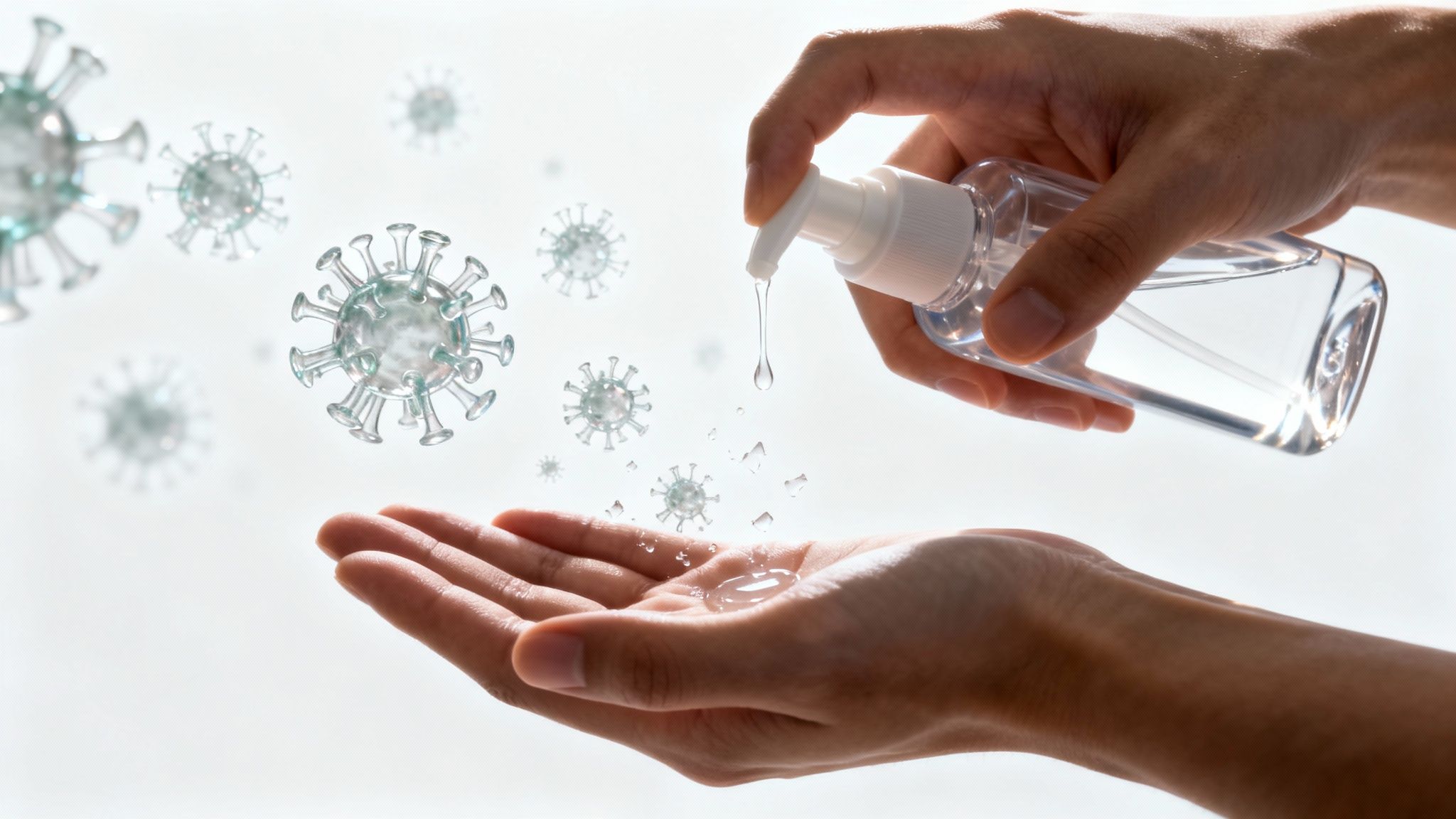
Yes, hand sanitizer does kill many viruses, but its effectiveness depends entirely on the virus’s structure. While it's a powerful tool, it's not a universal solution.
Alcohol-based sanitizers with at least 60% alcohol are highly effective against enveloped viruses like Influenza A Virus (H1N1) and SARS-Related Coronavirus 2 (SARS-CoV-2). However, they are significantly less effective against more resilient non-enveloped viruses such as Norovirus and Rhinovirus. For these tougher pathogens, and for cleaning surfaces, other methods are necessary.
How Hand Sanitizer Actually Works on Viruses

When you apply sanitizer, you're relying on its chemical properties to neutralize pathogens. But the viral world is diverse, and a simple pump of alcohol gel doesn't work uniformly against all threats.
The key lies in a virus's anatomy. Many viruses we are concerned about, including those responsible for the common cold, flu, and COVID-19, are "enveloped." This means their genetic material is enclosed in an outer layer made of lipids (fats). Alcohol, a solvent, excels at dissolving this fatty layer, causing the virus to disintegrate and become non-infectious.
Conversely, "non-enveloped" viruses lack this vulnerable fatty shell. They are protected by a tough, rigid protein shell called a capsid, which acts as microscopic armor, making them highly resistant to alcohol-based sanitizers.
The Two Types of Viruses You Need to Know
Understanding these two categories is crucial for knowing when to use sanitizer and when to seek a sink for hand washing.
Enveloped Viruses (Vulnerable to Sanitizer): These viruses possess a fragile lipid membrane that alcohol readily destroys. Examples include Influenza viruses (like H1N1), Coronaviruses (including SARS-CoV-2), Human Immunodeficiency Virus (HIV-1), Hepatitis B and C Viruses (HBV, HCV), and Herpes Simplex Viruses (HSV-1, HSV-2).
Non-Enveloped Viruses (Resistant to Sanitizer): Protected by a sturdy protein coat, these viruses are largely unaffected by alcohol. Key examples are Norovirus (the cause of viral gastroenteritis), Rhinovirus (a primary cause of the common cold), and Human Rotavirus.
For these tougher, non-enveloped pathogens, the mechanical friction of washing with soap and water is superior. Soap lifts the virus from the skin, and running water physically rinses it away—a task sanitizer cannot perform.
Key Takeaway: Hand sanitizer is specialized. It excels at destroying the fragile outer layer of enveloped viruses but is a poor defense against rugged, non-enveloped types that often cause gastrointestinal illness.
This is why public health officials emphasize hand washing during norovirus outbreaks. While sanitizer is a convenient tool against many respiratory viruses, it's not a comprehensive solution. Knowing the right tool for the job is essential for staying protected.
Hand Sanitizer Effectiveness At a Glance
This table compares the efficacy of alcohol-based sanitizers against different virus types.
| Factor | Effective Against | Less Effective Against | Best Practice |
|---|---|---|---|
| Virus Type | Enveloped viruses like Influenza (H1N1, H5N1), Coronaviruses (SARS-CoV-2), HBV, HCV, and HIV-1. | Non-enveloped viruses like Norovirus, Rhinovirus, and Rotavirus. | For respiratory viruses, sanitizer is effective. For gastrointestinal viruses, wash hands thoroughly. |
| Mechanism | Dissolves the outer lipid (fatty) envelope, inactivating the virus. | Cannot penetrate the durable protein capsid. | Alcohol targets the structural weakness of enveloped viruses. |
| Real-World Scenario | Ideal for quick sanitization after touching public surfaces during flu season. | Ineffective during a norovirus outbreak. | Always choose soap and water if hands are visibly soiled or after potential exposure to gastrointestinal viruses. |
While hand sanitizer is a useful hygiene tool, it's not a substitute for proper hand washing. Correct application, sufficient alcohol concentration, and knowing when to use soap and water are all crucial for staying healthy.
How Hand Sanitizer Actually Destroys Viruses
To understand how hand sanitizer kills certain viruses, it helps to view it as a rapid chemical demolition process targeting a key structural weakness in many common pathogens, such as Influenza A (H1N1) and SARS-CoV-2.
The active ingredient is alcohol—typically ethanol or isopropanol. The viruses most susceptible to this attack are enveloped viruses. These pathogens protect their genetic material with a fragile outer membrane composed of lipids (fats). As a solvent, alcohol is exceptionally effective at breaking down fats.
When you rub sanitizer on your hands, the alcohol molecules immediately begin to dissolve this fatty outer layer of any enveloped viruses on your skin, causing their protective structure to rupture and fall apart.
The Power of Protein Denaturation
Dissolving the envelope is just the first step. The alcohol then attacks the critical proteins that form the virus's structure and are essential for infecting host cells. This process is known as protein denaturation.
Imagine a complex, precisely folded key. Alcohol acts as a chemical force that instantly melts the key into a useless lump of metal. It breaks the delicate bonds holding the proteins in their specific three-dimensional shapes, scrambling them so they can no longer function.
Without its protective envelope and with its essential proteins denatured, the virus is inactivated and cannot attach to or enter human cells, rendering it harmless. You can explore our detailed guide to learn more about the structure of a viral envelope and its susceptibility to alcohol.
A virus without its structural integrity is like a key that has been melted down; it no longer has the shape required to unlock the door to our cells. This is precisely what alcohol-based hand sanitizer accomplishes in seconds.
Why Alcohol Concentration Is Crucial
This entire process depends on having the correct alcohol concentration. The CDC recommends a concentration of 60% to 95% for a reason—it's the optimal range for destroying viruses.
- Below 60%: The concentration is too low to effectively dissolve the lipid envelope and denature proteins before it evaporates.
- Above 95%: Pure alcohol evaporates too quickly. It flashes off the skin before it has sufficient contact time to complete the inactivation process. Water is a critical component, as it helps the alcohol penetrate the virus and slows evaporation.
This "magic window" of 60% to 95% ensures the alcohol remains on your hands long enough to systematically dismantle enveloped viruses like Human Immunodeficiency Virus (HIV-1) and Hepatitis B Virus (HBV). It’s a targeted chemical assault that works efficiently when used correctly against the right viral target.
The Key Difference: Enveloped vs. Non-Enveloped Viruses
The reason hand sanitizer isn't a universal solution comes down to a fundamental difference in viral architecture. Viruses are broadly classified as enveloped or non-enveloped. Understanding this distinction is key to knowing when sanitizer is effective and when another hygiene method is required.
Think of the difference between a soap bubble and a solid glass marble. One is fragile and easily burst, while the other is tough and resilient. This analogy illustrates why alcohol-based sanitizers are effective against some viruses but virtually useless against others.
The Vulnerability of Enveloped Viruses
Enveloped viruses are the "soap bubbles" of the microbial world. This group includes many viruses that cause respiratory illnesses and other common diseases.
- SARS-Related Coronavirus 2 (SARS-CoV-2)
- Influenza A Virus (H1N1)
- Avian Influenza Virus (H5N1)
- Herpes Simplex Virus 1 & 2 (HSV-1, HSV-2)
- Hepatitis B and C Viruses (HBV, HCV)
- Human Immunodeficiency Virus Type 1 (HIV-1)
Their defining feature is a delicate outer lipid envelope, which is essentially a stolen piece of the host cell's membrane, composed of fats. This fatty bubble is extremely vulnerable to alcohol, which acts as a powerful solvent.
When alcohol contacts this layer, it dissolves it, causing the virus to fall apart and become non-infectious.

This mechanism is straightforward: alcohol dismantles the virus's outer defenses, leading to its destruction. However, not all viruses share this weakness.
The Armor of Non-Enveloped Viruses
Non-enveloped viruses are the "glass marbles"—they’re built for durability. Instead of a lipid envelope, their genetic material is protected by a tough, rigid protein shell called a capsid. This protein armor is highly resilient and not easily degraded by the alcohol concentrations found in hand sanitizers.
These robust pathogens can survive harsh conditions, including exposure to alcohol, temperature changes, and acidic environments. This makes them notoriously difficult to eliminate without the mechanical action of soap and water or specific chemical disinfectants.
Common examples of these rugged viruses include:
- Norovirus (Norwalk Virus), the infamous cause of viral gastroenteritis.
- Rhinovirus Type 14 and 39, primary culprits behind the common cold.
- Human Rotavirus, a major cause of severe diarrhea, especially in children.
- Feline Calicivirus, a surrogate for Norovirus in scientific studies.
This structural difference explains why hand sanitizer is a poor choice during a norovirus outbreak. While it excels against viruses like influenza, it provides a false sense of security against these tougher pathogens. For them, nothing beats the physical removal achieved by vigorous hand washing.
Virus Susceptibility to Alcohol-Based Hand Sanitizer
The effectiveness of hand sanitizer is not binary; it depends on the virus's structure. Here’s a summary of which viruses are vulnerable and which can withstand sanitizer.
| Virus Type | Virus Examples | Structure | Sanitizer Effectiveness |
|---|---|---|---|
| Enveloped | Influenza, SARS-CoV-2, Herpes, HIV, HBV, HCV | A fragile, fatty lipid envelope | Highly Effective. Alcohol dissolves the envelope, destroying the virus. |
| Non-Enveloped | Norovirus, Rhinovirus, Rotavirus, Feline Calicivirus | A tough protein capsid | Poor to Ineffective. Alcohol cannot break down the durable protein shell. |
Research consistently supports this distinction. Studies show that hand sanitizers are powerful against enveloped viruses. For example, some foam-based sanitizers can achieve a 5.23 log reduction (a 99.999% reduction) against an enveloped virus model in just ten seconds.
However, their performance drops dramatically against non-enveloped types. The same study found a mere 0.04 log reduction—practically no effect—against a resistant non-enveloped virus.
For COVID-19, WHO-recommended formulas with 80% ethanol or 75% 2-propanol effectively neutralize the virus, confirming that sanitizers are excellent against enveloped coronaviruses. But they still struggle with robust pathogens like norovirus. You can explore the full study about sanitizer effectiveness on the PMC website.
Common Mistakes That Make Hand Sanitizer Ineffective

Choosing a sanitizer with the right alcohol content is the first step, but how you use it is equally important. Several common mistakes can render your sanitizer almost useless. Simply applying a small dab and giving your palms a quick swipe is not enough.
The most common error is not using a sufficient amount. A pea-sized drop cannot cover the entire surface area of your hands. You must use enough gel or spray to keep your hands wet for the entire duration of rubbing.
The Critical Role of Contact Time
For alcohol to effectively dissolve viral envelopes and denature proteins, it requires a specific duration of contact. This is known as contact time—the period the sanitizer remains wet on your skin while you work it in. Rushing this process is a critical failure.
You must rub the sanitizer over every part of your hands until they are completely dry. This should take at least 20 to 30 seconds. If your hands feel dry in 10 seconds, you either used too little sanitizer or wiped it off prematurely.
Simply put, if your hands aren't completely dry from rubbing alone, the alcohol hasn't had enough time to do its job. Shaking your hands to air-dry them or wiping them on your pants cuts the process short, leaving viruses intact.
Real-world studies show that most people do not follow these guidelines. Interestingly, some research suggests a residual effect, with one study showing that four hours after application, infection risk was slashed by 78.5% under heavy contamination. You can explore more on the efficacy of 60% alcohol hand gel from the HSE Library.
Why Dirty Hands Defeat Sanitizer
Another significant mistake is attempting to sanitize hands that are visibly dirty, grimy, or greasy. Hand sanitizer is designed for use on relatively clean skin; it is not a soap formulated to cut through dirt, food residue, or oil.
Dirt and grease act as a physical shield for germs. This barrier protects viruses and bacteria from the alcohol, preventing the sanitizer from penetrating the grime to reach the pathogens underneath.
If you’ve been gardening, working on a car, or handling greasy food, sanitizer is not the appropriate choice. In these instances, traditional soap and water is the only reliable option.
Your Step-By-Step Guide to Proper Application
To achieve the full protective benefit from your hand sanitizer, a systematic approach is necessary. Many people only rub their palms together, missing high-contact areas like fingertips and thumbs.
Follow these steps every time to ensure comprehensive coverage:
- Apply a Generous Amount: Squeeze a quarter-sized dollop into one palm.
- Palm to Palm: Rub your hands together, palm to palm.
- Cover the Backs: Rub your right palm over the back of your left hand, interlacing your fingers to clean between them. Switch hands.
- Interlace Your Fingers: Return to palm-to-palm, but this time interlace your fingers and scrub.
- Clean Your Thumbs: Clasp your left thumb in your right palm and rub in a rotational motion. Repeat for the other thumb.
- Focus on Fingertips: Rub the tips of your fingers on one hand back and forth in the palm of the other to clean under your nails. Switch hands.
- Rub Until Completely Dry: Continue rubbing until the sanitizer has fully evaporated and your hands feel dry. This must take at least 20 seconds.
This technique ensures that every surface is disinfected. While it’s an excellent on-the-go solution, if you're exploring other options, check our guide on how to make homemade hand sanitizer.
Why Soap and Water Is Almost Always Better

While alcohol-based hand sanitizer is a convenient backup, it is no substitute for the gold standard of hand hygiene: washing with soap and water.
The two methods operate on different principles. Hand sanitizer is a chemical agent that destroys the structure of certain viruses. Soap and water, however, relies on physical removal. It doesn't just kill some pathogens; it lifts and washes away nearly all of them, along with the dirt and grime they may be hiding in.
The Superior Mechanics of Soap and Water
Germs and dirt adhere to hands via microscopic oils and fats. Hand sanitizer attempts to destroy pathogens in place but can leave behind debris and any resistant microbes. Soap is more comprehensive.
Soap molecules are surfactants, meaning they have one end that binds to water and another that binds to oils and fats—the very substances that help germs stick to your skin.
When you lather, soap molecules pry microbes and dirt from your skin, trapping them in tiny bubbles called micelles. The friction from rubbing dislodges everything, and the final rinse with water washes it all down the drain.
The core difference is this: hand sanitizer disinfects, but soap and water cleans. The mechanical action of washing physically removes pathogens, making it far more effective against a broader spectrum of germs, especially the tough ones.
When Sanitizer Fails and Washing Prevails
There are specific situations where hand sanitizer is inadequate. In these cases, the physical removal provided only by soap and water is your best defense.
Hand washing is essential in these scenarios:
- When hands are visibly dirty or greasy: Dirt and oil create a barrier that alcohol cannot penetrate.
- Before preparing or eating food: This prevents the transfer of pathogens from your hands to your mouth.
- After using the restroom: This is critical for removing fecal matter that can harbor highly contagious viruses like Norovirus and Rotavirus.
- After coughing, sneezing, or blowing your nose: Washing away respiratory droplets helps prevent the spread of colds and flu.
The most significant distinction arises with tough, non-enveloped viruses. Public health authorities consistently state that alcohol-based sanitizers are largely ineffective against pathogens like norovirus. Studies confirm that soap and water is vastly superior.
While a sanitizer might achieve a 2.8 log10 reduction in norovirus, a simple 30-second wash with soap and water can achieve a reduction greater than 3.0 log10. The reason is mechanical—soap lifts the virus so water can wash it away. You can review more details about sanitizer's limitations compared to soap on StayWellCopper.com.
Of course, technique matters. To ensure you're getting the full benefits, check out our guide on the proper hand washing technique to physically remove pathogens effectively.
A Complete Hygiene Strategy for Home and Office
Clean hands are a crucial first step, but they are only one component of a comprehensive hygiene plan. Relying solely on hand sanitizer is like locking your front door but leaving all the windows open—it provides some security, but significant vulnerabilities remain.
Viruses can persist on surfaces for hours or even days. This means you can perfectly sanitize your hands, only to re-contaminate them by touching the next doorknob, keyboard, or countertop.
Breaking the Cycle of Contamination
Consider this common scenario: someone with influenza touches a light switch, depositing a microscopic field of viral particles. Moments later, you touch the same switch. The virus is now on your hands. You might sanitize immediately, but the source of contamination—the light switch—remains, posing a risk to the next person.
This is why a robust hygiene strategy must include regular surface disinfection. It is the only way to break the chain of transmission, especially for resilient non-enveloped viruses like Norovirus, which can survive on surfaces for weeks.
Where to Focus Your Disinfecting Efforts
So, where are the most critical areas to clean? Focus on high-touch surfaces that are frequently contacted by multiple people in your home or office.
Key targets include:
- Doorknobs and light switches
- Mobile phones, keyboards, and remote controls
- Kitchen and bathroom countertops and faucet handles
- Shared office equipment like printers, conference phones, and coffee makers
Using EPA-approved disinfecting wipes to regularly clean these surfaces is a practical and effective way to shut down viral transmission routes. This isn't just about cleaning for appearance; it's about eliminating the source of potential infection. For more general house cleaning tips to keep your space healthy, other resources can offer a broader perspective.
A truly effective hygiene plan is two-pronged: It protects the hands that touch the world, and it cleans the world that the hands touch. Ignoring either part leaves a massive gap in your defenses.
By combining diligent hand hygiene with routine surface cleaning using disinfecting wipes, you create a much safer environment. You move from reacting to contamination to proactively eliminating it. This integrated approach ensures your surroundings are as clean as your hands, providing a far more resilient defense against pathogens.
Common Questions Answered
When it comes to hand hygiene, the details matter. Let's clear up some of the most common questions people have about hand sanitizer and how it really works.
Do Alcohol-Free Sanitizers Actually Work on Viruses?
Not effectively. Most alcohol-free sanitizers use compounds like benzalkonium chloride. While these may reduce some bacteria, they are generally not effective against a wide range of viruses, especially tough non-enveloped ones.
The CDC is clear: for reliable protection against viruses like SARS-CoV-2, a sanitizer with at least 60% alcohol is required. Alcohol-based products are the only ones proven to consistently destroy the viral envelope of many common pathogens.
Can Hand Sanitizer Expire or Go Bad?
Yes, it can. An expiration date is typically printed on the bottle, usually two to three years from the manufacturing date. The primary issue with expired sanitizer is a loss of potency.
Over time, alcohol evaporates, even from a sealed container. This can cause the concentration to drop below the effective 60% threshold, rendering it unreliable for killing germs. Always check the date to ensure you're getting the protection you expect.
If I Use Sanitizer, Why Do I Still Need to Disinfect Surfaces?
Hand sanitizer is a momentary reset for your hands; it does nothing about the contaminated doorknob you are about to touch. Viruses can survive for hours or days on surfaces like phones, keyboards, and light switches.
You could have perfectly clean hands, touch your phone, and become re-contaminated instantly. A comprehensive hygiene strategy must include both cleaning your hands and regularly wiping down high-touch surfaces. This dual approach breaks the chain of transmission by eliminating the virus from the environment itself, a task for which disinfecting wipes are ideally suited.
A complete strategy protects both the hands that touch the world and the world that the hands touch. Neglecting either side leaves a significant gap in your defense against viruses.
Is It Safe to Make My Own Hand Sanitizer at Home?
While many DIY recipes are available, health organizations strongly advise against making your own sanitizer. The primary reason is the difficulty of achieving the precise alcohol concentration required for effectiveness outside of a controlled laboratory setting.
An incorrect formula can result in a sanitizer that is either ineffective or so harsh that it damages your skin. Commercially produced sanitizers are formulated and tested to be both safe and effective. Sticking with regulated products is the most reliable choice.
For a continuous stream of information, tips, and the latest research on health and hygiene, you can explore related articles and health updates on our blog.
Leave a Reply