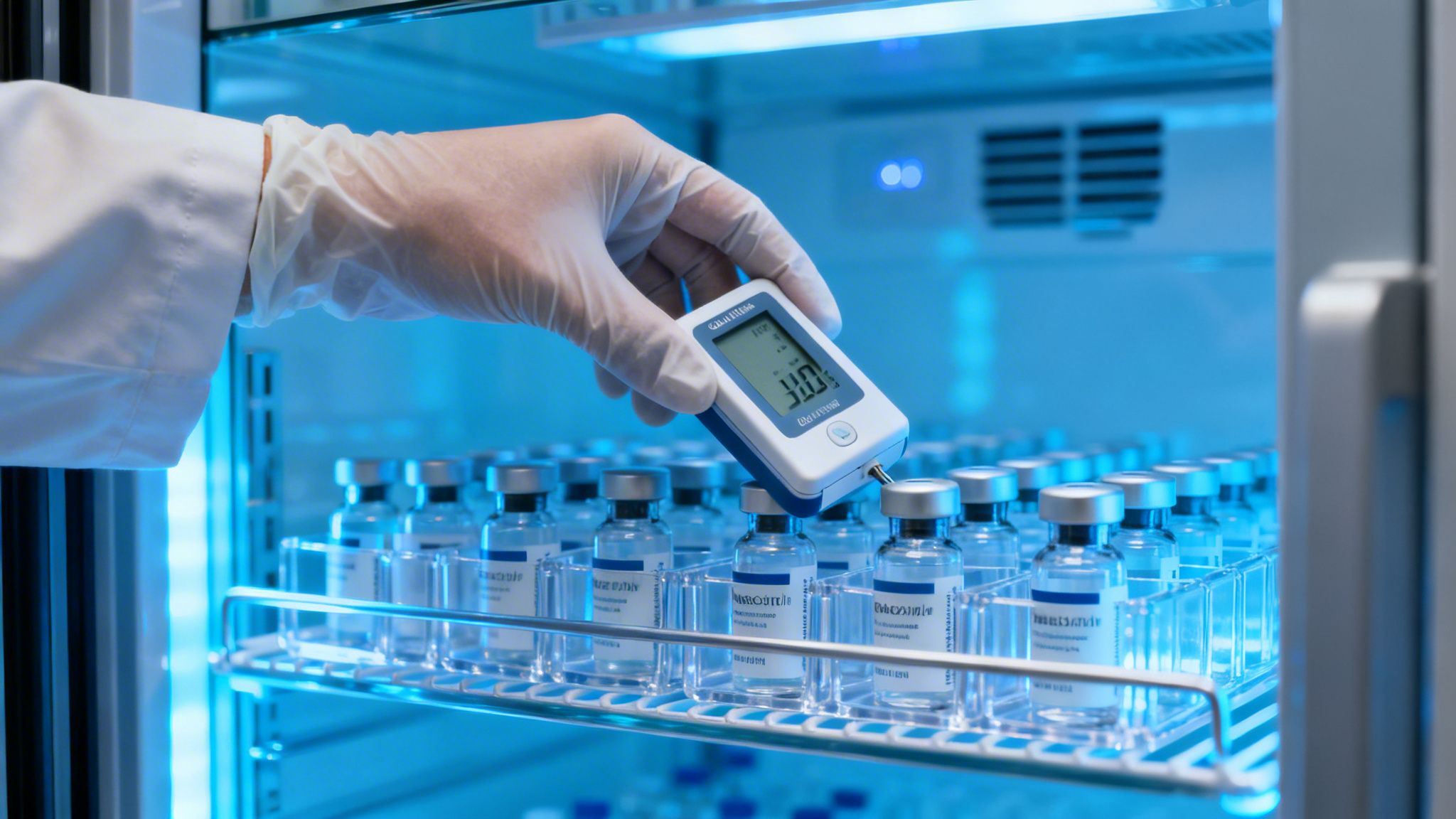
Proper vaccine storage and handling isn't just about following a checklist—it's the backbone of public health. This entire process, known as the cold chain, is a temperature-controlled journey that starts at the manufacturing plant and doesn't end until a vaccine is administered. A single break anywhere along that chain can render life-saving vaccines completely useless.
The Unbreakable Chain Protecting Vaccine Potency

The trip a vaccine takes from a lab to a patient's arm is a delicate, high-stakes relay race. Think of the "cold chain" less like a series of refrigerators and more like a solemn promise to protect the fragile biology inside every single vial.
One mistake is all it takes. A refrigerator door left ajar overnight, a brief power outage in a busy pharmacy—these seemingly small slip-ups can destroy an entire batch of immunizations. This is exactly why strict adherence to vaccine storage guidelines is non-negotiable for anyone handling these products.
The consequences of failure are staggering. Globally, it's estimated that 50 percent of vaccines are thrown away each year, often because they were exposed to the wrong temperatures. That waste translates into billions of dollars lost and, more importantly, countless missed opportunities to prevent disease.
Most refrigerated vaccines, like those for Influenza A virus (H1N1) or Human Rotavirus, must be kept between 2°C and 8°C (36°F to 46°F). It’s a narrow window that demands constant vigilance.
To put these critical temperature requirements into perspective, here is a quick reference table summarizing the CDC and WHO recommendations for common vaccine types.
Essential Vaccine Temperature Ranges
| Vaccine Category | Required Refrigerator Temperature | Required Freezer Temperature |
|---|---|---|
| Live Attenuated (e.g., MMR, Varicella) | 2°C to 8°C (36°F to 46°F) | -50°C to -15°C (-58°F to 5°F) for Varicella-containing vaccines |
| Inactivated/Recombinant (e.g., Tdap, HPV) | 2°C to 8°C (36°F to 46°F) | DO NOT FREEZE – Freezing destroys potency |
| mRNA (e.g., Pfizer, Moderna COVID-19) | Varies by formulation; can be refrigerated for short periods. | Ultra-Low: -90°C to -60°C (-130°F to -76°F). Standard Freezer: -25°C to -15°C (-13°F to 5°F) |
| Adenovirus Vector (e.g., J&J COVID-19) | 2°C to 8°C (36°F to 46°F) | DO NOT FREEZE |
As you can see, knowing the specific needs of each vaccine is the first step toward preventing a costly temperature excursion.
Why Temperature Protocols Vary
Not all vaccines are built the same, so their storage needs differ. Live attenuated or inactivated vaccines, like those for Hepatitis B Virus (HBV), are generally stable in a standard refrigerator. In fact, freezing them can permanently destroy their effectiveness.
On the other hand, the newer mRNA vaccines, developed to fight viruses like SARS-Related Coronavirus 2 (SARS-CoV-2), brought a new level of complexity. These vaccines are incredibly fragile. The delicate messenger RNA inside them will degrade unless kept at ultra-cold temperatures, sometimes as low as -70°C. This created a huge demand for specialized freezers and thermal shippers, completely changing the game for large-scale immunization campaigns.
The "unbreakable chain" of vaccine potency depends on a stable environment. This even includes things like enhancing commercial door energy efficiency in your facility. Even minor drafts can affect a room's ambient temperature, making your equipment work harder and increasing the risk of fluctuations.
Real-World Points of Failure
Beyond the equipment, people are often the weakest link in the cold chain. These are the kinds of all-too-common scenarios that keep public health officials up at night:
- The Mobile Clinic: An outreach team heads to a remote town for a flu shot drive. They use a portable cooler, but it wasn't conditioned properly. The internal temperature dips below freezing, and the entire day's supply of vaccines is ruined.
- The Busy Pharmacy: A new technician is unloading a vaccine shipment during a morning rush. They get distracted and leave the box on the counter for "just a minute"—which turns into an hour. That brief exposure to room temperature is more than enough to compromise potency.
- The Overlooked Maintenance: A clinic’s refrigerator has a tiny, worn-out door seal. Nobody notices. The compressor starts working overtime to keep things cool, leading to inconsistent temperatures and, eventually, a total equipment failure.
Each of these examples shows how small oversights can lead to huge problems. Mastering vaccine storage isn't just about following rules; it's about safeguarding public health, one carefully handled vial at a time.
Setting Up Your Vaccine Storage Environment

The quality of your vaccine storage unit is the absolute bedrock of your immunization program. Think of it less like a cold box and more like a lifeline for your entire vaccine supply. Getting the setup right from day one is non-negotiable for maintaining the cold chain and making sure every dose counts.
The first big decision is the hardware. It's tempting to grab a standard household or dorm-style fridge, but that’s a rookie mistake. Those units are built for keeping soda cold, not for the pinpoint temperature control vaccines demand. Their temperatures can swing wildly, and those built-in freezer compartments are notorious for accidentally freezing—and ruining—refrigerated vaccines.
This is where purpose-built pharmaceutical-grade refrigerators and freezers come in. They are the gold standard for a reason. These units are engineered with powerful fans and microprocessor controls to keep the internal environment uniform and stable, which is the cornerstone of any solid vaccine storage and handling plan.
Configuring Your Storage Unit for Maximum Stability
Once you've got the right unit, where you put it and how you organize it are just as critical. The unit needs to be in a well-ventilated room, far from direct sunlight or heating vents. Make sure there are at least 2-3 inches of clearance around the back and sides so the air can circulate properly.
Inside, a little strategic organization goes a long way toward keeping temperatures stable.
- Add Thermal Mass with Water Bottles: Don't leave shelves and door racks empty. Fill them with water bottles. This creates thermal mass, which acts as a buffer to stabilize the temperature when the door opens and can be a lifesaver during a brief power outage.
- Central Storage is Key: Always keep vaccines in their original boxes and place them in the middle of the unit. You want to stay away from the walls, floor, and cooling vents—those are the spots where temperatures can get too cold and fluctuate.
- The Door is a No-Go Zone: Never, ever store vaccines in the refrigerator door. It's the area that experiences the wildest temperature swings every single time it's opened. Don't put your most valuable assets at risk.
A simple but often-overlooked step is to start with a clean slate. Before you load a single vial, make sure all internal surfaces have been wiped down with a suitable disinfecting wipe. A clean storage space is just good practice and helps prevent any potential contamination from viruses that can persist on surfaces, such as Norovirus or Rhinovirus.
Implementing Continuous Temperature Monitoring
How do you know if your storage unit is truly holding steady? You monitor it. And while manual checks are still required, they only give you a snapshot. For a complete picture, a Digital Data Logger (DDL) is an absolute must-have.
A DDL is a small electronic device that works 24/7, taking temperature readings at set intervals. It creates a detailed log that can show you subtle temperature drifts or excursions you'd otherwise miss completely. It’s your early warning system, helping you spot an equipment issue before it turns into a catastrophic loss of inventory.
When you set up your DDL, put the probe right in the middle of the unit with the vaccines—that’s how you’ll get the most accurate read on their environment. The display should be mounted on the outside of the door so you can check it at a glance without having to open it.
A Real-World Setup Scenario
Let’s say you’re training a new team member, Alex, on setting up a new pharmaceutical fridge. Here’s how you’d walk them through it to avoid common pitfalls:
- Placement: Alex shoves the unit right up against the wall. You step in and explain the need for that 2-3 inch gap, showing how it lets the compressor's heat escape and prevents the unit from overworking.
- Loading: Next, Alex starts unpacking vials and puts them in the door for easy access. You correct this immediately, explaining the "no-fly zone" rule for doors and showing how to use water bottles to fill those spaces instead. This is also a great time to discuss why different vaccines have different needs, which you can learn more about in our guide on what inactivated vaccines are.
- DDL Setup: Alex places the DDL’s probe right next to the cooling vent. You move it to a central tray, explaining that this spot gives a much better reading of the actual temperature the vaccines are experiencing.
By walking through these hands-on steps, you're not just setting up a piece of equipment; you're building a reliable system and empowering your team to be guardians of the cold chain. This meticulous approach turns your guidelines from words on a page into a practiced reality that protects every single dose.
The New Frontier: Ultra-Cold Storage for mRNA Vaccines
The arrival of mRNA vaccines, especially those targeting viruses like SARS-CoV-2, wasn't just a scientific breakthrough—it completely upended the rulebook for vaccine storage. Their incredible effectiveness came with a new, complex logistical challenge. Because messenger RNA is so delicate, it needs to be kept at frigid temperatures to stop it from breaking down, forcing healthcare systems everywhere to adapt on the fly.
Unlike most vaccines that are perfectly happy in a standard refrigerator, many mRNA formulas require special ultra-low temperature (ULT) freezers. We're not talking about your kitchen freezer; these are sophisticated units that can hold temperatures as cold as an Antarctic winter. This single requirement forced a massive overhaul of the cold chain, demanding new equipment, new protocols, and new training for every person handling these vials. If you want to dive deeper into how these incredible immunizations work, check out our guide on how vaccines work against viruses.
Why So Cold? The Science Behind It
So, what’s the deal with the extreme temperatures? It all comes down to the active ingredient: the messenger RNA (mRNA) itself. Think of it as a fragile blueprint that tells our cells how to build a defense against a virus. But on its own, mRNA is notoriously unstable and can be destroyed by common enzymes in a heartbeat.
To survive the journey into our bodies, the mRNA is wrapped in a protective bubble made of fat particles called lipid nanoparticles. This entire package is extremely sensitive to heat. Storing it at ultra-low temperatures essentially freezes everything in place, locking the molecules down so they can't degrade. This ensures the vaccine is just as potent when it's administered as it was when it left the lab.
A Real-World Crash Course: The COVID-19 Rollout
The global rollout of COVID-19 vaccines was a masterclass in adapting to these incredibly strict storage rules. The Pfizer-BioNTech vaccine, for example, needed to be kept at an astonishing –70°C (±10°C), while Moderna's required a more manageable but still very cold –20°C for long-term storage.
This logistical puzzle sent facilities scrambling to get their hands on ULT freezers and write meticulous procedures for every single step.
To solve this, Pfizer developed special thermal shipping containers packed with dry ice. They also built in some much-needed flexibility, eventually allowing unopened vials to be stored in a regular refrigerator (2°–8°C) for up to 31 days. You can get the full story on these innovative solutions in the research on mRNA vaccine handling.
From the moment the doses arrived, the clock was ticking.
- Handling Shippers: Vaccines would show up in those high-tech coolers. Staff had to be trained to safely handle the dry ice and keep a close eye on the shipper's internal temperature.
- Thawing Just Right: You couldn't just leave vials on the counter. Thawing had to be a controlled process, either slowly in a fridge over a few hours or quickly at room temperature for a very specific, limited time.
- Timing is Everything: Once a vial was thawed or punctured, its shelf life dropped dramatically—sometimes to just a few hours. Meticulous tracking was non-negotiable.
Finding a Balance Between Rules and Reality
While the ultra-cold requirements seemed impossibly strict at first, both manufacturers and health agencies worked hard to build in practical workarounds.
The ability to move thawed Pfizer vials into a standard refrigerator for a month was a true game-changer. It meant smaller clinics and pharmacies that couldn't afford a pricey ULT freezer could still be part of the vaccination effort, which massively expanded access for everyone.
This highlights a key principle of modern vaccine management: the guidelines have to be scientifically sound but also practical enough to work in the real world. Precise temperature monitoring is the backbone of it all, especially with these sensitive mRNA products. Understanding the different temperature sensor types is critical for anyone tasked with protecting these life-saving doses. This built-in adaptability is what ensures even the most advanced vaccines can make it to every community, potent and ready to go.
Daily Protocols for Handling and Administration
Excellent vaccine storage is only half the battle. The cold chain's integrity has to extend all the way to the patient's arm, and that's where your daily workflow comes in. These day-to-day routines—from unpacking a new shipment to drawing a single dose—are where meticulous guidelines become practiced reality.
Think of these protocols as your front line of defense against vaccine waste and compromised immunity.
When a shipment lands on your dock, the clock starts immediately. Every box needs to be unpacked and stored right away, and you should always prioritize refrigerated vaccines over frozen ones. Before anything goes into a unit, find the temperature monitoring device packed with the shipment and check its readings. Document everything to confirm the cold chain held up perfectly during transit.
This is especially critical for ultra-cold vaccines, where every stage has its own strict temperature requirement.

As you can see, the process requires distinct, temperature-controlled environments at each step. There's simply no room for deviation.
Moving Vaccines Off-Site
Running an off-site clinic or just moving stock between facilities? This is one of the most vulnerable points in the cold chain. You absolutely must use a qualified container and pack-out system engineered to hold stable temperatures for the entire trip. This is no time to guess with a standard picnic cooler.
The process involves a few key steps:
- Conditioning Coolant Packs: You need to prepare your frozen or refrigerated coolant packs by letting them sit at room temperature until they start to "sweat." This crucial step prevents them from being too cold, which could accidentally freeze your vaccines.
- Creating a Buffer Zone: Always place a layer of bubble wrap or corrugated cardboard between the coolant packs and the vaccine boxes. This insulation is a simple but critical barrier.
- Including a DDL: A calibrated Digital Data Logger (DDL) must be packed right alongside the vaccines. It's the only way you'll know for sure that temperatures stayed within range during the entire journey.
The checklist below breaks down the essentials for both short and long-duration transport.
Vaccine Transport Checklist
| Action Item | Short-Duration Transport | Off-Site Clinic Transport |
|---|---|---|
| Container | Hard-sided cooler or validated container | Qualified container and pack-out system |
| Coolant Packs | Conditioned refrigerated/frozen packs | Conditioned packs, sufficient for entire trip |
| Insulation | Layer of bubble wrap/cardboard | Corrugated cardboard or other validated barrier |
| Temperature Monitor | Calibrated DDL placed with vaccines | Calibrated DDL placed with vaccines |
| Vaccine Placement | Centered, away from direct contact | Centered, fully insulated from coolant packs |
| Documentation | Record time out, time in, and temperatures | Maintain detailed transport log per CDC guidelines |
| Emergency Plan | Plan for delays or unexpected returns | Full plan for power loss or container failure |
Whether you're going down the hall or across town, following these steps ensures the cold chain remains unbroken.
The Nuances of Multi-Dose Vials
Multi-dose vials are incredibly efficient, but they demand strict management to prevent contamination and waste. The moment a vial is punctured for the first time, its shelf life changes completely.
You must immediately label it with the Beyond-Use Date (BUD). This is typically 28 days, unless the manufacturer's instructions say otherwise.
Never combine leftover vaccine from multiple vials to create a full dose. This practice, known as "pooling," dramatically increases the risk of contamination and can lead to incorrect dosing. Every single dose must be drawn from a single, uncompromised vial.
The BUD is a hard stop. Any vaccine left in the vial after that date must be discarded, even if the vial's original expiration date is months away. Keeping a clear, simple log of when each vial was opened is the key to minimizing waste and protecting patients.
Keeping Your Prep Space Hygienic
The final step—preparing the dose in a clean, designated area—is where vaccine handling and infection control truly intersect. The surfaces where you draw up vaccines can easily become contaminated, posing a risk to both the vaccine's integrity and the patient's health.
Just think about the viruses these vaccines prevent, like Influenza A Virus (H1N1) or Human Rotavirus, which are known to persist on surfaces. A contaminated countertop could easily lead to cross-contamination.
Your daily routine must include these non-negotiables:
- A Designated "Clean Space": Set aside an area used exclusively for vaccine preparation, far from any potentially contaminated items like lab specimens or used supplies.
- Routine Disinfection: Wipe down the preparation surface between patients or after any spill. Using an effective disinfecting wipe ensures the area stays free of pathogens.
- Proper Hand Hygiene: This one is obvious but critical. Always practice proper hand hygiene before handling any vial or syringe.
This focus on surface hygiene bridges the gap between proper vaccine storage and broader infection control, ensuring the last step in the immunization process is as safe as all the others.
Emergency Preparedness and Incident Response
Even with the best protocols in place, things can—and will—go wrong. A nasty storm could take out the power grid, or a brand-new freezer might decide to fail over a long weekend. This is precisely why a solid emergency response plan isn't just a nice-to-have; it's what separates a controlled, professional reaction from absolute chaos.
Your emergency plan is arguably the most critical piece of your entire vaccine management system. It’s not just about what to do when disaster strikes, but how you prepare for it before it happens. Think backup generators and solid agreements with alternate storage facilities.
When a temperature excursion happens, the first few minutes are everything. Panic is your enemy. A calm, methodical approach is your best friend. Your immediate goal is to stop any further damage and meticulously gather the data you'll need to figure out if the vaccines are still viable.
Responding to a Temperature Excursion
Picture this: you walk in on a Monday morning and the refrigerator’s Digital Data Logger (DDL) is flashing a high-temp alert. The unit feels warm to the touch. Don't panic. Here’s how you handle it.
- Isolate and Label: First things first, do not throw anything away. Immediately move the affected vaccines into a separate container inside a working refrigerator or freezer. Then, slap a big, clear label on it: "DO NOT USE — AWAITING GUIDANCE." This simple step is crucial to prevent anyone from accidentally administering compromised doses.
- Document Everything: This is where the real work begins, and you can't cut corners. Grab your logbook and record the current temperature inside the failed unit. Then, get the minimum and maximum temperatures reached during the excursion from your DDL. Don't forget to note the exact date, time, and your name.
- Contact Key Personnel: With the vaccines secured and initial data recorded, it's time to escalate. Notify your designated vaccine coordinator immediately. They will take the lead on contacting the vaccine manufacturer and your local or state immunization program for the final word.
This detailed documentation is non-negotiable. Without it, manufacturers have no way to determine if the vaccine’s potency was compromised. You'll likely be forced to discard the entire, very expensive, stock.
You can't tell if a vaccine has lost its potency just by looking at it. Always treat a temperature excursion as a serious event until you get the official all-clear from the manufacturer or public health authorities. Never, ever guess.
Developing a Robust Emergency Plan
A strong response is always built on a foundation of solid preparation. We've seen how strategic investments in the cold chain make a real difference. For example, a WHO-backed effort in Azerbaijan to upgrade its infrastructure with 476 vaccine-specific refrigerators and 25 freezers between 2021 and 2024 achieved 100% reliable storage capacity at the subnational level. This project is a perfect case study, proving that success comes from having the right equipment, well-trained staff, and meticulous planning. You can read more about these insights on boosting vaccine storage and management.
Your emergency plan needs to be a physical, written document that everyone can access and has been trained on. Make sure it includes:
- Up-to-date contact info for key staff, equipment repair services, and your backup storage locations.
- Clear protocols for transporting vaccines to a backup site, including having pre-conditioned transport coolers ready to go at a moment's notice.
- Step-by-step instructions for documenting a temperature excursion, just like we walked through above.
Proper Disposal of Compromised Vaccines
So, what happens if the manufacturer or health department confirms your fears? The vaccines are no longer viable and must be destroyed. You can't just toss them in the regular trash with the coffee grounds.
Compromised vaccines are considered medical waste. That means they require specific disposal procedures to keep you compliant and protect the environment. You'll need to work with a licensed medical waste management company to ensure they are handled correctly. Part of this process also involves thoroughly cleaning and disinfecting your workspace, especially after handling compromised materials, with appropriate disinfecting wipes. To learn more, our guide on public health emergency preparedness covers this in greater detail. Taking this final step closes the loop on the incident and ensures safety from start to finish.
Common Questions on Vaccine Storage and Handling
Even with perfect protocols on paper, real-world questions pop up all the time when you're managing vaccines day in and day out. Here are some clear, no-nonsense answers to the queries I hear most often, reinforcing the best practices we've covered.
What Is the Most Common Mistake in Vaccine Storage?
Hands down, the single most frequent—and costly—mistake is inconsistent temperature monitoring. It’s a quiet failure that can put your entire vaccine inventory at risk, and it usually happens in a couple of sneaky ways.
Many clinics still get by with a basic thermometer, maybe checking temps once when they open up. That gives you a single snapshot in time, completely missing dangerous temperature swings that can happen overnight or during a long weekend. Your best defense, and the modern standard of care, is a Digital Data Logger (DDL) that keeps a vigilant, 24/7 watch on your inventory.
Another classic error is putting the monitoring probe in the wrong spot, like on the door shelf or right next to a cooling vent. For a true reading of what your vaccines are experiencing, the probe needs to be right in the middle of the unit, nestled in with the vials themselves.
Can I Use a Dormitory-Style Refrigerator for Vaccines?
Absolutely not. You should never, ever use a dorm-style or bar-style combination refrigerator for storing vaccines. These units are built for convenience, not for the rock-solid temperature stability that vaccines demand.
Their temperatures can fluctuate wildly. Worse, their built-in freezer compartments create an extreme risk of accidentally freezing refrigerated vaccines. Once a liquid vaccine like one for Hepatitis B Virus (HBV) freezes, its potency is gone forever and it must be thrown out. Always invest in a purpose-built pharmaceutical unit or, at the very least, a carefully vetted standalone household model.
The cost of a proper storage unit is a tiny investment compared to the potential loss of thousands of dollars in ruined vaccines—not to mention the erosion of public trust that comes with it.
What Should I Do If a Vaccine Is Left at Room Temperature?
First thing's first: stay calm and be methodical. Whatever you do, don't just discard the vaccine.
- Isolate and Label: Immediately move the vaccine away from your other stock. Slap a clear label on it that says something like, "DO NOT USE – POSSIBLE TEMPERATURE EXCURSION."
- Document Everything: Grab a log sheet and note the exact time the vaccine was found, your best estimate of how long it was out, and the room's ambient temperature.
- Contact the Experts: With your notes in hand, call your state or local immunization program or the vaccine's manufacturer directly. They are the only ones who can give you the green light.
Some vaccines have a bit of a grace period at room temperature, but you must get official guidance before even thinking about using it. Never, ever guess.
How Often Should I Record Vaccine Temperatures?
According to CDC guidelines, you need to manually check and record the minimum and maximum temperatures from your DDL at the start of every workday. This creates a documented, human-verified paper trail.
But your real safety net is the continuous data from the DDL itself. I always tell my teams to make it a habit to review the full DDL data logs at least once a week. This is how you spot subtle temperature trends or slight shifts that could signal a failing compressor or a bad door seal, giving you a chance to fix the problem before it becomes a full-blown emergency.
Leave a Reply