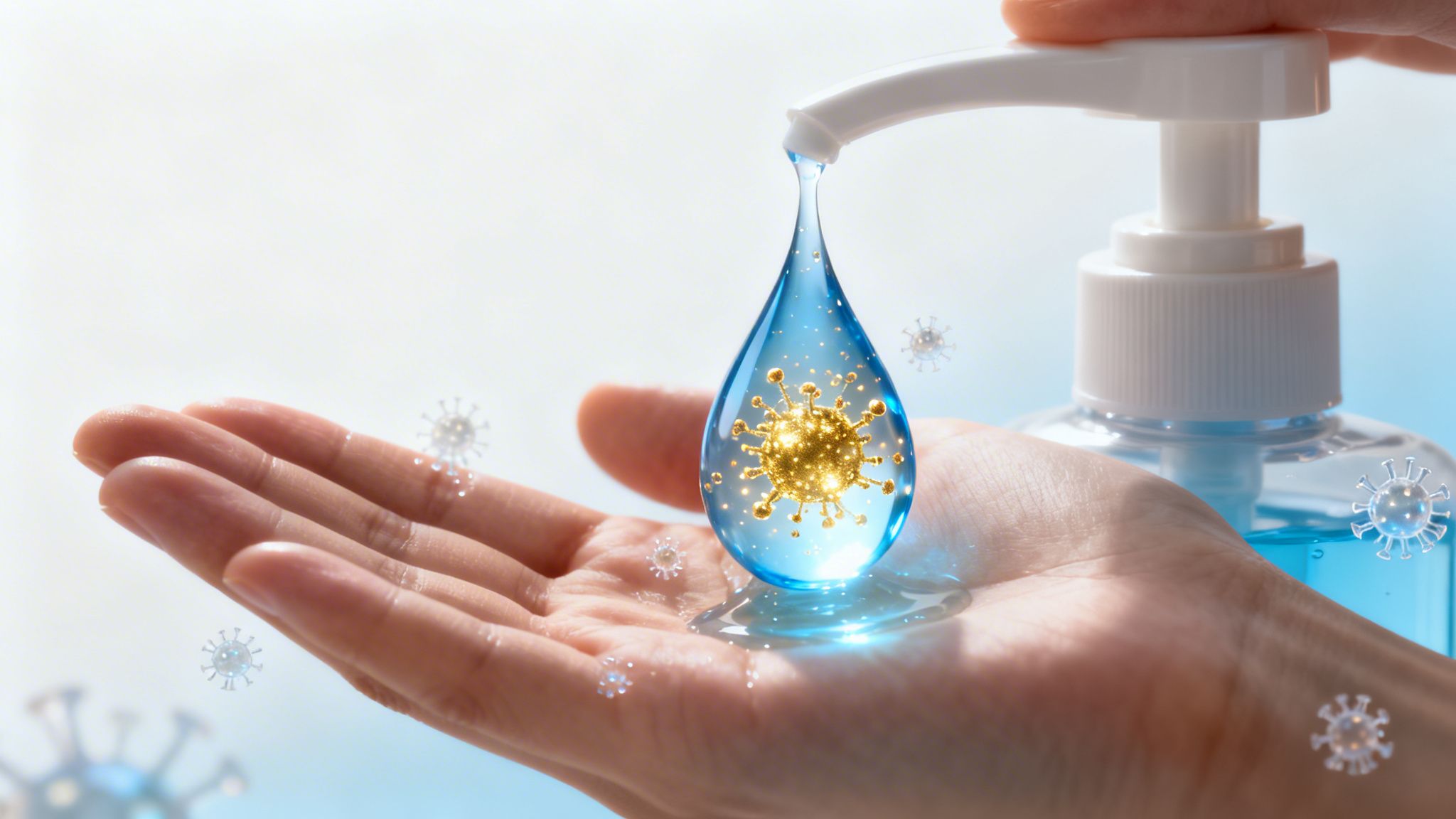
When you reach for hand sanitizer, that sharp, familiar scent of alcohol is what most of us expect. But there's another powerful, alcohol-free player in the world of hand hygiene: benzalkonium chloride (BAC).
This antimicrobial compound is the active ingredient in many modern sanitizers, and it works by literally breaking down the protective outer layer of microbes. It's a different approach, but a highly effective one, particularly against a wide range of viruses from Influenza A to SARS-CoV-2.
The Rise of Alcohol-Free Hand Sanitizers

While alcohol-based sanitizers are everywhere, the growing presence of benzalkonium chloride in hand sanitizer signals a major shift toward options that are both effective and non-drying.
Also known as BZK or BKC, this compound is far from new. It's been a trusted antimicrobial in the healthcare world for over 60 years, used in everything from high-level surface cleaners to preservatives in medications.
Its recent surge onto store shelves is a direct answer to a common problem: dry, cracked, and irritated skin from constant hand washing and sanitizing. This is where BAC-based formulas really shine.
What’s Driving the Switch?
For many people, the move to alcohol-free sanitizers is all about the practical, day-to-day benefits. If you sanitize your hands frequently—think teachers, healthcare workers, or parents—the advantages become obvious pretty quickly.
- Gentle on Skin: These formulas are much less likely to cause the dryness and irritation that alcohol is known for, making them a great fit for people with sensitive skin or conditions like eczema.
- Persistent Activity: Alcohol evaporates in seconds, and its germ-killing action stops. BAC, on the other hand, can remain on the skin, offering a longer-lasting protective effect after you've applied it.
- Non-Flammable: With no alcohol, these sanitizers are a safer choice for places like schools, long-term care facilities, and correctional institutions where flammability is a serious concern.
The real-world impact is pretty compelling. Some studies in school settings found that using non-alcohol, leave-on hand sanitizers helped reduce illness-related absenteeism by 30-40% compared to just hand washing.
So, how does BAC stack up against the old standby, alcohol? Here's a quick side-by-side look.
Quick Comparison Benzalkonium Chloride vs Alcohol Sanitizers
This table breaks down the key features of BAC and alcohol-based hand sanitizers to help you see the differences at a glance and choose the right one for your needs.
| Feature | Benzalkonium Chloride (BAC) | Alcohol (Ethanol/Isopropanol) |
|---|---|---|
| Mechanism of Action | Disrupts the outer membrane of microbes, causing them to leak and die. | Denatures proteins in microbes, essentially scrambling their internal structure. |
| Gentleness on Skin | Generally non-drying and non-irritating. Often formulated with moisturizers. | Can be very drying and irritating with frequent use, stripping natural oils. |
| Persistence | Leaves a residual protective layer on the skin, offering longer-lasting effects. | Evaporates very quickly, so its antimicrobial action is short-lived. |
| Flammability | Non-flammable and water-based, making it safer for storage and use in various settings. | Highly flammable, requiring special storage and handling considerations. |
| Effectiveness | Effective against many bacteria and enveloped viruses (like SARS-CoV-2, H1N1, and HSV-1). | Broad-spectrum effectiveness against bacteria, fungi, and many viruses. |
| Common Concentration | Typically 0.1% to 0.13%. | Recommended at 60-95% concentration for maximum effectiveness. |
Ultimately, both types of sanitizers have their place. But for daily, repeated use, the skin-friendly and persistent nature of BAC is a huge plus.
This guide will dive deeper into the science behind benzalkonium chloride, its performance against viruses like SARS-CoV-2 and Human Coronavirus, and how it really compares to traditional alcohol sanitizers. As you keep reading, you'll get a clearer understanding of why these formulas are more than just a trend.
If you're curious for more background, you can explore our detailed article on how alcohol-free hand sanitizers work. Knowing the details helps you make smarter choices to protect your health and the health of those around you.
How Benzalkonium Chloride Actually Fights Germs
To really get how benzalkonium chloride works, it's helpful to picture it as a tiny, targeted magnetic attack. Unlike alcohol, which basically scrambles a germ's internal machinery, BAC takes a more direct, physical approach. It’s a fascinatingly effective process that happens at a microscopic level.
The whole thing comes down to simple chemistry. Every single BAC molecule has a positive electrical charge. On the flip side, the outer layer of germs—like bacteria and many viruses—carries a negative charge. This difference creates an irresistible attraction, pulling the BAC molecules straight to the germ's surface.
The Magnetic Takedown of Germs
Once it’s attached, the BAC molecule doesn't just hang around. It starts acting like a tiny drill. The molecule’s long tail forces its way right into the germ's protective membrane, destabilizing it, creating weak spots, and eventually punching holes all the way through.
Think of it like poking a hole in a water balloon. Once that outer layer is compromised, all the germ’s insides start leaking out. This loss of essential cellular material is catastrophic for the microbe, leading to its quick inactivation and death.
This is exactly why BAC is considered a germicidal agent—it actively kills germs instead of just slowing them down. You can learn more about this in our guide on what it means to be germicidal.
A Persistent Protective Shield
One of the biggest upsides to using benzalkonium chloride in a hand sanitizer is its staying power. Alcohol-based sanitizers stop working the second they evaporate, which is usually just a few seconds. BAC is a different story.
After the sanitizer dries on your skin, a thin, imperceptible layer of BAC molecules stays behind. This residual layer creates a persistent barrier that continues to fight germs for a while, offering an extended window of protection that alcohol just can't match.
This feature is incredibly valuable in places where hands are constantly being re-exposed to germs. For example:
- In Schools: Kids are always touching desks, doorknobs, and shared supplies, so longer-lasting protection is a huge benefit.
- In Healthcare: Medical staff moving between patients and equipment need that persistent action to help cut down on cross-contamination risks.
- During Travel: A BAC sanitizer can provide a lasting shield against germs you might pick up from armrests and tray tables on a plane or train.
The power of BAC isn't just theoretical. Its persistent nature and potent mechanism make it a fantastic choice not just for hands, but also for disinfecting high-touch surfaces where germs like Avian Influenza Virus (H5N1) or Human Immunodeficiency Virus (HIV-1) can linger.
Proven Performance in Real-World Settings
The antibacterial strength of BAC is well-documented. Study after study shows it's far more than just a gentle alternative to alcohol; it's a powerful germ-killer in its own right. Its performance against specific bacteria really highlights why it’s trusted in so many products.
For instance, research has shown that BAC-based hand sanitizers can significantly reduce bacterial counts. One evaluation found a BAC-based gel reduced Staphylococcus aureus on the fingertips of healthcare workers more effectively than 70% ethanol in some tests. This antibacterial prowess was backed up in lab assessments where a formulated BAC sanitizer stopped nine out of eleven common bacterial strains, with a minimum killing concentration as low as 2% v/v. You can explore more about the hand sanitizer market by reviewing the latest market research.
Understanding Its Effectiveness Against Viruses
When it comes to hand sanitizers, the big question is always the same: does it actually work against viruses? With benzalkonium chloride, the answer really depends on the type of virus you’re up against. Viruses aren't a single, uniform enemy. They come in different structures, and that structural difference is the key to BAC's effectiveness.
To get a handle on how BAC works, you first need to know about the two major categories of viruses. The first group is enveloped viruses. These guys, which include familiar names like SARS-Related Coronavirus 2 (SARS-CoV-2), Influenza A Virus (H1N1), and Hepatitis C Virus (HCV), are surrounded by a fragile, fatty outer layer called a lipid envelope. This envelope is their Achilles' heel.
The second group is non-enveloped viruses. These are much tougher customers. They lack that delicate fatty layer and are instead protected by a rugged, resilient protein shell called a capsid. Viruses like Norovirus, Human Rotavirus, and Rhinovirus fall into this category, and their tough exterior makes them notoriously difficult to inactivate.
The Attack on Enveloped Viruses
Benzalkonium chloride is exceptionally good at destroying enveloped viruses. Its whole mechanism of action—disrupting membranes—is perfectly suited to attack that soft, fatty lipid envelope these viruses rely on to survive and infect.
Think of the lipid envelope as a soap bubble. It’s essential for protecting the virus, but it's also incredibly fragile. The positively charged BAC molecules are drawn to this negatively charged envelope and literally tear it apart, effectively "popping" the bubble. Once that protective layer is gone, the virus quickly falls apart and can no longer infect our cells.

This is precisely why BAC-based sanitizers are considered a reliable choice against many common viruses, including:
- Coronaviruses (like SARS-CoV-2 and Human Coronavirus)
- Influenza Viruses (like Influenza A strains H1N1, H2N2, and H5N1)
- Herpes Simplex Viruses (HSV-1, HSV-2)
- Hepatitis B and C Viruses (HBV, HCV)
If you want to go deeper on this, check out our guide that answers the question, "Does hand sanitizer kill viruses?" It gives more context on how different sanitizers stack up against various viral threats.
The Challenge of Non-Enveloped Viruses
The story completely changes when BAC comes up against a non-enveloped virus. Without a lipid envelope to attack, BAC has a much harder time breaking through the tough protein capsid that shields viruses like Norovirus (the infamous "stomach flu"), Human Rotavirus, and Rhinovirus.
This tough protein shell is more like a solid wall than a fragile bubble, and BAC's primary weapon just isn't as effective against it. While some studies suggest BAC might have a limited effect on certain small non-enveloped viruses like Feline Calicivirus, it is generally not the first line of defense against them.
For this reason, in situations where non-enveloped viruses like Norovirus or Rhinovirus Type 14 are a major concern—think cruise ships or daycare centers—health authorities often emphasize rigorous hand washing with soap and water as the most effective prevention method.
Understanding this distinction is crucial for making smart hygiene choices. A benzalkonium chloride hand sanitizer is a fantastic tool for everyday use, especially when enveloped viruses are rampant. But it’s not a magic bullet for every single virus out there. This is why a multi-faceted approach, combining hand sanitizing with thorough hand washing and surface disinfection, offers the most complete protection against the widest range of germs.
The Safety and Regulation of Benzalkonium Chloride
Whenever you’re talking about an active ingredient in a hygiene product, safety is the first thing that comes to mind. Benzalkonium chloride has been around for a long time, but understanding its safety profile and how health agencies view it is key to making smart choices about the products you use. This means looking at everything from skin sensitivity to its official status with major regulators.
The concentration of benzalkonium chloride in hand sanitizer is a huge factor. In consumer products, it’s carefully formulated at very low levels—typically between 0.1% and 0.13%. This specific range hits a critical sweet spot: it’s strong enough to knock out germs but gentle enough for repeated use on the skin without causing major irritation.
Navigating Skin Sensitivity
For most people, BAC-based sanitizers are a great fit, especially when compared to the notoriously drying effects of alcohol. Many are even designed for sensitive skin, packed with emollients and moisturizers that leave hands feeling soft, not stripped. This makes them a go-to option in places that demand constant hand hygiene, like schools and healthcare facilities.
That said, like any active ingredient, a small number of people might experience skin sensitivity or a mild allergic reaction called contact dermatitis. This is pretty uncommon at the low concentrations found in hand sanitizers, but it’s something to keep in mind if you have a history of skin allergies.
The Stance of Regulatory Agencies
The rules around benzalkonium chloride in hand sanitizer vary around the world, but the goal is always the same: ensure products are both safe and effective.
In the United States, the Food and Drug Administration (FDA) is the one in charge. While the FDA has long favored alcohol-based sanitizers for clinical settings, it continues to permit BAC in consumer hand sanitizers. The agency is still reviewing additional data on BAC to finalize its official stance for over-the-counter antiseptic rubs.
Meanwhile, the Centers for Disease Control and Prevention (CDC) primarily recommends hand sanitizers with at least 60% alcohol. This is especially true in hospitals where you need the broadest possible germ-killing power. Still, the CDC agrees that alcohol-free sanitizers with BAC can be a solid alternative when alcohol isn’t available or practical.
A Global Perspective on Safety
Regulators in other parts of the world are also keeping a close eye on BAC. For instance, in July 2024, the European Chemicals Agency noted that BKC could cause severe skin burns and eye damage at higher concentrations. This has pushed formulators to stick with lower doses and add skin-conditioning ingredients to personal care products.
But efficacy studies help balance the picture. One trial of a BAC hand gel showed no irritation among 10 participants, and the product was active against 9 out of 11 bacterial strains. It even outperformed ethanol against S. aureus in fingertip tests on 40 workers. You can dig deeper into this by exploring the global market insights for benzalkonium chloride.
This brings up a crucial point: formulation is everything. The safety and feel of a product don't just depend on the active ingredient, but on the entire mix of components working together to protect your health and your skin.
At the end of the day, a long history of safe everyday use, combined with smart formulation, allows benzalkonium chloride to remain a trusted active ingredient. It offers a non-drying, persistent way to keep hands clean—which is vital for maintaining healthy skin as your body's first line of defense.
Why Are People Switching to Alcohol-Free Hand Sanitizer?
If you've browsed the hand sanitizer aisle lately, you’ve probably noticed a lot more alcohol-free options on the shelves. This isn't just a passing trend—it's a direct response from people who want hygiene products that are effective but still practical enough for constant, daily use. And the powerhouse ingredient behind many of these formulas is benzalkonium chloride.
Let's be honest: while alcohol-based sanitizers are great at killing germs, they can be incredibly harsh on your skin. Regular use strips away natural oils, leaving hands dry, cracked, and irritated. This is a huge problem for anyone who needs to clean their hands constantly—think teachers, healthcare workers, and parents chasing around little kids.
A Gentler Approach to Staying Clean
This is where benzalkonium chloride (BAC) formulas really shine. They solve the harshness problem by offering a gentler alternative that still gets the job done. That makes them perfect for any situation where you’re sanitizing your hands dozens of times a day.
Think about these real-world scenarios:
- Schools: Kids are way more likely to use a sanitizer that doesn't sting or have a strong, overwhelming smell. Better compliance means better hygiene all around.
- Offices: When you're constantly sanitizing between meetings or after touching the shared coffee pot, a non-drying formula makes it feel less like a chore.
- Healthcare: For both patients and staff, especially those with sensitive skin, a gentler option helps keep the skin intact. That’s a critical first line of defense against infection.
By tackling the common complaints of dryness and irritation, benzalkonium chloride sanitizers have become the go-to choice for anyone building a sustainable, long-term hygiene routine. It’s proof that you don’t have to sacrifice your skin to kill germs effectively.
The Market Doesn't Lie
This shift isn't just something we're seeing anecdotally; the numbers back it up. The global demand for benzalkonium chloride is booming as more people discover its benefits in disinfectants and personal care products.
The market for benzalkonium chloride has seen some serious growth. It was valued at USD 4.05 billion in 2024 and is expected to rocket to USD 9.62 billion by 2032, growing at a solid 11.4% each year. Disinfectants, the category that includes hand sanitizers, make up the biggest piece of that pie, at 36.7% of all revenue.
With North America leading the charge at a 38.5% market share and the Asia-Pacific region growing the fastest, it's clear this is a global movement. You can dig into more of the market trends and projections yourself.
This data paints a very clear picture: the rise of BAC-based products is a direct reflection of what people want—hygiene solutions that are tough on germs but gentle and practical enough for modern life. As health remains a top priority, these effective alcohol-free options are becoming a fundamental part of our collective hygiene strategy.
Choosing the Right Hygiene Strategy for You

Once you understand the science, you can build a much smarter and more effective hygiene plan. The goal isn’t just to use a product—it's to use the right product at the right time. That means knowing when to reach for a sanitizer and when nothing can replace a good old-fashioned hand wash.
While a benzalkonium chloride in hand sanitizer is a fantastic tool against many germs, especially enveloped viruses like Human Coronavirus and influenza, it’s just one part of your overall strategy. Think of it as your first line of defense when you can't get to a sink.
But let's be clear: the gold standard for hand hygiene has always been thorough hand washing with soap and water for at least 20 seconds. The physical friction of washing is incredibly effective at lifting and removing a huge range of pathogens, including tough non-enveloped viruses like Norovirus that sanitizers often struggle with.
When to Choose Your Sanitizer
So, BAC or alcohol? The best choice really depends on the situation. Each has its own strengths that make it a better fit for certain environments and needs.
- For Frequent, Everyday Use: If you're constantly sanitizing your hands—think teachers, office workers, or parents at home—a benzalkonium chloride hand sanitizer is the clear winner. Its non-drying formula is much gentler on the skin, helping you avoid the cracking and irritation that often comes with repeated alcohol use.
- For Broad-Spectrum Clinical Needs: In high-risk settings like hospitals or clinics, an alcohol-based sanitizer is typically the go-to. Its rapid, aggressive action against an extremely wide array of germs, including some stubborn non-enveloped viruses and fungi, meets the strict demands of clinical hygiene.
For a deeper dive into home health and hygiene, a good medical equipment news and blog can offer some valuable perspectives to help you fine-tune your personal health strategies.
Extending Hygiene Beyond Your Hands
Real protection isn't just about clean hands; it's about a clean environment. Viruses and bacteria don’t just jump from person to person—they hang out on the surfaces we touch all day long. A truly complete hygiene strategy has to bridge the gap between personal care and environmental cleanliness.
Just think about all the high-touch surfaces you encounter daily:
- Doorknobs and light switches
- Kitchen counters and faucets
- Phones, keyboards, and remote controls
- Steering wheels and shopping cart handles
These spots are basically germ reservoirs, making it incredibly easy for pathogens to spread. This is why regularly cleaning these surfaces is just as crucial as washing your hands. Disinfecting wipes become an essential part of your defense here, breaking the chain of transmission right where it often starts.
Ultimately, the most robust protection for you and your family comes from a combination of diligent hand washing, smart sanitizer use, and consistent surface disinfection.
Got Questions About Benzalkonium Chloride?
When you’re trying to pick the right hygiene products for your family or workplace, the details can get a little confusing. We’ve pulled together some clear, straightforward answers to the most common questions we hear about benzalkonium chloride sanitizers. The goal is to give you solid, evidence-based info so you can feel good about the choices you make.
Is Benzalkonium Chloride Safe for My Kids to Use?
Yes, sanitizers made with benzalkonium chloride are generally considered safe for children to use as directed. In fact, their alcohol-free, non-drying formula is a big reason why many schools and parents prefer them. You don't get the harsh vapor that comes with alcohol sanitizers, and they're much less likely to sting or irritate sensitive skin.
Of course, with any sanitizer, it's always a good idea for an adult to be present to make sure kids use the right amount and don't try to taste it. The fact that BAC-based products are non-flammable adds another layer of safety, making them a great fit for classrooms and homes.
Does BAC Contribute to Antibiotic Resistance?
That's a really important question, especially with all the talk about superbugs. While it's true that we need to be careful with any antimicrobial agent, the risk from consumer hand sanitizers is considered very low. The real problem with resistance comes from the misuse of antibiotics, which work in a completely different way than a topical antiseptic like BAC.
Benzalkonium chloride works fast by physically destroying a germ's outer membrane—it's more like a wrecking ball than a targeted weapon. This rapid, disruptive action makes it incredibly difficult for microbes to develop resistance, unlike the very specific mechanisms of most antibiotics. Regulatory bodies are always keeping an eye on this, but the current consensus is that using BAC in hygiene products as intended doesn't pose a significant threat.
Can I Use a BAC Sanitizer on Surfaces?
It’s tempting to grab your hand sanitizer to wipe down your phone or countertop, but you're better off using a dedicated surface cleaner. While the active ingredient, benzalkonium chloride, is a powerful disinfectant used in many surface wipes and sprays, the formula for hand sanitizer is designed specifically for skin.
Hand sanitizers contain extra ingredients like emollients and moisturizers to keep your hands from drying out. These ingredients are great for your skin but can leave a sticky film on hard surfaces like phone screens, doorknobs, or tables, which might just attract more grime.
For disinfecting surfaces, your best bet is to use a product made for the job. Disinfecting wipes or sprays will give you the germ-killing power you need without leaving behind a sticky residue. Think of it as a complete hygiene strategy: the right product for your hands, and the right product for your environment.
Leave a Reply