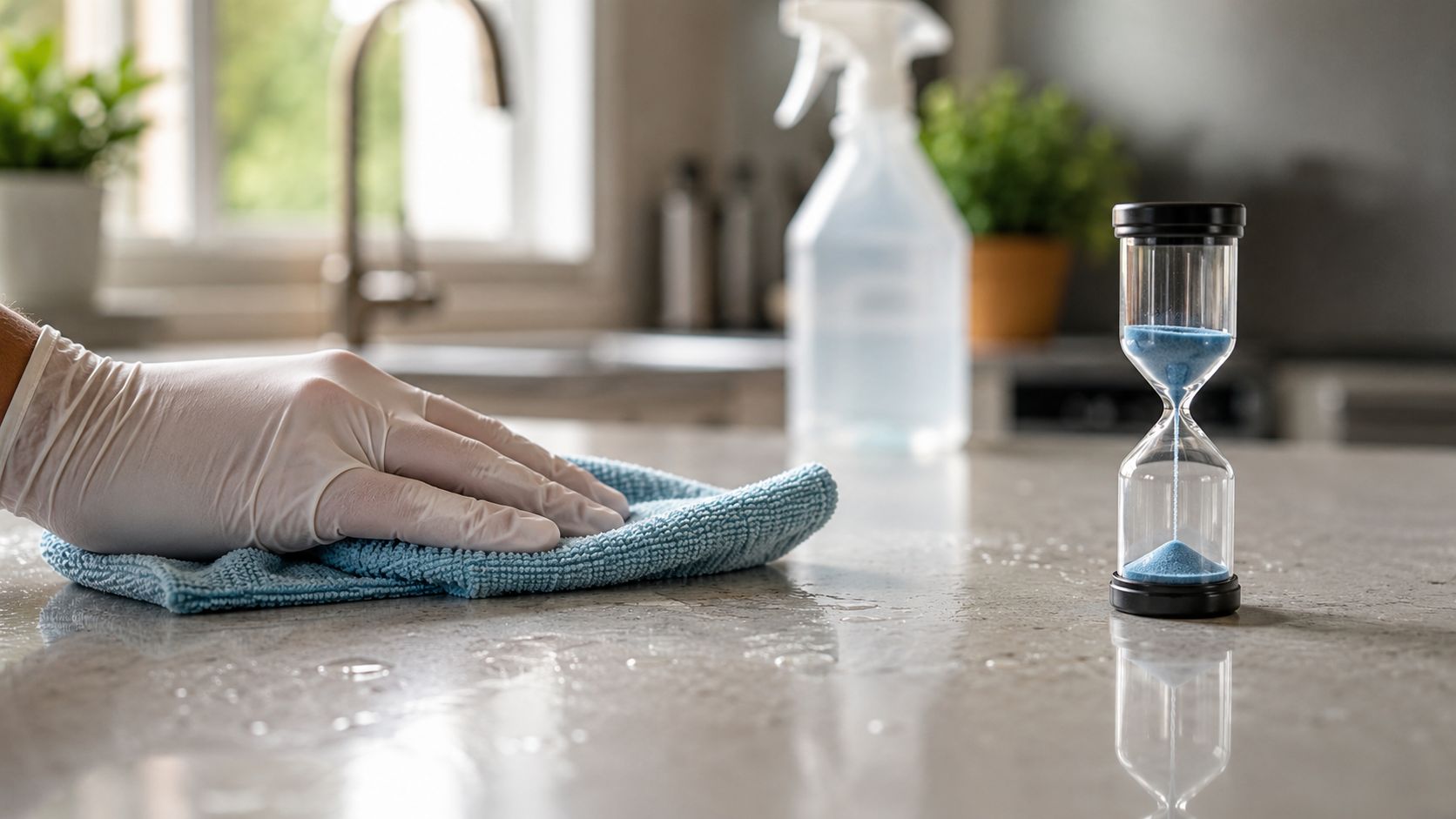
Contact time is the period a disinfectant must remain visibly wet on a surface to work, and the classic EPA benchmark for many hospital disinfectants is 10 minutes. Newer products may claim shorter times, including 30 seconds to 5 minutes, but the label determines which time applies.
You've just prepared raw chicken on the kitchen counter. You spray or wipe the surface, see it look clean, and toss the paper towel almost immediately. That ordinary action contains a hidden question: did the disinfectant remain wet long enough to kill the organisms named on its label, or did the towel remove moisture before the chemistry finished working?
The answer matters for households, childcare spaces, clinics, and any setting where people touch the same surfaces repeatedly. A clean-looking counter can still carry viable organisms if the product dried too soon or if the label's claim didn't cover the pathogen of concern. Readers who are also reviewing drinking-water or household hygiene practices may find the broader Water Filter Advisor help useful for separating different parts of a home prevention routine.
The Moment You Wipe a Counter, Something Is Already Deciding If the Germs Survive
The caregiver wipes the counter in one quick pass. The cloth picks up visible crumbs and grease, the surface looks fresh, and the used towel goes into the bin. During the next few seconds, the remaining film begins evaporating. That film, not the appearance of the counter, determines whether the disinfectant has enough time to act.
At the two-second decision point, many people have already moved on. They may place a cutting board on the counter, prepare another ingredient, or wipe the surface again with a dry towel. Yet the disinfectant may still need continued wet contact with the microorganisms. The product isn't judged by how quickly the surface looks tidy. It's judged by whether its labeled conditions were met.
Clean appearance and disinfection aren't the same thing
Cleaning removes soil and some organisms from a surface. Disinfection uses a chemical product to inactivate specified microorganisms under stated test conditions. Those actions can overlap in a disinfectant cleaner, but they aren't interchangeable.
Older EPA-registered hospital disinfectant labels commonly used 10 minutes as the classic contact-time benchmark, as explained in EPA guidance on selected registered disinfectants. That doesn't mean every modern product requires 10 minutes, nor does it mean a short wipe is always ineffective. It means the user must find the organism-specific claim and keep the surface visibly wet for that listed interval.
The gap between label language and wiping habits creates the practical problem. People often wipe until a surface feels dry, while the label may require a glossy wet film that remains undisturbed. The next step is to translate that technical instruction into something easy to observe.
Contact Time in Plain Language
Contact time, also called dwell time on some newer labels, has two parts. First, the disinfectant must remain visibly wet for the full stated period. Second, the product must achieve the pathogen-reduction level attached to that claim by the end of the period.
Think of marinating food. A marinade needs sustained contact with the food rather than a quick brush followed by immediate removal. Disinfectant chemistry works differently from a marinade, but the practical idea is similar: the active ingredients need ongoing contact with the target organism. If the film dries early, the product no longer has the same exposure conditions used to support its claim.

The wetness test
“Visibly wet” doesn't mean slightly cool, faintly damp, or marked by a few droplets. It means enough liquid remains across the treated area throughout the label's contact time. If a wipe leaves only a thin, quickly disappearing trace, the surface may not satisfy the instruction.
The EPA explains that when a label lists 10 minutes, the surface must stay visibly wet for at least 10 minutes, which is 600 seconds. The agency also notes that studies have shown efficacy against some pathogens with at least 1 minute of contact time, creating a practical split between the historical label standard and faster formulations.
The kill threshold
A product claim also depends on the required level of reduction. The disinfectant isn't merely making organisms uncomfortable for a moment. Its formulation and exposure must meet the performance standard associated with the named microbe and test method.
That's why a label may list different times for different organisms. The shortest time on the package isn't a universal permission to wipe every surface dry immediately. Match the organism, surface, and use claim first, then follow the corresponding wet period.
Why Skipping Contact Time Silently Breaks Disinfection
A disinfectant can begin acting as soon as it reaches a contaminated surface, but early action doesn't prove completed disinfection. At minute three, a surface that remains wet still provides active chemical contact. At minute one, a surface that has already dried has lost the wet exposure required for a longer claim.
The difference is invisible. Both surfaces may look clean, smell similar, and feel dry to the touch. One may have received the labeled treatment, while the other received only a brief exposure followed by evaporation or wiping.
Practical rule: A dry surface tells you that the liquid is gone. It doesn't tell you that the labeled disinfection claim was completed.
What happens after early drying
The exact outcome depends on the formulation, organism, soil, surface, and exposure conditions. A bacterium may be damaged without being fully inactivated, while a virus may remain viable if the product wasn't tested for that target at the shorter exposure. The important point is that appearance cannot verify the result.
That uncertainty matters because hands can move organisms from a contaminated surface to the mouth, nose, eyes, food, or another frequently touched object. A countertop, doorknob, phone, or examination-room surface can function as a fomite when infectious material transfers through contact.
| Condition | Time on Surface | Likely Pathogen Status |
|---|---|---|
| Disinfectant remains visibly wet for the relevant label interval | The complete labeled period | The product has the exposure condition required for its stated claim |
| Disinfectant dries before the relevant label interval ends | Only part of the labeled period | The claim is unverified, and viable organisms may remain |
| Surface is wiped with a dry cloth immediately after application | Brief exposure | Liquid removal may shorten the chemical contact period |
| Visible soil remains under the disinfectant | Variable | Soil can interfere with access to the organisms and may require pre-cleaning |
Homes with immunocompromised residents need especially careful routines because an invisible failure may be followed by repeated hand contact. Contact time doesn't replace hand hygiene, food safety, ventilation, or other infection-control measures. It makes one part of surface hygiene more predictable.
How EPA Labels and EN 14476 Define Contact Time Differently
EPA labeling and the European EN 14476 framework both connect efficacy to controlled test conditions, but they organize information differently. EPA product labels commonly present organism-specific claims and use instructions for registered products. EN 14476 defines formal virucidal performance conditions by product type and testing context.
The classic EPA reference point is 10 minutes for many registered hospital disinfectants, although individual labels may specify shorter periods. Under EN 14476, surface disinfectants intended for patient-care or frequently touched surfaces are tested with a maximum contact time of 5 minutes, while other surfaces may be tested for up to 60 minutes. Passing requires at least a 4-log reduction, meaning a 99.99% reduction in virus titre, as described in the EN 14476 standard information.
Side-by-side interpretation
| Feature | EPA Master Label | EN 14476 |
|---|---|---|
| Main reader-facing document | The registered product label | The test standard and product claim framework |
| Contact-time structure | Often varies by named organism and use claim | Varies by product type, surface category, and virucidal test condition |
| Familiar benchmark | Many hospital disinfectants carry 10 minutes | Patient-care or frequently touched surface testing has a maximum of 5 minutes |
| Other permitted test duration | Depends on the specific registered label | Other surfaces may be tested up to 60 minutes |
| Performance threshold | Tied to the applicable EPA method, organism, and claim | At least 4-log, or 99.99%, virus-titre reduction for the stated pass condition |
| User instruction | Keep the treated surface visibly wet for the label period | Apply the product under the stated standard and claim conditions |
The systems agree on the practical principle: the surface must receive the complete exposure used to support the claim. They diverge in terminology, organism menus, product categories, and regulatory presentation. A healthcare worker in the United States should follow the EPA-registered product label. A European user should interpret the product's EN claim alongside its regional authorization and instructions.
A short time in one framework doesn't automatically translate into a universal rule in the other. The organism, surface, product type, and intended setting still control the answer.
Reading a Real Disinfectant Label for Contact Time
A useful EPA label example shows why contact time is a moving target rather than one fixed number. On hard, nonporous surfaces, one registered product lists 3 minutes for common bacteria and viruses, including SARS-CoV-2, 10 minutes for fungi and Listeria monocytogenes, and 1 minute for some other bacteria. The EPA product label provides the organism-specific instructions.
Another EPA label illustrates the same principle with viruses. It lists 10 minutes for Influenza A2 Virus, Japan 305/57, Norovirus, and Human Rotavirus. In other hard, nonporous surface uses, it allows 30 seconds for sanitizing and 2 minutes for disinfecting, as shown in the EPA influenza and enteric virus label.
Why the times change
Microorganisms differ in structure and resistance. A product that reaches its validated threshold against one organism quickly may need longer exposure against another. The label isn't contradicting itself. It is separating claims that were tested under different conditions.
This is also why broad phrases such as “kills germs fast” aren't enough for a healthcare decision. A user needs to know:
- Target organism: Is the claim for SARS-CoV-2, Norovirus, Influenza A2 Virus, Human Rotavirus, bacteria, fungi, or another named target?
- Surface: Does the instruction cover the hard, nonporous material being treated?
- Use type: Is the listed time for sanitizing, disinfecting, or another claim?
- Wet period: Can the product keep the surface visibly wet for that entire interval?
If the shortest listed time is 30 seconds but the organism of concern appears beside 3 minutes or 10 minutes, use the longer relevant interval. Don't select a time because it is convenient. Select it because it matches the claim.
For readers comparing formulations, a focused guide to disinfectant solution and bleach can provide additional context, but the product label remains the controlling instruction for its registered use.
Real-World Factors That Change Effective Contact Time
A laboratory label gives you a defined starting point. The room adds variables that can shorten the wet period or make it harder for the active ingredient to reach the target.
Visible soil is one of the first obstacles. Blood, food residue, grease, and other organic material can shield microorganisms from the disinfectant. A blood-contaminated surface generally needs appropriate pre-cleaning before disinfection, following the product's safety instructions and the requirements of the setting.
What makes a surface dry sooner
- Material: Stainless steel usually holds a liquid film differently from a porous or textured countertop. Absorbent materials can pull liquid away from the surface.
- Air movement: Ventilation, fans, and drafts accelerate evaporation.
- Temperature: Warmer conditions can shorten the time before a film disappears.
- Humidity: Moisture in the air influences evaporation, although it doesn't guarantee that the surface will stay wet for the full label interval.
- Application volume: A light pass may leave too little liquid to maintain visible wetness.
- Wipe absorbency: A dry or highly absorbent wipe can remove more product instead of depositing enough to sustain contact.

The user-controlled variables
You can pre-clean visible soil, apply enough product, choose a suitable wipe, and reapply if the film starts to dry. The formulator controls the chemistry and the validated claim, but the user controls whether the treated surface receives the stated exposure.
Watch the surface, not the clock alone. A timer can't make a dry countertop satisfy a wet-contact instruction.
A surface that dries early needs more product, another pass, or a different product suited to the workflow. Applying more liquid isn't a reason to ignore material compatibility or ventilation. It means the user must balance label compliance, surface safety, and practical wetness.
Applying Contact Time Correctly in Everyday Settings
A workable routine begins before the disinfectant touches the surface. Remove visible soil, identify the organism or risk relevant to the task, and then choose a registered product whose label covers both the target and the material.
A repeatable workflow
- Pre-clean visible soil. Remove food, dirt, grease, or bodily-fluid residue using the method appropriate for the setting. Disinfection works more reliably when the active ingredient can reach the contaminated surface.
- Read the organism claim. Don't rely on the front-panel phrase “disinfectant.” Find the detailed label and locate the named organism, surface, and use category.
- Apply enough volume. Use a spray, liquid, or pre-saturated wipe that leaves the entire area visibly wet. Small wipes may require overlapping passes or more than one wipe.
- Allow the full dwell. Set a timer for the listed interval, and don't wipe the surface dry while the timer is running.
- Let it air dry when the label permits. If the film disappears before the time ends, reapply enough product to restore visible wetness.
The two common failure points are early wiping and mismatched claims. A household high-touch object, a childcare surface, and a clinical examination room may need different products, methods, and documentation. A product that works for one target at one time isn't automatically suitable for another.
For broader household routines, readers can consult how to disinfect your home, while still checking the label of the specific product in use. The marketing panel helps identify the product. The master label explains what the product has been tested and authorized to claim.
What Contact Time Means for the Future of Disinfecting Wipes
The familiar 10-minute benchmark remains important, but the label also includes pathogen-specific claims from 30 seconds to 5 minutes. EPA labels can assign different times to different organisms, while EN 14476 creates testing conditions that include a maximum of 5 minutes for patient-care or frequently touched surfaces. Faster claims can support busy rooms, but speed doesn't remove the need to match the target organism and keep the surface wet.

Pre-saturated wipes change the practical equation. A wipe controls the amount of liquid delivered, the area covered, and the rate at which the film evaporates. It can't guarantee the required wet period on every surface, but a properly saturated wipe can make application more consistent than an improvised cloth and a small amount of liquid.
Speed still involves trade-offs
A wipe designed around a shorter claim may be useful for a high-touch object that needs rapid attention. A broader claim may require longer wetness and a different workflow. Those choices involve pathogen coverage, material compatibility, user safety, waste, and the ability to keep the area unoccupied during the dwell.
Future product design may put contact time more visibly on packaging and dispensers. Possible directions include wipes developed around rapid Norovirus claims, indicators that signal organic burden, and dispenser-based timers. These are prospective product concepts, not established performance facts.
The practical principle won't change: the wipe is only effective when its label claim, target organism, surface, liquid coverage, and wet exposure align. A guide to disinfectant wipes for surfaces can help readers compare application formats, but the label is still the final authority.
Check the label on the disinfecting wipes or liquid you use today. Find the target organism, confirm the required contact time, apply enough product to keep the surface visibly wet, and set a timer before wiping it away. Choose a product that fits your surface and routine, then make correct dwell time part of every high-touch cleaning task.
Leave a Reply