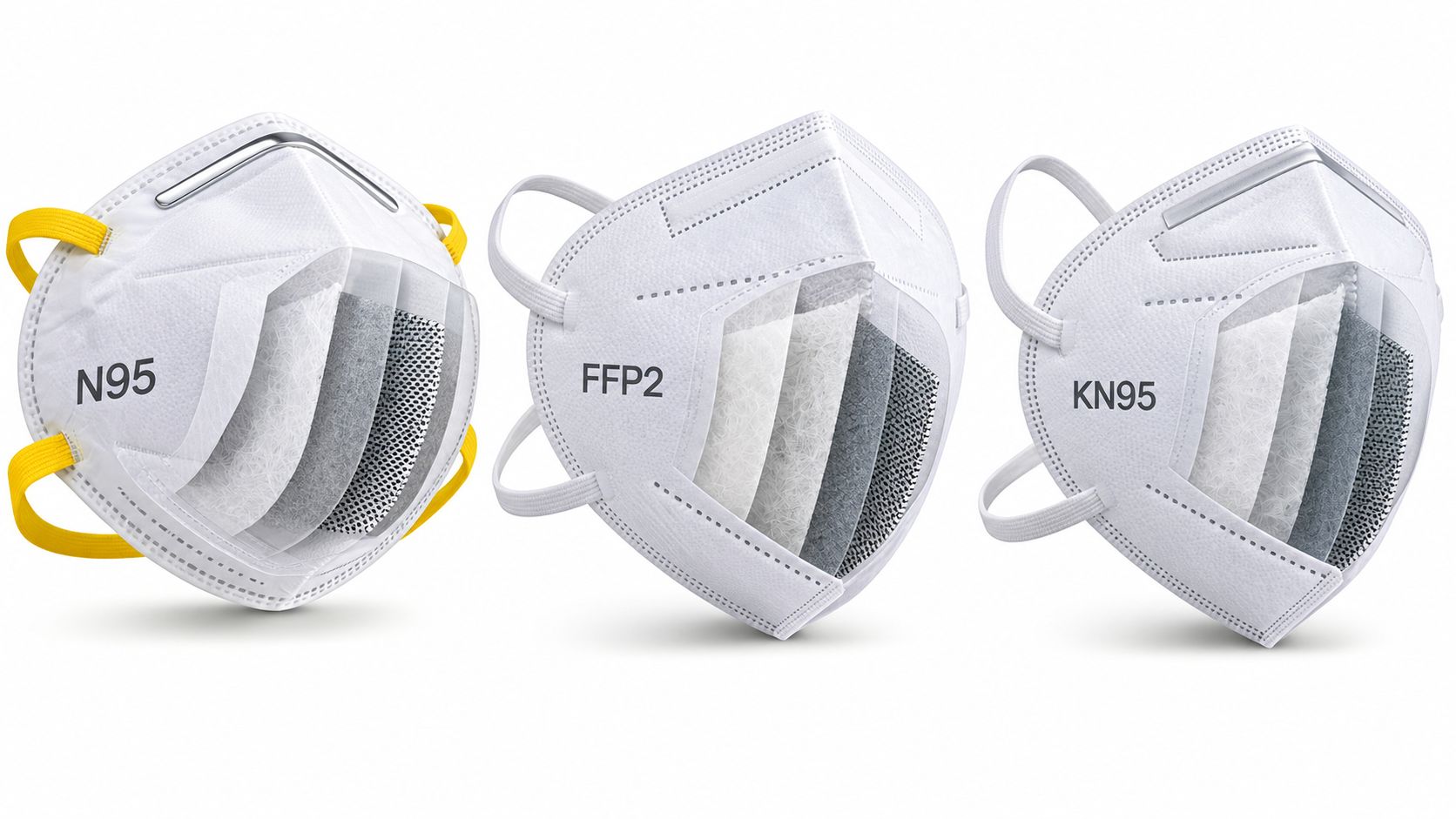
A higher filter number doesn't automatically mean safer respiratory protection. An N100, FFP3, or P100 may offer greater filter efficiency under its certification test, yet a poorly fitting respirator can leak around the face. A correctly selected, properly fitted N95 or FFP2 may provide more dependable protection for a particular wearer and hazard.
The practical way to understand respiratory protection standards is to treat performance as a system with three connected parts:
- Certification, which describes what the filter and respirator configuration achieved under a defined test.
- Face seal, which determines whether air bypasses the filter around the wearer's face.
- Program controls, including hazard assessment, medical evaluation, fit testing, training, maintenance, and supervision.
A healthcare worker performing an aerosol-generating procedure, a construction painter working around oil-containing aerosols, and a parent buying a mask for everyday errands may all need different products. Their decisions should begin with the hazard and the conditions of use, not with the largest number printed on a package.

The three questions that prevent most mistakes
Ask what the respirator is certified to do, whether it seals on the intended wearer, and whether the workplace can support its use. A filter can perform well in a laboratory while the complete device performs poorly on a person who has facial hair, uses the wrong size, or dons it incorrectly.
That is why purchasing teams should also consider traceability, approved models, supplier controls, and documentation. A practical procurement risks and compliance guide can help organizations evaluate those operational issues instead of treating respirator purchasing as a simple product comparison.
For a plain-language comparison of how different mask types perform, see this guide to mask effectiveness by type. The central lesson is simple: filter efficiency is only one part of protection.
Why a Higher Filter Number Is Not Always Safer
A respirator marked N100 has a higher stated minimum filter efficiency than an N95 under applicable NIOSH test conditions. That rating alone does not determine which product protects a particular person in a particular workplace. If an N100 leaks around the face while an N95 seals correctly, the higher-rated filter may provide less real-world protection.
Filter, seal, and program
A filter works only when inhaled air passes through it. Gaps near the nose, cheeks, or chin create an easier route, allowing contaminated air to enter without passing through the filter.
The program provides the conditions needed for reliable use. Employers must assess hazards, select an appropriate respirator, arrange medical evaluation where required, conduct fit testing for tight-fitting models, train users, and maintain equipment. A respirator chosen without those controls cannot deliver its certified performance, regardless of the filter rating printed on it.
Practical rule: Compare the complete protection system, not just the filter number.
A healthcare worker may need a tight-fitting respirator selected for biological aerosols and supported by a workplace program. A painter may need protection matched to particles and oil resistance. A household user may need an authentic product worn correctly for a limited situation, without assuming that workplace certification answers every consumer-use question.
Purchasing decisions also involve traceability, approved models, supplier controls, and documentation. A procurement risks and compliance guide can help organizations assess those operational factors rather than treating respirator selection as a simple product comparison.
Why similar labels can mislead
N95, FFP2, KN95, KF94, and FFP3 belong to different regulatory and conformity-assessment systems. Their labels may indicate broadly similar categories, while approval markings, test methods, breathing resistance, leakage requirements, product configuration, and enforcement still differ. For a plain-language comparison of how different mask types perform, see this guide to mask effectiveness by type.
Use one decision framework across the labels:
- Identify the hazard. Determine whether the concern is a biological aerosol, dust, mist, oil-containing aerosol, or oxygen-deficient atmosphere.
- Verify the product. Check the regulator, approval marking, model identity, and packaging information.
- Confirm the fit. Tight-fitting workplace respirators require fit testing before use and within ongoing program management.
- Support use. Training, seal checks, maintenance, and replacement practices affect performance outside the laboratory.
A higher number can be appropriate when the hazard assessment calls for it. It is not a universal shortcut to safety. Filter efficiency is only one part of protection.
How OSHA and NIOSH Built the U.S. Framework
Modern U.S. respiratory protection grew through several regulatory milestones rather than appearing as a single finished rule. ANSI Z88.2-1969, titled “Practices for Respiratory Protection,” provided the first national consensus standard. OSHA adopted its first major respiratory-protection requirements in 1971, drawing heavily on that standard.
The construction rule, 29 CFR 1926.103, was promulgated in April 1971. General-industry requirements were established through 29 CFR 1910.134. On February 9, 1979, OSHA formally recognized 29 CFR 1910.134 as applicable to construction, extending the general framework across additional workplaces.

The shift to a program-based standard
OSHA published a substantially revised respiratory-protection standard on January 8, 1998, and it became effective on April 8, 1998. The revision replaced the standards adopted in 1971 across general industry, construction, shipyards, longshoring, and marine terminals, establishing the program-based model still used today, as documented in this NIOSH history of respiratory protection.
A program-based model means the employer cannot treat the respirator as an isolated object. The employer must connect several activities:
- Hazard evaluation, to identify contaminants, concentrations, and workplace conditions.
- Respirator selection, to match the device to the hazard and required protection.
- Medical evaluation, to determine whether the worker can safely use the respirator.
- Fit testing, when the respirator depends on a tight face seal.
- Training, so users understand limitations, donning, seal checks, storage, and maintenance.
- Program administration, including written procedures, oversight, and review.
This structure matters for virus prevention because infectious aerosols can enter through leaks just as other airborne contaminants can. Respiratory protection belongs alongside, not instead of, appropriate ventilation, isolation practices, hygiene, and other infection-control measures. Readers comparing airborne and droplet precautions should keep that distinction clear.
OSHA and NIOSH have different roles
NIOSH evaluates and approves specific respirator configurations under its approval requirements. OSHA establishes and enforces workplace requirements for respiratory-protection programs. An employer therefore needs both a properly approved product and a process that ensures workers can use it correctly.
The 1998 revision applies when workers face contaminated or oxygen-deficient atmospheres and effective engineering controls are infeasible or are still being implemented. That condition prevents a common misunderstanding: respirators are not a substitute for controlling a hazard at its source whenever source controls are feasible.
Decoding NIOSH Labels and Filter Classes
A NIOSH particulate label contains two separate ideas. The number describes minimum filter efficiency under applicable certification test conditions. The letter describes resistance to oil.
A coffee filter makes the distinction intuitive. It blocks coffee grounds while allowing liquid to pass. A respirator filter similarly blocks particles while allowing air to flow, but its performance depends on the certified design and the conditions used for testing.

Read the number first
Under NIOSH approval requirements, the numerical class indicates minimum filter efficiency of at least 95%, 99%, or 99.97%, depending on the class, as described by OSHA's respirator selection criteria.
That means:
- 95 indicates at least 95% minimum filtration under the applicable test conditions.
- 99 indicates at least 99% minimum filtration.
- 100 indicates at least 99.97% minimum filtration.
The number isn't a promise that a wearer will inhale only the unfiltered fraction suggested by the label. It describes filter-media performance. Face leakage, donning technique, movement, facial hair, and respirator damage can change the protection a person receives.
Then read the letter
The letter addresses oil resistance:
- N-series filters are not resistant to oil.
- R-series filters are somewhat resistant to oil.
- P-series filters are strongly resistant to oil.
An N95, therefore, is not a generic name for any disposable mask. It identifies a specific approved filtering facepiece category with a defined minimum filtration level and additional requirements involving breathing resistance, labeling, construction, and quality control.
The letter matters in industrial environments where oil-based aerosols may be present. A substance-specific OSHA rule may also require a 100-class or HEPA-equivalent filter even when a lower class might otherwise appear suitable.
Approval is specific to the product
NIOSH approval applies to the particular respirator configuration and manufacturing specifications. A counterfeit, altered, or falsely labeled product cannot be assumed to provide the certified performance. Verify the approval marking and model identity instead of relying on a familiar-looking logo or a seller's product description.
A filter label tells you what was tested. It doesn't tell you whether the product is authentic, suitable for the hazard, or sealed to the wearer's face.
Comparing Global Standards Side by Side
Respirator labels often cross borders, but certification systems don't become identical because their efficiency categories appear similar. NIOSH, European, Chinese, Korean, and Australian or New Zealand systems use their own approval rules, test conditions, markings, and conformity processes.
WHO materials describe U.S. N95 respirators as filtering at least 95% of the most penetrating particles and identify European FFP2 and FFP3 as broadly comparable categories, with stated filtration thresholds above 94% and 98%, respectively, in its respirator comparison guidance. “Broadly comparable” is useful orientation, not a product-to-product guarantee.
Major Particulate Respirator Standards at a Glance
| Standard | Class | Minimum Filter Efficiency | Typical Use |
|---|---|---|---|
| NIOSH | N95 | At least 95% | Particulate workplace hazards where the N-series designation is appropriate |
| NIOSH | N99 | At least 99% | Higher-efficiency particulate applications |
| NIOSH | N100 | At least 99.97% | Very high-efficiency particulate applications |
| EN 149 | FFP1 | Standard-specific threshold | Lower-level particulate applications under European rules |
| EN 149 | FFP2 | Above 94% | Particulate and aerosol protection under European rules |
| EN 149 | FFP3 | Above 98% | Higher-level particulate and aerosol protection under European rules |
| GB 2626 | KN95 or KP95 | Verify the applicable product marking and rule | Chinese-certified particulate respirators |
| Korean standard | KF80, KF94, or KF99 | Verify the applicable product marking and rule | Korean-certified particulate respirators |
| AS/NZS | P1, P2, or P3 | Verify the applicable product marking and rule | Australian and New Zealand particulate respirators |
The table helps with orientation, but it doesn't establish interchangeability. Test aerosols, breathing resistance, inward leakage, valve design, labeling, manufacturing oversight, and conformity assessment can differ. A product can also be authentic yet unsuitable for a particular hazard or workplace rule.
A practical cross-border check
Start by identifying the regulator or conformity-assessment body named on the packaging. Confirm the exact model, not merely the product family. Then check whether the intended workplace accepts that certification and whether a fit-testing protocol is available for the device.
For infection-control decisions, don't stop at the efficiency threshold. Consider authenticity, leakage, breathing resistance, fit, facial hair, wear time, and compatibility with eye protection or other equipment. A respirator with a familiar international label still needs to work as part of the user's actual protection system.
Fit Testing, Fit Factors, and Assigned Protection
A respirator's face seal works like the weatherstrip around a door. The material may be strong, but drafts enter if the strip is damaged, compressed unevenly, or interrupted by an object. A respirator can have an effective filter and still allow contaminated air through a gap at the face.

Two ways to test the seal
A qualitative fit test uses a controlled challenge agent and a wearer's response. If the person detects the test agent through taste, smell, or irritation, the result is a fail. The method produces a pass or fail outcome.
A quantitative fit test uses an instrument to measure leakage numerically and calculate a fit factor. It provides a numerical result for a specific person wearing a specific respirator during the test.
Under 29 CFR 1910.134, a tight-fitting half-facepiece passes a quantitative fit test at a fit factor of at least 100, while a tight-fitting full-facepiece must reach at least 500. The same OSHA standard requires retesting at least annually and whenever the wearer changes to a different make, model, style, or size, as stated in the federal respiratory-protection regulation.
Fit factor is not assigned protection
A fit factor belongs to the individual test. An Assigned Protection Factor, or APF, is a workplace expectation for a respirator class when an effective program is operating. OSHA explains this distinction in its interpretation of APF and fit factor.
A passing test doesn't mean the user can ignore donning technique or seal checks. The wearer should perform a user seal check every time the respirator is donned. Facial hair, facial changes, movement, an incompatible size, or incorrect placement can undo the seal achieved during formal testing.
A fit test confirms that a particular respirator can seal for a particular wearer under test conditions. It doesn't certify every future donning.
Loose-fitting powered air-purifying respirators generally don't require fit testing because they don't depend on a tight face seal. They still require correct selection, training, inspection, maintenance, and use.
Choosing and Using a Respirator in Real Workplaces
A defensible selection process begins before anyone opens a respirator package. The safety manager or clinician should identify the contaminant, estimate the exposure, determine whether engineering controls are feasible, and select a device that matches the hazard and workplace conditions.
A workable selection sequence
- Define the hazard. Separate particles, biological aerosols, gases, vapors, oil-containing aerosols, and oxygen deficiency. A particulate respirator isn't automatically suitable for every airborne contaminant.
- Check the required protection. Compare the exposure with the applicable exposure limit and the respirator's assigned protection. CDC/NIOSH identifies an APF of 10 for a properly fitted half-mask air-purifying respirator, including an N95, and advises that it shouldn't be selected when airborne exposure exceeds the applicable exposure limit by more than a factor of 10, as explained in its N95 selection guidance.
- Verify the product. Confirm approval markings, model identity, size, and compatibility with other protective equipment.
- Prepare the user. Complete medical evaluation where required, fit-test tight-fitting models, and train workers in donning, seal checks, limitations, storage, and maintenance.
- Monitor the program. Repeat testing after relevant changes, replace damaged or unsuitable equipment, and document the controls that keep the program functional.
A healthcare worker performing an aerosol-generating procedure may need a fit-tested N95 selected for the clinical hazard, while a loose-fitting PAPR may be considered when a tight seal is impractical or when the program and hazard assessment support that choice. A surgical mask shouldn't be treated as a direct substitute for a tight-fitting respirator because its design and face-seal dependence differ.
Laboratory teams handling hazardous materials need broader controls than a mask alone. Guidance on essential precautions for lab staff can complement, but not replace, the employer's respiratory-protection program.
For readers comparing a specific respirator shape, this overview of the N95 duckbill mask offers product-focused context. VirusFAQ.com also publishes educational material on viruses, transmission, and prevention, which can help readers connect equipment choices with broader infection-control practices.
Common Misconceptions and a Quick Verification Checklist
Respirator mistakes often begin with a reasonable-sounding assumption. The problem is that labels describe different parts of the system, while users often treat one label as a complete safety judgment.
Four myths to retire
Myth one, N95, FFP2, and KN95 are fully interchangeable. Their categories may be broadly comparable in some contexts, but each belongs to a different certification system. Approval markings, test conditions, leakage requirements, and enforcement can differ. Treat cross-border labels as a starting point for evaluation, not a universal equivalence certificate.
Myth two, passing a fit test guarantees protection for the entire year. CDC/NIOSH states that tight-fitting respirators must form a complete seal, that fit testing can be qualitative or quantitative, and that users should be retested annually and whenever they switch to a different model, style, or size, as described in its respirator fit-testing guidance. A user seal check remains necessary each time the respirator is donned.
Myth three, any “95%” label blocks 95% of inhaled viruses. The number may describe a filter's minimum efficiency under a particular certification test. It doesn't account for face leakage, incorrect donning, an unsuitable contaminant, a counterfeit product, or failure to wear the respirator continuously.
Myth four, facial hair is only a personal preference. Hair in the sealing area can interfere with a tight-fitting respirator's seal. Workplace programs must address facial-hair interference because a filter cannot compensate for a leak at the face.
A quick verification checklist
Before approving or wearing a respirator, ask:
- Is the product authentic? Verify the approval marking and exact model identity.
- Does the class match the hazard? Check particle, oil, gas, vapor, oxygen, and exposure requirements.
- Is the device approved for the setting? Workplace rules may specify accepted certifications or additional requirements.
- Can the wearer achieve a seal? Consider face shape, facial hair, eyewear, and other equipment.
- Has fit testing been completed? Use the required qualitative or quantitative method.
- Was the respirator donned correctly? Perform a user seal check every time.
- Is the program maintained? Confirm training, medical evaluation, inspection, storage, and replacement procedures.
Putting It All Together for Safer Choices
Respiratory protection standards become easier to apply when every decision follows the same order. Verify the certification, match the respirator to the hazard, confirm the fit, and support use with a functioning program.
Certification answers what the product was designed and tested to do. Fit testing answers whether a particular wearer can obtain a seal with that model. Program controls determine whether the organization keeps selection, training, medical evaluation, maintenance, and supervision working over time.
For general readers, that framework prevents overreliance on a number printed on a package. For clinicians and safety managers, it provides a defensible way to explain why an approved respirator still needs proper selection and fit. For procurement teams, it highlights why model identity, supplier reliability, and documentation matter.
Respiratory protection also belongs within a wider infection-prevention plan. Depending on the hazard, that plan may include ventilation, hand hygiene, isolation procedures, environmental cleaning, and appropriate surface disinfection. Respirators reduce inhalation risk through the breathing zone, while disinfecting wipes can support cleaning of compatible high-touch surfaces according to the product label and the setting's infection-control procedures.
Use this final test: If you can name the hazard, verify the approval, explain the seal, and describe the program that supports the user, you're making a respiratory-protection decision rather than simply buying a mask.
Use the framework before your next purchase or workplace policy review. Verify the respirator's approval marking, ask whether the model has been fit-tested for the intended wearer, and check that training, seal checks, maintenance, and hazard controls are documented. For virus-related prevention guidance and plain-language explanations of transmission and protective practices, visit VirusFAQ.com.
Leave a Reply