
Most online advice turns viral vs bacterial diarrhea into a false choice: viral means you wait it out, bacterial means you need antibiotics. That shortcut feels tidy, but it misses the three things that matter most in real life, a positive stool PCR doesn't prove causation, identifying a bacterium often supports less antibiotics rather than more, and dehydration, not the label, drives immediate risk.
The practical question isn't, “Is it viral or bacterial?” It's, “How sick is the person, what do the stool features suggest, and will testing change care?” That's a better way to read symptoms, decide on stool tests, and avoid both missed infections and unnecessary treatment.
| Feature | Viral diarrhea | Bacterial diarrhea |
|---|---|---|
| Usual pattern | Often widespread, self-limited illness | More likely to become inflammatory or bloody |
| Common clue | Vomiting can stand out, especially with norovirus | Fever, cramping, blood, or mucus raise concern |
| Testing mindset | Often no testing for mild cases | Testing matters more when symptoms are severe or invasive |
| Treatment posture | Supportive care is usually the center | Antibiotics depend on the organism, severity, and risk |
| Main danger | Dehydration | Dehydration, invasion, outbreaks, and resistance decisions |
If you're looking for a plain-language resource on related day-to-day care needs, nursing insights for NDIS participants can be useful in the broader support context.
Why the Viral vs Bacterial Split Matters Less Than You Think
The most common mistake is treating diarrhea like a trivia question. People want a clean label, but acute diarrhea is a syndrome, which means the same symptom can come from viruses, bacteria, parasites, toxins, medications, or noninfectious gut irritation. The label matters, but it matters less than severity, hydration, blood in stool, fever, and host risk.
A more honest frame starts with the fact that childhood diarrhea is common on a global scale, and the causes are mixed. The WHO estimates nearly 1.7 billion childhood diarrhea episodes each year, with about 443,832 deaths annually among children younger than 5 years and another 50,851 deaths among children aged 5 to 9 years WHO diarrhoeal disease fact sheet. In a low-resource birth cohort, viruses accounted for 36.4% of diarrhea episodes and bacteria for 25.0%, while parasites accounted for 3.5% MAL-ED reanalysis30349-8/fulltext).
Why the binary still lingers
People cling to the viral-bacterial split because it feels actionable. Viral illness suggests rest and fluids. Bacterial illness suggests a prescription. That's too simple.
Practical rule: if the person is getting dehydrated, has bloody stool, has severe abdominal pain, or looks systemically unwell, the label matters less than getting evaluated.
The broader public-health reason the split matters is different from the bedside reason. Bacterial outbreaks, foodborne surveillance, and antimicrobial resistance all depend on accurate attribution. That's why the right question is not “Which side wins?” but “What kind of organism, if any, is likely, and does the result change management?”
VirusFAQ.com also covers viral transmission and prevention topics, which helps readers connect diarrhea to the wider world of enteric infection rather than treating it as an isolated stomach problem.

The Pathogens Behind Each Category
The viral side is dominated by a few familiar names. Norovirus, rotavirus, adenovirus, and astrovirus are the main enteric viruses clinicians think about in children and household outbreaks WHO diarrhoeal disease fact sheet. These viruses spread efficiently through the fecal-oral route, contaminated hands, shared surfaces, and close contact, which is why daycare clusters and family outbreaks are so common. For a deeper look at how these infections arise, see what causes viral gastroenteritis.
Viral causes that usually drive volume
Norovirus is the classic household virus. It often brings abrupt vomiting with watery, nonbloody diarrhea, and it spreads fast in homes, schools, cruise ships, and care settings. Rotavirus still matters because it can cause significant dehydration in young children, even though vaccination has changed its burden in many places. Adenovirus and astrovirus are less famous, but they remain part of the everyday background of pediatric gastroenteritis.
Bacterial causes that drive severity
On the bacterial side, the usual suspects are Escherichia coli, Shigella, Salmonella, and Campylobacter. The MAL-ED reanalysis points to diarrheagenic E. coli along with Shigella, Campylobacter, and Salmonella as common bacterial causes MAL-ED reanalysis. These organisms often point back to familiar exposure routes, contaminated food or water, person-to-person spread, undercooked poultry, or environmental contamination.
The label matters because it changes the next question. Viral diarrhea often explains the bigger volume of self-limited illness, while bacterial diarrhea matters more when the case is bloody, inflammatory, outbreak-related, or tied to public-health action. A mild watery illness in a child and a bloody diarrheal illness after travel deserve different attention, even though both fall under diarrhea.
Dehydration drives immediate risk. The pathogen name matters less than how sick the person looks, how much fluid they are losing, and whether the stool pattern suggests invasive disease.
Incubation Periods and Symptom Clues That Help

Timing helps, but it rarely settles the question on its own. In travel-associated illness, both viral and bacterial pathogens can start symptoms after roughly 6 to 96 hours LAAAP IDSA diarrhea guidelines. That overlap is why the clock can point you in a direction without proving the cause.
What the symptom pattern can suggest
Norovirus often makes vomiting stand out more than in many bacterial illnesses, and the usual course is short, often about 2 to 3 days. A much shorter incubation, with nausea and vomiting after about 24 hours, fits preformed bacterial toxins from Staphylococcus aureus or Bacillus cereus. what incubation period means in practical terms gives a plain-language explanation of why timing can help without acting like a diagnosis.
Bloody stool, marked cramping, and fever shift attention toward invasive bacterial disease.
The most useful clue is the inflammatory picture. Pain, blood, mucus, fever, and systemic illness suggest the gut may be invaded or strongly inflamed, which raises the stakes quickly.
Symptoms alone do not reliably identify the pathogen. Inflammatory features raise the likelihood of an invasive bacterial infection.
What people misread
A common shortcut is “vomiting means viral” and “diarrhea means bacterial.” Both categories can cause both symptoms. Travel history, food exposure, sick contacts, and duration matter more than one isolated clue.
If you want a visual reminder of how the patterns can overlap, the informational sign comparing symptoms of viral and bacterial diarrhea including fever and stool consistency illustrations shows the broad contrast without pretending that symptoms alone settle the case.
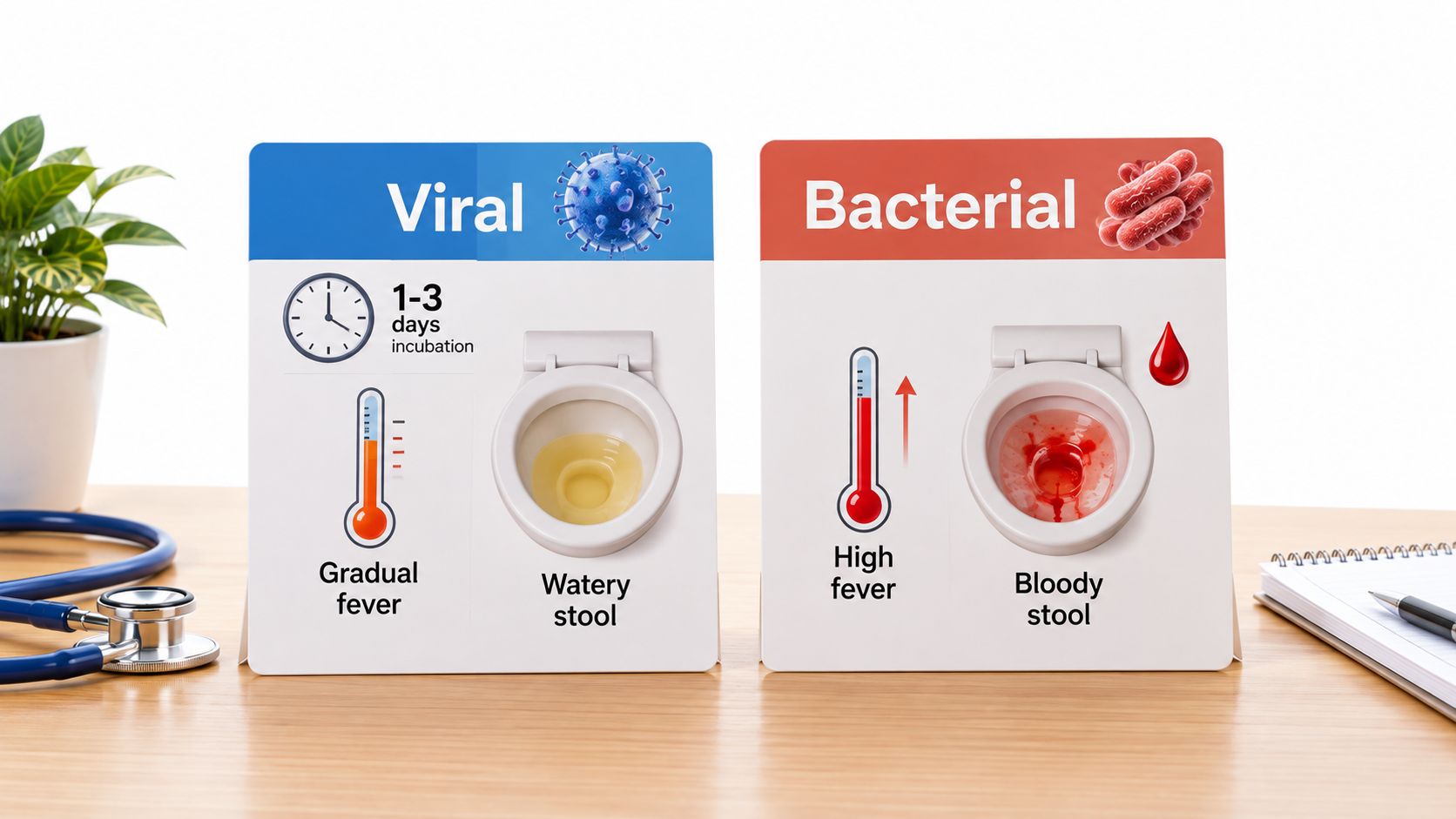
The practical takeaway is measured confidence. Sudden vomiting and watery stools in a household cluster make norovirus more likely. Blood, high fever, severe cramping, or illness after risky food or travel push bacterial causes higher on the list. The symptom pattern narrows the field, but it does not close the case.
What Stool Tests Can and Cannot Tell You
Testing sounds definitive, but stool diagnostics are only as good as the question you ask. Stool culture, antigen tests, and multiplex PCR panels do different jobs, and they don't all answer “what caused the diarrhea?” in the same way.
The key difference between detection and causation
Multiplex PCR detects nucleic acid, not necessarily live organisms. That means a positive result can reflect asymptomatic carriage, residual genetic material after recovery, or multiple organisms detected at once without a single clear culprit. A viral-positive result can coexist with bacterial detection, and a negative panel still doesn't exclude every infectious cause. That's why a panel result needs to be read alongside symptoms, exposure history, and duration.
Stool culture is slower, but it still matters when the question is bacterial identification, susceptibility testing, or public-health surveillance. Antigen tests can be rapid and useful in selected settings, but they have narrower coverage than broad molecular panels.
When testing is more likely to help
Testing makes more sense when diarrhea is severe, persistent, bloody, systemic, or high-risk. In otherwise healthy people with routine, self-limited diarrhea, labs are often unnecessary. The Infectious Diseases Society of America guideline specifically highlights testing when there's fever, bloody or mucoid stool, severe abdominal cramping or tenderness, or signs of sepsis IDSA infectious diarrhea guideline.
A practical way to think about it is this:
- Culture helps when you need to know whether a live bacterium is present and whether it's susceptible to treatment.
- Antigen testing helps when a rapid answer is useful and the target organism fits the test's scope.
- PCR helps when you need broad detection, but it still requires clinical correlation.
If a test reports a pathogen, that is not the same as proving it caused the diarrhea. That distinction is the entire point.
For readers comparing test options in more detail, VirusFAQ.com's discussion of antigen testing versus PCR is a useful companion, especially when someone has already had a panel and doesn't know what to do with the result.
When Antibiotics Help and When They Hurt
Antibiotics are often the wrong starting point for diarrhea. A bacterial result does not automatically mean treatment, and a viral result does not make medication irrelevant. In practice, the first job is usually rehydration, not labeling the germ.
Supportive care comes first
Patients need fluids and electrolytes first, plus food if they can keep it down. Recent clinical literature citing WHO guidance says routine antibiotics are not recommended for diarrhea, even when a bacterial cause is confirmed springer clinical literature on diarrhea and resistance. That can feel counterintuitive, but it reflects a basic principle: diarrhea becomes dangerous when dehydration develops, not because a stool test names a microbe.
When antibiotics can backfire
Empirical antibiotics can cause harm in the wrong setting. They may prolong shedding in some Salmonella infections or worsen outcomes in Shiga-toxin-producing E. coli. They also add pressure to a larger resistance problem. In 2025, WHO reported that one in six laboratory-confirmed cases of common bacterial infections worldwide in 2023 was resistant to antibiotic treatment.
The less obvious point is that a confirmed bacterium often supports less antibiotic use, not more. The right question is whether the organism, the illness severity, and the susceptibility pattern justify treatment. A positive stool panel does not answer that on its own.
For a practical look at adjunctive options, the VitzAi.com probiotic guide can help frame what probiotics can and cannot do. They may fit supportive care, but they do not replace fluids, and they do not turn an unclear stool result into proof of cause.

Red Flags That Warrant Medical Evaluation
Some diarrhea can stay at home. Some can't. The decision point is usually not the label, it's whether the person shows signs of dehydration, invasive disease, or a higher-risk host state.
Signs that should move you toward evaluation
Blood or mucus in stool pushes concern toward invasive bacterial infection. High fever, severe or localized abdominal pain, and a swollen or tender abdomen raise the stakes further. If diarrhea is persistent, especially when it's not easing after several days, a clinician may need to look beyond routine viral gastroenteritis.
Recent hospitalization or recent antibiotic exposure should also trigger attention to Clostridioides difficile. Infancy, older age, frailty, and immunocompromise lower the threshold for care because these patients dehydrate faster and tolerate gut infection poorly.
Red flags by context
- Travel exposure: recent travel, especially with dysentery, broadens concern for bacterial or parasitic causes.
- Foodborne cluster: illness in multiple people after a shared meal points toward outbreak investigation.
- Childcare or food service work: even a mild case may matter for reporting, exclusion, and transmission control.
Bottom line: dehydration, not the viral or bacterial label, is what drives immediate risk.
If the person can't keep fluids down, urinates much less, becomes lethargic, or looks dry and weak, that's not a “wait and see” situation. The next step is clinical assessment, and sometimes oral rehydration, stool testing, or intravenous fluids.
The point of red-flag screening is not to panic over every loose stool. It's to catch the cases where home care is no longer enough and where the pathogen category changes management.
A Side-by-Side Comparison and Practical Takeaways
A comparison table helps only if it changes what you do next. The useful question is not whether viral or bacterial diarrhea sounds more dramatic. It's which pattern fits the illness in front of you, and whether the person needs fluids, testing, isolation, or evaluation.
| Feature | Viral | Bacterial |
|---|---|---|
| Typical pathogens | Norovirus, rotavirus, adenovirus, astrovirus | E. coli, Shigella, Salmonella, Campylobacter |
| Common pattern | Sudden onset, watery stools, vomiting can be prominent | More likely fever, cramping, blood, mucus, or outbreak-linked illness |
| Incubation context | Often overlaps with bacterial timing, especially in travel illness | Also overlaps, so timing alone won't settle it |
| Stool appearance | Usually nonbloody | Bloody or mucoid stool raises concern for invasive disease |
| Useful tests | Usually none for mild cases, PCR if severe or high-risk | Stool culture, PCR, and sometimes toxin-focused testing |
| Default treatment posture | Supportive care first | Supportive care first, antibiotics only when clearly indicated |
For a plain-language refresher on coping with diarrhea at home, fast practical diarrhea relief can be helpful as long as it doesn't distract from red flags or hydration.
Three quick scenarios
A household outbreak with sudden vomiting and watery diarrhea fits a viral pattern, especially norovirus. A travel-related illness with blood in stool and significant cramping deserves evaluation for invasive bacterial disease. A young child with prolonged watery diarrhea may still have a self-limited illness, but dehydration risk changes the urgency.
The best question to ask is not “Which germ is this?” It's “Does this person need only supportive care, or do the symptoms justify testing and clinical assessment?”
If the illness is mild, self-limited, and the person is drinking well, home care may be enough. If the stool is bloody, the pain is severe, or dehydration is building, get evaluated.
If you're deciding what to do today, start with fluids, watch the red flags, and use testing only when it can change care. If the pattern is unclear, or if symptoms are worsening, arrange a medical review rather than guessing at viral vs bacterial diarrhea on your own.
Leave a Reply