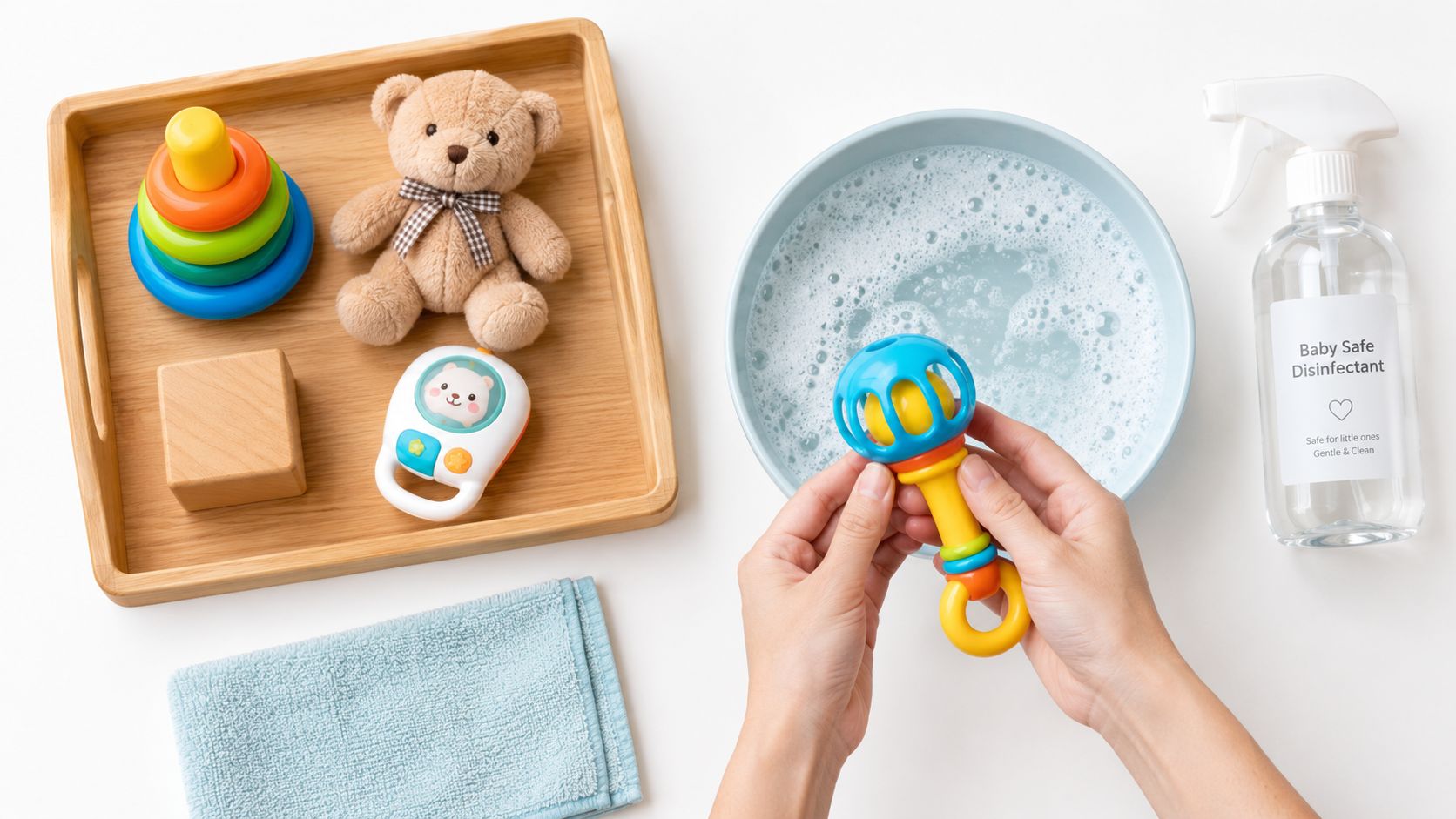
Your baby drops a teether on the floor, retrieves it before you can reach it, and puts it straight back in their mouth. Later, a stuffed animal gets sneezed on, a stacking cup disappears under the sofa, and a shared toy comes home from daycare looking perfectly clean. These moments are ordinary. They also show why how to disinfect baby toys depends on the toy, the type of contamination, and who has been using it, not on a rigid cleaning ritual.
Soap and water handle most everyday household dirt. Disinfection matters more after vomit, diarrhea, other body fluids, illness, or shared use among children. The safest approach is proportionate: clean regularly, disinfect deliberately, and never return a damp or chemically treated toy to a baby.
Understanding Toy Contamination and Why It Matters
A toy can look clean and still be contaminated. I see this pattern constantly with babies who mouth everything, then drop the same toy on the floor, into a stroller basket, or onto a high chair tray before it goes straight back into the mouth. Saliva, milk residue, food debris, and organisms from hands and household surfaces build up quickly on teethers, rattles, stacking cups, and textured grips. A foundational review of pediatric infection control found that toys in hospital and child-care settings can carry fecal coliforms and rotavirus, which is why appearance is a poor guide to safety (pediatric infection-control review).
Material matters. The same review showed that hard toys and soft toys do not behave the same after cleaning. Hard toys were effectively decontaminated after a one-hour bleach soak. Soft toys were harder to clear. Machine washing alone left contamination behind unless the toy first received a 30-minute bleach soak before washing. After one week of use, soft toys were contaminated again with coliforms, while hard toys were not, according to the same review.
That distinction matters more than many parents expect.
A sealed plastic teether, a plush animal, a wooden puzzle, and a battery-operated book do not present the same cleaning problem. Some surfaces release residue easily. Others trap moisture, saliva, and organic material in fibers, seams, stuffing, cracks, or internal spaces. A toy used by one healthy child at home also carries a different level of concern than a toy passed between several infants.

Risk matters more than the calendar
Parents often ask for a fixed schedule. In practice, risk matters more than the calendar. A toy dropped once on a normal household floor usually needs washing. A toy contaminated with stool, vomit, diarrhea, or heavy respiratory secretions needs a different response. Shared use, active illness in the home, and frequent mouthing also raise the bar.
Practical rule: Treat the contamination event first, then consider the material and the child's likelihood of mouthing the toy.
Disinfection can lower surface contamination, but it does not replace handwashing, ventilation, keeping sick children home, or removing heavily soiled items. Clean toys help reduce risk. They do not guarantee that a child will avoid infection.
Cleaning Baby Toys by Material Type
The most common mistake is treating every toy as if it were a solid plastic block. Nonporous surfaces release contamination more readily, while fabric, unfinished wood, seams, cavities, and electronics can retain moisture or suffer damage from the cleaning method.
Hard plastic and silicone
Solid, hard, nonporous toys are usually the most manageable. Wash them with soap and water, scrub seams and textured areas, rinse well, and use a compatible disinfectant when the situation warrants it. Toys designed for a dishwasher can go through a sanitizing cycle, provided the manufacturer permits it.
A sealed toy with a hollow interior needs closer inspection. If water enters through a small opening and can't drain, the outside may look dry while moisture remains trapped inside. That creates a persistent reservoir, so discard or retire toys that can't be opened, drained, or cleaned according to the manufacturer's directions.
Soft toys and fabric
Plush toys absorb saliva and other organic material into their fibers and stuffing. Surface wiping rarely reaches the full contaminated area. Follow the care label, use a pre-treatment or soak when appropriate, wash thoroughly, and dry the interior completely before reuse. If a soft toy has been heavily contaminated and can't be cleaned through its full depth, removing it is safer than repeatedly wiping the surface.
Wood and electronics
Wood is porous and can be damaged by immersion, strong chemicals, or prolonged moisture. Use a lightly dampened cloth with mild soap, then dry the surface promptly. Don't soak wooden toys unless the manufacturer specifically allows it.
Electronic toys require the greatest restraint. Remove batteries or disconnect power, keep liquid away from ports, speakers, switches, and battery compartments, and use only a method approved for that product. A toy that can't tolerate adequate cleaning shouldn't be used during a household illness or shared among infants.
Families choosing wooden climbing or play equipment should also consider material care and physical durability. This toddler tower stability advice is useful because cleaning decisions shouldn't compromise a toy or structure's stability.
For related infection-control principles, see what temperature kills viruses. Heat can be useful only when the toy is designed to tolerate it, and household assumptions about temperature aren't a substitute for the manufacturer's instructions.
The Two-Stage Cleaning Process That Works
A toy covered with dried puree or sticky saliva does not need stronger spray. It needs a better sequence. Cleaning removes the material that shields microorganisms, and only then can disinfection reach the surface underneath. That is the logic behind the CDC early-care and education cleaning guidance, and it matches what works in real homes.

Wash before you disinfect
Remove visible soil. Rinse off loose food, saliva, or dirt first, then wash with warm water and mild soap. Use a small brush on seams, textured grips, recessed handles, and any opening that traps residue.
Rinse thoroughly. Leftover soap and loosened debris interfere with the next step. A complete rinse also lowers the chance of unwanted chemical reactions when you apply a disinfectant.
Choose a compatible treatment. For hard, nonporous toys that can tolerate it, the same CDC guidance describes a bleach solution of one tablespoon of unscented bleach per gallon, or 16 cups, of water, with full immersion for at least two minutes. That is a targeted method for compatible items, not a routine answer for every toy in the house.
Keep the surface wet for the full label time. Many disinfection attempts fail at this step. EPA guidance is based on contact time, the period the product has to remain visibly wet to work (EPA disinfectant contact-time guidance). If a label requires 10-minute contact time, the toy has to stay wet that long. If it dries early, reapply. For a clearer explanation, see what contact time means for disinfectants.
Rinse and dry. If the toy may go into a baby's mouth, rinse with clean water after chemical treatment unless the label clearly says no rinse is acceptable. Then air-dry it fully on a clean towel before it goes back into rotation.
A common miss: air bubbles, narrow channels, and molded handles leave pockets untouched. Rotate the toy during immersion and check that the disinfectant reaches every compatible surface.
Do not mix bleach with other cleaners. Use ventilation, follow the label, and stop if the finish, paint, plastic, or electronics are not compatible. Parents also cleaning feeding gear may find bottle washer selection for new parents useful, especially for understanding how cleaning and drying features differ from what toys can safely tolerate.
Choosing Between Bleach, Hydrogen Peroxide, and Other Disinfectants
Choosing a disinfectant for baby toys starts with the exposure, not with the strongest product under the sink. A toy used by one healthy child in ordinary play usually needs cleaning, not chemical disinfection. Save disinfectants for situations that justify them, then match the product to the organism, the surface, and the label directions. More powerful isn't automatically safer, especially for toys that end up in a baby's mouth.
| Disinfectant | Best For | Mouth-Safe? | Key Limitation |
|---|---|---|---|
| Diluted unscented bleach | Compatible hard, nonporous toys and known contamination events | Only after correct rinsing when required and complete drying | Damages porous materials, finishes, and some plastics; never mix with other cleaners |
| Three percent hydrogen peroxide | Suspected or confirmed Cryptosporidium contamination on compatible objects | Rinse thoroughly before reuse | Requires complete coverage or soaking for 20 minutes; don't combine with bleach |
| EPA-registered disinfectant | Pathogen-specific treatment when the label covers the toy's surface | Only according to label directions, including rinsing | Contact time and approved surfaces vary by formulation |
| Dishwasher sanitizing cycle | Heat-tolerant toys approved for dishwasher use | After a complete cycle and drying | Heat and water can damage electronics, wood, paint, and hollow toys |
Bleach remains a practical choice for many hard, nonporous toys because it is inexpensive and familiar, but it is not gentle. It can fade finishes, weaken some plastics, and ruin anything porous or poorly sealed. If you use it, mix it correctly, keep the surface wet for the full label time, rinse when required, and let the toy dry fully before it goes back into use. For parents who want the details, this guide to bleach disinfectant solutions explains dilution and handling clearly.
Some organisms change the decision. During suspected Cryptosporidium contamination, CDC guidance calls for three percent hydrogen peroxide, with full coverage or soaking for 20 minutes, followed by thorough rinsing. In childcare control measures, toys and high-touch surfaces may need disinfection at least twice daily (CDC Cryptosporidium guidance). Routine bleach is not the fallback here, and hydrogen peroxide should never be combined with bleach.
Alcohol products have a narrower role than many parents assume. They can help on some hard electronic surfaces, but they are not a universal answer for baby toys and may damage coatings or plastics. The Playz cleaning guide gives useful context on alcohol-based cleaning, but the manufacturer's instructions still decide what is safe.
In group-care settings, repeated toy and surface disinfection has been linked with lower detection of adenovirus, rhinovirus, and respiratory syncytial virus, with reported odds ratios of 2.4, 5.3, and 4.1, respectively, but with no measurable effect on bacterial load or sickness absence. That is the core trade-off. Disinfection has a place, but it works best as a targeted tool, not a fixed ritual for every toy in the house.
When Disinfection Is Unnecessary and When It Becomes Essential
A baby drops a teether on the living-room floor, then reaches for it again. In most healthy homes, that moment calls for ordinary cleaning, not an automatic round of disinfectant. CDC guidance says soap-and-water washing is usually sufficient for children's toys in homes, and disinfectants matter more after vomit, diarrhea, other body fluids, or illness (CDC household cleaning guidance).
That distinction matters because parents often overcorrect. A toy with dust, snack residue, or normal saliva from one healthy child usually needs washing and thorough drying. It does not need repeated chemical treatment just because it was mouthed or used all day.
Use a higher level of caution in a few specific situations:
- Illness is present: Clean and disinfect compatible toys that were mouthed or handled during a respiratory or gastrointestinal illness.
- Body fluids are involved: Vomit, diarrhea, stool, or other heavy soil should be removed promptly, followed by an appropriate disinfecting process.
- Children share toys: Pay closer attention to toys passed between infants, especially when several children put them in their mouths.
- The material is hard to clean well: During higher-risk periods, remove porous plush toys or items that trap moisture from circulation.
A risk-based approach works better than a fixed weekly rule. The same CDC guidance does not support a mandatory weekly disinfection schedule for toys in healthy households. The practical point is simple. Put effort where exposure is plausible, and avoid unnecessary chemical use when routine washing already does the job.
Cleaning is not a contest to eliminate every microorganism. The aim is to remove contamination safely and interrupt meaningful transmission routes.
I see the same mistake often. Parents focus on killing germs but miss the basics that matter just as much: complete rinsing, intact toy surfaces, and full drying. For babies who mouth everything, a properly washed and fully dried toy is often safer than a chemically treated toy with residue left behind or moisture trapped inside.
Practical Daily Habits for Toy Safety and Storage
By the end of a normal day, the issue usually is not whether every toy needs disinfection. The key question is which items should go back into circulation now, which need washing tonight, and which should be set aside. A separate wash bin makes that decision easy. If a toy has been mouthed over and over, dropped outside, shared between children, or soiled with body fluids, put it there instead of tossing it back with clean toys.
That one habit prevents a common mistake. Parents often clean the room, then let one dirty teether or rattle travel through the whole basket.
Once you have a small batch, sort by material. Hard, nonporous toys usually tolerate the full two-stage cleaning process or a compatible dishwasher cycle. Soft toys need laundering that gets to the filling, not just the surface. Wood does better with limited moisture and fast drying. Electronics need the power off, careful surface cleaning, and no liquid entering the casing.
In group settings, toys that pass from child to child need quicker turnover. The pediatric infection-control review cited earlier supports cleaning between users whenever practical, or at least by the end of the day when constant turnover makes immediate cleaning unrealistic. At home, the routine is usually simpler. Collect used teethers before bedtime, wash what is contaminated, and leave clean-looking, low-risk toys alone unless there is a reason to step up.
Storage is part of the process
A toy is not ready for storage until it is dry all the way through. Leave washed items on a clean towel or drying rack with air around them. Then store them in a dry, covered basket or container. Damp plush toys sealed in a bin can stay wet inside, and stacked plastic toys can hold water in seams, holes, and cavities.
Check condition before anything goes back to a baby. Cracks, splinters, loose parts, broken seams, peeling paint, and battery compartments that no longer close properly all change the safety picture. If a toy cannot be cleaned without trapping moisture or has become a choking risk, remove it from rotation.
A simple hierarchy works well:
- Everyday use: Wash with soap and water when dirty.
- Mouth contact: Clean promptly and dry fully.
- Shared use or illness: Clean and disinfect compatible toys more often.
- Vomit, diarrhea, stool, or other body fluids: Remove the toy and use a validated material-appropriate process.
- Uncleanable or damaged toys: Discard rather than repeatedly treating the surface.
That approach keeps the routine realistic. You do not need to disinfect the whole house because one toy hit the park ground or came home from daycare. Remove the item, look at the exposure, match the cleaning method to the material, and escalate only when the situation calls for it.
For more evidence-based explanations of viruses, surface transmission, and prevention, explore the practical and scientific resources at VirusFAQ.com.
Leave a Reply