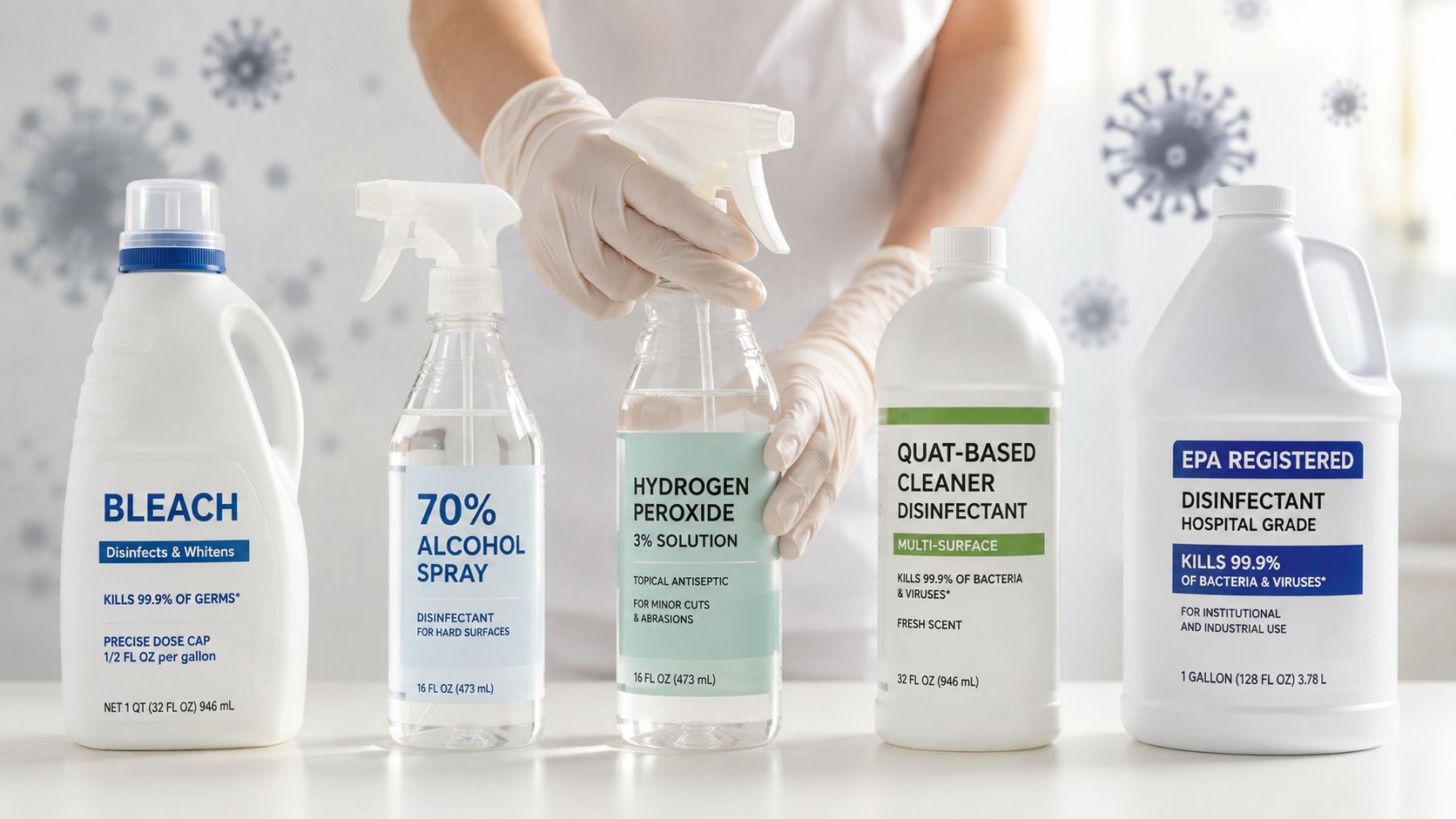
Most “best disinfectants for viruses” lists are built on the wrong question. They rank bleach, alcohol, hydrogen peroxide, or quaternary ammonium compounds as if the active ingredient alone determines success. In practice, a disinfectant can work well against one virus and poorly against another, fail because the surface dries too quickly, or underperform because the user wipes before the required contact time.
A better evaluation asks three questions: What kind of virus is involved? What does the label require? Can the product remain wet on that particular surface for the full contact time? The answers matter for concerns ranging from influenza A, HIV-1, HSV-1, HSV-2, and SARS-CoV-2 to norovirus, rhinovirus, and rotavirus.
| Decision factor | Why it matters | What to verify |
|---|---|---|
| Virus structure | Enveloped viruses are generally easier to inactivate than non-enveloped viruses | The product's tested virus claim |
| Active ingredient | Different chemical families have different spectra and material risks | Active ingredient and registration |
| Concentration | Dilution changes performance | Exact label concentration |
| Contact time | The surface must remain visibly wet for the listed duration | EPA label contact time |
| Application method | Wiping, spraying, soil removal, and surface texture affect results | Whether the label requires wiping or pre-cleaning |
| Surface | Porous, painted, metallic, and delicate materials behave differently | Compatibility instructions |
Why There Is No Single Best Disinfectant
The strongest disinfectant in a bottle isn't automatically the best choice. A product's real performance depends on the virus, the formulation, the contact time, and the way someone applies it. A solution that rapidly disrupts an enveloped influenza virus may not provide the same margin against a non-enveloped virus such as norovirus.
The CDC makes this distinction explicit. Its environmental-services guidance says low-level disinfection inactivates vegetative bacteria, fungi, and enveloped viruses such as HIV and influenza viruses, but only some non-enveloped viruses, including adenoviruses. That classification matters because norovirus, rhinoviruses, and rotaviruses are non-enveloped and harder to inactivate than many enveloped viruses. (CDC environmental control guidance)
The four questions behind a defensible choice
A practical decision starts with the pathogen, not the marketing label.
- Virus: Is the concern an enveloped virus such as influenza, herpesvirus, or SARS-CoV-2, or a more resistant non-enveloped virus such as norovirus or rotavirus?
- Product: Is the formulation registered for the intended pathogen or an approved reference claim?
- Contact time: How long must the surface remain visibly wet?
- Application: Does the method provide enough liquid, coverage, and mechanical wiping for the material involved?
Those questions create a more useful framework than a universal ranking. The five major categories considered here are sodium hypochlorite, alcohols, hydrogen peroxide, quaternary ammonium compounds, and EPA-registered combination products. Each can be appropriate, but none should be treated as interchangeable.
EPA List N is especially important for products intended against SARS-CoV-2. EPA says listed products are expected to kill all strains and variants of SARS-CoV-2 when used according to label directions, while also clarifying that inclusion on List N isn't an EPA endorsement. (EPA explanation of List N)
Practical rule: Judge the complete product-and-application system, not the active ingredient in isolation.
The useful skill isn't memorizing a winner. It's learning to read a label, identify the virus class, and decide whether the surface can stay wet long enough for the claim to matter.
How Virus Structure Determines Susceptibility
Viruses don't all present the same chemical target. Enveloped viruses carry a lipid membrane around their protein shell. Influenza A viruses such as H1N1 and H2N2, HIV-1, HSV-1, HSV-2, and SARS-CoV-2 belong to this broad category. Chemicals that disrupt lipids or damage viral proteins can often inactivate these viruses more readily than viruses protected by a tougher external structure.
Non-enveloped viruses lack that lipid membrane. Norovirus, rhinovirus, and rotavirus are important examples. Their protein capsids provide a more durable exterior, which helps explain why a product that performs well against influenza may not be adequate for a stomach-virus incident. The CDC specifically identifies low-level disinfection as effective against enveloped viruses and only some non-enveloped viruses. (CDC distinction between low-level disinfection and virus types)
A simple susceptibility map
Think of the virus structure as the first screening step:
- Enveloped viruses: Alcohols often have strong utility when the concentration and contact time are correct. EPA-registered products may offer faster options for high-touch surfaces.
- Non-enveloped viruses: Product-specific testing becomes more important. Alcohol alone shouldn't be assumed to provide adequate coverage for every virus.
- Mixed-risk environments: A registered formulation with a stated broad virucidal claim may be more defensible than a homemade solution chosen by reputation.
The CDC states that ethyl alcohol at 60% to 80% is a potent virucidal agent against all lipophilic viruses, including herpes, vaccinia, and influenza, and many hydrophilic viruses, including adenovirus, enterovirus, rhinovirus, and rotaviruses. It also states that this range doesn't inactivate hepatitis A virus or poliovirus. (CDC chemical disinfectants guidance)
That guidance shouldn't be converted into a blanket claim that every alcohol wipe handles every virus. Formulation, soil, wetness, and the tested contact time still control the result. Readers researching capsids, envelopes, and replication can use this virus structure and function guide for deeper biological context.

The central lesson is counterintuitive. A familiar virus name doesn't tell you whether a surface product will work. Envelope status narrows the field, but the label claim and application method decide whether the product is suitable.
Comparing the Five Major Disinfectant Types
No category wins every use case. The relevant comparison is spectrum, speed, material compatibility, and whether an ordinary user can apply the product correctly.

Sodium hypochlorite
Bleach-based products are often considered when contamination involves body fluids or a virus that may tolerate routine alcohol use. Their limitations are practical: bleach can damage or corrode some materials, and the prepared concentration, storage, ventilation, and contact time must follow the product directions. A homemade dilution shouldn't be treated as equivalent to an EPA-registered formulation with a specific claim.
Alcohols
Ethanol and isopropanol are useful for rapid treatment of compatible, hard surfaces. The CDC identifies ethyl alcohol at 60% to 80% as a potent virucidal range, with activity against enveloped viruses and many hydrophilic viruses. (CDC alcohol evidence)
Alcohol evaporates quickly, which is both its advantage and its weakness. It can support fast turnover on a small high-touch object, yet it may be difficult to keep the entire surface visibly wet for the listed duration. Users comparing lower-waste formats can also consult this low-waste cleaning guide.
Hydrogen peroxide
Hydrogen peroxide formulations can offer broad activity and compatibility across many surfaces, but those properties belong to the specific registered product, not to the chemical name alone. Check the label for the virus claim, required wet time, and surface restrictions. A generic peroxide cleaner isn't automatically a virucidal disinfectant.
Quaternary ammonium compounds
Quats are common in routine surface-care products and may offer useful material compatibility and cleaning characteristics. Their weakness is that low-level products shouldn't be assumed to handle resistant non-enveloped viruses. The label's organism claim matters more than the category name.
EPA-registered combinations
Combination products use multiple active ingredients or combine disinfection with cleaning functions. Their value is verification. An EPA registration and a pathogen-specific label establish a more reliable benchmark than a DIY recipe, provided the user follows the approved application method.
The best format for a high-touch surface may be a ready-to-use liquid or a pre-moistened disinfecting wipe, especially when consistent dosing and simple application matter. Convenience doesn't remove the need for wet contact time, but it can reduce measuring and dilution mistakes.
Concentrations and Contact Times That Deliver Results
Contact time often determines whether a disinfectant performs as labeled. EPA guidance lists ethanol-based List N products with wet-contact requirements ranging from 30 seconds to 1 minute or longer. The surface must remain visibly wet for the entire product-specific duration. (EPA List N advanced search guidance)
A wipe that dries almost immediately may not provide the claimed reduction. Applying excess product does not correct a mismatched formulation, poor coverage, or a surface that was not prepared as directed. Follow the label's application method rather than judging effectiveness by how much liquid was used.
Reading log reduction without the jargon
A 3-log reduction means a 99.9% reduction in infectious virus, while a 4-log reduction means a 99.99% reduction. The European EN 14476 suspension test requires at least a 4-log reduction. Its reference-virus approach can support claims against broader virus groups, rather than only one named virus. (EN 14476 virucidal testing overview)
| Disinfectant | Typical concentration | Contact time | Enveloped viruses | Non-enveloped viruses |
|---|---|---|---|---|
| Sodium hypochlorite | Follow the registered product label | Label-specific | Often covered when claimed | Requires a specific tested claim |
| Alcohols | 60% to 80% ethyl alcohol is the CDC-supported virucidal range | Product-specific, including 30 seconds for some List N products and 1 minute or longer for others | Broad activity when claimed | Don't assume universal coverage |
| Hydrogen peroxide | Follow the registered product label | Label-specific | Product-specific claim | Product-specific claim |
| Quaternary ammonium compounds | Follow the registered product label | Label-specific | Often suited to claimed routine uses | Requires a specific tested claim |
| Combination products | Follow the registered product label | Label-specific | Verify the exact claim | Verify the exact claim |
The table shows why active ingredient alone is an incomplete selection rule. The virus type, registered concentration, tested claim, and wet-contact requirement must align. A product removed before its listed contact time has not necessarily delivered its registered performance. For a closer explanation of this metric, see what contact time means for disinfectants.
What Independent Testing Reveals About Application
Ingredient rankings fail because surfaces aren't laboratory suspensions. A countertop may contain soil, texture, seams, or a coating that changes how evenly a disinfectant spreads. Wiping also changes the physical process by removing contamination and distributing the liquid across the target area.
Independent testing found that a CDC bleach solution had low efficacy against SARS-CoV-2 on some non-porous materials unless it was applied with mechanical wiping. The same testing reported greater than 3-log reduction only when wiping was combined with certain products or bleach on stainless steel, SBR, and painted wallboard tape. (Independent testing of product and wiping methods)
The surface changes the experiment
A smooth stainless-steel surface, a painted wallboard tape surface, and another non-porous material may not behave alike. Porosity, visible soil, and the force and coverage of wiping can alter how much disinfectant reaches the virus and how long it stays there.
That leads to a more rigorous question: Which product-plus-method achieves the needed reduction on this material? The answer may favor a wipe for a small high-touch object, a liquid application for a larger contaminated area, or a different registered product when compatibility is a concern.
Sprayers don't automatically solve the problem. An electrostatic disinfectant sprayer guide can help readers understand application mechanics, but any device still has to provide complete coverage and comply with the product label.
Application matters: A strong chemical applied unevenly can underperform a more suitable product used correctly.
EPA-listed products must be used exactly as labeled. That includes pre-cleaning requirements, application method, wet contact time, personal protection, and approved surfaces. The label isn't a formality. It's the boundary of the evidence.
Choosing the Right Disinfectant by Setting
There is no universal household, office, or clinical disinfectant. The appropriate choice depends on the virus, the surface, the required wet contact time, and whether the application method can deliver complete coverage.

At home
Start by separating routine cleaning from a defined contamination event. Infrequently touched surfaces may need only soap-and-water cleaning. A frequently touched object or an area contaminated by bodily fluids may justify targeted disinfection, but the product still needs a relevant virus claim and a compatible surface.
A suspected norovirus incident requires a different approach from routine influenza concerns. Norovirus is non-enveloped, so alcohol should not be assumed to provide sufficient coverage. For vomit-contaminated areas, select a registered bleach-based product or another product with a specific claim, remove soil as directed, keep the surface wet for the labeled contact time, and follow the safety instructions.
Influenza concerns may allow a product with a shorter listed contact time on compatible high-touch surfaces, especially where repeated application is needed. The shorter time matters only if the surface remains wet long enough to complete the claim.
Stone also limits the choice. Guidance on how to clean granite countertops safely can help readers assess material compatibility before applying a disinfectant.
In schools and offices
Shared door handles, desks, keyboards, and bathroom fixtures merit targeted attention when contamination or increased risk gives a clear reason to disinfect. A long wet time may be impractical during rapid room turnover. A fast-acting product can still fail if it evaporates before the labeled contact time ends.
Use a short audit before choosing a product:
- Touch frequency: Which objects do many people handle?
- Virus concern: Is the concern respiratory, gastrointestinal, or unknown?
- Material: Is the surface sealed, painted, metallic, electronic, or porous?
- Label: Does the product claim activity against the relevant virus?
- Wetness: Can staff maintain the required wet contact time?
In clinical settings
Clinical teams must distinguish routine environmental disinfection from processes intended for demanding contamination or equipment requirements. Shared equipment adds compatibility constraints, and a product suitable for a floor may damage a device or conflict with its care instructions.
The decision should therefore rest on documented product selection, trained application, and strict label compliance. A familiar household product is not a substitute for one approved for the intended surface and use.
Practical Recommendations and Safe Use
A defensible routine starts with the reason for treatment, not the active ingredient.
Clean only when a surface is infrequently touched and there is no known contamination or high-risk situation. Soap and water may be sufficient for ordinary areas, and many household surfaces do not need daily disinfection.
Disinfect selectively when a frequently touched object, contaminated surface, or suspected case creates a clear reason. Choose an EPA-registered product whose label covers the virus concern, then follow its contact time and material instructions. The product must remain visibly wet for the full labeled interval.
Use wipes strategically on small, compatible high-touch surfaces when the pre-moistened format can provide adequate coverage. Wipes are convenient, but one wipe may not supply enough liquid for a large or heavily soiled area. Mechanical wiping also removes material, so application technique matters alongside the disinfectant itself.
Verify before applying
Check EPA List N when SARS-CoV-2 is the relevant concern. EPA states that listed products are expected to kill SARS-CoV-2 strains and variants when used according to label directions, but inclusion is not an endorsement. The approved label remains the controlling document.
Apply these safety rules every time:
- Never mix chemicals: Do not combine bleach with other cleaners or disinfectants.
- Ventilate the area: Improve airflow during use, especially with strong-smelling products.
- Protect your hands: Wear the protective equipment specified on the label.
- Respect the surface: Test compatibility as directed, particularly on metals, finishes, electronics, and stone.
- Store securely: Keep products in their original containers and away from children, pets, heat, and incompatible chemicals.
VirusFAQ.com publishes educational material on virus characteristics, transmission, and prevention, including surface-disinfection discussions. Use those articles as background, then verify the product label and applicable public-health guidance before acting.
The least marketable conclusion is often the most accurate: many surfaces don't need daily disinfection. Clean ordinary areas, disinfect targeted high-touch or contaminated surfaces, and judge the choice by virus structure, registered claim, contact time, surface compatibility, and application method.
Choose the product only after identifying the surface and virus concern in the home, school, office, or clinic. For small compatible high-touch surfaces, a properly labeled pack of pre-moistened disinfecting wipes can support targeted treatment, provided the label contact time is followed exactly.
Leave a Reply