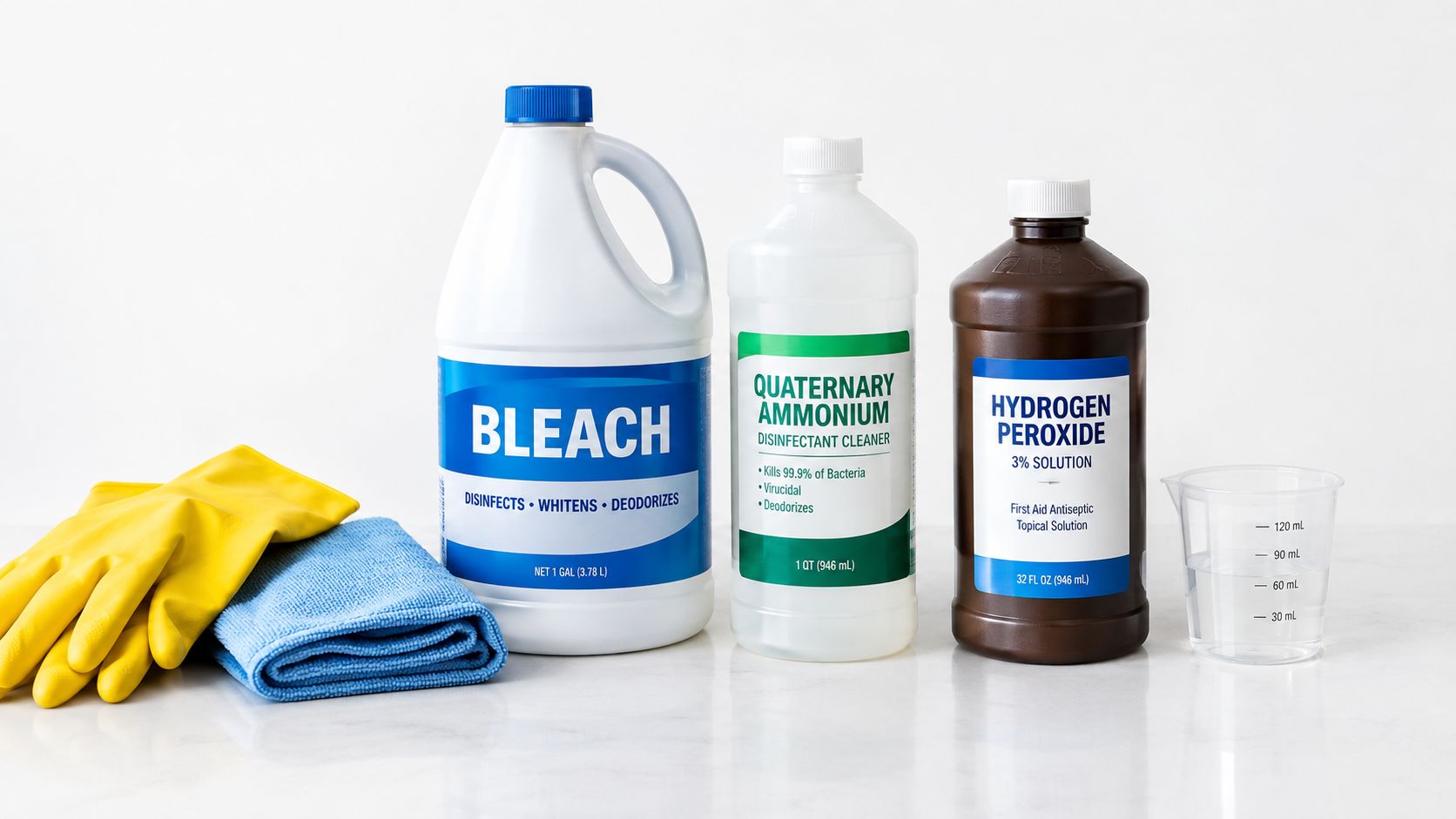
Someone in your home has just recovered from vomiting, the toilet seat needs attention, or you're doing the ordinary weekly wipe-down before guests arrive. The bottle in your hand may promise fast germ-killing power, but that front-label claim doesn't tell you whether it works against norovirus, whether the surface must stay wet for several minutes, or whether the product is safe for your tile and fixtures.
The best disinfectant for bathrooms is not automatically the strongest-smelling spray or the most expensive bottle. It's the EPA-registered product whose organism claim, concentration, contact time, and surface directions match the job. For routine hard, nonporous surfaces, a correctly used bleach solution remains my default when broad viral coverage matters. For everyday maintenance, a ready-to-use product with a shorter validated contact time may be easier to use consistently.
Why the Best Bathroom Disinfectant Depends on the Job
A household recovering from a stomach bug needs a different protocol from a bathroom receiving a routine weekly wipe. A visibly soiled toilet needs cleaning before disinfection, because fecal material and other organic soil can shield microbes from the active ingredient. Treating all three situations with the same quick spray is poor practice.
The central rule is simple: match the disinfectant to the target pathogen and contamination level, not to fragrance, foam, brand price, or a generic kill claim. The CDC's household cleaning guidance recommends an EPA-registered disinfectant for the specific harmful germ when it's known and emphasizes keeping the treated surface visibly wet for the complete label contact time.

Match the surface and exposure
Toilet handles, flush levers, faucets, door handles, light switches, and counters receive frequent hand contact. Floors and grout collect splashes, soil, and moisture. Toilet bowls and the area around the base may contain organic contamination that demands more preparation than a dry, lightly used mirror frame.
Norovirus deserves special attention because it's a non-enveloped virus and can be harder to inactivate than many enveloped respiratory viruses. For suspected norovirus contamination, CDC guidance identifies chlorine bleach as a stronger default than quaternary-ammonium products and recommends 1,000 to 5,000 ppm available chlorine, depending on the contamination scenario. The same guidance calls for at least 5 minutes of wet contact after visible soil has been removed. See the CDC norovirus environmental-cleanup guidance for the concentration and handling framework.
Practical rule: A product only disinfects under the conditions tested on its label. If the surface dries before the stated contact time, you haven't completed the disinfection step.
For most homes and facilities, a small cabinet containing two or three carefully selected EPA-registered products is more useful than a shelf full of overlapping sprays. Keep one product for routine hard-surface work and one option with a clear norovirus claim or an appropriate bleach protocol for vomit or diarrhea contamination.
How Common Active Ingredients Compare
Bathroom disinfectants commonly rely on sodium hypochlorite, quaternary-ammonium compounds, alcohol, or hydrogen peroxide. These chemistries don't have interchangeable strengths. One may be excellent for a large contaminated floor but unsuitable for a metal faucet, while another may be convenient for a small high-touch surface but evaporate before it completes its validated contact time.
| Active Ingredient | Mechanism | Typical Concentration | Strengths | Limitations |
|---|---|---|---|---|
| Sodium hypochlorite | Oxidizes cellular and viral components | Household bleach commonly contains 5% to 9% sodium hypochlorite | Broad activity against bacteria, viruses, and fungi when correctly diluted | Can irritate skin and lungs, damage metals, discolor materials, and must never be mixed with other cleaners |
| Quaternary-ammonium compounds | Disrupt cell membranes and envelopes | Product-specific | Convenient, often low-odor, and generally suitable for many hard surfaces | A generic quat product may not carry a norovirus claim |
| Ethanol or isopropanol | Denatures proteins and disrupts envelopes | Product-specific | Useful for small compatible surfaces and rapid evaporation | Can dry before completing contact time on large bathroom surfaces and is flammable |
| Hydrogen peroxide | Oxidative damage to microbial components | Product-specific | Often leaves little residue and can be surface-friendly when the label permits | Performance, material compatibility, and contact time vary by formulation |
Sodium hypochlorite
Bleach is my first choice when broad viral coverage or suspected norovirus contamination is the priority and the surface can tolerate it. The CDC says regular, unscented household bleach commonly contains 5% to 9% sodium hypochlorite. Where no product-specific dilution is available, its household guidance specifies 5 tablespoons per U.S. gallon of room-temperature water, with the surface kept visibly wet for at least 1 minute. The CDC bleach dilution guidance also says to prepare diluted bleach fresh daily.
Bleach is not gentle chemistry. It can corrode metal, affect colored grout, irritate airways, and damage finishes. Use ventilation, gloves, and eye protection, and consult a material safety resource such as this bleach SDS for construction before workplace use.
Quats, alcohol, and peroxide
Quaternary-ammonium products are practical for routine maintenance, especially where odor and material compatibility matter. They're not my automatic choice after vomiting or diarrhea unless the label specifically includes norovirus efficacy.
Alcohol can work well on small compatible items, but evaporation is its weakness. A product that disappears quickly may never keep a large sink, floor, or toilet exterior wet for the required interval. Hydrogen peroxide products offer a useful alternative when their label supports the target organism and surface. For readers comparing preparation methods, bleach disinfectant solution guidance provides additional context, but the in-use product label remains controlling.
Reading Disinfectant Labels the Right Way
Ignore the large marketing promise on the front until you've checked the operational details on the back. A bottle can advertise broad germ-killing performance while lacking a claim for the virus that concerns you.
Four checks that matter
Start with EPA registration. Look for an EPA registration number and confirm the product in the relevant EPA database or list. List N is the key reference for products with claims relevant to SARS-CoV-2, while other EPA lists and label records may address additional organisms or use cases. If the bottle lacks a clear EPA establishment or registration reference, don't treat it as a validated disinfectant.
Find the organism claim. “Effective against bacteria” doesn't establish efficacy against norovirus. A claim for Staphylococcus aureus isn't the same as a claim for human norovirus, influenza, or SARS-related coronavirus 2. EPA's selected registered disinfectants show why the product must be matched to the pathogen rather than selected by ingredient name alone.
Locate the contact time. Contact time is the period the surface must remain visibly wet. It varies by product, concentration, organism, and formulation. One EPA label specifies 5 minutes for a hard, nonporous surface, another specifies 4 minutes for norovirus, and another lists 1 minute for norovirus and 30 seconds for SARS-related coronavirus 2. Those differences make immediate spray-and-wipe an unreliable habit.
The EPA explanation of disinfectant contact time reinforces the central point: keep the treated surface wet for the entire listed interval. If the product dries early, reapply enough to restore visible wetness.
Check the material directions
Natural stone, finished wood, unsealed grout, damaged coatings, and some metals may react badly to bleach or peroxide. Test only as the label allows, and never assume that a product safe for porcelain is safe for every nearby fixture.
Cross-reference the EPA registration number with the manufacturer's master label when you need to verify dilution, organism claims, application method, rinsing, or surface restrictions. For a deeper explanation of the operational issue, see this guide to contact time for disinfectants.
How to Disinfect a Bathroom Step by Step
Disinfection starts before the disinfectant leaves the bottle. Put on gloves and eye protection, and use a mask if splashing or aerosolized material is likely. Turn on the exhaust fan or open a window, particularly when using bleach or another irritating formulation.
Clean before you disinfect
Remove hair, soap scum, dust, fecal material, and other visible soil with detergent and water. Organic material can reduce disinfectant performance, and a dirty surface prevents the product from reaching the entire area. Use disposable towels for vomit or fecal contamination, place them in a sealed bag, and discard them according to local requirements.
Apply the disinfectant generously enough to make the surface visibly wet. Start with the toilet handle and flush lever, then clean the faucet, door knob, light switch, counter, and other high-touch areas. Keep each surface wet for the full label contact time, and reapply if it begins to dry.
Work from cleaner zones to dirtier zones
Use separate cloths for different areas. Clean the bowl interior last, with a dedicated tool or cloth that never returns to the sink, counter, or door handle. This order reduces the chance of moving contamination from the toilet to hand-contact surfaces.
Pink or reddish residue around a shower or sink may involve more than ordinary dirt. A practical resource on Miami bathroom pink residue removal can help distinguish residue removal from the separate task of disinfection. Removing the buildup is important, but a cleaner alone isn't automatically a registered disinfectant.
Rinse only where the product label requires it or where the surface will contact food. Countertops used for food preparation may require rinsing after the contact time. Wash reusable cloths appropriately, or dispose of heavily contaminated materials in a sealed bag. For broader surface technique, consult this guide on how to disinfect surfaces.
Choosing the Right Product for Each Scenario
The right product changes with the incident. I'd use a convenient EPA-registered product for routine maintenance, verify an appropriate respiratory-virus claim when that risk is known, and move to a chlorine-based protocol for vomit or diarrhea contamination.
| Scenario | Recommended Product | Dilution / Strength | Contact Time | Surface Notes |
|---|---|---|---|---|
| Routine bathroom maintenance | EPA-registered product for the target organism, or household bleach when compatible | If no product-specific bleach direction exists, 5 tablespoons per U.S. gallon | At least 1 minute under the CDC default when no label direction is available | Use on compatible hard, nonporous surfaces after cleaning |
| Respiratory-virus concern | EPA-registered product with the relevant viral claim | Follow the exact label dilution and strength | Use the complete label contact time | Check compatibility on metals, stone, grout, and finished surfaces |
| Norovirus, vomit, or diarrhea contamination | Fresh chlorine bleach solution or an EPA-registered product specifically effective against norovirus | 1,000 to 5,000 ppm available chlorine; the higher end is for heavy body-fluid contamination | At least 5 minutes after visible soil is removed | Use disposable absorbent materials first and rinse where appropriate |
Routine maintenance
For a normal wipe-down, select a registered product with a claim that fits the organisms of concern and a contact time household members can follow. A ready-to-use wipe can be practical for a faucet, handle, or switch, but only if it deposits enough liquid to keep the whole surface wet for the listed interval.
Bleach is appropriate for compatible hard, nonporous surfaces when mixed and used according to the label or CDC fallback direction. The CDC identifies toilets, sinks, handles, and floors as suitable examples when the material tolerates bleach.
Respiratory-virus precautions
For a known respiratory-virus concern, check the EPA label for the specific virus or applicable emerging-pathogen pathway. Alcohol may suit a small compatible item, while a registered spray or wipe may be more practical on a large surface if it provides adequate wet coverage.
Don't substitute a generic antibacterial claim for a viral claim. A product's performance against an enveloped respiratory virus doesn't establish performance against norovirus or another non-enveloped virus.
Gastroenteritis cleanup
After vomit or diarrhea, remove the bulk contamination with disposable absorbent towels. Then apply a fresh chlorine solution in the 1,000 to 5,000 ppm range, using the higher concentration when the contamination is substantial, and maintain wet contact for at least 5 minutes. Follow the product label, use ventilation and protective equipment, and rinse where appropriate.
Avoid bleach on natural stone, unsealed wood, damaged finishes, or colored grout unless the manufacturer confirms compatibility. In shared facilities with vulnerable occupants, a clearly labeled registered product is usually safer operationally than an improvised mixture that staff may dilute inconsistently.
Mistakes That Make Bathroom Disinfection Fail
Most bathroom disinfection failures don't come from choosing a weak brand. They come from using a valid product under conditions that don't match its tested directions.
The five errors I see most often
Spraying and wiping immediately. A disinfectant can't complete a five-minute claim if the user wipes it off after a few seconds. The EPA defines contact time as the period the surface remains wet, so reapply whenever the surface dries before the label interval ends.
Keeping diluted bleach indefinitely. Diluted bleach loses effectiveness over time. The CDC recommends preparing it fresh daily because its performance declines after 24 hours. Mix only what you can use within that period.
Mixing cleaning chemicals. Never combine bleach with ammonia, acids, or other bathroom cleaners. The resulting gases can seriously injure the eyes and lungs. Use one product at a time, rinse when the label requires it, and never improvise combinations.
Trusting “kills 99.9% of germs” without checking the organism. A broad percentage claim doesn't tell you whether the product was tested against norovirus, rotavirus, influenza, or SARS-related coronavirus 2. Look for the specific registered organism claim and its contact time.
Skipping pre-cleaning. Soap scum, feces, vomit, and other organic soil can interfere with the disinfectant. Remove visible contamination first, then cover the entire surface with enough product to maintain wetness.
The one-question test: Was the surface visibly wet for the full label contact time? If not, the disinfection step wasn't completed under the tested conditions.
That test exposes the most common false confidence in bathroom cleaning. A fragrant spray, a disposable wipe, or a bleach solution can all fail when the user applies too little product, wipes too soon, or skips removal of visible soil.
Quick Checklist and Common Questions
Keep this decision guide near the cleaning cabinet:
- Routine wipe: Choose an EPA-registered quat, peroxide product, or other registered formulation whose label covers the organism of concern. Follow its exact contact time.
- Respiratory-virus concern: Use a product with the relevant viral claim, and keep the surface wet for the complete label interval.
- Norovirus or vomit event: Use an EPA-registered norovirus product or freshly prepared chlorine bleach in the 1,000 to 5,000 ppm range, with at least 5 minutes of wet contact after cleaning. See the CDC norovirus prevention guidance.
- Every situation: Remove visible soil first, verify the EPA registration, ventilate, wear gloves and eye protection, and never mix chemicals.

Common questions
How long should I ventilate? Open a window or run the exhaust fan while applying the product and during use. There isn't a universal ventilation duration that replaces the label, so judge airflow by whether fumes remain irritating and follow the product's safety directions. If the room still smells harsh or causes eye, throat, or breathing irritation, leave the area and improve ventilation before continuing.
What PPE do I need? For ordinary spray use, wear gloves and eye protection, and add a mask when splashing or strong fumes are possible. Pouring or diluting concentrate requires greater care, including the protective equipment specified by the label and the product safety documentation.
Can I store diluted bleach? Treat diluted bleach as short-lived. The CDC recommends making it fresh daily because effectiveness declines after 24 hours. Unopened product storage and shelf life depend on the manufacturer's packaging and label, so check the bottle rather than applying a universal rule.
Can I alternate quats and bleach on one surface? Don't mix them or apply one immediately over the other. Follow the first product's rinsing and compatibility directions before using a different chemistry, and only alternate products when the label and facility procedure support it.
What if there's no EPA establishment number? Don't rely on the product for validated disinfection. Choose a product with clear EPA registration information and confirm the pathogen claim in the appropriate EPA list or manufacturer label.
How do I verify SARS-CoV-2, norovirus, or influenza claims? Search the product's EPA registration information and master label for the exact organism. List N is relevant to SARS-CoV-2, while other EPA records and lists may address additional pathogens. For norovirus, look for a direct claim or an approved surrogate pathway, not a generic “kills germs” statement.
The best disinfectant for bathrooms is the product you can match correctly, apply safely, and keep wet for the required time. Choose a registered formula for routine work, keep a validated norovirus option available for gastroenteritis cleanup, and reserve bleach for compatible surfaces and situations where its broad activity justifies the trade-offs.
Before the next bathroom cleanup, check the label, confirm the pathogen claim, and place a suitable EPA-registered product, fresh bleach supplies, gloves, eye protection, and disposable towels where staff or household members can reach them. For virus-specific background and practical prevention guidance, visit VirusFAQ.com and build your cleaning routine around the organism and exposure scenario, not the loudest promise on the bottle.
Leave a Reply