When it comes to neutralizing dangerous viruses, few things are as reliable and accessible as a properly prepared bleach solution. The real workhorse here is its active ingredient, sodium hypochlorite, which is incredibly effective at inactivating a wide host of pathogens when you mix it up the right way.
What Makes Bleach Such a Powerful Disinfectant

Before you start preparing a solution, it’s worth understanding why bleach has been the go-to for serious disinfection for so long. It's not just an old wives' tale; the power is all in the chemistry. The sodium hypochlorite in your standard household bleach is a serious oxidizing agent.
When a properly diluted bleach solution meets bacteria or viruses, it gets to work immediately. It attacks and breaks down the proteins and genetic material (their RNA or DNA) that these pathogens need to survive and replicate. Once that happens, they’re completely neutralized. Game over. This process is what makes it so brutally efficient against a wide range of microbes.
The Chemistry of Clean
Think of sodium hypochlorite as a tiny demolition crew for pathogens. It’s particularly good at wiping out some of the toughest and most contagious viruses out there, including:
- Norovirus (Norwalk Virus): The notoriously resilient, small non-enveloped virus that causes gastroenteritis and spreads like wildfire.
- Influenza A Virus (H1N1): A major enveloped virus responsible for seasonal flu outbreaks.
- SARS-Related Coronavirus 2 (SARS-CoV-2): The enveloped virus that causes COVID-19.
- Hepatitis B Virus (HBV) and Hepatitis C Virus (HCV): Enveloped viruses that can survive on surfaces and pose significant health risks.
- Herpes Simplex Virus 1 (HSV-1) and Herpes Simplex Virus 2 (HSV-2): Common enveloped viruses that are susceptible to bleach disinfection.
This broad-spectrum killing power is why you'll find bleach used everywhere from hospitals to homes. Its long track record in public health, from sanitation to purifying water, really speaks to how reliable it is.
Bleach Effectiveness Against Common Pathogens
| Pathogen Type | Common Examples | Effectiveness of Bleach Solution |
|---|---|---|
| Viruses (Enveloped) | Influenza (H1N1, H5N1), SARS-CoV-2, HIV-1, HBV, HCV, HSV-1, HSV-2 | Highly Effective. Bleach quickly destroys the outer lipid envelope, inactivating the virus. |
| Viruses (Non-Enveloped) | Norovirus, Human Rotavirus, Rhinovirus | Highly Effective. Bleach is one of the few disinfectants strong enough to destroy these hardy viruses. |
| Bacteria (Gram-Positive) | Staphylococcus aureus (Staph), Streptococcus | Highly Effective. Disrupts the cell wall and internal components, leading to rapid cell death. |
| Bacteria (Gram-Negative) | E. coli, Salmonella, Pseudomonas | Highly Effective. Penetrates the outer membrane and destroys essential cellular structures. |
| Fungi/Mold | Aspergillus, Candida albicans (Yeast) | Effective. Kills fungal spores and inhibits mold growth on hard, non-porous surfaces. |
As you can see, bleach doesn't just target one or two things; its chemical action is effective against bacteria, viruses, and even mold, making it a valuable tool for comprehensive disinfection.
Check the Concentration
Now, here’s a crucial detail: not all bleach is created equal. Before you mix up a batch of disinfectant, always check the label for the sodium hypochlorite concentration. Most standard household bleach products will fall somewhere between 5% and 9%.
This number is everything. The recipes for disinfecting solutions are built around these specific concentrations. If you grab a bottle with a different strength and don't adjust your measurements, you could end up with a mix that’s too weak to be virucidal or one that’s so strong it’s overly corrosive and hazardous.
The demand for hypochlorite bleaches just keeps growing, underscoring their vital role in keeping us safe. The market was valued at around USD 339 million in 2025 and is expected to hit about USD 573.3 million by 2035, largely thanks to sanitation needs in healthcare and other industries. You can learn more about the global market for hypochlorite bleaches and their widespread applications.
Making your own solution is a fantastic, budget-friendly way to disinfect, but it demands respect and careful measurement. For those quick, everyday cleanups where you just need to grab something and go, pre-made options like disinfecting wipes can be a great alternative. They take the guesswork out of the equation and ensure proper concentration every time.
Essential Safety Measures for Handling Bleach

While a homemade disinfectant solution bleach is a powerhouse against viruses, you have to respect its chemical nature. Handling it the right way isn't just a suggestion—it's a non-negotiable part of keeping yourself, your family, and your home safe. Think of it as your pre-flight check before you even uncap the bottle.
First things first: get some air moving. As soon as you open a bottle of bleach, it releases fumes that can irritate your lungs. Always crack open a window or turn on a fan to create some airflow, especially if you're in a tight space like a bathroom. It’s a simple move that makes a huge difference in dispersing those fumes.
Personal Protective Equipment Is Key
You don't need a full hazmat suit, but personal protective equipment (PPE) isn't just for scientists. When you're mixing or using a bleach solution, a few basic items are essential to prevent a painful accident.
- Eye Protection: A stray splash can cause serious eye damage. A simple pair of safety glasses or goggles is a quick and easy way to prevent that from happening.
- Gloves: Bleach is incredibly harsh on the skin. Always wear waterproof gloves—rubber or nitrile work great—to protect your hands from irritation and chemical burns.
With good ventilation and basic PPE, you've already created a much safer environment. But what you don't do is just as important.
Never mix bleach with other cleaning products, especially anything containing ammonia. This is one of the most common and dangerous mistakes people make. The combination creates toxic chloramine gas, which can cause severe respiratory damage. Stick to just bleach and water.
Creating a Safe Workspace
Beyond your personal gear, take a look at your surroundings. If you have curious kids or pets, make sure they're out of the area while you’re mixing and cleaning. Once you've prepared your solution, store it and the original bleach bottle somewhere secure and completely out of their reach.
Here’s another pro tip: when you dilute bleach, always use cold water, not hot. Hot water actually causes more chlorine gas to be released into the air and can make your solution less stable and effective. It's a simple switch that significantly improves safety.
Following these steps is crucial for mixing at home, but it also highlights why professionally made products exist. High-quality disinfecting wipes, for example, are formulated to be stable and ready-to-use, minimizing the risks that come with handling pure chemicals and offering a convenient, reliable solution for daily use.
These practices aren't just arbitrary rules; they are fundamental to safe and effective disinfection. Adhering to strict safety protocols is a core principle in preventing illness, and it extends far beyond the home. In fact, understanding these basics gives you a glimpse into the broader strategies for hospital-acquired infection prevention, where chemical safety is absolutely paramount.
Getting Your Bleach Disinfectant Mix Just Right
When it comes to mixing up a bleach disinfectant, getting the ratio right is everything. A mix that's too weak won't do the job against serious viruses, but one that's too strong can wreck your surfaces and be a real hazard to work with. The trick is knowing which ratio to use for the task at hand.
Think of it like being in a lab. Precision matters. A little too much of one thing, not enough of another, and the whole experiment fails.

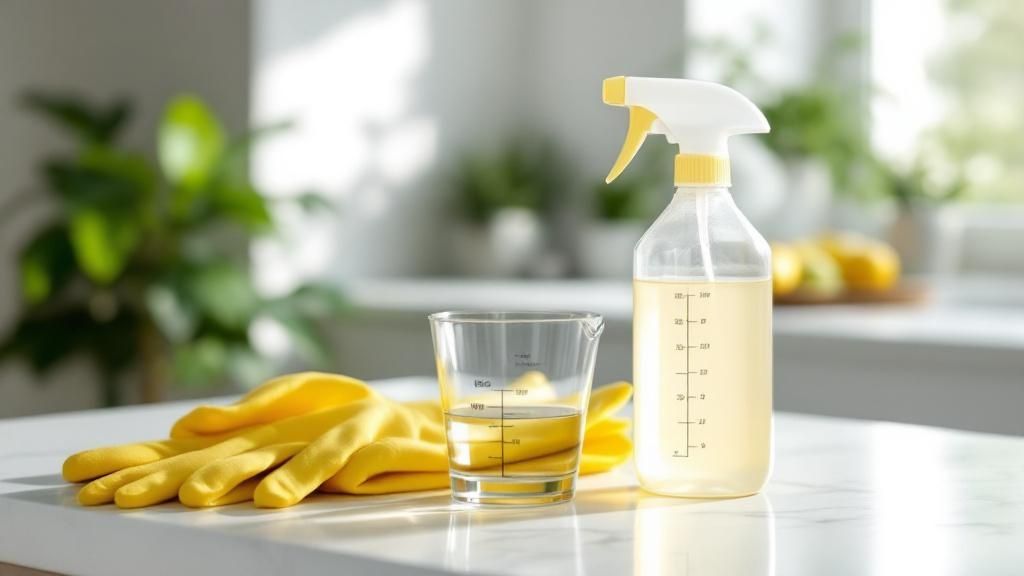
As you can see, using standard household measuring tools is all it takes. But that accuracy is non-negotiable if you want a solution that's both safe and effective at killing pathogens.
Ratios for General Disinfection
For those everyday hard, non-porous surfaces—think countertops, tile floors, doorknobs, and bathroom fixtures—you'll want a standard dilution. This is your go-to mix for tackling tough viruses like Norovirus or Influenza A Virus (H1N1).
- For a big job: Mix 1/3 cup of 5%-9% household bleach with 1 gallon of cool water.
- For a smaller batch: Just need a little? Mix 4 teaspoons of bleach with 1 quart (4 cups) of cool water.
This concentration is powerful for a reason. Its properties are what make it a potent enemy against pathogens. If you're curious about the science behind it, our guide explains in detail what makes a substance germicidal.
Food-Contact Surface Ratios
Now, if you're disinfecting surfaces that touch food, like your kitchen counters or cutting boards, you have to switch gears. Safety is paramount here, so you need a much milder, food-safe concentration.
- The Food-Safe Ratio: Mix just 1 tablespoon of 5%-9% household bleach with 1 gallon of cool water.
After you've applied this gentler solution and let it sit for the required contact time, it’s crucial to rinse the surface thoroughly with clean water. Let it air dry completely before any food touches it.
A Critical Reminder: Don't mix up a big batch to use all week. A bleach solution is only at its peak for about 24 hours. After that, it starts breaking down and losing its germ-killing power. Only mix what you'll use in a single day to avoid wasting bleach and, more importantly, using a solution that no longer works.
Best Practices for Mixing
Accuracy and safety are two sides of the same coin. Always start with fresh, unexpired bleach. Its potency drops over time, even in an unopened bottle. Once you open it, you’ve got about six months before it’s significantly less effective.
And here’s a tip I can't stress enough: label your container. A simple piece of tape with "Bleach Solution" and today's date can prevent a dangerous mix-up with other cleaners. It also ensures you're always grabbing a fresh, potent batch.
While making your own disinfectant is a great way to save money, the need for precision really underscores why pre-measured disinfecting wipes are so handy. They are always ready at the proper strength, making them a superior choice for those quick cleanups where you just can't afford to guess.
Proper Application for Maximum Disinfection
You’ve carefully mixed your bleach solution, and that’s a huge first step. But the real work begins now. How you apply that solution is what actually neutralizes nasty pathogens like Hepatitis B Virus (HBV) or Human Rotavirus lurking on your surfaces.
It all comes down to technique.
A lot of people make the mistake of treating disinfection like a quick spray-and-wipe job. To be truly effective, the bleach solution needs to remain on the surface for a very specific amount of time. We call this contact time, and honestly, it's the single most important part of the entire process.
The Importance of Contact Time
For a bleach solution to do its job, the surface you're treating has to stay visibly wet for the entire recommended duration. This gives the sodium hypochlorite enough time to get in there and demolish the proteins and genetic material of viruses and bacteria.
- As a general rule: Most standard bleach solutions need a solid 5 to 10 minutes of contact time to be effective against tough viruses. A good example is Feline Calicivirus, a surrogate virus often used in labs for its resilience, which is similar to the notoriously hard-to-kill Norovirus.
- Always check the label: If you’re using a store-bought bleach product, the label is your best friend. It will tell you the exact contact time needed for different pathogens.
Spraying and immediately wiping a surface dry does next to nothing. You've got to let the solution sit and work its magic.
Cleaning vs. Disinfecting: A Crucial Distinction
Here's something I see people get wrong all the time: you can't disinfect a dirty surface. It just doesn't work. Grime, dust, and other organic matter can act like a shield for germs, blocking the bleach from ever reaching them.
This is why you always have to clean before you disinfect.
Think of it as a one-two punch. Cleaning is the jab that clears the field by physically removing germs and dirt. Disinfecting is the knockout blow that kills whatever pathogens are left behind.
Start by giving the surface a good scrub with soap and water to get rid of any visible soil. Once it’s clean and rinsed, then you can apply your bleach solution. This two-step approach is fundamental for anyone wanting to truly understand the difference between basic disinfection and the broader world of antiseptics, where proper prep is everything.
Know Your Surfaces
Bleach is a powerhouse, but it's not a one-size-fits-all solution. Using it on the wrong material can lead to permanent damage like corrosion or ugly discoloration.
Surfaces That Are Generally Safe for Bleach:
- Hard, non-porous countertops (like laminate, granite, or quartz)
- Ceramic and porcelain tile
- Glass
- Most plastic items (think toys or patio furniture)
- Stainless steel (just be sure to rinse it off promptly when you're done)
Surfaces to Steer Clear Of:
- Wood: Bleach can damage and discolor both finished and unfinished wood. It's just too porous.
- Porous Stone: Materials like marble and some types of granite can be etched or dulled by bleach's harshness.
- Certain Metals: Definitely avoid using bleach on aluminum, copper, and silver. It will cause them to corrode.
One last pro-tip from my experience: for any surface that will come into contact with food, like your kitchen counters or cutting boards, you have an extra step. After the contact time is up, always rinse the surface thoroughly with fresh, clean water. Let it air dry completely before you start prepping your next meal. This makes sure no bleach residue is left behind to spoil your food.
Safe Storage and Disposal of Your Bleach Solution
Once you’ve finished disinfecting, you’re not quite done. What you do with the leftover bleach solution—and the original bottle—is the final and most critical piece of the safety puzzle. Getting storage and disposal right prevents accidents, keeps the bleach potent for next time, and protects the environment.
The active ingredient in bleach, sodium hypochlorite, is a bit fragile. It breaks down when it gets hot or sits in the sun. To keep your bleach effective, always store the original bottle in a cool, dark spot, like a high cabinet away from any heat sources. It's also good to know that once you open a bottle of household bleach, it has a shelf life of only about six months before it starts losing its disinfecting punch.
Storing Your Prepared Solution
Your freshly mixed bleach water needs the same kind of careful handling. Don't just leave it in an open bucket or an unmarked spray bottle—that’s asking for trouble.
Instead, pour it into an opaque, sealed container to keep light out. Most importantly, label it clearly and store it somewhere children and pets absolutely cannot reach.
A simple label that says "Bleach Solution" with the date you mixed it is non-negotiable. Why? Because the solution is really only effective for about 24 hours. That label ensures you don’t grab a weak, useless mix when you need to do a serious disinfecting job.
The key thing to remember is that a bleach solution is a temporary tool. Its power fades fast, so treating it that way—by storing it correctly and using it quickly—is essential for effective disinfection.
How to Dispose of Bleach Safely
When it’s time to get rid of leftover solution, the process for small, household amounts is usually pretty simple. You can typically pour the diluted bleach solution right down a sink or toilet.
To do it safely, turn on the cold water first. Let it run as you slowly pour the solution down the drain. This dilutes the bleach even more and helps flush it cleanly through your pipes. Never, ever pour undiluted bleach straight down the drain, and try to avoid dumping large quantities this way. For bigger jobs or commercial disposal, you’ll want to check with your local waste management authority for their specific rules.
Bleach is a staple in our lives for a reason. Its importance is reflected in the global bleaching agents market, which was valued at USD 908 million in 2024. This market covers everything from the bleach under your sink to industrial applications in paper and textile manufacturing. To get a bigger picture of its role, you can read more about the diverse role of bleaching agents in global industries.
While a DIY solution is effective, for effortless, consistent, and safe disinfection, nothing beats the convenience of high-quality disinfecting wipes. They eliminate all the steps of mixing, measuring, and storing, giving you virucidal power right at your fingertips.
Common Questions About Bleach Disinfectant Solutions
Even after you've got the mixing and application down, a few questions always seem to pop up. Let's be honest, there are a lot of myths and "common knowledge" about bleach floating around. Getting clear, straight answers helps you use it confidently and, more importantly, safely.
Let's cut through the noise and tackle some of the most frequent questions.
How Long Does Bleach Actually Last on the Shelf?
This is a great question, and the answer might surprise you. An unopened bottle of household bleach is good for about a year. But the moment you crack that seal, the clock starts ticking a lot faster. Once it's opened, bleach starts to degrade and lose its disinfecting punch.
For the best results, you'll want to use an opened bottle of bleach within six months. After that, the concentration of sodium hypochlorite drops off, meaning it won't be strong enough to reliably kill nasty pathogens like Norovirus or SARS-CoV-2.
I always tell people to grab a permanent marker and write the date they opened the bottle right on the label. It’s a simple trick, but it stops you from accidentally using expired bleach that isn't actually disinfecting anything.
Can I Use Scented or "Splash-Less" Bleach for Disinfecting?
I’d steer clear of those for serious disinfecting jobs. Many of the scented or splash-less bleach products you see on the shelf aren't actually registered with the EPA as disinfectants. They often have a lower concentration of sodium hypochlorite or contain other additives that can interfere with its virucidal power.
When you need a reliable disinfectant, always reach for plain, unscented household bleach with a sodium hypochlorite concentration somewhere between 5% and 9%. Just take a quick look at the label—it will tell you if it's meant for disinfection.
Does Bleach Really Not Kill Mold?
This one is a classic, and there's some truth to it. Bleach is great at killing surface mold on hard, non-porous materials like tile, glass, or a sealed countertop. But on porous stuff like wood or drywall? It’s a different story.
The chlorine in bleach can't soak deep enough into porous surfaces to kill the mold's "roots" (mycelia), so the mold just grows right back. Even worse, the water in your bleach solution can actually feed the mold that's hiding inside the material, potentially making your problem worse. For any serious mold issue, you really need to use a product made specifically for mold remediation.
The trust we place in bleach for hygiene isn't just anecdotal; it's driving major market trends. Especially since the COVID-19 pandemic, the demand for effective disinfectants has skyrocketed. The global bleach market is expected to grow by USD 408 million between 2024 and 2029, largely because of its critical role in healthcare and public sanitation. You can explore more details about this market growth on Technavio.org.
Is It Safe to Use a Bleach Solution Around My Pets?
You need to be extremely careful here. Bleach fumes can be really irritating to an animal’s sensitive respiratory system, and it’s definitely toxic if they ingest it. Never, ever use a bleach solution while your pets are in the room.
Make sure the area is well-ventilated and keep your pets away until every surface is completely dry. If you're cleaning floors, their food bowls, or crates, it's a good idea to rinse the surfaces with plain water after disinfecting and let them air dry completely before letting your furry friends back in.
When in doubt, especially for quick clean-ups in a home with pets, pre-formulated disinfecting wipes are a much safer and more convenient alternative. They are designed for quick drying and controlled application, minimizing risk and providing peace of mind.
Leave a Reply