As few as 10 norovirus particles may be enough to infect a person, according to CDC technical guidance. That tiny infectious dose explains why a bathroom handle, shared serving utensil, or small vomiting incident can become the starting point for illness across a household, classroom, care facility, restaurant, or ship.
Norovirus transmission is mainly fecal-oral. In practical terms, virus from stool or vomit reaches another person's mouth through hands, food, water, objects, contaminated surfaces, or droplets produced during vomiting. People can also spread it before symptoms begin and for 2 weeks or more after recovery, according to the CDC, so feeling better doesn't immediately mean the transmission risk has ended.
Why Norovirus Is the Most Contagious Stomach Virus
Norovirus causes about 685 million cases each year and roughly 200,000 deaths, mostly among young children in low- and middle-income countries, according to the World Health Organization. It affects every age group and remains a major cause of acute gastroenteritis worldwide.
Its exceptional contagiousness starts with a very low infectious dose. Human challenge research commonly places that threshold at about 10 to 18 viral particles. A contaminated hand can transfer enough virus to a mouth, sandwich, cup, or utensil without leaving any visible sign. In a household, that threshold may be crossed through a shared bathroom, a meal prepared by someone shedding virus, or a surface touched after toileting. During vomiting, the same small dose may be delivered across nearby surfaces and objects, while contaminated droplets or particles reach the surrounding area.
Several biological features help norovirus move efficiently:
- A non-enveloped capsid helps protect the virus from conditions that damage many enveloped viruses, including some environmental stresses.
- Short-lived immunity means one infection does not reliably protect a person for life.
- Multiple genogroups and variants give people repeated opportunities to encounter a strain their immune system does not recognize well.
- Human shedding in stool and vomit places large amounts of virus in spaces where people eat, sleep, work, and share bathrooms.

The four everyday pathways
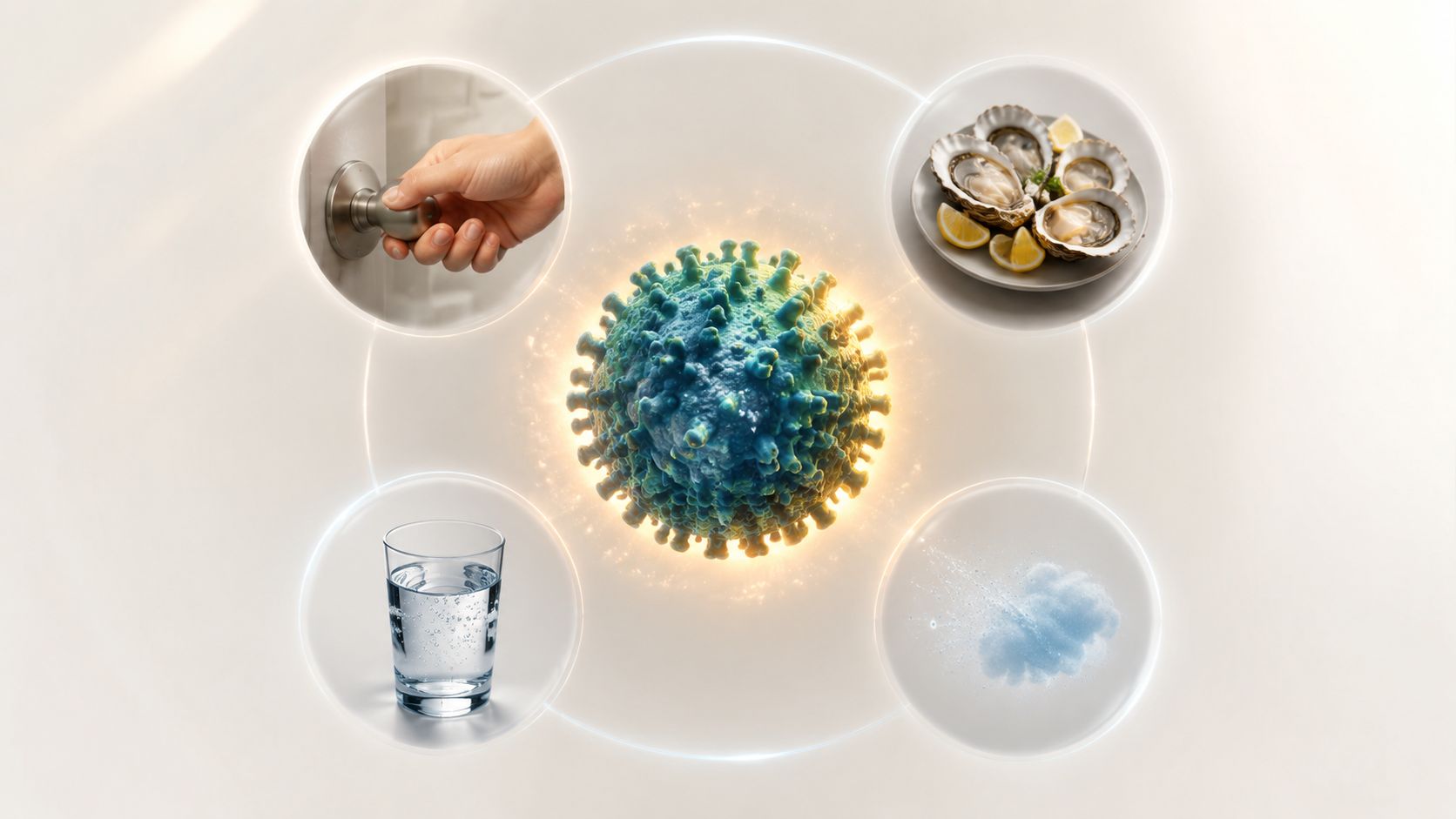
To understand how is norovirus transmitted, follow the contamination chain. An infected person can contaminate hands or surfaces. Food and water can carry the virus into the digestive tract, while vomiting can affect nearby air, objects, and surfaces at the same time.
The VirusFAQ explanation of norovirus transmission mechanisms explains how these routes overlap and why cleaning must address more than visible dirt.
Norovirus does not require a dramatic exposure. A shared bathroom, buffet utensil, contaminated food item, or area left untreated after vomiting can provide enough opportunity for infection. Household spread often follows repeated hand and surface contact, whereas a vomiting event can contaminate several routes at once. Prevention works best when it interrupts multiple pathways together.
The Fecal-Oral Route and How Norovirus Moves Between People
Norovirus follows a simple but highly efficient biological cycle. After a person ingests the virus, it infects cells in the small intestine. The infected person then sheds virus in stool and vomit, and another person becomes infected when even a trace amount crosses from the contaminated environment into the mouth.

CDC outbreak surveillance illustrates the importance of close contact. Among 17,927 outbreaks reported by participating states during one reporting period, 79% were transmitted person-to-person and 14% were foodborne, according to the CDC norovirus causes page. These figures describe reported outbreaks in that surveillance system, not every norovirus infection, but they show how often direct human contact dominates in real-world spread.
How contamination reaches a new host
Person-to-person spread can occur when someone cares for an ill family member, shares a bathroom, or touches another person after using the toilet without adequate handwashing. A person may look healthy while shedding virus, which makes ordinary social contact difficult to assess by appearance alone.
Foodborne transmission often begins with contamination shortly before food is eaten. An infected food handler may touch ready-to-eat food, serving utensils, or preparation surfaces. Raw shellfish can create a separate risk because oysters and similar animals filter water and can concentrate contamination from polluted growing areas.
Waterborne spread may occur when sewage contaminates drinking water, recreational water, or water used to rinse produce. A swimming area, campsite, or community water source can expose people who never meet the person who introduced the virus.
Fomite transmission involves objects such as bathroom handles, taps, phones, tables, railings, and shared utensils. Fomites cut across the other categories because contaminated hands can move virus from a person to an object, and from that object to food or another person.
Practical rule: Treat every vomit or diarrhea incident as a contamination event, not just a symptom episode.
The CDC overview of norovirus transmission describes this combined fecal-oral pattern, including person-to-person contact, contaminated food and water, and contaminated surfaces. It also notes that humans are the only known reservoir for human norovirus, keeping infected people at the center of prevention.
Infectious Dose and How Long You Can Spread the Virus
A dose of 10 to 18 particles is difficult to visualize. The quantity capable of initiating infection is microscopic, yet it can be transferred through ordinary contact. That low threshold helps explain why a surface that looks clean may still spread norovirus.
Human dose-response research by Teunis and colleagues found that infection probability rises sharply as exposure increases from roughly 10 to 1,000 particles. A few transferred particles may infect one person. A larger invisible residue, moved repeatedly by hands, can reach several people. In a home, that may happen through shared bathroom fixtures, towels, or food preparation. During vomiting, contaminated droplets and particles can spread beyond the immediate surface area, creating a more intense exposure event.

The contagious window
Norovirus can be present in stool before a person realizes they are ill. Shedding is often greatest during active illness, but recovery does not immediately mark the end of contagiousness.
People can continue spreading norovirus for 2 weeks or more after recovery. Evidence reviews report that shedding may persist for up to 22 days after infection and 5 days after symptoms resolve, with extra caution warranted for people who have prolonged illness or weakened immune systems. The CDC guidance on duration recommends avoiding food preparation and close-contact settings while symptoms are active and during the recovery period.
For practical guidance on the illness timeline, see this guide to how long norovirus lasts.
Remain home for at least 48 hours after vomiting and diarrhea stop before returning to work, school, or food handling. Workplace, school, healthcare, or food-safety rules may require longer exclusion, especially for people who prepare food or work with vulnerable populations.
High-Risk Settings Where Norovirus Spreads Fastest
Norovirus spreads fastest where people live or work close together, share bathrooms and touchpoints, and have little time to isolate after symptoms begin. Because only a small amount of virus may cause infection, each shared surface, meal, or restroom visit can act like another handoff. The setting amplifies transmission by creating repeated opportunities for the same contamination to reach many mouths.
Cruise ships show how this pattern develops. Passengers share dining rooms, elevators, handrails, cabins, and recreational facilities. Someone may board while incubating the infection, then begin vomiting or having diarrhea after arrival. Travelers checking health procedures and outbreak updates for cruise ships should follow crew instructions and ship-specific sanitation notices promptly. The VirusFAQ guide to cruise ship virus outbreaks explains how shared spaces, contaminated surfaces, and delayed isolation can connect individual cases.
Four settings, overlapping routes
Long-term care facilities face added difficulty because residents may be older, medically vulnerable, or dependent on caregivers. Staff move between rooms, bathrooms, and communal areas, allowing one contaminated glove, hand, cart, or touchpoint to connect several rooms. Severe vomiting and diarrhea can also leave residents at greater risk of dehydration.
Schools and childcare settings combine close contact with shared toilets, desks, toys, and drinking fountains. Young children may wash poorly or return to class before adults identify the illness. One vomiting episode can contaminate nearby surfaces and the people who clean them.
Restaurants and institutional kitchens provide a direct path from an infected worker to ready-to-eat food. A food handler who works while ill or returns too soon may contaminate food, utensils, refrigerator handles, and preparation areas. Customers can then carry the virus home to people who never entered the restaurant.
Cruise ships add extended travel in crowded shared spaces. Passengers eat from common service areas and spend prolonged periods near strangers. Buffet tools, cabin surfaces, bathrooms, and railings can support several overlapping routes of spread.
Across these venues, the same conditions recur: density, shared touchpoints, shared food or bathrooms, and delayed isolation. Together, they give a low-dose virus repeated chances to cross the threshold for infection.
Aerosols From Vomiting and the Airborne Question
Norovirus isn't limited to hands and countertops. During forceful vomiting, droplets and fine particles from vomit can enter nearby air, settle on surfaces, and potentially reach another person's mouth or nose before being swallowed.
A Hong Kong Centre for Health Protection review summarizes evidence that airborne norovirus RNA was detected in 21 of 86 air samples from patients in one study. The reported concentrations ranged from 5 to 215 copies per cubic meter, and investigators detected particles both below 0.95 micrometers and above 4.51 micrometers. RNA detection doesn't automatically prove that every airborne particle remains infectious, but it supports treating active vomiting as an air-and-surface contamination event.
This matters most in enclosed settings such as healthcare facilities, schools, cruise ships, and long-term care homes. A person cleaning vomit may stand close to the source, while nearby people can touch contaminated surfaces shortly afterward. Wastewater treatment workers also deserve careful risk assessment because recent research has detected norovirus sequences in aerosols around treatment facilities, although this emerging occupational concern shouldn't be presented as evidence of routine community transmission from wastewater air.
What “airborne” means here
Norovirus aerosol exposure generally refers to short-range particles associated with vomiting, not long-distance respiratory transmission in the same category as measles. The practical response is immediate isolation, careful ventilation where feasible, and suitable protective equipment for people cleaning the area.
Cleanup needs the same caution used for other biological contamination. Guidance on cleaning cat vomit on carpet safely can help with general spill-handling principles, but suspected norovirus requires public-health-grade disinfection, disposable gloves, and avoidance of actions that propel contamination into the air.
During vomiting events, move unprotected people away first. Clean second.
Environmental Survival and What Kills Norovirus on Surfaces
Norovirus can remain infectious after the original contamination is no longer visible. A peer-reviewed environmental review reports survival on food-preparation surfaces for up to 7 days and persistence in groundwater for at least 3 years. Infectious virus was reported in groundwater for at least 61 days in the cited literature. In a kitchen or bathroom, that persistence gives contaminated material time to reach hands, utensils, food, and other touchpoints.
The virus has a non-enveloped capsid, a structure that affects which disinfectants work reliably. Alcohol-based hand sanitizers may reduce some microbes, but soap-and-water handwashing remains the preferred approach for norovirus, especially when hands are visibly soiled. Surface products also need careful selection. Check the label for the target organism, approved surface, dilution, and required wet contact time.
Norovirus survival versus disinfection
| Surface or disinfectant | Persistence / contact time |
|---|---|
| Food-preparation surfaces | Norovirus may persist for up to 7 days, according to the review linked above. |
| Groundwater | Virus may persist for at least 3 years, with infectious virus reported for at least 61 days, in the cited review. |
| Chlorine bleach solutions | Public-health guidance commonly recommends an appropriate chlorine solution with sufficient wet contact time. Follow the product label and local guidance. |
| EPA List G products | Choose products registered for norovirus and follow the label's dilution and contact-time instructions. |
| Alcohol sanitizer | It should not replace soap and water for norovirus hand hygiene, particularly when hands are visibly soiled. |
A ten-second wipe may remove visible residue while leaving contamination behind. The product may be unsuitable, the surface may dry too soon, or the cloth may transfer virus to nearby areas. Effective disinfection requires the correct product to keep the surface wet for the full labeled contact time. That distinction matters after vomiting or diarrhea, when a small amount of hidden residue can contaminate many hands and surfaces.
Prevention Steps That Interrupt Norovirus Transmission
Norovirus spreads when a tiny amount of contamination reaches the mouth. Prevention therefore needs several barriers: hand hygiene limits hand-to-mouth transfer, isolation reduces close exposure, environmental cleaning removes contamination, and food-safety controls protect people who never see where exposure began.
Start with hands
Wash with soap and running water for at least 20 seconds. Clean the backs of the hands, between the fingers, and beneath the nails, then rinse and dry with a clean towel or air dryer. Alcohol-based sanitizer may help when washing is not immediately available, but it should not replace soap and water for norovirus control.
Clean the environment correctly
After vomiting or diarrhea contaminates an area, keep other people away and wear disposable gloves. Remove visible material carefully. Avoid sweeping or vacuuming, which can disperse particles, then disinfect hard surfaces with an appropriate chlorine solution or an EPA List G product.
- Use the label: Follow the product's registered dilution, approved surface instructions, and wet contact time.
- Cover the whole area: Clean floors, bathroom fixtures, handles, switches, tables, and nearby touchpoints.
- Separate cleaning tools: Do not use the same cloth in a contaminated bathroom and a food-preparation area.
- Handle laundry carefully: Do not shake contaminated clothing, towels, or bedding. Wash them according to public-health guidance.
A vomiting incident needs extra care because particles and droplets can reach nearby surfaces. Keep people out of the area during cleanup, and handle contaminated materials in a way that limits further spread. These food poisoning prevention tips offer complementary guidance on food handling and sanitation.
Isolate illness
Stay home while vomiting or diarrhea continues and for at least 48 hours after symptoms stop. Do not prepare food for other people during illness or during that recovery window. Food-service employers should exclude symptomatic workers and apply the same return-to-work rule before allowing them to resume food preparation.
People with severe dehydration, persistent symptoms, or increased medical vulnerability should contact a healthcare professional. Avoid unnecessary visits while actively ill. If medical evaluation is needed, call ahead so staff can reduce exposure to others.
VirusFAQ.com provides educational material on virus transmission and prevention, including general and technical explanations of norovirus. Following these layered steps significantly reduces the risk of norovirus spread.
Key Takeaways and Where to Read the Primary Research
The answer to how is norovirus transmitted includes more than dirty hands. Norovirus spreads through fecal-oral contact involving infected people, contaminated food and water, objects and surfaces, and short-range particles produced during vomiting.
As few as 10 viral particles may cause infection. This low threshold explains why ordinary household contact, such as sharing a bathroom or touching a contaminated serving spoon, can trigger illness even when dirt is not visible.
The most useful prevention measures are direct:
- Wash hands with soap and water: Scrub for at least 20 seconds after toilet use, caregiving, and cleanup, and before preparing food.
- Disinfect contaminated surfaces: Use an appropriate bleach solution or an EPA-registered product for norovirus. Keep the surface wet for the labeled contact time.
- Stay home after illness: Remain away from work, school, and food handling until at least 48 hours after vomiting and diarrhea stop.
- Protect ready-to-eat food: Keep ill food handlers out of kitchens, wash produce, cook shellfish thoroughly, and avoid bare-hand contact with food that will not be cooked.
- Treat vomiting as a special event: Keep nearby people away, improve ventilation where possible, and wear protective equipment during cleanup.
Primary public-health guidance is available through CDC norovirus transmission and prevention resources, World Health Organization information on viral gastroenteritis, and the EPA norovirus disinfectant list. Researchers can compare those recommendations with dose-response research by Teunis and colleagues and outbreak-route analyses in public-health and infectious-disease journals.
VirusFAQ.com also provides educational material on virus transmission and prevention, including general and technical explanations of norovirus.
Understanding the routes changes daily decisions. Do not wait for a surface to look dirty or for someone to say they are sick. Wash hands carefully, isolate illness, and disinfect contamination promptly with a product labeled for norovirus. In homes, schools, workplaces, and food-service areas, keep suitable protective supplies available and clean high-touch surfaces after contamination events.
Leave a Reply