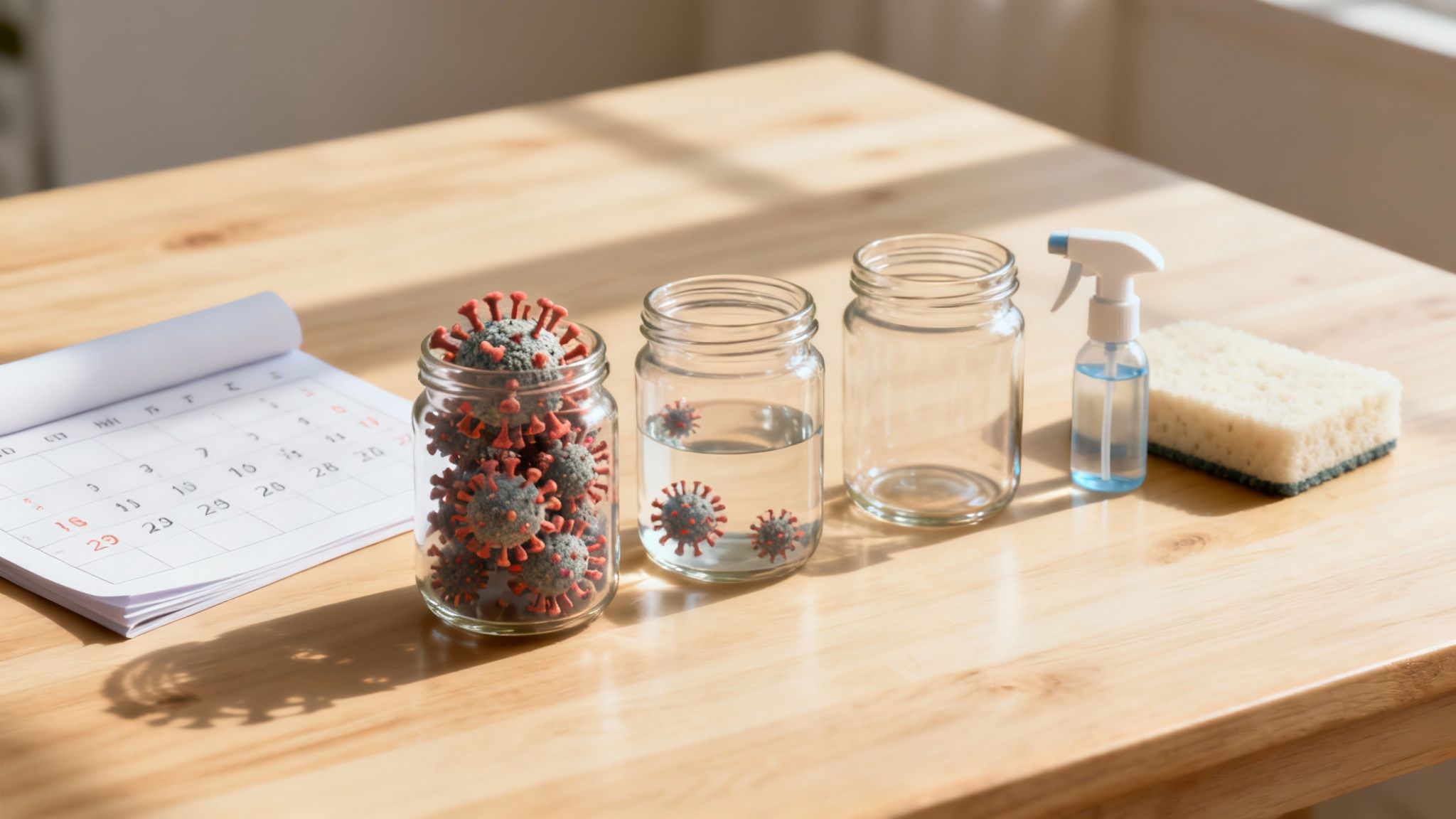
When norovirus hits, the first question on everyone's mind is usually, "How long is this going to last?" While the worst of the symptoms—that intense, miserable feeling—typically lasts for only 1 to 3 days, you can actually remain contagious for much longer. We're talking weeks, even after you feel completely back to normal.
Understanding this gap between feeling sick and being contagious is absolutely critical. This microscopic, non-enveloped virus is notoriously resilient, and failing to grasp its full lifecycle is how it tears through a household, school, or office.
Your Norovirus Timeline At A Glance
Getting a handle on the complete norovirus timeline is so important because feeling better and being non-contagious are two very different things. This virus, also known as the Norwalk Virus, is a master of rapid spread, mostly because people underestimate how long it sticks around as a threat. To clear things up, let's break down exactly what to expect.
This graphic gives you a clear visual of each phase of the infection, from how long the sickness lasts to how long the virus can survive on a countertop.

As you can see, the illness itself is short-lived, but the contagious window and the virus's ability to hang out in your environment are much, much longer. This extended timeline is precisely why you can't let your guard down with cleaning and disinfection just because you feel okay.
The Key Stages of Infection
To really wrap your head around how long norovirus lasts, it helps to look at each phase individually. The journey from initial exposure to full recovery isn't just one block of time; it's a series of distinct stages, each with its own rules. Knowing these stages helps you manage expectations and, more importantly, protect others.
Here’s a quick-reference table that maps out the entire journey, from the moment you’re exposed to that long tail-end of the contagious period.
Norovirus Infection Timeline Summary
| Infection Stage | Typical Duration | Key Characteristics |
|---|---|---|
| Incubation Period | 12 to 48 hours | The virus is quietly multiplying in your body. You feel fine and have no symptoms, but you might become contagious right at the end of this stage. |
| Symptomatic Illness | 24 to 72 hours | This is the main event. Symptoms like vomiting, diarrhea, nausea, and stomach cramps hit you suddenly and intensely. You are extremely contagious. |
| Post-Symptom Contagious Period | Up to 2 weeks or more | You're feeling much better, but your body is still shedding the virus in your stool. This is the "stealth" phase that fuels so many outbreaks. |
| Surface Viability | Days to weeks | The virus can survive on everyday surfaces like doorknobs, remote controls, and countertops, just waiting to infect the next person who touches them. |
The key takeaway here is the dangerous mismatch between how long you feel sick and how long you can spread the virus. A person can be back at their desk, feeling perfectly fine, while still shedding norovirus and putting everyone else at risk.
This is why ongoing diligence is a must. To get a better grasp of the virus itself and how it gets around, check out our in-depth guide on what norovirus is and how it spreads. Arming yourself with that knowledge is your best first step toward stopping it in its tracks.
The Three Phases of a Norovirus Infection
To really get a handle on how long norovirus sticks around, you have to look past the few days you feel awful. The infection unfolds in three distinct stages: a quiet beginning, a violent peak, and a long, deceptive tail end. Understanding this lifecycle is key to seeing why it spreads so efficiently.
Phase 1: The Incubation Period (The Quiet Invasion)
Norovirus doesn't knock on the door to announce its arrival. It starts with a silent takeover called the incubation period. This is the time between when you first get exposed—maybe from a contaminated doorknob or a shared serving spoon—and when you first feel sick.
This clock starts ticking the moment you're infected and runs for about 12 to 48 hours.
During this window, you feel completely fine. But inside your intestines, the virus is already hard at work, hijacking your cells and forcing them to churn out millions of new copies of itself. Think of it as a microscopic army quietly building its forces, getting ready to launch an all-out assault.
Phase 2: The Symptomatic Phase (The Body Fights Back)
Once that viral army reaches a critical mass, your immune system finally sounds the alarm. This is when the symptomatic phase kicks in, and it often arrives with shocking speed. The sudden, violent onset of vomiting and diarrhea isn’t just a symptom—it's your body's scorched-earth attempt to physically kick the invaders out.
It’s an aggressive, and frankly miserable, defense mechanism. Your body is trying to expel the virus as forcefully as possible.
For most healthy adults, this intense phase is thankfully brief, lasting somewhere between 24 and 72 hours. It’s the peak of the illness, but it’s usually over in one to three days.
This is also when you are at your most contagious. Every surface you touch can become a new infection point, as both vomit and stool are teeming with billions of viral particles.
Phase 3: The Recovery Phase (The Deceptive Aftermath)
Just as suddenly as it started, the misery often stops. You start to feel human again. Your appetite comes back. You assume the battle is won. This is the recovery phase, and it’s the most misunderstood part of a norovirus infection.
Here’s the critical part: feeling better doesn't mean you’re in the clear.
Even after your symptoms are long gone, your body can continue to shed the virus in your stool for two weeks or even longer. This is called viral shedding, and you are still contagious this entire time.
This sneaky, extended contagious period is exactly why norovirus outbreaks are so hard to stop. People go back to work, school, or family gatherings feeling fully recovered, but they are unknowingly still spreading the virus. It’s a tough lesson: recovering from the symptoms and stopping the spread are on two totally different timelines.
How Long You Are Actually Contagious With Norovirus
This is probably the single biggest—and most dangerous—misunderstanding about norovirus. Most people think that once the awful symptoms finally stop and they feel human again, the ordeal is over. But feeling recovered and no longer being a threat to others are on two completely different timelines.
Assuming you're in the clear just because you feel better is how this virus rips through homes, schools, and offices so effectively.
You are an absolute viral super-spreader while you're actively sick with vomiting and diarrhea. During this phase, your body is expelling billions of viral particles. But the real kicker is that you remain contagious for days, and sometimes even weeks, after you feel back to normal.

The Concept Of Viral Shedding
To get why the contagious window is so long, you have to understand a process called viral shedding. This is when your body continues to release—or "shed"—live virus particles in your stool, even after you've stopped feeling sick. This biological process is the engine that drives norovirus outbreaks.
Think of it like invisible glitter. After a messy craft project, you can clean up the big piles, but you'll keep finding stray specks of glitter on your hands, clothes, and furniture for days. Viral shedding is the same idea. Your body is still dropping these invisible, infectious norovirus particles long after the main "mess" of symptoms is gone.
These lingering particles can easily contaminate bathroom surfaces, get on your hands, and then spread to doorknobs, light switches, and eventually, other people. This is exactly how someone who feels perfectly fine can unknowingly kick off a whole new wave of misery at home or work.
The crucial takeaway is this: You are still contagious for at least 48 to 72 hours after your last symptom disappears. However, low-level viral shedding can continue for two weeks or longer, posing a continued, albeit lower, risk of transmission.
How Long Does The Contagious Period Last
The timeline for being contagious is much longer than the illness itself. While norovirus symptoms usually only last a couple of days, research shows that viral shedding keeps you infectious long after you've recovered. Studies have confirmed that while the nausea and vomiting might be gone in 48 hours, infected people can continue to shed the virus in their stool for weeks. In places like hospitals and nursing homes, the median outbreak lasts 16 to 19 days—a clear sign of how long the virus hangs around. You can read the full research about these findings for a deeper dive.
This extended shedding period is precisely why strict hygiene is non-negotiable, even after you feel 100% better.
Here’s a simple breakdown of the contagious timeline:
- Most Infectious Period: While you are actively sick with vomiting and diarrhea.
- High-Risk Post-Symptom Period: For the first 48-72 hours after symptoms stop. This is the minimum isolation time health authorities recommend.
- Extended Shedding Period: You can continue shedding the virus in your stool for two weeks or more, meaning a risk of transmission is still there.
This long tail is why you can't let your guard down. Continued, obsessive handwashing and proper surface disinfection are vital. Just feeling better isn't a reliable sign that you're no longer a risk. That "invisible glitter" is still around, and thorough cleaning is the only way to break the chain of infection.
How Long Norovirus Survives On Surfaces
Norovirus doesn't just make you sick; it turns your environment into a minefield. Its ability to survive for long stretches outside the human body is a huge reason why it spreads so ferociously. This incredible resilience transforms everyday objects—doorknobs, countertops, remote controls—into silent transmission hotspots, just waiting for the next person to touch them.
Simply cleaning up after someone gets sick often isn't enough to break the cycle. The virus can stubbornly cling to surfaces for days or even weeks, which is why having effective disinfecting wipes on hand is essential.

A Hardy Environmental Survivor
Unlike many other viruses that are fragile outside a host, norovirus is exceptionally tough. As a small non-enveloped virus, its simple but powerful protein capsid shields it from common cleaners and environmental threats. This is what allows it to remain infectious on all sorts of materials long after it got there.
This environmental persistence is a major driver of outbreaks, especially in the winter when we're all cooped up indoors. The virus can survive for weeks on surfaces and potentially even months in contaminated standing water. One study found norovirus could hang around on food prep surfaces for up to seven days, which really drives home its durability.
That long survival time means disinfection isn't just a good idea—it's absolutely mandatory to protect your home or workplace.
This table breaks down how long you can expect norovirus to remain a threat on various common surfaces.
Norovirus Survival on Common Surfaces
| Surface or Environment | Estimated Survival Time | Recommended Cleaning Action |
|---|---|---|
| Hard, non-porous surfaces (stainless steel, plastic, countertops, doorknobs) | Days to weeks | Clean with soap and water first, then use a disinfecting wipe or bleach solution. |
| Fabric and soft surfaces (clothing, bedding, carpets, upholstery) | Up to 12 days | Wash in the hottest water possible and dry on high heat. Steam clean carpets and upholstery. |
| Food (produce, prepared meals) | Several days | Discard any food that may have been contaminated. Cook shellfish thoroughly. |
| Contaminated Water (standing water, pools) | Months | Professional treatment or shock chlorination is often required. |
As you can see, the virus's ability to linger makes thorough, targeted cleaning essential for stopping an outbreak in its tracks.
Why Surface Viability Is a Major Transmission Route
When someone with norovirus vomits, tiny, invisible aerosolized particles containing the virus can travel several feet and settle on just about everything in the room. From there, all it takes is a single touch to pick up the virus and get sick yourself.
Think about all the common touchpoints in a home or office:
- Hard Surfaces: Doorknobs, faucets, light switches, and countertops can harbor the virus for days to weeks.
- Fabric and Soft Surfaces: Bedding, towels, and clothing easily become contaminated and need careful washing.
- Food: Unwashed hands can transfer the virus to food, where it can survive until someone eats it.
The core problem is the virus's ridiculously low infectious dose. It only takes a tiny number of viral particles—as few as 18—to make a healthy person sick. When you combine that with its ability to last for weeks on a surface, you've got the perfect recipe for an outbreak.
For a deeper scientific look into how the virus persists in different settings, our detailed article explores norovirus transmission mechanisms and environmental persistence. This is why meticulous cleaning followed by effective disinfection is the only way to truly eliminate the threat from your environment.
Why Disinfection Is Non-Negotiable
Because norovirus is so tough, many standard cleaning routines just don't cut it. Wiping a counter with a simple soap-and-water solution or using a standard alcohol-based wipe might get rid of the visible mess, but it often leaves active virus particles behind.
This is where true disinfection comes in. You need to use a product specifically rated to kill norovirus. The difference between cleaning and disinfecting is critical:
- Cleaning is about physically removing germs and dirt from a surface.
- Disinfecting uses chemicals to actually kill the germs on that surface.
To stop a norovirus outbreak, you have to do both. First, clean the surface to get rid of any organic matter, then apply a disinfectant proven to work against norovirus, like a bleach-based solution or a specially formulated disinfecting wipe. This two-punch approach ensures you aren't just pushing the virus around—you're actually destroying it and making the environment safe again.
A Practical Guide to Preventing the Spread of Norovirus
Knowing the science behind norovirus is one thing, but turning that knowledge into practical steps to protect your family is what really matters. Since the virus hangs around for so long on surfaces and you stay contagious even after you feel better, prevention comes down to being disciplined about isolation, hygiene, and disinfection.
This is your no-nonsense guide to doing it right.
Isolation: The 48-Hour Rule
The single most effective way to stop norovirus in its tracks is to stay home when you're sick. But here's the catch: you're still highly contagious long after the worst is over. This is why a simple rule is so critical for keeping your community safe.
Health authorities are clear on this: you need to stay home from work or school for at least 48 hours after your last symptom disappears. That means two full days after the vomiting and diarrhea have completely stopped.
This isn't just a friendly suggestion; it's a vital public health measure. Rushing back to daily life is exactly how norovirus explodes through offices, daycares, and schools. Sticking to this 48-hour buffer is your responsibility to protect everyone around you.
Personal Hygiene: Hand Washing is King
When you’re up against norovirus, not all hand hygiene is created equal. The virus has a tough outer shell that shrugs off most common hand sanitizers.
- Why Soap and Water Wins: The best defense is good old-fashioned hand washing. Scrubbing your hands with soap and warm water for at least 20 seconds is the gold standard. The friction from rubbing your hands together, combined with the soap, physically lifts the tiny virus particles off your skin and sends them down the drain. It's about removal, not just killing.
- Alcohol Sanitizers Fall Short: Sorry, but your pocket-sized alcohol sanitizer won't cut it here. Most alcohol-based sanitizers are not effective at killing norovirus. While they're great for many other germs, they just can't break down its stubborn structure. Only use them when soap and water are absolutely not an option.
Consistent and thorough hand washing is your best personal defense, especially after using the restroom, changing diapers, or before touching any food.
Cleaning and Disinfecting Your Home
Because norovirus can survive for days—or even weeks—on household surfaces, a two-step cleaning and disinfecting process is mandatory to get it out of your environment. Cleaning removes the mess; disinfecting is what actually kills the virus.
First things first: always wear disposable gloves when cleaning areas contaminated with vomit or stool. You do not want to get this stuff on your skin.
Step 1: Clean the Surface
Before you disinfect, you have to clean. Use soap and water or another cleaning spray to wipe away all visible grime and organic matter. This step is non-negotiable because disinfectants can't work properly if they have to cut through a layer of filth first.
Step 2: Disinfect the Surface
After the surface is clean, it's time to bring out the big guns. You must use a disinfectant proven to kill norovirus. For quick and effective cleanup, disinfecting wipes designed for norovirus offer a convenient and powerful solution. Alternatively, your best options are:
- A Bleach-Based Solution: This is the most effective and recommended choice. You can easily make your own by mixing 5 to 25 tablespoons of standard household bleach per gallon of water. Let the solution sit on the surface for at least five minutes before wiping.
- EPA-Registered Disinfectants: If you're not using bleach, look for a product specifically on the EPA’s List G, which certifies it as effective against norovirus. These are often the same products used in hospitals and provide a powerful, ready-to-use alternative.
Focus your efforts on high-touch surfaces like doorknobs, light switches, remote controls, faucets, and countertops. Our comprehensive guide on how to disinfect surfaces effectively dives deeper into the specific products and techniques that work best.
Beyond hard surfaces, think about fabrics. Knowing how often you should wash bedding is important, as contaminated linens are a common route for the virus to spread. Handle any soiled laundry carefully—without shaking it—and wash it in the hottest water setting possible, followed by a long cycle in the dryer on high heat.
By combining strict isolation, obsessive hand washing, and meticulous disinfection, you can break the chain of transmission and keep your household safe.
Common Questions About Norovirus
Even after you've weathered the storm, a few nagging questions about norovirus can stick around. It’s a notoriously tough and confusing virus, so let's clear up some of the most common concerns.
Can I Get Norovirus More Than Once?
Yes, absolutely. Getting sick with norovirus once, unfortunately, doesn't give you a lifetime pass.
Your body might build up a little short-term immunity to the specific strain that got you, but that protection often fades after just a few months. On top of that, there are many different types (genotypes) of norovirus circulating at any given time. This means you could get over one strain and be vulnerable to a completely different one almost immediately.
This is why norovirus outbreaks are so common, especially in the winter. Your best defense is always diligent hygiene, not relying on a past infection to protect you.
Are Alcohol-Based Hand Sanitizers Effective?
No, alcohol-based sanitizers are not your best friend when fighting norovirus. While they’re great for many other germs like the flu, norovirus has a tough protective shell that alcohol just can't break down effectively.
The gold standard is, and always has been, washing your hands thoroughly with soap and warm water for at least 20 seconds.
Think of it this way: hand washing isn't just about killing the virus—it's about physically kicking it off your skin. The friction from scrubbing and the soap work together to lift the virus particles off your hands and send them down the drain. Hand sanitizer simply can't replicate that physical removal.
When you have the choice, always head to a sink. Only use an alcohol-based sanitizer as a last-ditch effort when soap and water are nowhere to be found.
How Can I Tell If It's Norovirus or Food Poisoning?
This is a classic question, mostly because norovirus is a leading cause of what we commonly call "food poisoning" or the "stomach flu." The symptoms often look the same as bacterial foodborne illnesses, but there are a few clues that can point toward norovirus.
- The Onset is Sudden: Norovirus hits you like a ton of bricks. Symptoms typically explode out of nowhere between 12 to 48 hours after exposure.
- It's Intense but Brief: The illness is often violent, but the worst of it is usually over in 1 to 3 days for most healthy people.
- Vomiting is a Telltale Sign: While both can cause diarrhea, projectile vomiting is a notorious hallmark of a norovirus infection.
At the end of the day, the only way to be 100% certain is with a lab test on a stool sample, but that’s usually reserved for public health officials trying to track a major outbreak. For most of us, the distinction doesn't really matter—the recovery plan is the same: rest and push fluids.
Why Does Norovirus Spread So Easily on Cruise Ships?
Cruise ships, nursing homes, schools, and daycares are all perfect breeding grounds for norovirus. They create a perfect storm where the virus can spread with stunning efficiency.
Here’s why these places are hotbeds for outbreaks:
- Close Quarters: You have a large number of people living, eating, and socializing in a very confined space. Person-to-person contact is practically guaranteed.
- Shared Everything: Everyone touches the same railings, elevator buttons, and bathroom door handles. They eat in the same dining halls and use the same public restrooms.
- It Sticks Around: The virus is incredibly resilient and can survive for days or even weeks on surfaces, just waiting for the next person to come along.
- A Tiny Dose is All it Takes: It takes as few as 18 viral particles to make someone sick. That’s an astonishingly small amount.
Put all those factors together, and it's easy to see how one sick person can unknowingly set off a chain reaction that quickly becomes a ship-wide (or school-wide) problem. It’s a powerful reminder of just how contagious this virus is.
Leave a Reply