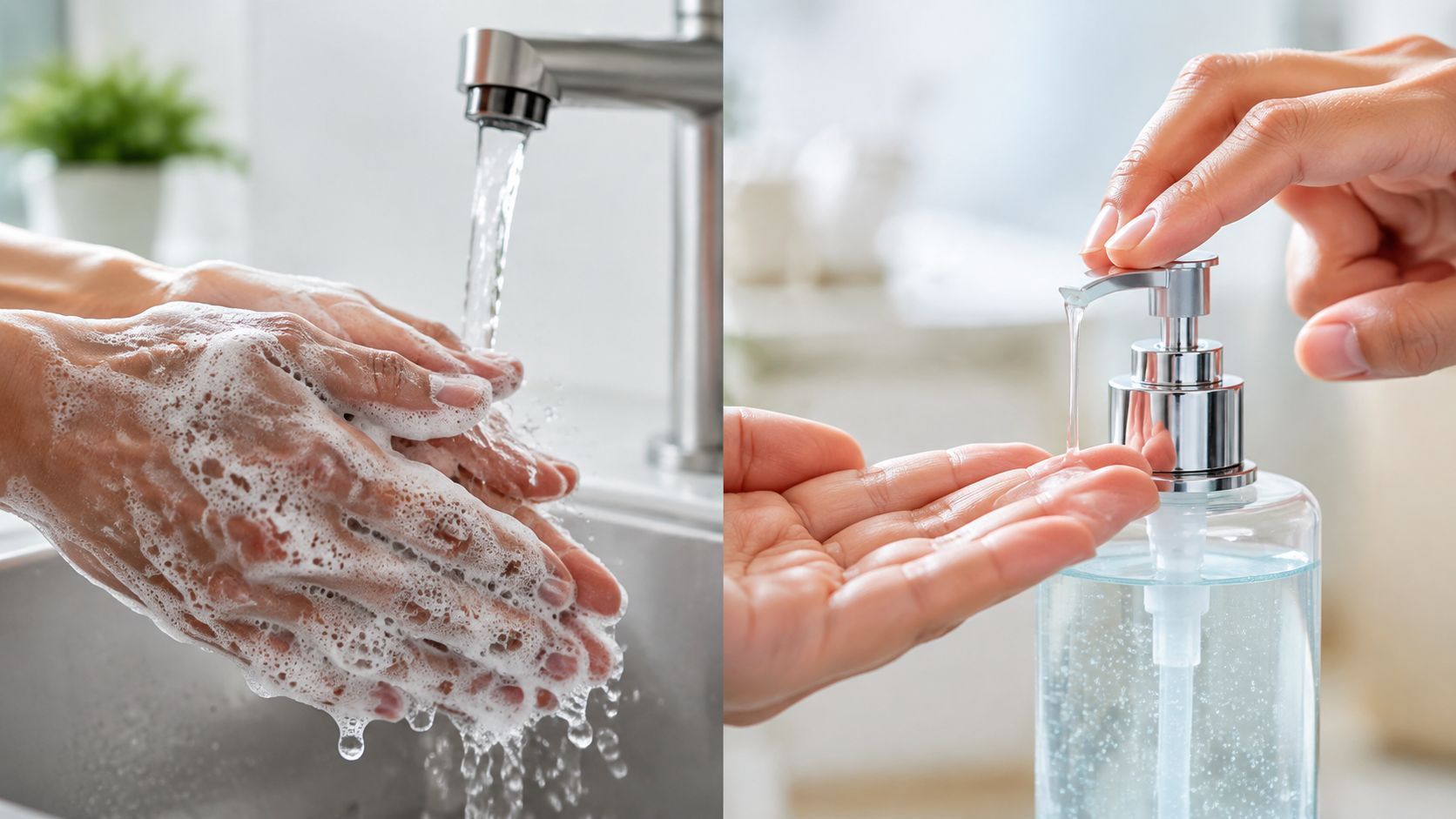
You're standing at a playground while your toddler's hands collect dirt from the slide. A nurse is moving between patient rooms. A commuter reaches a transit turnstile and squeezes sanitizer into one palm. Each person faces the same practical question: which hand-cleaning method fits this moment?
The hand sanitizer vs soap and water decision isn't about naming one universal winner. It depends on whether the hands are visibly dirty, which type of pathogen may be present, whether you're in a home, healthcare, or outbreak setting, and whether repeated use is irritating your skin. Soap and water remove a broader range of contamination, while alcohol-based sanitizer offers a fast option when hands look clean and a sink isn't available.
The Underlying Question Behind Hand Sanitizer vs Soap and Water
A kitchen counter shows why the choice matters. Disinfectant may inactivate some germs on a surface, yet crumbs, grease, and sticky residue remain until cleaning removes them. Hands follow a similar pattern. Sanitizer mainly inactivates susceptible microbes in place, while soap, water, friction, and rinsing physically lift contamination away.
That distinction changes with the pathogen. Alcohol-based sanitizer can work well against many enveloped viruses, whose fragile fatty outer layer is vulnerable to alcohol. Soap and water also disrupt that envelope while carrying contamination away. Non-enveloped viruses and bacterial spores are harder targets, so removal with soap and running water has the advantage.
The Centers for Disease Control and Prevention recommends soap and running water in most situations because they remove germs and chemicals. Alcohol-based sanitizer needs at least 60% alcohol, and it does not eliminate every pathogen. The CDC identifies soap and water as more effective against norovirus, Cryptosporidium, and Clostridioides difficile than sanitizer. CDC guidance on hand sanitizer
Setting matters too. In daily community life, sanitizer is a practical option when hands look clean and a sink is unavailable. During an outbreak, a healthcare response, or contact with hardy pathogens, soap and water may better fit the risk. For visibly dirty hands, CDC and WHO guidance directs people toward soap and running water. Australian health guidance on hand hygiene
Use these questions:
- Can you see dirt, grease, food, soil, or residue? Choose soap and water.
- Could a non-enveloped virus or bacterial spore be involved? Favor soap and water.
- Are you in routine community life, healthcare, or an outbreak response? Match the method to the setting.
- Will repeated sanitizer use dry or crack your skin? A gentler washing and moisturizing routine may be easier to maintain.
Facilities serving guests, staff, or customers can also review guidance on antibacterial soap for hospitality venues. The decision rule is straightforward: match the tool to the contamination.
How Soap and Sanitizer Actually Work
Soap contains surfactants. Each surfactant molecule has a water-attracting end and an oil-attracting end. The oil-attracting end interacts with grease, dirt, and oily material on the skin, while the water-attracting end helps carry that material into the rinse water.
Friction loosens contamination from the skin's uneven surface. Rinsing then carries the suspended material down the drain. That physical removal model explains why soap and water can handle not only microbes, but also chemicals and grime that sanitizer may leave behind.
Soap can also disrupt enveloped viruses, which have a fragile lipid, or fatty, outer layer. Once that envelope is damaged, the virus loses an important structure required for infection. Alcohol can also disrupt lipid membranes and denature proteins, which helps explain its strong activity against many enveloped viruses and bacteria.

Inactivation versus removal
Alcohol-based hand rubs commonly use ethanol or isopropanol. Effective products must contain at least 60% alcohol, according to the CDC. CDC hand sanitizer facts
Sanitizer works through chemical inactivation. The alcohol must contact the relevant surfaces at a sufficient concentration and remain there until the hands dry. If dirt, grease, or organic material blocks contact, the product may not reach every microbe. Alcohol also has important limits against non-enveloped viruses, bacterial spores, and some chemicals.
That distinction matters when interpreting laboratory results. A log-reduction result describes how much infectious material a method inactivated or removed under particular test conditions. It isn't a universal score that makes sanitizer and soap interchangeable in every real-life situation.
Organizations that manage public-facing facilities may pair hand hygiene with appropriate single-use hygiene products, particularly where many people share spaces and touchpoints. Those products support hygiene operations, but they don't change the basic choice: use washing for broad removal, and sanitizer for practical rapid inactivation when conditions are suitable.
Comparing Effectiveness Against Real Pathogens
The pathogen's structure often determines the result. Enveloped viruses have a lipid outer layer that alcohol can disrupt. Non-enveloped viruses lack that fragile coat, so alcohol-based products may perform less reliably. Spores and chemical residues create another problem because inactivation isn't the same as removal.
A quantitative comparison of three ethanol-based sanitizers and three antimicrobial soaps found that each produced a 4 log10 reduction, meaning more than 99.99% reduction, against tested enveloped viruses. Peer-reviewed comparison of soaps and alcohol-based sanitizers
That result supports a practical conclusion for routine viral hygiene. When the target is an enveloped virus and hands aren't visibly dirty, a properly formulated sanitizer and correctly performed handwashing can both be highly effective. The conclusion doesn't automatically transfer to norovirus or spores.
A controlled handwashing study found that washing with soap and water for 30 seconds completely removed norovirus genomic copies from finger pads in several tested conditions, with reductions greater than 5 log10 for MNV1, greater than 6 log10 for norovirus GI.4, and 4 log10 for GII.4. A propanol-based disinfectant produced much smaller, often partial reductions across the same viruses. Norovirus handwashing study
| Pathogen Type | Examples | Soap and Water | Alcohol Sanitizer, 60% to 80% |
|---|---|---|---|
| Enveloped viruses | SARS-CoV-2, influenza, RSV | Strong performance when washing is done correctly | Strong performance when the product is properly formulated and used until dry |
| Non-enveloped viruses | Norovirus, hepatitis A, rhinovirus | Broader removal advantage | Less reliable against certain hardy viruses |
| Bacterial spores | Clostridioides difficile | Preferred for removal after relevant exposure | Alcohol rub may be ineffective against spores |
| Chemicals and residues | Pesticides, grease, other contaminants | Preferred because washing physically removes material | Not a reliable removal method |
The CDC notes that controlled studies found alcohol rub ineffective against C. difficile spores in some conditions, while soap and water achieved better removal. During norovirus outbreaks, CDC recommends soap and water after contact with suspected or confirmed cases and says sanitizer hasn't been proven as a substitute. CDC norovirus recommendations
For a broader virus-focused explanation, see does hand sanitizer kill viruses. The short answer is conditional, not absolute.
Proper Technique for Each Method
A good product can fail when people use too little, miss key surfaces, or stop before the required contact time. Technique matters because fingertips, thumbs, nail edges, finger webs, and the backs of hands often receive less attention than palms.
For soap and water, begin with clean, running water and wet the hands. Apply soap, then rub all surfaces for at least 20 seconds. Include the backs of the hands, between the fingers, thumbs, fingertips, and beneath the nails before rinsing thoroughly.
Drying completes the process. Use a clean towel or air-dry the hands, and avoid touching a contaminated faucet or handle immediately after washing. A single-use towel can also help reduce remaining contamination during drying.

Getting sanitizer coverage right
Choose an alcohol-based product containing at least 60% alcohol, and follow its label for the amount. A common practical cue is a small puddle that covers every hand surface, but the label takes priority because products differ.
Rub palm to palm, then work the product across the backs of the hands, between fingers, around thumbs, over fingertips, and along the nails. Keep rubbing until the hands are completely dry. Wiping the product away early shortens contact time and reduces coverage.
Self-audit: If the sanitizer disappears before you've covered your thumbs, fingertips, and finger webs, you probably stopped too soon or used too little.
Several habits weaken either method. A quick rinse without soap doesn't provide the same cleaning action. Foam that disappears before friction is complete leaves areas untreated. Pre-wet, greasy, or visibly soiled hands reduce the usefulness of sanitizer.
For a visual refresher, use this proper hand-washing technique guide.
Which to Use and When
The fastest decision rule starts with what you can see. If your hands are dirty, greasy, sticky, or contaminated with food, soil, or chemicals, use soap and running water. Sanitizer isn't a substitute for physically removing that material.
The setting then adds context. In routine community life, sanitizer is useful when hands look clean and no sink is available. In healthcare, alcohol-based hand sanitizer is generally preferred in many situations when hands aren't visibly soiled because it's faster and can improve compliance. Soap and water takes priority when hands are visibly dirty or after exposure to organisms such as C. difficile. CDC healthcare hand hygiene FAQ
| Scenario | Preferred Method | Acceptable Fallback | Key Reason |
|---|---|---|---|
| Visibly dirty or greasy hands | Soap and running water | Wait for access to a sink rather than relying on sanitizer | Washing removes grime and residue |
| Suspected norovirus or viral gastroenteritis outbreak | Soap and water | Sanitizer only as a temporary measure when directed by local guidance | Norovirus is harder for sanitizer to control |
| Healthcare contact without visible soil | Alcohol-based hand sanitizer | Soap and water | Sanitizer is fast and supports frequent compliance |
| Possible C. difficile exposure | Soap and water | Follow facility infection-control guidance if a sink is unavailable | Alcohol may not remove spores effectively |
| Food preparation or chemical residue | Soap and running water | Use the appropriate safety response for the substance | Sanitizer doesn't reliably remove chemicals |
| Travel, transit, or outdoor activity | Alcohol sanitizer with at least 60% alcohol | Soap and water at the next available sink | A portable product is practical when no sink is nearby |
| Routine daily life with clean-looking hands | Either method, based on access | Use sanitizer when washing isn't practical | Both can work well in suitable conditions |
Childcare adds frequent contact with food, saliva, toys, soil, and bodily fluids, so washing deserves priority whenever a sink is available. For travel, keep sanitizer accessible, but treat it as a complement to handwashing rather than a permanent replacement. Product concentration and correct use are covered in hand sanitizer with 60% alcohol.
Skin Health, Safety, and Product Quality
Repeated sanitizer use can dry the skin because ethanol and isopropanol remove some surface lipids. Dryness may lead to cracking, irritation, or dermatitis, especially when people apply product frequently or already have eczema-prone skin.
Soap can also irritate skin, particularly when it's heavily fragranced or harsh. A mild cleanser, thorough rinsing, careful drying, and regular use of an emollient can make washing easier to tolerate. The best routine is the one people can perform consistently without allowing painful skin damage to build.

What to check before buying
- Alcohol content: Choose a product with at least 60% alcohol, and check whether the label identifies ethanol or isopropanol.
- Additives: Fragrance can bother sensitive skin. A simpler formulation may be easier to tolerate.
- Product source: Check the manufacturer, label, lot information, and any public safety notices. The FDA has recalled sanitizers contaminated with methanol or 1-propanol, so product quality matters.
- Child safety: Young children shouldn't ingest sanitizer. Store it out of reach and supervise use.
- Fire risk: Alcohol-based products are flammable until dry. Keep them away from flames and heat sources.
- Skin support: Healthcare workers, childcare staff, and people with eczema may need a soap, moisturizer, and sanitizer routine that protects the barrier instead of relying on repeated alcohol exposure.
Facilities preparing food should also pair hand hygiene with broader operational controls. A practical UK food safety hygiene checklist can help teams review supplies and cleaning responsibilities without treating hand sanitizer as a replacement for washing.
Common Myths Worth Retiring
Public-health educators hear the same misconceptions in clinics, schools, and online discussions. Most arise because people turn a conditional recommendation into a slogan.
Myth one, sanitizer kills every germ
Alcohol sanitizer doesn't work equally well against all pathogens. It's less suitable for visibly soiled hands, and it doesn't provide the same protection against norovirus or C. difficile spores that soap and water can provide. Some contamination also requires removal, not chemical inactivation.
Replacement rule: Sanitizer needs clean-looking hands, full coverage, and enough time to dry.
Myth two, soap and water are obsolete
Sanitizer is convenient, but convenience doesn't erase the physical removal advantage of washing. Soap and water can remove non-enveloped viruses and chemicals that alcohol-based products may not reliably handle.
Replacement rule: Soap wins when hands are dirty, after bathroom use, during suspected norovirus outbreaks, and after relevant spore exposure.
Myth three, more alcohol always means stronger protection
The label percentage isn't the only factor. Formulation, coverage, contact time, storage, and whether the hands are greasy all affect performance. A very high number on the bottle can't compensate for applying too little or wiping it away before drying.
CDC guidance sets the practical minimum at 60% alcohol for hand sanitizer. CDC hand sanitizer guidance The useful question is whether the product meets the threshold and whether you can use it correctly, not whether you can find the highest printed percentage.
Rule of thumb: Label-checking beats percentage-obsessing. Use sanitizer correctly when washing isn't practical, and choose soap when removal matters.
Quick Decision Checklist and Authoritative Sources
Choose by the contamination and the setting, not by convenience alone:
- Visible dirt, grease, food, soil, or chemicals? Wash with soap and running water.
- After bathroom use, suspected norovirus outbreak, or possible C. difficile exposure? Choose soap and water.
- Hands look clean, but no sink is available? Use an alcohol-based sanitizer with at least 60% alcohol, covering every surface until dry.
- Sanitizer irritates or cracks your skin? Wash with a mild product when possible and moisturize.
- Still unsure? Soap and running water provide the broader default.

Where to verify the guidance
CDC handwashing recommendations explain when and how to clean hands. Its clinical FAQ adds healthcare guidance about routine sanitizer use and situations that call for soap and water. CDC clinical hand hygiene FAQ
WHO's hand hygiene fact sheet covers public-health practice worldwide, while its healthcare-worker guidance addresses clinical technique. EPA's List N helps identify disinfectants for surfaces. Those products are not substitutes for hand products.
Keep this checklist accessible when an outbreak, workplace policy, or product label changes. Soap and water are the broad-spectrum default. Sanitizer is the portable, fast option when hands look clean and a sink isn't available.
For travel, transit, and other sink-free situations, carry a clearly labeled sanitizer with at least 60% alcohol. Make soap and running water the first choice after visible contamination, bathroom use, suspected norovirus exposure, or possible C. difficile contact. Share the decision rule with household members, childcare staff, or coworkers, and check CDC and WHO guidance before changing your routine.
Leave a Reply