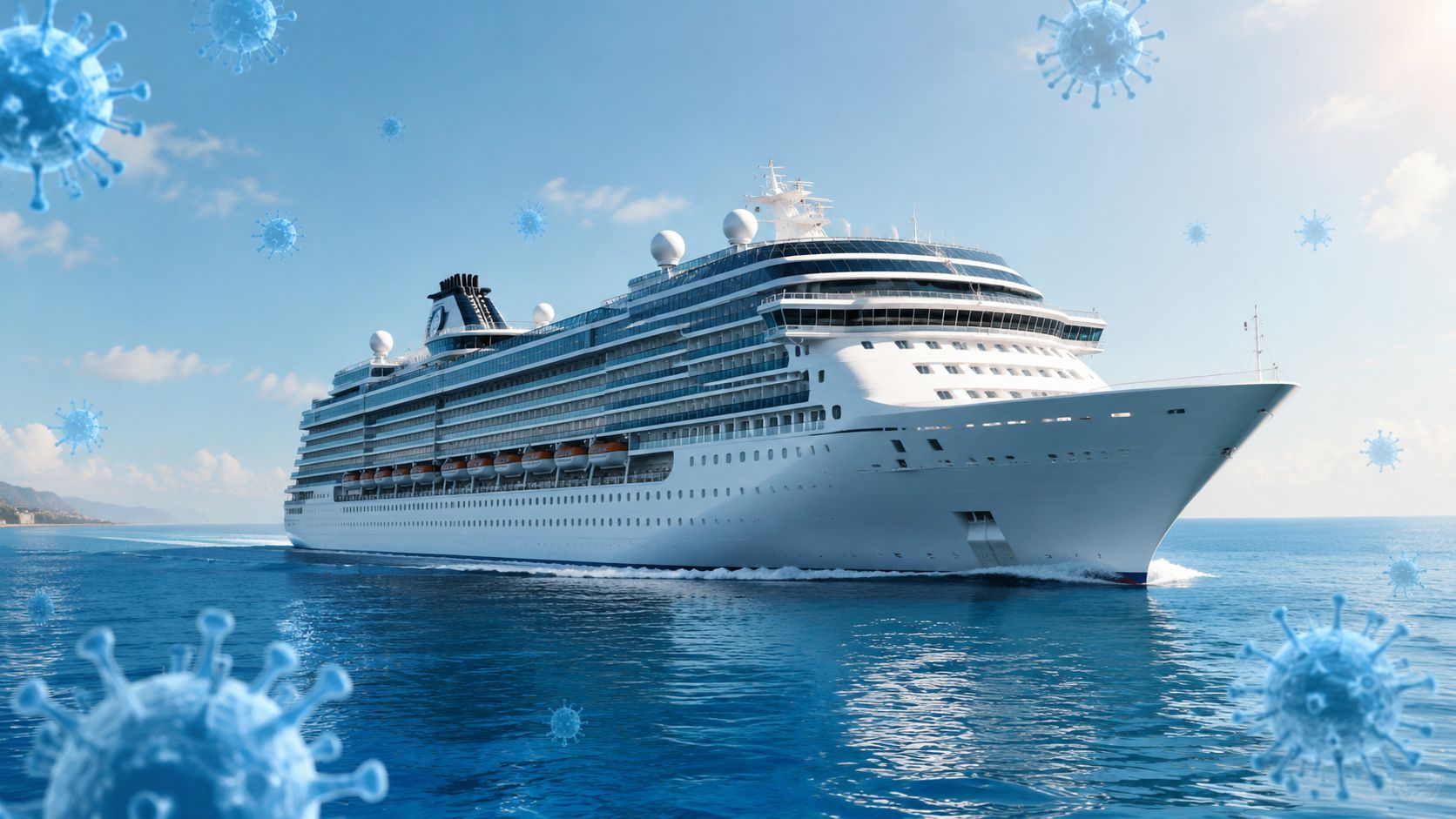
A family settles into deck chairs, orders cold drinks, and starts watching the horizon. Somewhere else on the same ship, a passenger with an upset stomach touches a handrail on the way to the buffet, or someone boards carrying a virus picked up on land before the voyage began.
That contrast is why cruise ship virus outbreaks attract so much attention. A ship feels like an escape from everyday life, but from a public health perspective it's also a compact, moving community where infection control has to work very well, very quickly.
The Unseen Stowaways on Your Cruise
A cruise ship is designed to feel effortless. Meals appear on time, cabins reset themselves while you're ashore, and the whole trip runs like a floating resort. Viruses don't care about that polish. They move through habits, surfaces, air, and timing.
That's what makes cruise ship virus outbreaks so unsettling to travelers. People aren't just worried about getting sick. They're worried about losing days of a long-planned vacation, being isolated in a cabin, or bringing an infection home to family members after disembarkation.

Before booking, many travelers compare itineraries, ship size, and passenger experience on sites that track cruise ships. That's useful for more than vacation planning. The size of the vessel, the style of dining, and the rhythm of embarkation and port days all shape how people mix with one another.
Why the anxiety feels bigger at sea
Part of the fear comes from headlines. A virus outbreak on a ship is easy to picture: one vessel, one manifest, one visible event. On land, the same kinds of transmission can happen across restaurants, schools, hospitals, and households without becoming a single dramatic story.
Another part comes from uncertainty. Travelers often lump all outbreaks together, as if norovirus, influenza, and a rare emerging pathogen pose the same kind of threat and require the same response. They don't.
Cruise travel isn't uniquely mysterious. It's a setting where the basics of epidemiology become easier to see.
What actually matters to a traveler
The key questions are practical:
- What kind of virus is involved? A stomach virus behaves differently from a respiratory virus.
- How does it spread? Hands, food, shared surfaces, and indoor air don't all matter equally for every pathogen.
- What happens if someone gets sick onboard? The answer can range from routine cleaning and isolation to cross-border public health follow-up.
If you understand those differences, cruise ship virus outbreaks become less like horror stories and more like solvable public health problems.
Why Cruise Ships Are Unique Viral Environments
A cruise ship is best understood as a temporary high-density city. People sleep, eat, exercise, watch shows, share elevators, and pass through the same indoor spaces for days at a time. That combination creates efficient paths for viral spread.
Some settings have crowding but short exposure, like a concert. Others have long exposure but less mixing, like a small office. Ships often have both.

Density changes the math
When many people share a limited space, chance encounters pile up. You touch the same railings, buffet utensils, elevator buttons, and restroom doors as hundreds or thousands of others. Even without dramatic crowding, routine contact becomes repetitive.
That matters because viruses don't need chaos. They need opportunity. A ship gives them repeated opportunities.
Duration turns brief contact into repeated exposure
A hotel guest might have one contaminated meal and leave the next morning. On a ship, passengers often return to the same dining rooms, lounges, and cabin corridors over several days. Crew members also remain onboard and interact across shifts and departments.
Travelers often get confused, assuming the main danger is one big exposure event. In reality, many outbreaks build through a chain of smaller contacts that would be forgettable on land.
Practical rule: The longer people share indoor routines, the more important everyday infection control becomes.
Shared systems create shared vulnerability
Cruise ships centralize many functions. Food preparation, housekeeping, entertainment, and sanitation all operate at scale. That efficiency is great for hospitality, but it means one weak point can affect many people quickly.
Think about these shared features:
- Dining spaces: Large numbers of guests move through the same food service areas.
- Recreation areas: Pools, gyms, theaters, and kids' clubs increase close contact.
- Cabin turnover: New passengers arrive while the ship keeps moving through its operating cycle.
- Global mixing: People board from different regions carrying different recent exposures.
For travelers trying to choose the right style of trip, resources with expert insights on cruise choices can help frame how different cruising environments feel in practice. Smaller, more intimate settings may feel calmer, but they still involve shared living and shared routines.
One imported infection can be enough
WHO and CDC investigations of the 2026 Andes-virus cruise cluster concluded that the likely index case was infected before boarding, with onward human-to-human transmission occurring onboard. In WHO's earlier report, the event involved 8 total cases with 3 deaths, a 38% case fatality ratio, and all 6 laboratory-confirmed cases were identified as Andes virus by PCR or sequencing, supporting a chain from pre-boarding exposure to onboard spread (WHO outbreak report).
That example captures the basic lesson. A ship doesn't need to generate a virus from scratch. It only needs to receive one infected person at the wrong moment.
The Usual Suspects Norovirus Flu and SARS-CoV-2
Most travelers use the phrase "a bug going around" as if all onboard illnesses are interchangeable. They're not. The three names people most often mean are norovirus, influenza, and SARS-CoV-2, and each behaves differently enough that prevention should be specific.
Norovirus
Norovirus is the classic cruise ship stomach virus. It usually causes sudden vomiting, diarrhea, stomach cramps, and a miserable but often short-lived illness. On ships, it's especially associated with contaminated hands, shared surfaces, and food handling.
Norovirus also has a reputation problem. Many people hear "cruise outbreak" and assume norovirus automatically, which is understandable because it's historically the best-known gastrointestinal culprit in this setting. If you want a deeper explainer focused on this virus alone, this norovirus guide on what it is, how it spreads, and how to stop it is a useful companion read.
Influenza
Influenza spreads mainly through respiratory exposure. A guest with flu may not touch a buffet tong at all and still infect people in close indoor settings through coughing, talking, or spending time nearby while symptomatic.
This is why a ship theater, shuttle bus, excursion coach, or crowded elevator can matter for flu in ways that differ from a stomach virus outbreak. The symptoms are also different. Travelers often notice fever, cough, body aches, fatigue, and sore throat rather than vomiting and diarrhea.
SARS-CoV-2
SARS-CoV-2 changed how many people think about travel medicine. It highlighted how quickly a respiratory virus can turn a leisure setting into a complex public health operation involving testing, isolation, port decisions, and post-voyage follow-up.
For passengers, the practical confusion usually comes down to this question: if norovirus is about hands and contaminated surfaces, and flu or SARS-CoV-2 are more about respiratory spread, what should I focus on?
What differs most onboard
| Virus | Common symptom pattern | Main onboard concern |
|---|---|---|
| Norovirus | Vomiting, diarrhea, cramps | Hands, food, high-touch surfaces |
| Influenza | Fever, cough, body aches | Close indoor respiratory exposure |
| SARS-CoV-2 | Respiratory symptoms that vary widely | Indoor transmission, isolation, operational disruption |
The smartest approach isn't choosing one prevention habit. It's layering them.
- Use soap and water well: Especially before eating and after restroom use.
- Treat cabin surfaces as shared-risk zones: Remote controls, door handles, light switches, and bathroom fixtures deserve attention.
- Respect early symptoms: "It's probably nothing" is how shipboard spread gets a head start.
A traveler who wipes down high-touch cabin items and washes hands consistently isn't being paranoid. They're interrupting the most ordinary transmission routes before they matter.
Beyond the Headlines Real vs Perceived Outbreak Risks
A family can sail for seven days, come home healthy, and never make the news. One vomiting outbreak on a single ship can dominate headlines for days. That mismatch is the first thing to understand about cruise risk.
Cruise ships are unusual public health settings because illness is easier to count, easier to connect to one place, and harder to ignore. A ship has a passenger manifest, a set itinerary, onboard medical staff, and reporting systems that make clusters visible quickly. Many land-based outbreaks happen in fragments across homes, clinics, schools, or care facilities, so they attract less attention even when the total burden is larger.

Why cruise outbreaks feel bigger than they are
Media coverage favors outbreaks with a clear setting and a clear storyline. A named ship, one voyage, and a visible response create exactly that. By contrast, a norovirus cluster spread across a nursing home system or several hospital wards may affect more people while receiving far less public attention.
That visibility can distort risk in two directions at once. Travelers may overestimate how often cruises become outbreak events, yet underestimate how disruptive a real onboard outbreak can be for the people involved. Both mistakes matter.
A useful comparison is weather versus aviation. Plane crashes are rare but memorable, so they loom large in public memory. Routine road injuries are far more common, but they rarely receive the same sustained coverage. Cruise outbreaks work in a similar way. The event is concentrated, dramatic, and easy to picture.
Visibility and danger are not the same thing
High visibility does not automatically mean high personal risk on every voyage. It means cruise illness is monitored in a public, organized way.
For passengers, the better question is not "Are cruise ships unusually dangerous?" The better question is "What kind of outbreak is this, and what response does it require?"
That distinction changes everything.
A stomach bug and a rare pathogen are different public health problems
A norovirus outbreak is unpleasant, fast-moving, and common enough that ships have established playbooks for cleaning, case finding, food-service controls, and isolation of sick passengers. Public health teams treat it like a cabin fire. Contain it fast, identify where it spread, and keep a manageable event from growing.
A rare, high-consequence pathogen raises a different level of concern even if the number of cases is small. The issue is not just how many people are sick today. The issue may be severity, uncertainty, incubation period, diagnostic difficulty, or whether health authorities need to monitor exposed travelers after they leave the ship. In those situations, the response can involve contact tracing across ports, laboratory confirmation, and multi-agency coordination. If you want to understand how officials sort through that process, this guide to outbreak investigation steps used during complex exposure events gives helpful context.
How to read the headlines more clearly
Use a three-part filter:
- How common is this pathogen on cruises? Common gastrointestinal and respiratory viruses require one kind of concern.
- How severe are the likely outcomes? A miserable but self-limited illness is different from a pathogen with a higher consequence profile.
- How broad is the response? Extra cleaning and short isolation are different from cross-border tracing and prolonged monitoring.
This framework helps explain why a common norovirus cluster may affect more passengers, while a much rarer event can trigger a more intense public health response. Frequency and consequence are separate dimensions.
Cruise medicine looks strict for a reason. In a shared, mobile environment, public health teams have to respond to the virus that is onboard, not the one the headlines trained people to expect.
From the Case Files Diamond Princess to the Andes Virus
Some outbreaks become symbols. The Diamond Princess became one for the modern era because it showed how a respiratory virus can transform a cruise ship from a vacation setting into an international containment challenge.
Even without revisiting every detail, the lesson is familiar. A ship can compress all the classic outbreak problems into one place: close quarters, repeated contact, delayed certainty about who was exposed, and difficult decisions about isolation while the vessel remains linked to multiple ports and health systems.
What a famous outbreak taught the public
The Diamond Princess fixed one idea in public memory. Cruise ships are not just hospitality businesses. In an outbreak, they also become temporary public health jurisdictions where medical teams, operators, port authorities, and national agencies have to coordinate fast.
That's why outbreak investigation matters so much. If you want the practical sequence of how officials identify cases, define exposure, and manage containment, this walkthrough of outbreak investigation steps is a helpful primer.
Why the Andes virus event matters more than its size suggests
The 2026 Andes virus cruise-ship event was different. It wasn't a common stomach bug, and it wasn't just a replay of a well-known respiratory outbreak. It was a rare, high-consequence pathogen with a long monitoring window and complicated cross-border implications.
WHO reported that by 27 May 2026 the cluster had reached 13 cases and 3 deaths, for a 23% case fatality ratio. WHO also estimated an effective reproduction number of 0.7 as of 22 May, indicating declining spread. Using the outbreak data, WHO estimated a mean incubation period of 22 days and stated that 42 days of quarantine corresponded to a 96% probability of safe release, compared with 91% at 35 days. The investigation concluded that the likely index case acquired infection before boarding, followed by onboard human-to-human transmission (WHO investigation summary).
Those numbers tell an important story. The outbreak remained small in absolute count, yet it was clinically severe and operationally disruptive.
Small outbreak, large consequences
For a traveler, this can seem contradictory. If the number of cases is limited, why does the response become so large?
Because public health response isn't based only on case count. It also depends on:
- Severity: A pathogen with deaths attached to a small cluster demands a different posture.
- Timing: A long incubation period stretches monitoring far beyond the voyage itself.
- Geography: Passengers may disembark into multiple countries before all exposures are resolved.
Rare pathogens force health systems to keep working long after the vacation ends.
That is the key contrast between familiar cruise illness stories and emerging-virus preparedness. A norovirus outbreak may be disruptive onboard. A rare pathogen can create weeks of public health management after passengers have already gone home.
The Ship's Shield How Cruise Lines Fight Back
A cruise ship handles infection control the way an airport handles security. The system works best before any one passenger sees a problem.
That can make the response feel disproportionate. A few guests visit the medical center, and suddenly hand-sanitizing stations are staffed, buffet service changes, and crew members are cleaning railings over and over. From a public health standpoint, that early reaction is the shield. On a ship, waiting for absolute certainty gives a virus time to spread through cabins, dining rooms, and excursion groups.
Why ships respond before an outbreak looks dramatic
Cruise lines are built for close living. Thousands of people share elevators, restrooms, dining spaces, and entertainment venues in a setting that keeps everyone in the same circulation loop for days. Epidemiologically, that makes a ship less like a hotel and more like a small moving town with a single operations team.
So the response starts with signals, not headlines.
Medical staff watch for patterns in reported symptoms. Housekeeping teams increase attention to the surfaces many hands touch in sequence. Food service managers reduce shared handling points. Officers communicate clearly about what to report and when to stay in the cabin. Each step is meant to interrupt transmission early, before a mild cluster becomes a shipwide problem.
The response depends on the kind of virus
This distinction matters, and travelers often miss it.
For common gastrointestinal viruses such as norovirus, the priority is usually fast identification, isolation of sick passengers, intensified disinfection, and tighter food service controls. The goal is to break short-cycle person-to-person spread. For respiratory viruses, the focus may shift toward masking in some settings, ventilation, distancing where practical, and testing based on symptoms or exposure.
A rare, high-consequence pathogen calls for a different playbook altogether. The concern is no longer only how many people feel sick onboard. It includes severity, incubation period, cross-border contact tracing, and coordination with port and national health authorities. In other words, the same ship may use one response for a disruptive stomach virus and a much broader response for an unusual pathogen with serious clinical consequences.
What passengers usually notice first
The visible parts of the response are only the surface layer:
- Medical screening: Staff assess symptoms, exposure history, and whether isolation is needed.
- Targeted cleaning: Crews focus on bathrooms, railings, elevator buttons, door handles, and other repeated contact points.
- Food service changes: Self-service stations may be limited to reduce many hands touching the same utensils.
- Cabin isolation guidance: Sick guests may be asked to remain in their rooms for a defined period.
- Operational reporting: Ship staff document illness patterns and communicate with public health authorities when required.
Cleaning during an outbreak is not routine tidying. It works more like a fire response, with attention directed to the places transmission is most likely to continue. Travelers who want to understand why product choice, contact time, and surface sequence matter can read more about cleaning and sanitation principles.
Why your choices still matter
A ship can supply protocols, trained staff, and constant cleaning. It cannot report your symptoms for you.
That is why early self-reporting matters so much. A passenger who visits the medical center after the first vomiting episode or the first fever and cough gives the crew a chance to contain spread while the chain of transmission is still short. Waiting until after dinner, a show, and a crowded elevator ride creates more contacts for the same response team to chase.
On a cruise ship, infection control is shared work. The crew builds the barrier, and passengers help keep gaps from opening.
Your Onboard Health Guide to Prevention
The most effective traveler isn't the least worried one. It's the one who treats prevention as part of the trip, like sunscreen or a passport.
You don't need a medical kit the size of a clinic. You need a few reliable habits done consistently.

Start with the basics that actually work
Handwashing remains the anchor habit. Wash before meals, after using the restroom, after returning from excursions, and after touching heavily used public surfaces. Soap and water matter because your hands are often the final delivery system between the environment and your mouth, nose, or eyes.
Respiratory etiquette matters too. If you develop cough, fever, or congestion, don't frame it as just pushing through vacation fatigue. Limiting close contact and reporting symptoms early can stop a cluster from growing.
Treat your cabin like your controllable zone
You can't sanitize the whole ship. You can reduce risk in the small environment you touch over and over.
Focus on:
- Remote controls and phone handsets: Frequently handled, easy to forget.
- Door handles and light switches: Repeated contact points, especially when returning from public areas.
- Bathroom fixtures: Faucet handles, flush controls, and counters deserve extra attention.
- Nightstand and desk surfaces: These often collect phones, room keys, and used tissues.
EPA-registered disinfecting wipes are practical, not fussy. For many travelers, a small pack in the carry-on is one of the simplest tools for reducing contamination in the cabin. Use them according to product directions, especially on high-touch items you and your travel companions will handle repeatedly.
Don't hide symptoms
People often avoid the ship's medical center because they don't want to miss an excursion or be told to isolate. That's understandable, but it's the wrong calculation.
A better approach is simple:
- Notice the pattern early: Vomiting, diarrhea, fever, new cough, or unusual fatigue matter onboard.
- Report promptly: Medical staff can only act on what they know.
- Limit contact while waiting: Skip group dining, crowded events, and casual visits to other cabins.
A vacation mindset says, "I don't want to make a fuss." A public health mindset says, "Early action keeps this smaller."
Prevention onboard isn't about fear. It's about controlling the few parts of the environment that are yours to control.
Frequently Asked Questions About Cruise Ship Health
Travelers usually don't ask abstract epidemiology questions. They ask whether it's safe to go, what happens if they get sick, and whether modern ships are prepared for something unusual.
Is it actually safe to cruise?
For travelers, cruising is a reasonable travel choice if they understand the environment and act responsibly. The key is not pretending the risk is zero. It isn't. The key is recognizing that ships are monitored closely and that personal behavior still matters.
A traveler who washes hands well, pays attention to symptoms, and respects onboard medical guidance is in a much better position than someone who assumes the crew can handle everything without passenger cooperation.
What should I do if I feel sick onboard?
Report symptoms to the ship's medical team early. Don't self-diagnose based on whether it feels like food poisoning, a cold, or "just travel stress." Those labels can be wrong, and timing matters more than certainty.
While waiting for guidance:
- Stay in your cabin if you have active symptoms
- Avoid shared dining and entertainment spaces
- Reduce close contact with your travel party if possible
Do rare viruses change the response after the trip ends?
Yes. Preparedness for emerging viruses can extend well beyond disembarkation. Following the 2026 Andes virus outbreak, the CDC placed exposed passengers under a 42-day public health monitoring period and emphasized that the risk to the broader public remained extremely low (CDC hantavirus FAQ).
That's very different from the public health footprint of a routine stomach virus event. The voyage may end on schedule, but monitoring and coordination can continue afterward.
Should I think about medical evacuation or travel coverage?
If you're traveling with health concerns, visiting remote itineraries, or just want a clearer backup plan, it's sensible to learn about medical flight insurance before departure. The value isn't panic planning. It's knowing what options exist if medical needs become complicated far from home.
Do surfaces still matter if the main concern is respiratory spread?
Yes, but not equally for every virus. For gastrointestinal viruses, contaminated hands and surfaces can be central. For respiratory viruses, close indoor exposure may matter more, but high-touch items in your cabin are still worth cleaning because they create repeated opportunities for transfer.
The practical answer is layered prevention. Clean your hands. Clean your immediate environment. Report symptoms fast. Those habits remain useful even when the exact pathogen isn't known yet.
If you want more plain-language virus explainers and practical prevention guidance, visit VirusFAQ.com.
Leave a Reply