The 2022 global mpox outbreak reached 77,264 laboratory-confirmed cases and 36 deaths across 109 countries, territories, and areas by 30 October 2022, according to the CDC's clinical overview of mpox. That scale changed the question from “Where is mpox found?” to “How does mpox move between people?”
Monkeypox transmission, now more commonly called mpox transmission, is mainly a close-contact problem. The practical questions are straightforward: how does the virus pass from one person to another, when is someone infectious, which everyday situations create meaningful exposure, and which prevention measures matter most?
Why Monkeypox Transmission Matters in 2026
Mpox had been associated primarily with particular regions and animal-to-human exposure. The 2022 outbreak showed that close human contact could carry it rapidly into places where it had not previously been reported. The CDC summary of the outbreak notes that the outbreak eventually exceeded 100,000 cases in 122 countries, including 115 countries where mpox had not previously been reported.
The spread resembled a spill moving across a connected floor rather than remaining inside one room. Each close-contact interaction created another possible path, especially when people didn't recognize symptoms, didn't know that lesions could occur in different body areas, or assumed the virus required a particular kind of exposure.
Practical rule: Focus on the contact, not on assumptions about who is at risk.
Understanding the route helps you make better decisions without creating unnecessary fear. Direct contact with lesions, scabs, mucosal surfaces, or body fluids generally matters more than passing someone in a hallway. Household exposure deserves attention because caregivers and family members may share beds, towels, clothing, bathrooms, and other objects. Healthcare workers need a separate level of protection because lesion care and certain procedures can create more intense exposure.
The most useful framework has four parts:
- Transmission route: Identify whether exposure involved skin, mucosal surfaces, respiratory particles, or contaminated materials.
- Infectious period: Treat unresolved lesions and unhealed skin or mucosa as ongoing sources of exposure.
- Setting: Compare a shared bedroom or intimate contact with a brief office or transit encounter.
- Prevention: Prioritize isolation, appropriate barriers, cleaning, and vaccination when indicated.

The World Health Organization's mpox topic guidance and CDC recommendations translate this framework into practical choices for families, clinicians, and public-health communicators.
What Mpox Is and How It Spreads
Mpox, formerly called monkeypox, is a viral zoonosis caused by an orthopoxvirus. It belongs to the same broader virus family as smallpox, but mpox is a distinct infection. Historically, transmission involved infected animals and human cases in regions where the virus circulated. In recent international outbreaks, however, sustained human-to-human close contact has been central.
A useful analogy is a virus that once stayed mostly within a fenced reserve and then moved beyond the fence through dense human networks. The key change wasn't necessarily that the virus became an airborne infection. Rather, people connected through intimate contact, caregiving, household living, and other forms of prolonged physical interaction created new opportunities for spread.
Mpox exists in different genetic groups, commonly called clades. Clade I has historically been associated with more severe disease in some settings, while clade II, particularly clade IIb, drove the major international outbreak that began in 2022. The public-health response must still account for local epidemiology, healthcare access, immune status, and the type of contact involved.
The CDC science brief on mpox transmission describes the recent outbreak as one in which people were infected mostly during sexual activity through contact with lesions on the skin or mucosal surfaces. That observation matters, but it shouldn't be reduced to “mpox is only sexually transmitted.”
WHO and CDC describe several possible routes. Skin-to-skin, mouth-to-skin, and mouth-to-mouth contact can transfer the virus. Contaminated bedding, clothing, towels, linens, or other materials can also create exposure, particularly when they have been touched by lesions or bodily fluids. Close face-to-face contact may involve infectious respiratory particles, although casual proximity is not considered a typical route.
The central idea is simple: mpox transmission usually requires meaningful physical closeness or contact with infectious material. The next question is how those routes operate in real life.
The Main Routes of Monkeypox Transmission
Monkeypox transmission is best understood by asking what touched what, and for how long. Direct contact with an active lesion, scab, or infected fluid creates a clearer exposure than sharing indoor air. Prolonged skin-to-skin contact can move virus to another person's skin or mucosal surfaces. Intimacy is one example. Caregiving can create the same risk when someone changes dressings, helps with bathing, or touches an unhealed lesion.
Exposure can also occur when infectious material reaches the mouth, eyes, genitals, anus, or another mucosal site. A hand that touches a lesion and then rubs an eye can act as a bridge between the material and a vulnerable body site. Washing hands after contact, and avoiding contact with the face, reduce that pathway.
Direct lesion contact carries more concern than simply sharing indoor air.
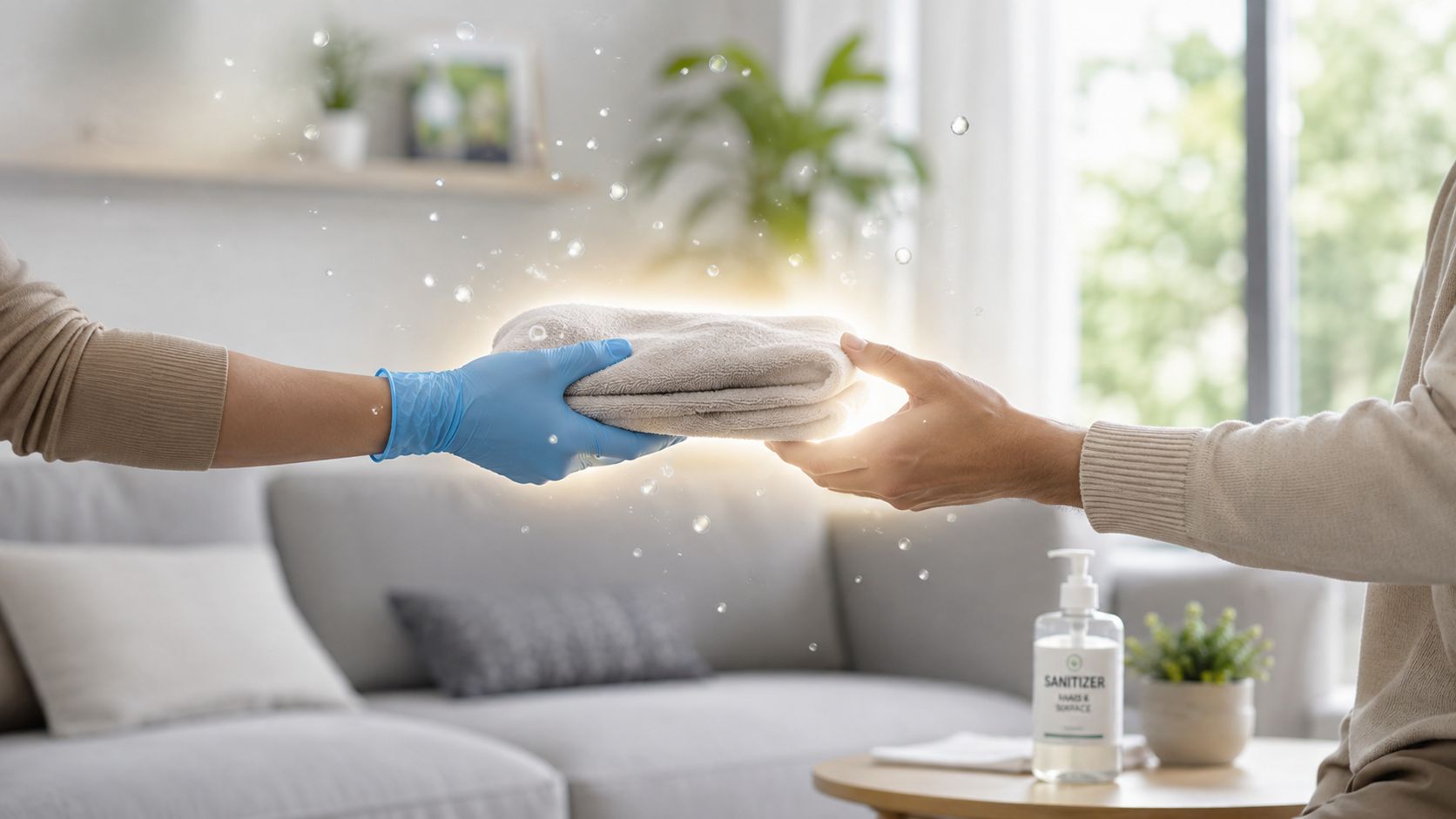
A second route involves contaminated materials, known as fomites. Bedding, towels, clothing, linens, and other objects touched by lesions or bodily fluids may expose the person who handles them. The practical response is targeted rather than treating every object as dangerous: keep used linens separate, avoid shaking them, wash them with detergent according to public-health guidance, and clean hard surfaces that may be contaminated. This fomite transmission guide explains how objects can participate in infection spread.
Respiratory exposure requires careful distinction. Close face-to-face contact can produce infectious respiratory particles. Mpox does not spread through air like a routine airborne infection, and brief interactions in classrooms, offices, or during travel are not typical transmission situations. Prolonged face-to-face contact with an infectious person matters more than briefly passing someone.
| Exposure route | More meaningful example | Less typical example |
|---|---|---|
| Direct contact | Touching an active lesion during intimacy or care | Passing someone in a corridor |
| Mucosal exposure | Fluid reaching the eye, mouth, or genital area | Touching intact skin briefly |
| Contaminated items | Handling used bedding or clothing from an infected person | Sitting near someone in a public space |
| Respiratory particles | Prolonged close face-to-face contact | Brief proximity in an office or vehicle |
These categories help families, caregivers, and clinicians judge exposure proportionately. Someone handling unhealed lesions needs protective measures. Someone who briefly stood beside another person on public transport generally does not face the same exposure pattern.

When an Infected Person Is Contagious
Mpox doesn't usually become contagious immediately after exposure. The CDC science brief states that the incubation period averages about 7 days and can extend to approximately 3 weeks. During this period, a person may have no symptoms, so they may not realize that an exposure occurred.
Symptoms can begin with fever, swollen lymph nodes, headache, or other systemic signs. A rash or lesions may then appear, although presentations can vary. Lesions can affect the skin and mucosal sites, including the mouth, throat, eyes, vagina, and anus.
The infectious period is tied to symptom onset and healing. CDC says an infected person can spread mpox from when symptoms start until the rash has fully healed and fresh skin has formed. WHO similarly says infectiousness continues until every lesion has crusted, the scabs have fallen off, and new skin has formed underneath, including at mucosal sites.
That benchmark is more reliable than judging the visible skin alone. A person may have a lesion in the mouth, throat, eye, vagina, or anus that isn't obvious to others. The WHO questions and answers on mpox says healing usually takes 2 to 4 weeks.
Evidence about transmission before visible symptoms remains nuanced. CDC materials describe possible spread 1 to 4 days before symptoms appear, while the available guidance does not establish asymptomatic transmission as a routine, confirmed route. That means a person who feels well after a known exposure should follow public-health or clinical advice rather than assume either absolute safety or inevitable transmission.
For households, the action window is clear: isolate while symptoms and lesions are present, avoid direct contact with lesions and contaminated materials, and don't end precautions until all lesions have healed according to clinical or public-health guidance.
Where Transmission Happens Most Often
Risk depends on the quality and duration of contact, not just on being in the same building. A shared bedroom can create repeated exposure through bedding and close physical contact. A caregiver may face risk while helping with lesion care. An intimate partner may encounter skin lesions or mucosal lesions during prolonged contact.
Sexual networks received considerable attention during the 2022 outbreak because prolonged skin-to-skin and mucosal contact supported transmission. That framing remains useful for some exposures, but it's incomplete if it causes families, caregivers, or people in shared housing to ignore household precautions.
The CDC transmission overview distinguishes close or intimate contact, including sex, kissing, and direct skin-to-skin contact, from casual interactions. It also states that mpox doesn't spread through casual contact such as brief classroom, office, or travel encounters.
Comparing settings
| Setting | Why exposure may occur | Sensible response |
|---|---|---|
| Household | Shared rooms, towels, clothing, bedding, and caregiving | Separate sleeping arrangements and linens where possible |
| Intimate contact | Prolonged skin-to-skin and mucosal contact | Avoid contact while lesions remain unhealed |
| Healthcare | Lesion care, contaminated materials, and certain procedures | Follow facility PPE and infection-control protocols |
| Casual public contact | Brief proximity without lesion or fluid contact | Routine precautions are generally proportionate |
Healthcare environments require professional protocols rather than improvised household measures. Staff should assess the procedure, the possibility of contact with lesions or fluids, and whether respiratory particles may be generated.
Casual settings still deserve accurate communication. A gym, office, classroom, or transit vehicle isn't automatically risk-free, but brief contact without direct lesion exposure is not the pattern emphasized by WHO and CDC. Risk ranking should help people choose appropriate precautions, not encourage avoidance of everyone who may have been nearby.
How to Prevent Monkeypox Transmission
Prevention works best when actions match the route of exposure. Start with the person who has symptoms. Anyone with suspected or confirmed mpox should avoid close physical contact and follow medical guidance until lesions have crusted, scabs have fallen away, and fresh skin has formed.
Prioritize the highest-yield actions
Isolate the infectious person. Use a separate bedroom and bathroom where possible. Keep distance from household members and pets, avoid intimate contact, and don't share towels, bedding, clothing, razors, utensils, or other items that may contact lesions or bodily fluids.
Act promptly after an exposure. Public-health authorities may recommend post-exposure vaccination. Vaccines used in relevant programs include JYNNEOS, known as Imvanex in Europe, and ACAM2000 where indicated and appropriate. Eligibility and timing depend on local guidance, the type of exposure, and individual health factors.
Use healthcare PPE correctly. Clinical teams may need gloves, gowns, eye protection, and fit-tested respirators for aerosol-generating care. Facilities should apply their infection-control protocols rather than relying on ordinary household precautions.
Handle laundry carefully. Don't shake contaminated linens or clothing. Place them directly into a suitable bag or container, wash them with detergent according to public-health guidance, and perform hand hygiene after handling them.
Clean hard surfaces. Use an appropriate disinfectant, including products listed for mpox where available. Prioritize high-touch surfaces and areas contaminated by lesions or bodily fluids instead of disinfecting every object indiscriminately.
Consider vaccination for higher-risk groups. Depending on local recommendations, this may include men who have sex with men with multiple partners, sex workers, laboratory staff, and others with occupational or exposure risk.
Prevention works through consistency: isolate, avoid lesion contact, separate contaminated materials, clean proportionately, and seek clinical advice after a meaningful exposure.
No single step replaces the others. Isolation limits direct contact, laundry and surface controls address materials, PPE protects caregivers, and vaccination can reduce risk for people who qualify.
Common Myths and the Evidence on Silent Spread
Myth: Mpox only spreads through sex.
Sexual contact can involve prolonged skin-to-skin and mucosal exposure, but WHO also identifies household contact, contaminated materials, and close physical contact as relevant routes. A caregiver or family member can face exposure without sexual contact.
Myth: Mpox spreads through the air like measles.
CDC says mpox doesn't spread through the air or through casual contact such as brief interactions in an office, classroom, or during travel. Close face-to-face contact may involve infectious respiratory particles, but that isn't the same as routine airborne spread across a room.
Myth: Everyone in a room will catch it.
Exposure depends on what happened in the room. Direct contact with lesions, prolonged close contact, or handling contaminated materials matters more than sharing space briefly.
Myth: Toilet seats are a major risk.
Public-health guidance emphasizes lesions, skin-to-skin contact, mucosal exposure, and contaminated bedding, clothing, linens, and similar materials. A toilet seat isn't automatically a high-risk object. Cleaning shared bathroom surfaces remains sensible, especially in a household with an infected person, but fear should follow the exposure evidence.
Myth: Pets always become sick.
Animal exposure is possible, but “always” is inaccurate. People with mpox should discuss animal contact with public-health professionals and avoid exposing pets to lesions, scabs, body fluids, or contaminated materials.
Silent spread requires careful distinction. Presymptomatic transmission means spread before symptoms are noticeable. Asymptomatic transmission means spread from someone who never develops symptoms. The discussion of asymptomatic viral shedding addresses why detectable viral material and proven infectious transmission aren't interchangeable.
CDC-linked summaries currently state that there's no evidence of transmission from asymptomatic individuals, while CDC guidance recognizes that spread may occur 1 to 4 days before symptoms appear. The practical response is neither complacency nor panic. Ask what contact occurred, whether lesions or fluids were involved, whether bedding or clothing was shared, and whether face-to-face contact was prolonged.
Practical Guidance for Clinicians and Households
Clinicians should begin with exposure history, symptom timing, lesion location, and the intensity of contact. A patient with a compatible illness may need testing, isolation counseling, and advice about monitoring contacts. After a significant exposure, clinicians and public-health teams can assess whether post-exposure vaccination is appropriate.
Patients should receive clear instructions about lesions that may be hidden or atypical. A person shouldn't assume that visible skin healing means all mucosal lesions have healed. Follow-up should account for the whole body and any unresolved symptoms.
Public-health communicators can improve trust by leading with close physical contact rather than presenting mpox as belonging to one sexual identity or community. Messages should explain both the higher-risk routes and the low likelihood of transmission through brief casual encounters. That approach reduces stigma while preserving accurate prevention advice.
Households need a workable plan:
- Separate sleeping areas: Use a separate bedroom and bathroom if possible.
- Limit caregivers: Assign one primary caregiver when practical, rather than increasing the number of exposed people.
- Protect hands: Wear gloves when handling dressings, lesions, or contaminated materials, then wash hands.
- Control laundry: Keep used linens contained, avoid shaking them, and wash them with detergent according to guidance.
- Clean touchpoints: Disinfect surfaces that may have contacted lesions, fluids, or contaminated fabrics.
Hand hygiene and targeted surface disinfection are proportionate responses to the documented role of contaminated materials. They don't require theatrical cleaning of an entire home. They require attention to the places and objects that an infectious person touched.
If you want more evidence-based explanations of virus biology, transmission routes, and prevention, visit VirusFAQ.com and explore its educational guides for readers, clinicians, students, and public-health communicators.
Leave a Reply