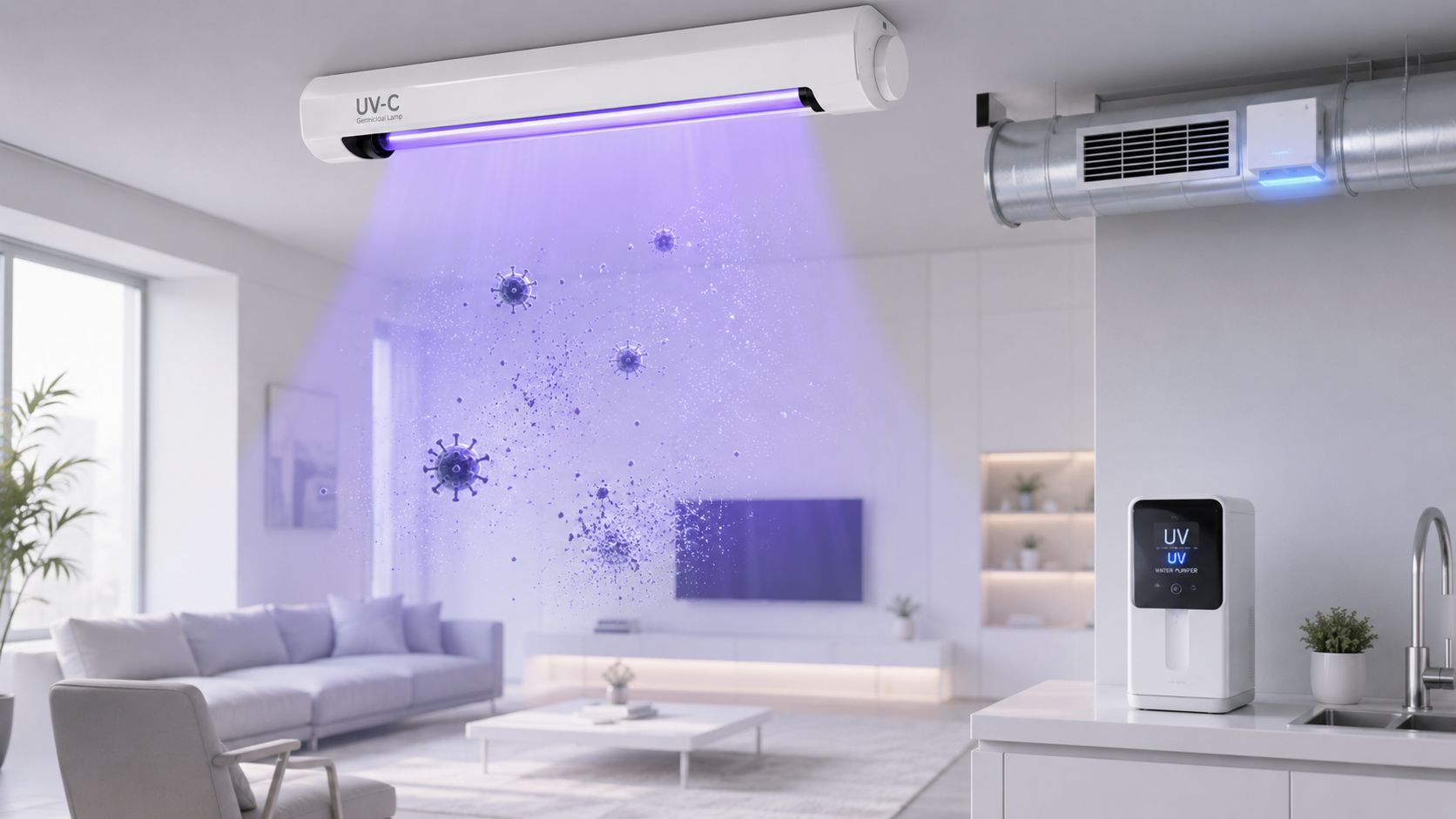
A dose of about 2 mJ/cm² at 254 nm can achieve 4-log inactivation of SARS-CoV-2, while approximately 40 mJ/cm² can achieve 6-log inactivation, according to a review in ACS Photonics. Those figures make one point immediately clear: UV disinfection systems are dose-delivery machines, not just powerful lamps.
UV-C can inactivate viruses, bacteria, and other microorganisms without adding a chemical disinfectant, but performance depends on what reaches the target, for how long, and under what physical conditions. This guide explains the mechanism, the main system categories, dose-response data, evidence from healthcare and decentralized water settings, validation, safety, and how to match equipment to a real building, water plant, or home. For readers comparing air-treatment options, this practical discussion of the cost and benefits of UV air purifiers adds useful context.
Why UV Disinfection Systems Matter Right Now
The phrase “UV kills germs” is true but incomplete. A buyer needs to know which organism, which wavelength, which delivered dose, and which environment the equipment can treat. The SARS-CoV-2 figures above illustrate why lamp wattage alone is a poor specification. A lamp can produce substantial radiation, yet the target may receive too little because of distance, airflow, shielding, poor transmittance, or a dirty optical surface.
UV disinfection systems use ultraviolet radiation to inactivate microorganisms, usually by damaging genetic material so the organism can no longer replicate. They sit alongside other control methods rather than automatically replacing them. Filtration physically removes particles, chemicals can react with or destroy contaminants, and UV provides a physical inactivation barrier without relying on chemical residuals.
Practical rule: Treat “UV output” as an equipment characteristic. Treat delivered dose at the target as the performance question.
That distinction matters in air, water, and surface applications. An upper-room UVGI fixture, an in-duct reactor, a water chamber, and a portable surface device all deliver radiation through different geometries. Their results can't be compared by lamp size alone.
The most useful way to evaluate a system is to ask seven questions:
- Mechanism: What biological damage does the light cause?
- System type: Is the device designed for air, water, or surfaces?
- Dose-response: What dose does the target organism require?
- Evidence: Has performance been demonstrated outside a simple laboratory setup?
- Validation: Was dose delivery measured with biodosimetry or RED?
- Safety: Can people occupy the treated space?
- Use-case fit: What happens when maintenance, turbidity, airflow, or surface geometry changes?
By the end, “UV works” should no longer be the decision. The decision should be whether a particular system delivers a verified dose, safely, to the organisms and locations that matter.
How UV Light Actually Inactivates Viruses
Sunlight gradually fades fabric because radiation changes molecules in the material. UV-C applies the same broad idea more deliberately. It reaches microbial genetic material and creates damage that prevents a virus from completing the replication process.
UV-C is the most germicidal part of the ultraviolet spectrum. CDC materials identify 265 nm as the optimum wavelength for killing or inactivating many microorganisms, while also emphasizing that effectiveness depends primarily on fluence, or delivered dose, rather than lamp power or exposure time alone. A plain-language explanation of this mechanism appears in what germicidal means.
Viruses don't reproduce independently. They use a host cell's machinery to copy their DNA or RNA and produce new virus particles. UV-C damage can interrupt that genetic copying process. The particle may remain physically present, but it has been inactivated because it can no longer generate a productive infection.
The outer structure also matters. Enveloped viruses, including HIV-1, influenza viruses, and SARS-CoV-2, have a lipid envelope surrounding their internal components. Non-enveloped viruses, such as norovirus, adenovirus, and rotavirus, lack that outer membrane and can be more resistant under some treatment conditions. Resistance isn't determined by the label alone, however. Wavelength, dose, humidity, water quality, surface material, and test method all influence the result.

A useful mental model is:
Dose = intensity × time, adjusted by the conditions between the source and the microorganism.
Distance reduces intensity. Angle changes how much radiation reaches a surface. Dust, shadows, droplets, particles, and opaque material can block exposure. In water, UV transmittance determines how far radiation travels. In air, mixing and residence time determine whether an airborne particle passes through the effective treatment zone.
That is why a UV disinfection system should be evaluated as a complete optical, electrical, mechanical, and control system. The lamp creates radiation, but the reactor or fixture determines whether the microorganism receives enough of it.
The Main Types of UV Disinfection Systems
The hardware category tells you what problem the manufacturer designed the system to solve. Four broad groups cover most practical deployments.
Airborne treatment
Upper-room and whole-room UVGI systems place UV-C in a controlled zone above occupants or operate in an empty room. Air movement carries microorganisms through the treated region. The design challenge is exposure control in occupied spaces, because direct UV-C reaching skin or eyes creates a safety hazard.
In-duct UV systems install inside HVAC equipment or an air-handling passage. They treat moving air within a shielded enclosure, where the system can control distance and residence time without exposing occupants. They may also be designed to limit microbial growth on internal coil or drain-pan surfaces, but a vendor's claim must specify whether it refers to air treatment, surface treatment, or both.
Water treatment
UV water reactors pass drinking water, reuse water, or wastewater through a chamber containing one or more lamps or LEDs. Water quality becomes central. Turbidity, particles, fouling, and low UV transmittance can prevent radiation from reaching microorganisms consistently.
Published guidance illustrates the wide design envelope. Drinking-water and reuse applications often use roughly 10-12 mJ/cm² for 3-log targets for Giardia and Cryptosporidium, while adenovirus can require about 186 mJ/cm² for a 4-log target; municipal wastewater guidance reports typical effective doses of 30-80 mJ/cm². These figures come from the EPA and NYSERDA analysis of UV disinfection for wastewater effluent.
Surface devices
Handheld, portable, and conveyor UV devices expose objects or surfaces directly. They work best when the target is visible and positioned at a controlled distance. Seams, recesses, textured materials, stacked objects, and shadows create untreated areas. Readers comparing enclosed equipment can also compare sterilization box options while checking whether the product provides measured dose data rather than only a lamp description.
A surface-cleaning machine should be judged by coverage, contact time, geometry, and verification, not by appearance or advertised bulb count. The surface cleaning machine guide provides related context for evaluating automated equipment.
| System Type | Deployment | Typical Dose Range | Common Use Sites | Primary Tradeoff |
|---|---|---|---|---|
| Upper-room or whole-room UVGI | Air passes through a treated upper zone or an empty room | Application-specific, based on air mixing and exposure control | Clinics, classrooms, shared spaces | Safety and airflow integration |
| In-duct UV | UV-C operates inside a sealed HVAC airstream | Application-specific, based on airflow and residence time | Air handlers, ducts, coil sections | Requires correct installation and maintenance |
| UV water reactor | Water flows through a controlled chamber | About 10-186 mJ/cm² in the cited drinking-water examples, with wastewater commonly about 30-80 mJ/cm² | Drinking water, reuse, wastewater | Turbidity, transmittance, hydraulics, and fouling |
| Handheld or conveyor device | Direct exposure to visible surfaces | Published studies range from 0.01-729 mJ/cm² | Equipment, rooms, production lines | Shadowing and uneven surface dose |
The table's ranges aren't interchangeable specifications. They show why a water reactor, air unit, and surface device require separate validation.
Dose-Response Data for Human Viruses
SARS-CoV-2 demonstrates how sharply microbial inactivation can change as dose rises. At 254 nm, about 2 mJ/cm² achieved 4-log inactivation, while about 40 mJ/cm² achieved 6-log inactivation, as reported in the ACS Photonics review. A system intended for a higher reduction target therefore needs more than a small adjustment to the lamp specification. It needs a verified increase in delivered dose.
Surface data add another warning. EPA's compiled guidance reports a median dose of about 3.6 mJ/cm² for 90% SARS-CoV-2 inactivation, while some studies required as much as 10 mJ/cm² for the same one-log reduction. The EPA surface-disinfection guidance shows why a single advertised number can mislead when test conditions differ.

The target organism changes the design
Water applications make the contrast even clearer. Guidance commonly places Giardia and Cryptosporidium 3-log targets around 10-12 mJ/cm², whereas adenovirus may require about 186 mJ/cm² for a 4-log target. The harder-to-inactivate organism should drive the design if the system makes a broad pathogen-control claim.
The same principle applies to surfaces. A Frontiers review found published device doses ranging from 0.01 to 729 mJ/cm². In one conveyor system, inactivation rose with dose at 13.7-56.2 mJ/cm², then leveled off across tested surfaces at 60-140 mJ/cm², a pattern associated with shadowing and surface geometry. The Frontiers review of UV decontamination studies makes the practical limitation visible: more radiation can't reliably reach a surface hidden behind a fold, particle, or irregular edge.
A credible specification names the organism, reduction target, wavelength, matrix, geometry, and measured dose. “Powerful UV” doesn't answer those questions.
Evidence of Efficacy in Real Settings
Laboratory efficacy establishes what UV can do under defined conditions. Real settings ask a harder question: does the system reduce risk after airflow, maintenance, occupancy, surface complexity, and human behavior enter the picture?
Healthcare evidence provides a useful calibration. A 2023 systematic review found that UV-C use was associated with a statistically significant reduction in Gram-negative rod infections, with an incidence rate ratio of 0.82 and a 95% confidence interval of 0.68-0.99. The same evidence did not find statistically significant reductions for C. difficile and VRE. The review is available through the PubMed Central systematic review.
That result supports a measured interpretation. UV-C can add value, but its effect depends on pathogen, setting, deployment, and the infection-control program surrounding it. A room device can't compensate for missed cleaning, poor ventilation, incorrect placement, or inadequate exposure.
A 2025 systematic review reported up to a 70% decrease in C. difficile in some high-risk settings, while also finding that results varied by setting and pathogen. The 2025 hospital UV disinfection review concluded that UV works best as part of a broader infection-control strategy rather than as a standalone solution.
Water systems face a different evidence problem
Decentralized systems show why implementation deserves as much attention as laboratory performance. A 2026 case-study compilation examined 19 small UV water systems across four continents and found that UV can improve safe-water access in rural and low-resource settings, while emphasizing the need for unified measurement, tracking, and engineering guidance. The 2026 small-system UV case-study compilation highlights how variable operating conditions can be outside the assumptions of a controlled test.
That evidence changes the buyer's question from “does UV work?” to “under what conditions does it work, for which organisms, and with what maintenance burden?” A system may be a strong choice where chemical handling is difficult or a physical barrier is useful. It still needs pretreatment, monitoring, correct operation, and a plan for failures.
The most defensible claim is not that UV sterilizes everything. It is that a correctly engineered and maintained system can provide a valuable reduction barrier when its delivered dose and limits are understood.
Installation and Operational Considerations
A UV system can meet its laboratory specification and still underperform in service. The gap usually appears in the path between the lamp and the microorganism.
Start with the treatment matrix
Water operators should measure or manage UV transmittance, turbidity, and particle loading. Suspended material can absorb or scatter radiation, creating protected zones around microorganisms. Pretreatment may therefore be necessary before the water reaches the UV chamber.
Air systems face different variables. Designers must account for airflow, mixing, residence time, fixture placement, and the volume that receives an effective dose. A lamp installed in a duct isn't automatically equivalent to a validated in-duct reactor.
Lamp aging and quartz-sleeve fouling reduce usable output. Operators need a replacement schedule based on the equipment's validated operating life, plus inspection and cleaning procedures. A sensor or alarm can warn about declining performance, but it can't correct poor hydraulics or a blocked optical path.
Validate the delivered dose
Industry and regulatory practice commonly uses biodosimetry and reduction equivalent dose, or RED, because measured inactivation depends on lamp output, reactor hydraulics, UV transmittance, and pathogen-surrogate behavior. Guidance also allows performance to be expressed against a 254 nm dose benchmark or at a UV-LED emission wavelength. The dose-validation literature indexed by PubMed explains why lamp wattage isn't a substitute for reactor validation.
EPA guidance states that systems operating below 40 mJ/cm² RED may require case-by-case validation for disinfection credit, making dose verification a practical design constraint. Operators should request the test method, flow conditions, transmittance assumptions, sensor location, and reduction target.

A practical operating checklist includes:
- Test the input: Establish water quality or airflow conditions before selecting equipment.
- Control the flow: Confirm that maximum flow still receives the validated dose.
- Clean the optics: Inspect sleeves, reflectors, and fixtures on a defined schedule.
- Track lamp life: Replace lamps or modules according to validated output, not visual appearance.
- Verify performance: Use biodosimetry, RED data, calibrated sensors, or an appropriate combination.
- Document failures: Record alarms, downtime, maintenance, and corrective actions.
The 2026 small-system evidence shows why this discipline matters in rural and low-resource deployments. UV offers promise, but highly variable conditions require local measurement and practical engineering rather than a copied product claim.
Safety Limits and Occupied-Space Use
Direct UV-C exposure can injure skin and eyes. The ACGIH threshold limit values for UV exposure are wavelength-dependent, so a safety review must identify the emitted spectrum, exposure duration, irradiance, and accessible locations rather than treating every UV product as equivalent.
Unoccupied-room systems should operate only after people and animals leave, with interlocks, warning signs, and controls that prevent accidental entry. Occupied-space UVGI uses shielding and carefully positioned fixtures so direct radiation doesn't reach occupants. In-duct systems place the source inside a sealed air path, which can avoid direct exposure when installed correctly.
Older mercury-lamp designs can create additional concerns. A broken lamp can release mercury-containing material, and lamps that emit around 185 nm can generate ozone. A safety data sheet and installation manual should state lamp construction, emitted wavelengths, ozone behavior, access controls, interlocks, and cleanup procedures.
Municipal experience also shows that UV isn't an experimental idea. The historical technical record of UV disinfection494) documents the first UV disinfection system in Marseilles in 1910, later advances in lamps and electronics during the 1950s, and more than 2,000 European drinking-water installations by the early 1990s. That history reflects decades of operational learning, not permission to ignore site-specific safety controls.
Far-UVC, including research around 222 nm, is being studied for occupied-room air applications. The technology remains an evolving area, and long-term human safety evidence is still maturing. Don't treat a far-UVC label as a complete safety assessment.

Matching UV Disinfection Systems to Your Setting
The right system depends on the target, not the novelty of the product. A homeowner, hospital engineer, water operator, and school administrator may all search for UV disinfection systems, but they need different evidence.
Homeowners and small offices
Choose a contained HVAC or portable surface system with clearly stated dose data, safety controls, and maintenance requirements. Use manual cleaning for visible soil and high-touch surfaces. A surface device can't treat what the light can't see, and an air unit can't disinfect every object in a room.
For broader virus education, VirusFAQ.com provides articles covering viral characteristics, transmission, and prevention, including accessible and scientific formats. Use educational material to understand the hazard, then assess the product's validated performance separately.
Healthcare facilities
Upper-room UVGI or in-duct treatment may support an infection-control program, while whole-room devices can provide supplemental treatment between occupancy periods. Keep terminal cleaning, ventilation, hand hygiene, and room-management procedures in place. The healthcare evidence shows why pathogen-specific outcomes matter more than a universal “kills germs” promise.
Municipal and decentralized water operators
Benchmark the reactor against RED and biodosimetry, not lamp wattage. Match flow, UV transmittance, turbidity, hydraulic design, alarm logic, and maintenance capacity to the target organism and reduction objective. Small-system deployments deserve especially careful monitoring because local conditions can differ substantially from the assumptions used in a laboratory validation.
Facilities managers and educators
Treat UV as one layer in a broader program. Verify vendor claims against published guidance, ask for test conditions, and confirm whether the device is designed for occupied or unoccupied use. Resources on indoor air quality improvement can help place UV alongside ventilation, filtration, and routine cleaning.
Several technical questions remain open. UV-C LED systems are advancing, but reviews still identify efficiency and lifetime limitations. In-pipe hydropowered UV designs remain subjects of feasibility, optimization, and lifecycle research. Far-UVC may support occupied-room applications, but long-term safety evidence continues to develop.
Before buying, ask the vendor to identify the target organism, reduction level, wavelength, delivered dose, test matrix, maximum flow or room volume, maintenance interval, sensor arrangement, and exposure controls. If the answer is only a lamp wattage and a broad claim about sterilization, keep comparing.
Choose a UV disinfection system only after matching its validated dose, safety controls, and maintenance plan to your actual air, water, or surface problem. Before placing an order, request the performance report and operating instructions, test the relevant water or airflow conditions, and add manual cleaning or filtration where UV can't reach. Take those steps now, then use the resulting checklist to reject products that offer confidence without measurable evidence.
Leave a Reply