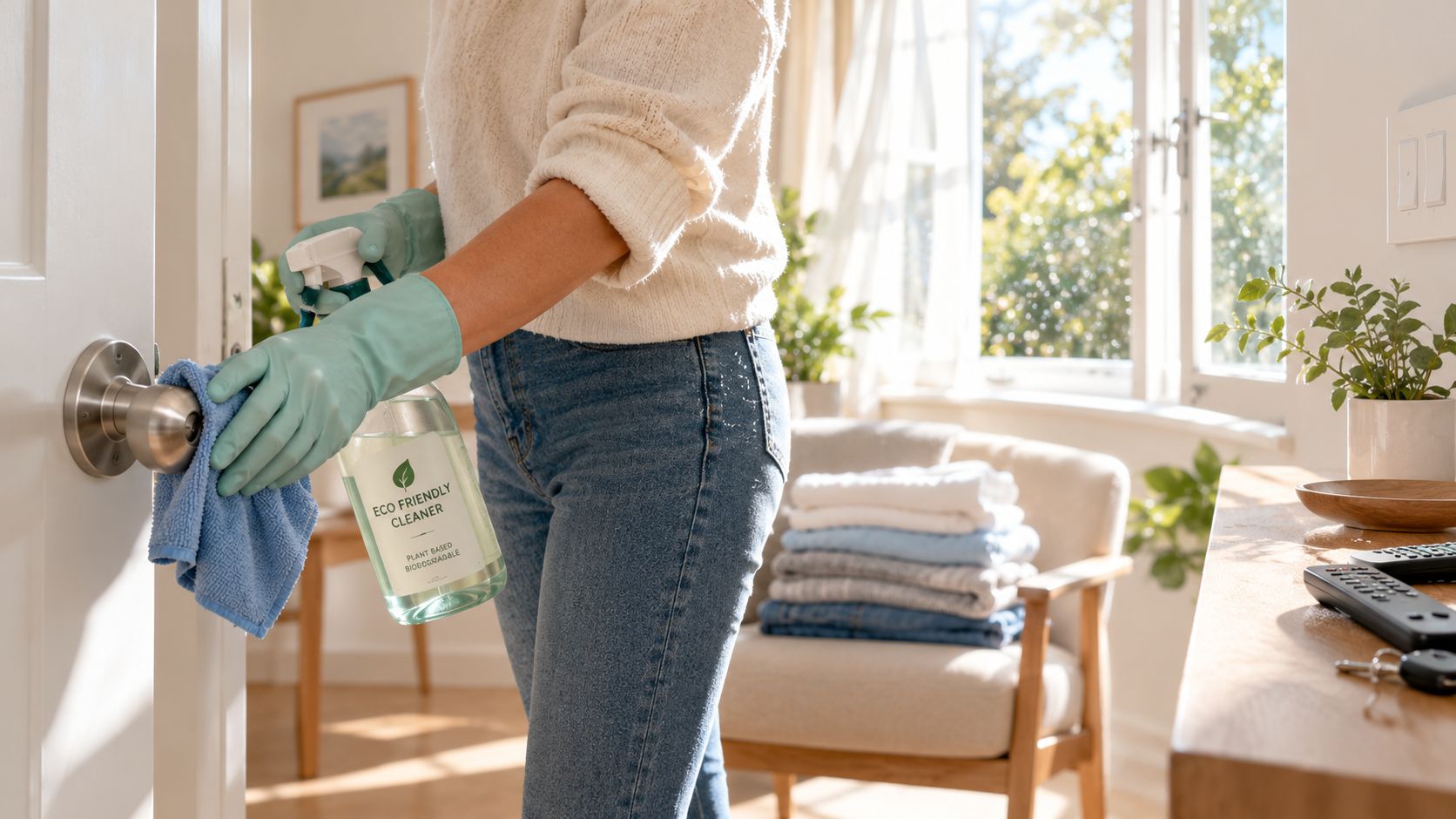
Norovirus requires only about 18 viral particles to cause infection, which is why environmental house cleaning matters even when a surface looks spotless. Stopping spread depends on removing contamination and using the right disinfectant for the right wet contact time.
A household outbreak rarely announces itself with visible dirt. Someone becomes ill, touches a bathroom handle, opens a refrigerator, or picks up a remote, and another person later touches the same object before touching their face or eating. That ordinary sequence is fomite transmission, the movement of infectious material from a surface to hands and then to the mouth, nose, or eyes.
Environmental house cleaning is therefore more than an aesthetic routine. It combines surface cleaning, targeted disinfection, air management, and fabric care to interrupt transmission without creating unnecessary chemical exposure. The most effective approach isn't automatically the harshest product or the label with the most reassuring environmental language. It is the method that matches the hazard.
Why Environmental House Cleaning Matters for Virus Prevention
A clean-looking surface can still carry risk
Visible grime and infection risk overlap, but they aren't the same thing. A polished faucet may still become a route for transmission after an ill person uses it, while a dusty corner may be unpleasant without being the immediate source of an outbreak.
Norovirus illustrates the problem sharply. The infectious dose is about 18 viral particles, according to the CDC's norovirus prevention guidance. A small amount of contamination can therefore matter, especially in shared bathrooms, kitchens, childcare settings, and homes where several people use the same touchpoints.
Consider a typical evening. One family member vomits or has diarrhea, washes their hands, and steadies themselves on the bathroom door handle. Another person opens that door, checks a phone, and prepares food. The virus doesn't need to spread across every surface in the home. It only needs a few connected opportunities to move from a contaminated object to a hand and then to the face or food.
Practical rule: Clean the objects people touch repeatedly, not just the surfaces that look dirty.
Cleaning interrupts a chain
The chain usually includes a source, a surface, a hand, and a vulnerable entry point. Environmental house cleaning weakens that chain in several ways:
- Remove soil first. Detergent and water lift organic material and debris that can shield contamination.
- Disinfect selectively. A suitable product can inactivate pathogens on compatible hard surfaces when its label conditions are followed.
- Reduce transfer. Damp cloths, disposable materials where appropriate, and handwashing limit movement between rooms.
- Control recontamination. A disinfected handle can become contaminated again if the source remains ill or cleaning tools are reused carelessly.
Viruses differ in their resistance and behavior. Non-enveloped viruses such as norovirus and rotavirus demand particular care because a quick wipe may not provide the exposure needed for reliable inactivation. A household doesn't need to panic or sterilize every possession. It does need a deliberate response in high-risk areas after vomiting, diarrhea, or another known contamination event.
The practical standard is simple: treat environmental house cleaning as a public-health barrier, while keeping the response proportionate. Remove contamination promptly, disinfect where transmission is plausible, and avoid spreading particles through dry cleaning methods.
The Science Behind Effective Disinfection
Cleaning and disinfection do different jobs
Cleaning removes soil. Disinfection acts on microorganisms that remain after or during the cleaning process. Combining those steps casually can leave a surface visually improved but microbiologically inadequately treated.
A controlled household study found that detergent with hot water produced no observable reduction in microbial contamination, while hypochlorite and phenolic disinfectants produced substantial bacterial reductions. The same household disinfectant study also found that the benefit was short-lived, with contamination only marginally below baseline again after about 3 to 6 hours.
That finding doesn't make detergent useless. It shows that detergent cleaning and residual disinfection aren't interchangeable. Cleaning removes the material that can interfere with a disinfectant, while disinfection requires a product and process capable of acting on the target organism.

Wet contact time is the hidden variable
Disinfectants need time in contact with a wet surface. If a product is sprayed and immediately wiped away, the surface may never receive the labeled exposure.
Think of contact time like allowing a stain remover to sit before scrubbing. The liquid must remain present long enough for its chemistry to work. Product labels control this detail, so use the stated wet time rather than assuming that a fast pass is sufficient.
The EPA disinfectant-wipe label shows that some products specify a 1-minute wet contact time. Its efficacy language for tough, non-enveloped viruses includes feline calicivirus, norovirus, rhinovirus, and rotavirus as test organisms used to support claims. That doesn't mean every wipe works against every virus. It means the user must check the exact label, target organism, surface compatibility, and required wet time.
WHO surface-disinfection guidance recommends a minimum contact time of 1 minute for coronavirus disinfection unless the manufacturer specifies otherwise. The broader lesson applies across products: don't confuse speed with efficacy.
Green chemistry still requires technical discipline
The modern environmental cleaning movement grew from late twentieth-century concern about chemical exposure and environmental damage. The history of green cleaning describes the influence of environmental concern in the 1960s and 1970s, phosphate restrictions in the 1980s and 1990s, and later emphasis on life-cycle assessment, eco-labels, and circular-economy thinking.
That history matters because safer formulation and effective disinfection aren't opposing goals. The correct question is whether a product is appropriate for the pathogen and used according to its label. “Natural” doesn't replace concentration, coverage, or contact time.
Green Cleaning Myths and Indoor Air Quality Risks
Eco-labels do not answer the air-quality question
The global market for eco-friendly cleaning products is estimated at USD 13.2 billion in 2025, rising to USD 14.3 billion in 2026 and projected to reach USD 33.6 billion by 2035, with a long-run CAGR of 10%, according to this market overview of eco-friendly cleaning products.
That growth reflects rising demand for biodegradable, lower-toxicity, and sustainability-labeled products. It does not show that every product improves indoor air chemistry. An eco-label may address ingredients, packaging, or environmental impact while saying little about what the formula releases during use.
A 2024 study found no strong evidence that green cleaners improve indoor air quality compared with regular products. Fragranced products marketed as green can emit monoterpenes. Indoors, those compounds may react with oxidants and form secondary pollutants, including formaldehyde and PAN species. Fragrance-free products produced far fewer VOCs in the same research, as reported in the study of emissions from fragranced and fragrance-free cleaners.
Choose the exposure profile, not the marketing adjective
For routine cleaning, use a short decision process:
- Fragrance-free formulas: Fewer added scent compounds generally mean fewer fragrance-related emissions.
- Low-VOC labeling: Treat this as an exposure consideration, not proof that a product disinfects.
- Ventilation: Open suitable windows or run exhaust ventilation while cleaning and afterward.
- Task-specific products: Reserve disinfectants for situations where pathogen risk justifies their use instead of applying them across every surface.
Method matters as much as formulation. Damp wiping captures soil and particles, while dry dusting can redistribute them into the breathing zone. Apply enough solution to clean effectively, avoid unnecessary spraying, and allow ventilation to clear vapors. During painting or renovation, related choices also affect exposure. The resource on indoor air quality and painting offers practical advice for considering those sources together.
A biodegradable cleaner can still release irritating compounds indoors. A disinfectant may also be appropriate during a high-risk contamination event, even if it has a greater environmental burden than a routine dusting product. Environmental house cleaning should assess three separate factors: environmental burden, indoor air exposure, and microbial efficacy.
For virus-specific surface decisions, VirusFAQ.com provides guidance on cleaning and disinfecting. Choose the least-emitting product that meets the hygiene requirement, use it with the correct damp method, and ventilate instead of treating scent as evidence of cleanliness.
High-Risk Areas and Targeted Cleaning Protocols
Start with the contamination event
Vomiting or diarrhea requires prompt cleaning and disinfection of contaminated hard surfaces. Norovirus cleanup calls for a chlorine bleach solution of 1,000 to 5,000 ppm, equivalent to about 5 to 25 tablespoons of household bleach per gallon of water, with at least 5 minutes of wet contact time, according to EPA norovirus cleanup guidance.
Use a controlled sequence:
- Put on disposable gloves and improve ventilation if possible.
- Cover and remove visible contamination with disposable absorbent material.
- Clean the area, then apply the bleach solution or an EPA-registered disinfectant effective against norovirus.
- Keep the surface visibly wet for the full 5 minutes.
- Clean again with soap and hot water where specified, then wash hands thoroughly.
Never mix bleach with ammonia, acids, or other cleaners. Check product directions, confirm surface compatibility, and discard or launder cleaning materials safely. Fragrance-free products are preferable where possible because a strong scent does not prove that a surface is disinfected.
Use a room-by-room target list
Bathrooms need prompt attention because illness can contaminate nearby fixtures and floors. In kitchens, clean handles, faucets, counters, refrigerator pulls, and surfaces touched during food preparation. Across the home, include doorknobs, light switches, toilet flush handles, phones, keyboards, and remotes used by an ill person.
| Situation | First action | Disinfection choice |
|---|---|---|
| Routine soil without known illness | Clean with detergent and water | Disinfect only when risk warrants it |
| Known norovirus contamination | Remove soil promptly | Bleach at the specified range or an EPA-registered norovirus product |
| Small high-touch area | Clean if visibly soiled | A labeled disinfecting wipe can be practical |
| Sensitive material | Check compatibility first | Use only a product approved for that surface |
Wipes can limit dosing errors, but their label still controls the decision. Check the listed organism, approved surface, and wet contact time. Some products specify 1 minute, while a wipe that dries sooner may not meet its claim.
Surface note: Dirty window tracks can hold dust and organic debris. Understanding why dirty window tracks matter helps residents include these overlooked areas in routine cleaning, although they do not replace outbreak-focused disinfection of high-touch surfaces.
Fomite transmission is the transfer of pathogens through contaminated objects and surfaces. Clear guidance on how fomite transmission works helps households prioritize surfaces connected to the contamination event instead of treating every object as equally hazardous. Use damp cleaning methods to capture soil, and avoid dry dusting that can redistribute contaminated particles into the air.
Ventilation and Laundry Strategies for Reduction
The cleaning method changes what enters the air
Dry dusting and dry mopping can push dust and allergens back into circulation. That matters in homes with asthma, allergies, mold concerns, or wildfire smoke residue, where the cleaning process itself can increase short-term exposure.
Use a damp microfiber cloth on hard surfaces, working from cleaner areas toward dirtier ones. For floors and carpets, a HEPA vacuum can capture fine particles more effectively than a dry broom. Avoid shaking cloths, rugs, or bedding indoors, and bag heavily contaminated disposable materials before taking them out.
A residential monitoring study found post-cleaning concentration increases in about 60% of measured VOCs and about 80% of measured SVOCs. Most peaks faded within a few hours, but some lower-volatility compounds persisted for more than 5 hours, and carpet spot cleaning produced 2-butoxyethanol emissions that remained high for days, according to the study of residential cleaning emissions.

Treat air, surfaces, and textiles as one system
Run bathroom and kitchen exhaust fans so moisture and airborne contaminants leave the home rather than spreading through it. Guidance from the New York State Department of Health on healthy homes also emphasizes damp cleaning, HEPA vacuuming, ventilation, MERV 13 filtration, and HEPA air cleaners as parts of a broader indoor-air strategy.
Laundry can undo careful surface work if contaminated textiles are handled casually. Keep soiled clothing, towels, and bedding contained, avoid snapping or shaking them, wash them with detergent using the warmest suitable cycle, and dry them completely according to the fabric care instructions. Clean hands and the laundry area after handling items from an ill person.
For a wider framework covering household air management, see this resource on indoor air quality improvement. Ventilation won't replace disinfection, and a purifier won't remove contamination from a handle. Each control addresses a different route of exposure.
Creating a Sustainable Cleaning Schedule
Match effort to risk
A sustainable schedule distinguishes ordinary maintenance from an active illness response. Routine cleaning can focus on soil, moisture, dust, and frequently touched surfaces. Outbreak cleaning requires faster action, a suitable disinfectant, correct wet time, and attention to items used by the ill person.
A practical weekly pattern might look like this:
- High-touch check: Clean handles, switches, faucets, remotes, and appliance pulls according to household use.
- Damp maintenance: Wipe surfaces and mop with a damp method rather than redistributing dry dust.
- Air and fabric care: Vent moisture-prone rooms, maintain filtration, vacuum with HEPA equipment, and launder shared textiles.
- Illness response: After vomiting or diarrhea, isolate the task, remove soil, disinfect affected hard surfaces, and follow the product's label.
Prefer repeatable routines over panic cleaning
Damp microfiber cleaning is generally the better default for dust and allergen control, while disinfecting wipes are useful for small, compatible, high-touch surfaces when their label supports the intended pathogen and contact time. Bleach has an important role in norovirus cleanup, but using it for every routine task can increase odor and chemical exposure without adding proportional protection.
Don't let an eco-label make the decision by itself. Ask three questions: What am I trying to remove? Which pathogen, if any, is relevant? How long must the surface stay wet? That short checklist prevents both under-treatment and unnecessary product use.
The strongest environmental house cleaning plan is consistent, targeted, and comfortable enough to maintain. Keep fragrance-free, low-VOC routine products available, reserve stronger disinfectants for defined risks, use damp tools, ventilate during and after cleaning, and teach every household member why contact time matters.
If your neighborhood association is preparing shared cleaning guidance, create a written protocol for bathrooms, kitchens, high-touch surfaces, laundry, and ventilation. Share the product labels, dilution instructions, and wet contact times with residents so that the next illness response is calm, coordinated, and effective.
Leave a Reply