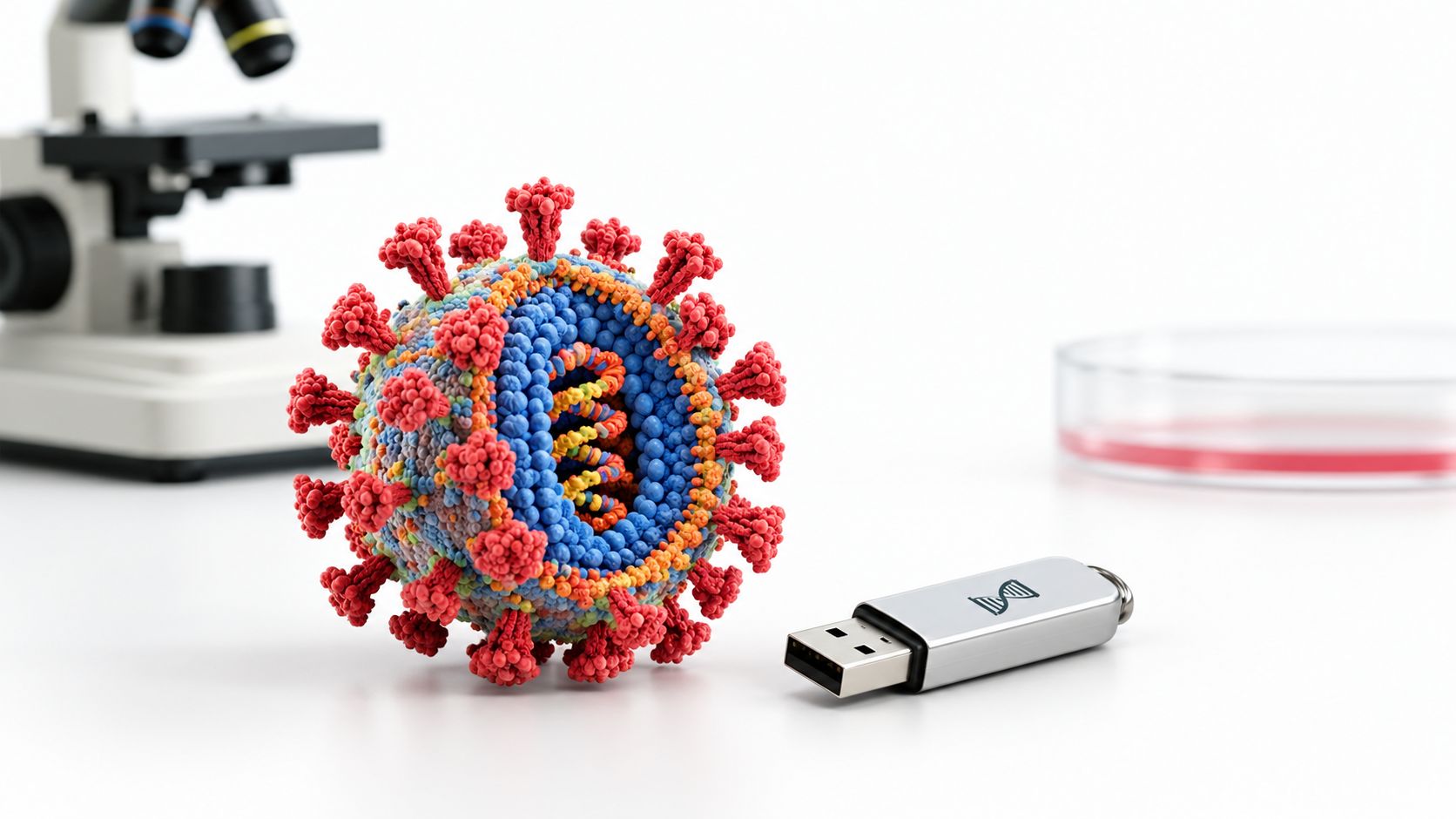
You touch a restaurant door handle, adjust your phone, and reach for a sandwich. Later, someone mentions a “viral outbreak,” and an ordinary moment suddenly feels threatening. Virology for beginners offers a calmer way to understand that risk: viruses aren't random clouds of bad luck. They're biological particles with particular structures, entry points, transmission routes, and weaknesses.
This field became a recognized scientific discipline in 1898, when Friedrich Loeffler and Paul Frosch showed that foot-and-mouth disease could pass through a filter that stopped bacteria, providing clear evidence for a smaller infectious agent (historical overview of virology). Once you understand the rules, sensible prevention becomes much easier than guessing.
The Hidden World Living on Your Doorknob
You grasp a smooth handrail at the gym. At a restaurant, you push open a door, pull out a chair, and handle a menu before eating. Those surfaces may have contacted many hands, but the important question isn't whether every object is dangerous. It's which virus might be present, how long it can remain infectious, and whether it can reach a suitable entry site.

Virology studies viruses, the tiny infectious particles that depend on living cells to reproduce. Bacteria are complete cells with their own internal machinery. A virus is closer to an encrypted USB drive: it carries instructions, but it needs your body's “computer,” a host cell, to unpack those instructions and manufacture new particles.
That dependence explains why viruses are not just miniature bacteria. Most viruses contain genetic material inside a protein shell, and many animal viruses also have a lipid envelope borrowed from a host-cell membrane (virus structure and environmental stability). Their size is commonly measured in nanometres, far below what ordinary light microscopy can resolve.
From fear to useful questions
Hearing “viral outbreak” often triggers a broad fear of contamination. A better response is to ask focused questions:
- What virus is involved? HIV-1, influenza A, SARS-CoV-2, norovirus, and hepatitis viruses don't behave alike.
- How does it spread? Transmission may involve respiratory material, blood, contaminated food or surfaces, sexual contact, or insects.
- What protects it outside the body? An envelope, or lack of one, changes its sensitivity to drying, detergents, alcohol, and disinfectants.
The world's viral threats illustrate that range. WHO estimates that more than 3.9 billion people in over 132 countries are at risk of dengue, with about 96 million symptomatic cases and around 40,000 deaths each year (WHO information on vector-borne diseases). Viral hepatitis B and C affect about 325 million people globally, while hepatitis C caused an estimated 1.75 million new infections in 2015, according to the same WHO source.
Understanding those differences replaces vague alarm with practical judgment. For surface questions, consult this guide to how long viruses live on surfaces, then match your precautions to the actual route of exposure.
Anatomy of a Virus, Capsids, Envelopes, and Surprises
Think of a virus as a sneaker packaged for delivery. The genetic material is the instruction set. The capsid is the protective protein container around it. Some viruses add an envelope, a fatty outer layer that helps them enter certain cells but also makes them more vulnerable to environmental damage.

Three parts to recognize
Genetic material
A virus carries DNA or RNA. This material contains the instructions for making viral components, but the virus can't read and execute them independently.Capsid
The capsid is a protein shell that protects the genome. Capsids can form icosahedral, helical, or complex shapes, and their design affects stability and how viral proteins interact with host cells.Envelope
An envelope is an optional lipid membrane. Influenza A viruses, including H1N1, H2N2, and H5N1, have envelopes. SARS-CoV-2 also has one. Soap can disrupt lipid membranes, which helps explain why thorough handwashing is useful against many enveloped viruses.
The distinction becomes especially important when comparing enveloped viruses with non-enveloped viruses. Norovirus, human rotavirus, rhinovirus, and feline calicivirus lack that fatty outer layer. Their protein-based exterior can tolerate conditions that damage a lipid membrane, so routine alcohol products aren't automatically reliable against them.
Structural clue: An envelope can help a virus enter a cell, but it can also make the particle easier to disrupt outside the body.
Envelope status isn't a complete prediction of transmission. HIV-1 is enveloped and spreads through particular body fluids, not casual contact with a doorknob. Influenza A and SARS-CoV-2 are also enveloped, but their respiratory transmission patterns differ because their surface proteins, preferred receptors, tissue targets, and shedding routes differ.
For a deeper explanation of the components and their jobs, explore virus structure and function. The central lesson is simple: a virus's hardware shapes both its biology and the cleaning method that can disable it.
The Viral Playbook, How Infection Actually Happens
A virus begins infection by finding a compatible host cell. Its surface molecules must attach to a receptor, much like a key fitting a particular lock. If the lock isn't present, or if the interaction is too weak, infection may fail even when the particle reaches the tissue.
The usual sequence is orderly:
- Attachment connects the virus with a host-cell receptor.
- Penetration moves the particle or its genome across the cell boundary.
- Uncoating releases the genetic instructions.
- Genome replication and protein synthesis produce viral material.
- Assembly and maturation build new virions.
- Release sends them toward other cells.
This cycle can involve membrane fusion for enveloped viruses, while non-enveloped viruses may enter through endocytosis or routes that disrupt a membrane. Once inside, the virus redirects host ribosomes and other biosynthetic machinery toward viral production (viral replication cycle).
Why timing confuses people
Exposure and symptoms don't occur at the same moment. During the incubation period, the virus may be replicating, moving through tissues, and provoking an immune response before you feel ill. A test taken very early can miss an infection if the sampled site contains too little detectable viral material.
That doesn't mean a negative result is meaningless. It means the result answers a time-specific question: “Was enough target material present in this sample at this moment for this test to detect?” Clinicians consider symptoms, exposure history, sampling quality, and the test's purpose when interpreting the result.
The viral playbook also explains why entry points matter. Blocking contact with the eyes, nose, and mouth, covering respiratory emissions, and avoiding contact with infected blood or secretions can interrupt the earliest stage of infection. This is not about making every environment sterile. It's about reducing the chances that a viable virus reaches the cells it can use.
For a plain-language walkthrough of this process, see how viruses infect cells.
Why Some Viruses Fly Through the Air and Others Don't
“How did I catch it?” rarely has one universal answer. Viruses travel in different vehicles, and those vehicles determine which behaviours create meaningful exposure.
| Transmission route | Typical setting | Why the route matters |
|---|---|---|
| Respiratory | Shared indoor air, coughs, sneezes, close conversation | The virus must leave one person's airway and reach another person's susceptible tissue |
| Fecal-oral | Contaminated hands, food, water, or surfaces | A small lapse before eating can move particles from a contaminated object to the mouth |
| Bloodborne or fluid exposure | Shared needles, sexual contact, medical exposure, or infected body fluids | Infection depends on direct access to susceptible tissue or bloodstream |
| Vector-borne | Mosquitoes and other insects | The vector transfers the virus during feeding rather than through an ordinary surface |
Structure helps explain the contrast, but it doesn't replace route-specific evidence. Non-enveloped enteric viruses such as hepatitis A virus, rotavirus, and astrovirus can remain infectious on surfaces for at least 2 months, while influenza viruses have been documented for up to 48 hours on hard, non-porous surfaces and up to 12 hours on porous surfaces (review of virus persistence on surfaces).
That difference changes priorities. A stomach-virus concern makes handwashing, food handling, bathroom hygiene, and effective surface disinfection central. A respiratory-virus concern places more emphasis on ventilation, staying away from symptomatic people, and reducing inhalation exposure.
The route is more important than the label
HIV-1 provides a useful corrective to surface anxiety. It is an enveloped virus, but its known transmission depends on specific infected fluids reaching vulnerable tissues. Touching an intact surface isn't equivalent to that exposure.
H5N1, SARS-CoV-2, and seasonal influenza also require separate risk assessments. Their names may all appear in respiratory-health discussions, but host range, tissue preference, environmental stability, and the circumstances of exposure affect what prevention makes sense.
Practical rule: Don't ask only whether a virus is “contagious.” Ask how it leaves the host, how it survives long enough to reach another person, and where it enters.
How Doctors Catch a Stealthy Invader, Testing and Diagnosis
A clinician choosing a viral test is matching a tool to a biological target. The sample might contain viral genetic material, viral proteins, or evidence that the immune system has responded to an earlier infection. Each approach answers a different question.
PCR reads the genetic fingerprint
PCR works like a highly controlled photocopier. It amplifies selected genetic material so laboratory instruments can detect it more readily. For RNA viruses, the laboratory first converts RNA into a form that can be amplified, then looks for matching sequences.
PCR can be highly sensitive, but it still depends on the right sample, collection technique, timing, and target. A sample taken from the wrong site or too early in infection may not represent what is happening elsewhere in the body.
Antigen tests provide a faster snapshot
Rapid antigen tests look for viral proteins rather than copying genetic material. They can produce results quickly, which makes them useful when a person needs an immediate indication, but they may miss an infection when the amount of target protein is low.
A negative rapid result therefore needs context. Symptoms, recent exposure, the disease being considered, and local clinical guidance all influence whether repeat testing or a different method is appropriate.
Antibody tests look backward
Serology detects antibodies produced by the immune system. It can help show that the body encountered a virus or responded to vaccination, but it generally isn't the same as detecting an active infection at the moment of testing.
The timing of antibody development matters, and antibodies don't automatically reveal when exposure occurred or whether a person can transmit the virus. Doctors interpret serology alongside medical history and other findings.
A test result is evidence, not a complete story. The sample, timing, method, and clinical question all shape what the result can tell you.
The Ultimate Viral Defense, Cleaning, Wipes, and Hygiene
Cleaning works best when you match the method to the virus and the surface. Soap removes material from hands, while a disinfectant must be used according to its label, with enough coverage and contact time to inactivate the target organism.
Non-enveloped viruses deserve special attention. Norovirus is resistant to many common disinfectants, and public-health guidance recommends chlorine bleach or an appropriate EPA-registered product. CDC guidance uses bleach at 1,000 to 5,000 ppm, equivalent to 5 to 25 tablespoons of household bleach per gallon of water, with at least 5 minutes of contact time (norovirus disinfection guidance).
Daily habits and outbreak cleanup aren't identical
For ordinary daily maintenance, focus on handwashing, cleaning visibly dirty surfaces, and following the product label. During suspected norovirus contamination, use a product specifically suited to that virus. CDC-linked guidance says alcohol and disinfecting wipes alone aren't sufficient for norovirus, so don't treat every convenient wipe as interchangeable with a norovirus-effective disinfectant (public-health cleaning advice).
For outbreak cleanup, OSHA and state guidance describe different bleach mixtures by surface:
- Food or mouth-contact items: Use 1 tablespoon per gallon.
- Most non-porous surfaces: Use 1/3 cup per gallon.
- Heavily contaminated non-porous surfaces: Use 1 and 2/3 cups per gallon.
- Contact time: Leave the solution in place for 10 to 20 minutes, then rinse where appropriate (OSHA norovirus factsheet).
Never mix bleach with ammonia, acids, or other cleaners. Improve ventilation, wear suitable gloves, remove organic material before disinfecting, and follow the product's safety directions.
Hands require a separate approach. Wash with soap and water, especially after using the bathroom, caring for someone who is ill, or cleaning contamination. If you handle laboratory or preparation materials, keep hygiene chemicals separate from specialised supplies such as bacteriostatic water, which has its own handling requirements.
Your Next Steps in Virology and Staying Safe
You don't need to memorize every virus to think like a careful beginner. Learn the structure, identify the transmission route, check the quality of the source, and choose prevention that blocks the route that actually matters.
VirusFAQ.com offers educational and scientific articles on viral biology, transmission, prevention, and individual viruses, including Influenza, Herpes, Coronaviruses, Norovirus, HIV-1, HBV, HCV, SARS-CoV-2, and others. Pair that reading with guidance from public-health agencies and a clinician when symptoms or exposure create a medical concern.
Misinformation makes this discipline harder to handle. A systematic review found misinformation rates ranging from 1% to 51% in vaccine-related social posts, 0.2% to 28.8% in COVID-19 posts, and 4% to 60% in pandemic-related posts; it also found that about 20% to 30% of YouTube videos about emerging infectious diseases contained inaccurate or misleading information (overview of health misinformation risks).
Build your next habit today: learn the route of transmission for the virus you're concerned about, check the relevant public-health guidance, and stock a disinfectant whose label specifically covers that virus. Knowledge won't remove every risk, but it will help you replace panic with precise, effective action.
Visit VirusFAQ.com to explore the virus-specific guides, then review your household cleaning products and choose one clearly labelled for the pathogens you need to manage. If you're dealing with suspected norovirus or another illness, follow public-health instructions and contact a healthcare professional for personalised advice.
Leave a Reply