Ebola disease has produced case-fatality proportions ranging from 25% to 90%, with an average around 50%, yet its transmission depends on a much narrower route than casual proximity. According to the World Health Organization's Ebola disease fact sheet, infected people don't transmit the disease during incubation. Transmission generally begins when symptoms appear and occurs through direct exposure to blood or other body fluids.
That contrast defines the most useful way to understand Ebola virus characteristics. Ebola can cause severe, systemic illness, but it isn't an invisible airborne threat that spreads only because people share a room. Its biology, clinical progression, species differences, and environmental behavior determine where prevention efforts should focus. Surface cleaning is one part of a wider response that also includes rapid recognition, isolation, protective equipment, safe care, contact tracing, and safe burials.
Understanding the Core Ebola Virus Characteristics
Ebola disease comes from viruses in the genus Orthoebolavirus, part of the Filoviridae family. Six orthoebolavirus species have been identified, and three are known to cause large outbreaks: Ebola virus, Sudan virus, and Bundibugyo virus. “Ebola” therefore describes a related group, not one perfectly uniform pathogen. That distinction helps explain why vaccines, treatments, and fatality patterns can differ between outbreaks.
The incubation period is typically 2 to 21 days. People are not considered infectious until symptoms begin, according to the WHO clinical overview. Someone may have been exposed, feel well, and still need careful monitoring. Once illness starts, however, the risk assessment changes because body fluids can carry the virus.
What drives transmission
Ebola most commonly spreads through direct contact with blood, vomit, sweat, saliva, and other body fluids from a symptomatic patient. Exposure may occur while caring for someone who is ill, touching contaminated materials, or handling a body after death without appropriate infection-control measures.
The route is dangerous but defined. Casual proximity alone isn't the central transmission mechanism, and walking past an infected person before symptoms appear does not by itself create the same risk as fluid contact. Risk increases when fluids reach damaged skin or mucous membranes, especially during close care or cleanup without suitable protection. The CDC's Ebola transmission guidance also emphasizes contact with infected blood or body fluids as the primary route.
That practical boundary matters for prevention. The virus can produce severe systemic disease inside the body, yet its environmental fragility makes rigorous cleaning and disinfection of contaminated surfaces a practical circuit-breaker outside it.
Practical rule: Treat any suspected infectious fluid as hazardous, and leave assessment, testing, isolation, and clinical care to trained public health and medical teams.
Why the fatality range needs context
Reported fatality has fallen in outbreaks with early supportive care, while the 25% to 90% WHO range reflects settings with differing clinical capacity. Outcomes also vary with the virus species, speed of recognition, access to supportive care, infection-control systems, and the circumstances of the outbreak.
The most useful mental model is a severe infection with defined biological constraints. Prevention works when responders identify cases early, limit fluid exposure, disinfect contaminated environments correctly, and interrupt contact chains. That focus connects Ebola's frightening pathology with practical actions that can reduce transmission.
Morphology and Genomic Architecture

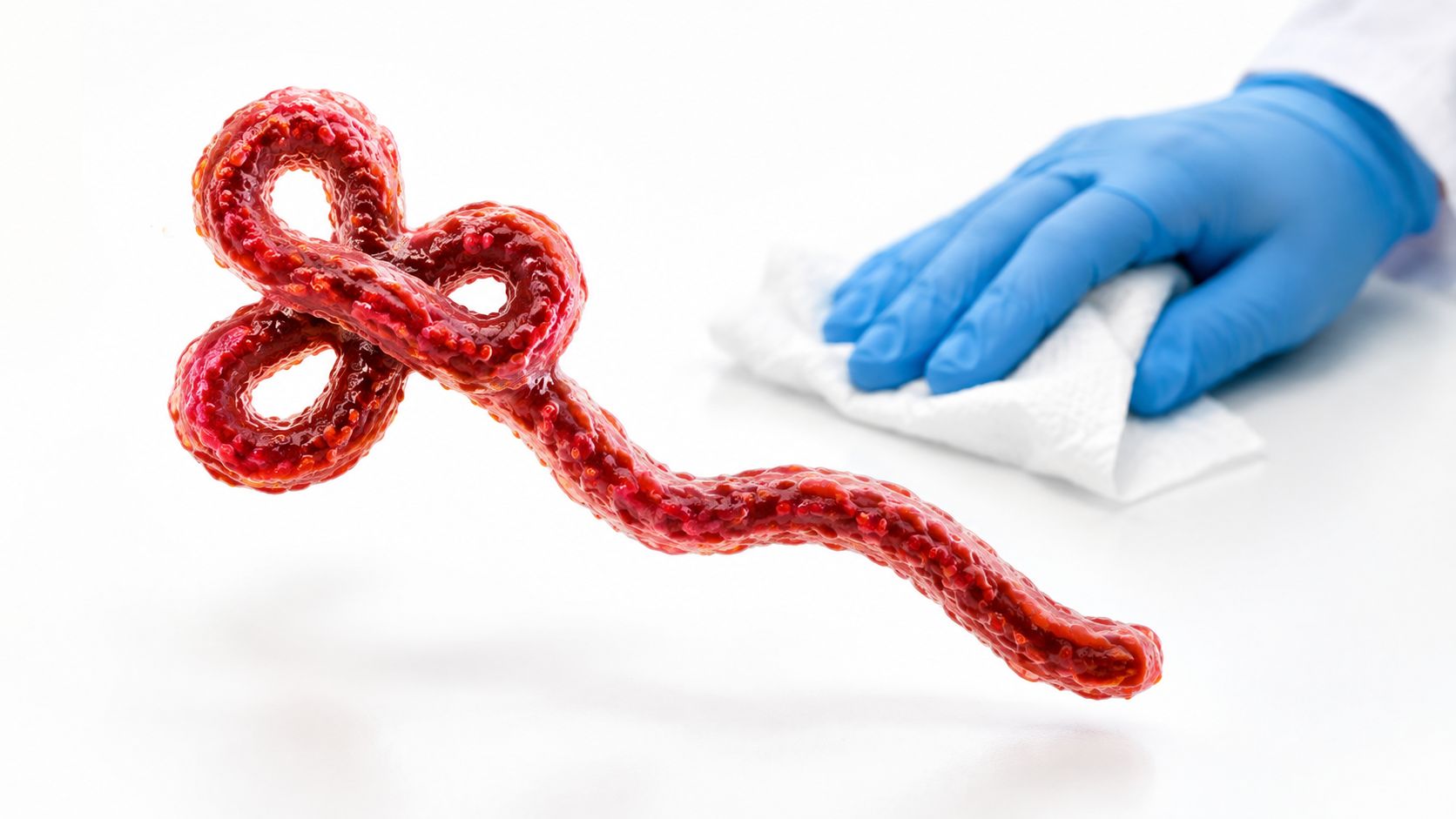
Ebola virions are slender, threadlike particles. Under an electron microscope, their distinctive filamentous shape reflects an enveloped structure wrapped around a helical nucleocapsid. Approximate dimensions are 80 nanometers in diameter and 970 to 1200 nanometers in length, as described in the AABB technical reference on Ebola virus.
The envelope is a lipid membrane surrounding the viral core. It helps the virion attach to and enter susceptible host cells, while also leaving the particle dependent on the envelope's physical integrity. Heat, drying, environmental conditions, and suitable disinfectants can damage enveloped viruses more readily than many non-enveloped viruses. The broader principle is explained in viral envelope biology.
The genome works like a compact instruction set
Ebola virus is a non-segmented, negative-sense RNA virus. Its genome is about 19 kb and contains 7 genes that produce 9 proteins, according to the Journal of Leukocyte Biology review.
“Negative-sense” means host ribosomes cannot read the genome directly as messenger RNA. The virus first needs to produce a readable RNA copy. It therefore packages its own RNA-dependent RNA polymerase machinery inside the virion, supplying the tools needed to begin transcription and genome synthesis after entry into a susceptible cell.
This compact arrangement helps explain Ebola's acute infection pattern. The virus arrives with the machinery required to start replication rather than relying on a dormant genetic program that later reactivates. Clinical reviews also do not describe a carrier state comparable to the lifelong latency associated with some other viruses.
Structure connects to prevention
The lipid envelope supports cell entry, yet it also creates a practical weakness outside the host. Rigorous disinfection can disrupt contaminated material on frequently touched surfaces. It does not replace clinical isolation, protective equipment, or trained handling, but it can interrupt an environmental contact route.
Protect the patient, protect the caregiver, and remove infectious material from the environment. Effective disinfection requires a product approved for the intended pathogen or setting, careful adherence to its label, and enough wet contact time for the product to work. The terrifying systemic effects of Ebola begin inside the body, while its fragile outer structure gives everyday cleaning a concrete role in breaking transmission.
Transmission Dynamics and Environmental Persistence
Ebola transmission is best understood as a chain. A symptomatic person sheds virus in infectious body fluids. Another person encounters those fluids through care, cleaning, medical procedures, funeral practices, or contaminated materials. The chain continues only if the exposure reaches a susceptible person and infection-control measures fail to stop it.
This explains why outbreak control uses several safeguards at once. Health teams identify suspected cases, arrange testing, isolate patients, monitor contacts, provide clinical care, use protective equipment, and manage bodies safely. Cleaning contaminated surfaces adds another barrier, especially in treatment areas, homes, transport settings, and facilities where people handle equipment or bodily fluids.
The environmental route is practical, not magical
A contaminated surface doesn't independently create an outbreak. It becomes relevant when infectious material reaches it and another person later touches that material, then touches their eyes, nose, mouth, broken skin, or protective equipment incorrectly. The exact risk depends on the amount and condition of contamination, the surface, handling practices, and the effectiveness of cleaning.
That's why routine visual tidiness isn't enough in a suspected exposure setting. Trained personnel need a defined process for spill management, waste handling, reusable equipment, laundry, and disinfection. Household members shouldn't attempt to care for a suspected patient without guidance from health authorities.
Exposure control works as a chain of barriers. If one barrier fails, isolation, protective equipment, hand hygiene, and environmental disinfection can still prevent the next exposure.
Recovery doesn't erase every biological question
Recent reviews describe a more complex recurrence pattern. The review of survivor-linked Ebola recurrence notes that the 2021 Guinea outbreak established survivor-linked recurrence as a transmission pattern, with genetically identical Ebola virus persisting in an immune-privileged site for over five years after recovery.
This finding doesn't mean recovered people are generally contagious or that ordinary contact with survivors is unsafe. It means public health teams must account for rare, biologically plausible persistence in protected body sites when investigating an unexpected re-emergence. Survivor care, clinical follow-up, sensitive communication, and genomic investigation all matter.
Symptom-based screening remains useful because people aren't infectious during incubation, but it can't answer every outbreak question by itself. Transmission patterns also depend on illness severity, the intensity of contact, caregiving practices, and the possibility of persistence in survivors.
Incubation Period and Clinical Manifestations
After exposure, Ebola disease usually begins after an incubation period of 2 to 21 days, with symptoms averaging 8 to 10 days after contact, according to the CDC Health Alert Network notice. During incubation, infected people aren't considered contagious. Once symptoms begin, the situation changes, and suspected illness requires immediate medical and public health attention.
Early symptoms can resemble other infections. Fever, weakness, headache, muscle pain, gastrointestinal symptoms, and abdominal discomfort may appear before severe disease becomes obvious. Bleeding is widely associated with Ebola in popular culture, but it isn't the only or even the defining early sign. A clinician must consider exposure history, local outbreak conditions, symptom progression, and appropriate laboratory testing.

Why severe illness becomes systemic
Ebola pathogenesis involves far more than direct destruction of infected cells. The clinical pathogenesis review describes a connected process involving intense immune suppression, abnormal inflammatory signaling, endothelial dysfunction, coagulopathy, and progressive multiorgan injury.
The endothelium lines blood vessels. When vascular regulation becomes impaired, fluid balance and circulation can deteriorate. Coagulation abnormalities can contribute to bleeding and tissue injury, while inflammatory and immune disturbances can worsen damage across multiple organs.
A patient may therefore move from apparently nonspecific illness to profound weakness, fluid loss, circulatory instability, and organ dysfunction. The clinical priority isn't to wait for dramatic hemorrhage. It's to recognize risk early and monitor the systems most likely to fail.
What care teams need to watch
Severe disease requires careful attention to:
- Fluid and electrolyte loss: Vomiting and diarrhea can rapidly undermine circulation and organ function.
- Coagulation changes: Abnormal clotting can contribute to bleeding and vascular injury.
- Kidney and liver function: Multiorgan injury can alter laboratory findings and medication decisions.
- Circulatory status: Vascular dysfunction and fluid depletion can produce shock-like deterioration.
- Infection-control needs: Every clinical interaction must protect staff, other patients, caregivers, and the wider community.
Early care can improve the chance of a better outcome, but suspected Ebola is a medical emergency. People shouldn't self-test, handle potentially contaminated materials, or travel through public spaces seeking informal advice. Contact local health services first and follow their instructions.
Species Variations and Historical Outbreak Context
Ebola is not one uniform virus. Related orthoebolavirus species differ in documented fatality patterns, available countermeasures, and outbreak-control requirements. The New England Journal of Medicine perspective on species-specific Ebola response explains that approved vaccines currently target Ebola virus, also called Zaire ebolavirus. No approved vaccine or therapeutic agent exists for Bundibugyo virus disease, while the 2025 Uganda trial focused on Sudan virus because licensed protection for non-Zaire species remains limited.
Species identification therefore affects decisions from the beginning. Laboratory confirmation, and genomic characterization where available, can show whether a vaccine or treatment developed for one species is relevant to the outbreak at hand.
Comparison of Primary Orthoebolavirus Species
| Species | Historical Fatality Range | Approved Vaccine Availability |
|---|---|---|
| Ebola virus, Zaire ebolavirus | 25% to 90% across Ebola outbreaks, as reported in the historical benchmark below | Approved vaccine available |
| Sudan virus | About 40% to 65% in documented outbreaks, according to the NEJM species-response perspective | No approved vaccine |
| Bundibugyo virus | About 25% in the 2007 to 2008 DRC outbreak, according to the CDC MMWR historical account | No approved vaccine |
These figures describe historical outbreaks, not a guaranteed outcome for every patient or future event. They show why risk, countermeasures, and outbreak control differ by species.
The historical benchmark
The largest Ebola outbreak occurred in West Africa from 2014 to 2016. It caused 28,610 cases and 11,308 deaths across 10 countries, with a case fatality proportion of about 40%, according to the CDC MMWR historical account. Delayed case detection and limited health-system capacity allowed transmission to expand across communities and borders.
Ebola was first identified in 1976. Outbreaks have remained concentrated mainly in sub-Saharan Africa, where natural reservoirs can occasionally enable spillover into humans. The West African epidemic became a defining benchmark because its death toll exceeded that of all earlier outbreaks combined by more than tenfold.
A 2025 DRC outbreak caused by Zaire ebolavirus was rapidly contained with more than 47,500 vaccinations. Sudan and Bundibugyo outbreaks, by contrast, showed the practical limits of species-specific protection. Preparedness begins with recognizing Ebola, then determining which Ebola virus is involved.
Surface Disinfection and Prevention Strategies
Ebola's lipid envelope is the most useful structural fact for prevention: correctly applied disinfection can disrupt this outer layer and interrupt contamination on suitable surfaces. The virus can cause severe systemic disease in a person, yet its environmental weakness makes careful cleaning a practical circuit-breaker for transmission.
“Wipe the surface” is not a complete protocol. Choose a disinfectant approved for the setting, manage visible contamination according to the facility's procedure, and keep the surface wet for the label-specified contact time. Staff also need gloves, eye protection, gowns, and masks or respirators where indicated, along with training for spills and waste.

A safer cleaning sequence
- Restrict access: Keep unprotected people away from suspected contamination.
- Put on appropriate protection: Follow the protective-equipment requirements set by trained infection-prevention personnel.
- Remove visible contamination safely: Organic material can reduce disinfection performance, so use the facility's approved spill procedure.
- Apply the correct disinfectant: Select a product authorized for the intended pathogen and surface.
- Respect contact time: Keep the surface wet for the full label instruction. Drying it too soon can reduce effectiveness.
- Dispose of materials correctly: Treat used wipes, gloves, and other contaminated items as regulated infectious waste where applicable.
- Perform hand hygiene: Clean hands after removing protective equipment and handling waste.
Disinfecting wipes suit controlled, small-area cleaning because they deliver a measured amount of product without requiring a spray that could spread droplets or aerosolize contamination. They still require careful selection and label use. Follow institutional guidance, and never mix chemicals.
High-risk work involving blood or body fluids requires procedures beyond ordinary household cleaning. Guidance on forensic pathologist safety precautions illustrates why trained personnel use specialized protective measures.
Prevention starts before the surface
Environmental disinfection works alongside early reporting, isolation, contact monitoring, safe patient transport, and professional management of bodies after death. Family members should avoid touching a sick person's blood, vomit, diarrhea, saliva, sweat, or bedding, then contact public health authorities for instructions.
For product-selection principles and virus-focused cleaning considerations, see this comparison of disinfectants effective against enveloped and non-enveloped viruses. No consumer product replaces emergency guidance when Ebola is suspected.
Cleaning is a circuit-breaker, not a diagnosis. Use it to interrupt contamination after trained responders establish a safe plan.
Key Takeaways for Public Health and Safety
Ebola's most important characteristics form a connected pattern. It's an enveloped, filamentous, negative-sense RNA virus with a compact genome. It causes acute disease through systemic immune, vascular, coagulation, and organ disturbances. It usually spreads through direct exposure to body fluids from symptomatic people, not through casual proximity during incubation.
The practical implications are clear:
- Recognize symptoms in context: Fever, weakness, gastrointestinal illness, and worsening systemic signs require urgent professional assessment when exposure is possible.
- Don't handle fluids or contaminated materials casually: Blood, vomit, sweat, saliva, and other body fluids can create exposure risk once illness begins.
- Use layered controls: Isolation, protective equipment, hand hygiene, testing, contact monitoring, clinical support, and safe burials work together.
- Clean deliberately: Use a suitable disinfectant, follow the label, maintain contact time, and dispose of wipes and protective materials safely.
- Respect species differences: A vaccine or treatment designed for Zaire ebolavirus shouldn't be assumed to work against Sudan or Bundibugyo virus.
The most frightening feature of Ebola is its potential for severe systemic disease. The most useful feature for prevention is that transmission follows identifiable routes. Public health teams can break those routes by finding cases early, protecting caregivers, managing fluids safely, and removing contamination from the environment.
If you're building a reliable reference library for virus biology, transmission, and prevention, visit VirusFAQ.com for accessible educational and scientific articles, then share this Ebola guide with healthcare educators, students, and community teams who need clear, evidence-based information.
Leave a Reply