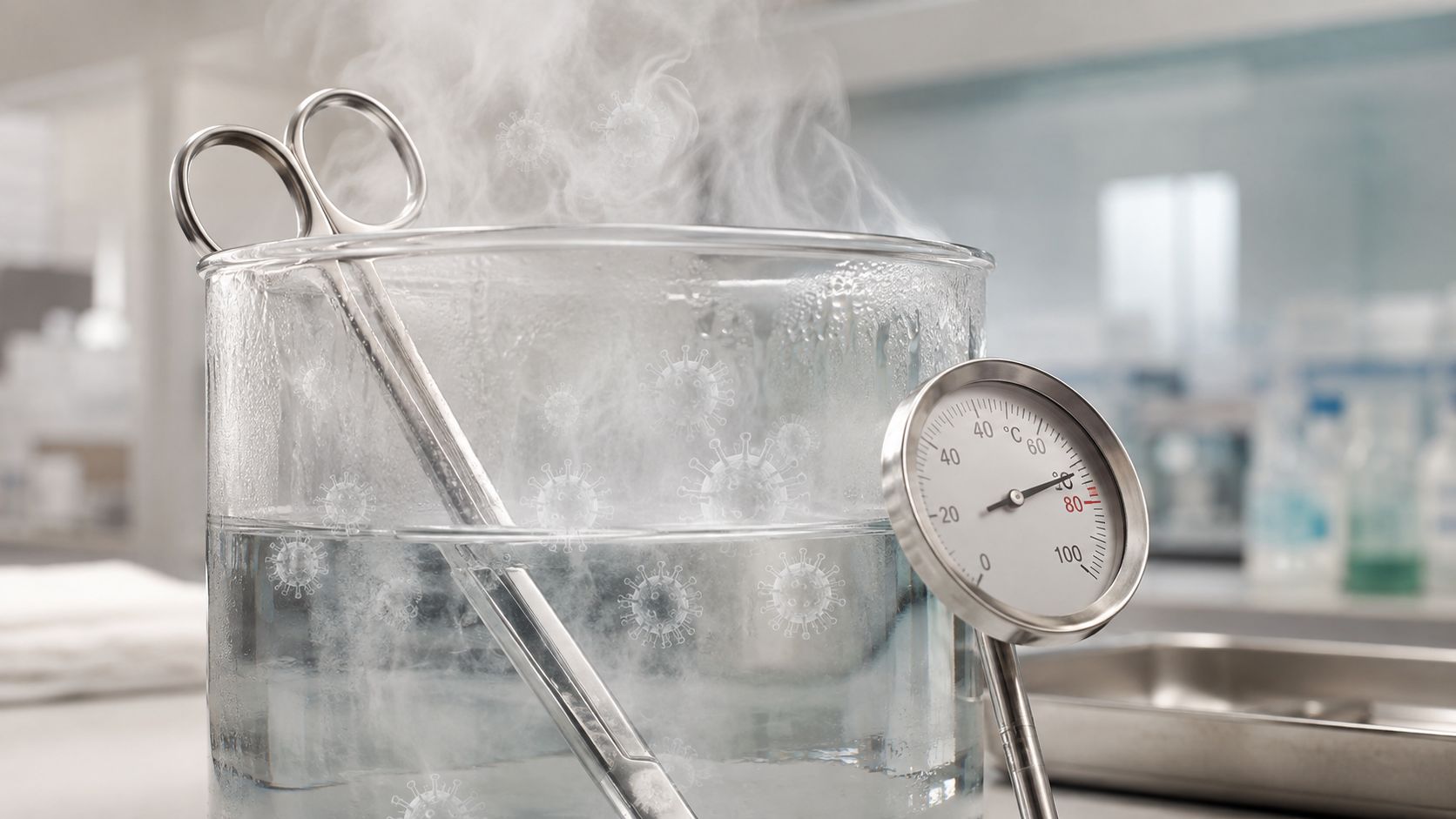
“Hot water kills everything” is useful household shorthand, but it's unsafe infection-control advice. Thermal disinfection is an engineered process, not a hot rinse. It depends on the relationship between temperature, exposure time, steam or water contact, device design, soil, and the arrangement of the load. A machine display can show the right temperature while a lumen, hinge, folded textile, or shielded surface receives something very different.
That distinction matters across the virus spectrum, from SARS-Related Coronavirus 2 (SARS-CoV-2) and influenza viruses to hepatitis B virus, norovirus, rotavirus, rhinoviruses, and other non-enveloped viruses. The practical question isn't “How hot did the water get?” It's “Did the entire item receive a validated heat dose under the actual conditions of use?”
Why Hot Water Alone Is Not Enough
Hot water can reduce contamination, but temperature by itself doesn't prove disinfection. A brief rinse may leave microorganisms protected by organic soil, trapped in a joint, or hidden inside a narrow channel. Even a high-temperature cycle can fail when the load is overcrowded or when water cannot reach every surface.

The three variables that control microbial kill
A reliable thermal process controls at least three connected variables:
- Temperature: The delivered heat must reach the required level at the coldest or hardest-to-heat location.
- Hold time: The item must remain exposed long enough to achieve the intended microbial lethality.
- Load configuration: Instruments, textiles, containers, and devices must be positioned so heat and water can contact the relevant surfaces.
The CDC describes steam-processing benchmarks that illustrate the principle. For porous loads and instruments, common sterilization conditions include 132°C to 135°C for 3 to 4 minutes, while 121°C requires a 30-minute exposure in gravity systems according to CDC guidance. These are sterilization examples, not universal thermal-disinfection settings, but they show why a small temperature change can require a much longer hold.
Microbial inactivation follows an exponential curve. In practical terms, reducing the temperature doesn't create a small inconvenience that can be ignored. It can demand a disproportionately longer exposure, and that relationship changes again when the organism is protected by residue or a complex device.
Why a household cycle isn't automatically clinical reprocessing
A dishwasher's “sanitize” program may be appropriate for its intended domestic or food-service use, but that label doesn't automatically establish compliance with a healthcare washer-disinfector standard. The machine may measure water temperature rather than the temperature at the most difficult location on the load. It may also lack the validated spray pattern, instrumentation, documentation, and device-specific loading instructions required for medical reprocessing.
Practical rule: Treat a temperature display as one process measurement, not as proof that every surface has been disinfected.
Cleaning comes first because dried blood, mucus, food residue, and other organic material can physically shield microorganisms. Thermal disinfection then has to deliver the required heat dose to the cleaned item. Without both steps, “hot” can become a misleading description rather than a defensible infection-prevention process.
How Heat Destroys Viral Structures
Heat inactivates viruses by damaging the structures and molecules that make infection possible. A useful analogy is cooking an egg. Raw egg proteins have a specific arrangement, but heat changes their bonds and causes them to unfold and aggregate. The result isn't merely a warmer egg. It's a different material with different properties.
Viruses depend on similarly precise molecular structures. Their capsid proteins form a protective shell and help some viruses attach to host cells. Enveloped viruses also carry a lipid membrane containing proteins needed for entry. Heat can disrupt protein shape, weaken membrane structure, and damage the coordinated arrangement required for the virus to bind, enter, and replicate.

Enveloped and non-enveloped viruses behave differently
Enveloped viruses, including SARS-CoV-2 and influenza viruses, have a lipid membrane that can be disrupted by environmental conditions and heat. That doesn't mean any warm exposure is sufficient. A review reported that 60°C for 30 minutes, 65°C for 15 minutes, and 80°C for 1 minute each reduced coronavirus infectivity by at least 4 log10 in the cited review of coronavirus heat inactivation. For SARS-CoV-2 specifically, one study reported efficient inactivation at 56°C for 30 minutes, 70°C for 10 minutes, and 90°C for 5 minutes in its experimental conditions.
Those findings demonstrate a time-temperature relationship, not a universal household recipe. The material being treated, the amount of virus, and the way the experiment was performed still matter.
Non-enveloped viruses lack that lipid membrane. Their protein shells can be more resistant to environmental stress, which is one reason norovirus surrogates, rotaviruses, rhinoviruses, and other non-enveloped viruses require careful validation. A peer-reviewed review reported complete inactivation of murine norovirus in suspension and dried mussels at 85°C for 10 minutes, while 100°C for 1 minute also achieved complete inactivation. Another study found approximately 4.7 to 4.8 log reductions in norovirus surrogates at 80°C for 3 minutes as summarized in the peer-reviewed review.
The material around the virus changes the result
Laboratory suspension tests don't perfectly represent a soiled instrument, a dried textile, or a food-contact surface. Food residue, dried mucus, blood, and embedded proteins can insulate microorganisms or reduce heat transfer. A study reported parvovirus inactivation at 80°C for 10 minutes and 90°C for 1 minute even under soiled conditions, but that result applies to the tested conditions and doesn't remove the need for validation in other materials as described in the validation study.
Heat therefore doesn't “seek out” viruses. It must reach them through the surrounding material. A clean, exposed surface and a protected organism inside a residue layer present different engineering problems, even when the machine reports the same water temperature.
Understanding Time and Temperature Thresholds
The A0 concept gives thermal disinfection a common engineering language. It converts a time-temperature exposure into the equivalent microbial lethality delivered at 80°C, using a Z value of 10°C. This helps engineers and infection-prevention teams compare cycles instead of treating temperature and time as unrelated settings.
For surgical instruments, ISO 15883-2 sets a minimum A0 of 600. That target can be achieved through practical combinations such as 10 minutes at 80°C, 1 minute at 90°C, or 30 seconds at 93°C, provided the process delivers the required exposure to the relevant parts of the load as described in the AAMI discussion of the ISO 15883 framework.
A practical comparison
| Temperature | Hold Time | A0 Value | Typical Application |
|---|---|---|---|
| 70°C | 10 minutes | 60 | Bedpan washers |
| 80°C | 10 minutes | 600 | Surgical instruments |
| 90°C | 1 minute | 600 | Surgical instruments |
| 93°C | 30 seconds | 600 | Practical equivalent cycle example |
| 90°C | 5 minutes | 3000 | Higher target cited for heat-resistant viruses such as hepatitis B |
The table shows why a hotter cycle can be shorter while producing a comparable A0. It doesn't mean every device can use any row interchangeably. The device's material, geometry, risk classification, cleaning method, and validated product family still determine which target is suitable.
The same standard series defines A0 60 for bedpan washers, equivalent to 10 minutes at 70°C in the AAMI-described framework. A lower target for a different application isn't a contradiction. It reflects a different intended use and risk profile.
For some heat-resistant viruses, literature has cited A0 3000, equivalent to 5 minutes at 90°C, rather than A0 600 in the referenced epidemiology review. The lesson is simple: there is no single “disinfection temperature” that applies to every organism, device, or load.
For readers comparing household advice with clinical values, the temperature guidance for killing viruses should be interpreted through this same lens. A temperature only becomes meaningful when paired with a validated hold time and a defined application.
Thermal Disinfection Versus Chemical Methods and Sterilization
Thermal disinfection occupies a specific place between routine cleaning and sterilization. It can provide a validated reduction of many vegetative microorganisms and viruses, but it isn't a universal substitute for sterilization. Critical surgical instruments, which enter sterile tissue or the vascular system, require sterilization rather than relying on a disinfection cycle.
Bacterial spores are a key boundary. Thermal disinfection conditions may not reliably destroy them, while sterilization is designed to eliminate all forms of microbial life, including spores. Steam sterilization uses higher temperatures and controlled exposure parameters, and facilities must validate the complete process rather than infer success from a hot chamber.

Choosing between heat and chemicals
Chemical methods can offer advantages when a device contains delicate materials, narrow channels, or heat-sensitive components. Agents such as bleach, hydrogen peroxide, and quaternary ammonium compounds can reach surfaces that hot water may not contact effectively, but only when staff use the correct product, concentration, contact time, compatibility controls, and rinsing procedure.
Thermal methods avoid chemical residue and reduce staff exposure to chemical handling. They can be particularly useful for heat-stable semi-critical devices, bedpan processing, and suitable laundry applications. Heat still has limitations, including poor penetration into inaccessible lumens and the possibility of damaging materials through repeated exposure.
| Method | Main strength | Important limitation |
|---|---|---|
| Thermal disinfection | Consistent moist-heat exposure without chemical residue | Requires heat compatibility and validated contact with all relevant surfaces |
| Chemical disinfection | Can treat some heat-sensitive materials and complex geometries | Depends on concentration, contact time, material compatibility, and effective rinsing |
| Sterilization | Required for critical devices and intended to address spores | Needs dedicated validated equipment and a controlled reprocessing workflow |
A sterile processing team may need equipment planning, storage controls, workflow separation, and documentation beyond the washer itself. Resources on sterile processing department solutions can help facilities assess that wider operational environment.
High-level disinfection may suit some heat-sensitive endoscopes, while steam sterilization remains appropriate for compatible critical instruments. The difference between these categories is explained further in this guide to the difference between disinfecting and sterilizing. The correct choice follows the device's intended use and risk classification, not convenience alone.
Practical Applications Across Real-World Settings
Thermal disinfection is not one generic “hot wash.” An instrument washer, laundry tunnel, commercial dishwasher, and household water system each expose different materials and surfaces to heat. The shared principle is controlled heat, while the required load arrangement, contact conditions, and evidence of performance vary by setting.

Healthcare instrument reprocessing
A washer-disinfector must deliver heat where contamination may remain. Staff need to follow the manufacturer's loading pattern, open hinged instruments, remove visible soil through pre-cleaning, and connect lumened devices to the correct flushing ports. Powered devices may require specific adapters or handling because internal components can restrict cleaning and heat delivery.
The 2025 edition of EN ISO 15883-2 addresses washer-disinfectors that use thermal disinfection for critical and semi-critical medical devices. Its updated scope and adoption notes include a water-quality clause and clarified requirements for lumens and powered devices in the published standard information. Device-family assignment and documented validation therefore matter as much as the programmed temperature.
A washer's cycle name is not evidence that every surface of a specific device received the required treatment.
Healthcare laundry
Laundry processing depends on more than a heated wash. Guidance for healthcare laundry uses a practical time-temperature benchmark of 70°C to 71°C held for 25 minutes, as described in the referenced medical-laundry material as described in the referenced medical-laundry material. Sorting, safe transport, detergent action, mechanical movement, rinsing, and controlled drying all affect the outcome.
An overloaded washer can restrict water movement and create cooler zones. Shaking soiled textiles can spread contamination before washing starts. Heat cannot correct poor handling or inadequate soil removal.
Dishwashers and food-service equipment
Commercial dishwashers may use high-temperature final rinses for food-service hygiene. Their rack arrangement, surface contact, intended performance, and certification requirements differ from those of healthcare washer-disinfectors. A plate surface, a surgical-instrument hinge, and the inner wall of a narrow lumen are different test locations.
A domestic “sanitize” label does not establish clinical-grade disinfection. For items used around vulnerable people, follow the product manufacturer's instructions and select a validated healthcare or food-service process when the application requires one.
Domestic hot water
Raising a household water heater to 60°C may affect microbial survival in the water system, but temperature alone does not establish viral disinfection. Storage conditions, circulation, outlet temperature, contact time, and scalding risk also matter. Hot tap water should not be used to disinfect medical devices, drinking water, or contaminated materials.
Anyone selecting a boiling-water appliance for a workplace kitchen should first find the right boiling water tap for the intended use, safety controls, and installation environment. Regulated healthcare processing requires consultation with the device manufacturer and the facility's reprocessing policy. Broader equipment choices are covered in this overview of medical device sterilization methods.
The Validation Gap Most Guides Overlook
Many explainers stop after listing a temperature and a hold time. That approach misses the operational risk. The hardest question is whether the required heat dose reached the actual device under the actual load conditions.
EN ISO 15883-2:2025 ties thermal disinfection to more than a generic hot-wash program. It connects the process with device risk class, A0 targets, product-family assignment, water quality, and the special challenges of lumen and powered devices as outlined in the standard publication information. A facility therefore needs evidence that its selected cycle works for the devices it reprocesses.
Why the load matters more than the display
Validation should account for cold spots, restricted channels, hinges, surface contact, detergent performance, rinsing, and the arrangement of instruments. A probe placed in an easily heated part of the chamber may not represent the most difficult location in a complex product.
Water quality also matters because deposits, corrosion, residues, and impaired cleaning can affect both device condition and process performance. The newer water-quality requirement highlights that the process begins with the quality of the water entering the machine, not only with the final heat phase.
Organism-specific testing
Thermal resistance isn't interchangeable between organisms. The FDA notes that thermophilic mycobacterium species are used for testing thermal disinfection processes, which reinforces why a generic “kills germs” statement isn't adequate for validation in the multisociety guidance and related regulatory context.
The evidence should be tied to the intended device family and use. A successful cycle for an open metal instrument doesn't automatically validate a powered device or a long lumen. Staff also need routine monitoring, maintenance, alarm review, and records showing that the process remains within its validated operating range.
Temperature still matters, but it's only one part of the proof. Validation converts a machine setting into defensible evidence of performance.
Frequently Asked Questions About Thermal Disinfection
Can thermal disinfection kill norovirus?
It can inactivate norovirus surrogates when the validated time-temperature combination is sufficient. Studies have reported complete inactivation under specific high-heat conditions, but residue, drying, and the treated material can change the result.
How is it different from pasteurization?
Pasteurization applies a controlled heat treatment to a defined product, often food or liquid, to reduce pathogens while preserving quality. Thermal disinfection usually refers to reprocessing devices, textiles, equipment, or other materials under a validated cycle.
Does a home dishwasher disinfect?
A dishwasher may reduce contamination during its intended cycle, but its label doesn't prove compliance with a clinical washer-disinfector standard. Load design, surface temperature, cleaning, and validation determine suitability.
Why use A0 3000 instead of A0 600?
A0 targets reflect the required microbial lethality for the application and organism. Literature has cited A0 3000 for heat-resistant viruses such as hepatitis B, while A0 600 is the minimum cited for surgical instruments in the referenced guidance.
Use thermal disinfection as a validated process, not a synonym for hot water. For virus-specific explanations, device-reprocessing guidance, and practical prevention information, visit VirusFAQ.com and use its educational resources to compare the organism, material, exposure conditions, and appropriate disinfection method before choosing a product or procedure.
Leave a Reply