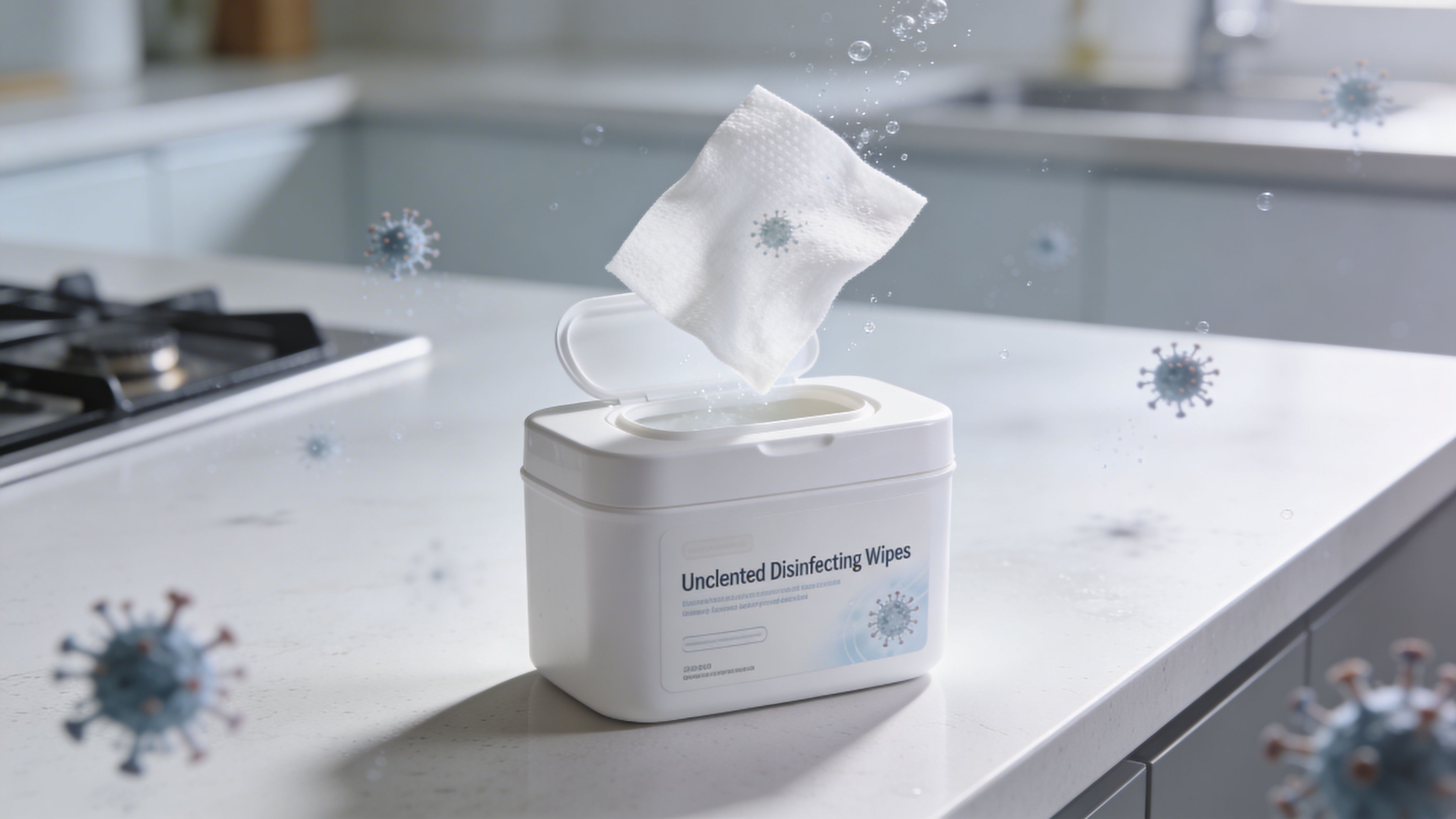
Someone in your home wakes up congested, tired, and coughing. By afternoon, the bathroom faucet, the refrigerator handle, the TV remote, and the phone screen have all been touched. Nobody means to spread anything. It happens because hands move faster than awareness.
That’s why surface disinfection still matters, especially during a stretch of flu, a coronavirus infection, or a stomach bug. A contaminated surface can become a relay point. One person touches it, then another person touches their eyes, nose, mouth, or food.
Many people reach for unscented disinfecting wipes because they’re fast, portable, and easier to tolerate in kitchens, classrooms, break rooms, and healthcare spaces where strong fragrance can be a problem. Their popularity also reflects a much larger shift in consumer behavior. The global disinfectant wipes market was valued at USD 5.73 Billion in 2026 and is projected to reach USD 8.17 Billion by 2033, a 6.1% CAGR, according to Coherent Market Insights' disinfectant wipes market report.
Convenience, though, can create false confidence. Not every wipe kills every virus. “Unscented” doesn’t always mean fragrance-free. And if the surface dries too soon, the chemistry may never finish the job.
Used correctly, unscented disinfecting wipes can help interrupt transmission. Used casually, they can become an expensive cleaning cloth that leaves the highest-risk microbes behind.
Stopping Viruses Before They Spread
A household outbreak often starts with ordinary objects.
A child with a runny nose grabs the cereal box. A parent later wipes the counter with a dish towel, then answers a text. Someone else opens the bathroom cabinet after brushing their teeth. In a busy home, the same few high-touch surfaces collect fingerprints all day.
Where spread happens fastest
Viruses don’t need dramatic conditions. They need timing and opportunity.
High-touch items create that opportunity:
- Shared controls: remotes, light switches, game controllers, elevator buttons
- Food-zone surfaces: refrigerator handles, cabinet pulls, countertops, lunch tables
- Personal devices: phones, tablets, keyboards, mouse devices
- Bathroom points: faucet handles, toilet flush levers, door knobs
The confusion for many people is simple. If a surface looks clean, it feels safe. But clean and disinfected aren’t the same thing.
Cleaning removes soil. Disinfecting uses chemistry to inactivate target microbes on hard, nonporous surfaces.
Why unscented options matter
In real settings, people are more likely to use products they can tolerate repeatedly. Strong fragrance can be distracting in enclosed spaces, and for some users it can be irritating.
Unscented disinfecting wipes fit a practical niche because they let people disinfect common touchpoints without filling the room with perfume-like odors. That matters in schools, clinics, shared offices, and homes with children, older adults, or anyone sensitive to fragranced products.
A good disinfecting routine isn't about making every surface sterile. It's about breaking the chain between one sick person’s hands and the next person’s face.
A wipe also lowers friction. You don’t need to mix a solution, find a rag, or carry a spray bottle from room to room. That makes it easier to act at the moments that matter most, such as after handling a used tissue, cleaning a bathroom, or resetting a kitchen surface before food prep.
A realistic public health approach
No wipe can replace handwashing, fresh air, staying home when sick, or good cleaning habits. But surface disinfection still has a place, especially when several people share a space and one person is already ill.
Use wipes where transmission pressure is highest:
- During active illness: focus on repeated-touch points
- After visitors leave: clean shared surfaces before the next round of contact
- In food areas: choose products labeled for those surfaces and follow label directions
- In sensitive environments: unscented products are often easier for everyone in the room to live with
That’s the practical value of unscented disinfecting wipes. They don’t solve everything. They make it easier to interrupt one common route of spread.
The Science Inside an Unscented Disinfecting Wipe
The chemistry inside a wipe matters more than the word on the lid.
Many users think of a wipe as a moist cloth. In microbiology terms, it is a delivery system. The fabric spreads an active liquid over a surface, keeps that liquid in contact with the target for a set period, and helps lift away some debris at the same time.
How quats do the work
Many unscented wipes rely on quaternary ammonium compounds, often shortened to quats. A common example is alkyl dimethyl benzyl ammonium chloride. In many products, these actives are present at specific concentrations, and the wipe liquid is often alkaline. That combination helps disrupt viral lipid envelopes and can achieve greater than 99.9% reduction in enveloped viruses like SARS-CoV-2 on hard surfaces within seconds, as described in NCL's product information for disinfecting wipes.
A useful analogy is a soap bubble.
An enveloped virus has an outer fatty layer. Coronaviruses and influenza viruses fall into that category. Quats interact with that outer layer and destabilize it. Once the envelope is disrupted, the virus loses the structure it needs to infect cells.
Think of the envelope as a thin balloon skin. The wipe chemistry doesn’t just wash over it. It helps collapse it.
For readers who want the broader terminology, this explanation of what “germicidal” means helps clarify how disinfectants are categorized.

Why pH matters
People often skip over pH on a safety sheet because it looks technical. It is one of the clues that tells you how the formula works.
An alkaline environment can make quat activity more effective against certain microbes. It helps the chemistry interact with proteins and membranes in ways that increase killing efficiency on hard surfaces.
That doesn’t mean “higher pH is always better.” It means the formula is tuned for a job. A wipe is not just wet. It’s chemically engineered.
Enveloped viruses versus non-enveloped viruses
This is the biggest scientific distinction most labels don’t explain well.
Enveloped viruses are generally easier to inactivate with many disinfectants because their outer lipid layer is vulnerable. Examples include:
- SARS-CoV-2
- influenza viruses
- human coronavirus
- HSV-1 and HSV-2
- HIV-1
- HCV
- HBV
Non-enveloped viruses are tougher because they don’t rely on that fragile fatty outer coat. Instead, they have a more resilient protein shell called a capsid.
Examples include:
- norovirus
- rotavirus
- rhinoviruses
- feline calicivirus
That difference changes product choice and contact time. A wipe that handles influenza well may not work the same way against norovirus.
Practical rule: Ask two separate questions. “What virus am I worried about?” and “Does this wipe’s label list it or an accepted surrogate?”
Unscented does not mean chemically weak
Some people assume an unscented product must be gentler in every sense, as if fragrance was the active ingredient. It isn’t.
The disinfecting action comes from the registered antimicrobial ingredients. Removing fragrance changes the sensory experience, not necessarily the microbiological power. In fact, fragrance-free or unscented options can be the better choice in places where repeated use matters, because people are less likely to avoid them.
The wipe cloth matters too
The cloth isn’t just packaging. It controls how well liquid spreads across the surface.
A wipe that glides smoothly can keep more of the disinfectant where you need it. A dry, thin, or overloaded wipe can leave gaps. That’s one reason users sometimes get mixed results even when they buy a reputable product. The chemistry may be good, but the application may be uneven.
In short, the science inside unscented disinfecting wipes is a combination of active ingredient, pH, surface coverage, and time. Leave out any one of those, and the label claim becomes much harder to achieve in practice.
Measuring True Efficacy Viral Kill Claims and Contact Times
The most important number on a disinfecting wipe label is often the one people ignore. It’s the contact time, also called dwell time.
That’s the length of time the surface must stay visibly wet for the product to inactivate the listed pathogen. If you wipe a counter and it dries right away, or if you buff it dry with a paper towel, you may stop the chemistry before it finishes.

What EPA registration tells you
For hard-surface disinfecting wipes in the United States, EPA registration matters because these products are regulated as pesticides for surface disinfection claims. That means the label is tied to specific tested organisms, directions, and conditions of use.
Readers often assume “kills germs” is broad enough. It isn’t. A product may be effective against one group of pathogens but require different conditions for another.
If you want a broader framework for evaluating surface products, this guide on what kills viruses on surfaces is a helpful companion.
Why norovirus changes the conversation
Norovirus is the stress test for many disinfection routines.
Unlike enveloped viruses, norovirus is non-enveloped. That makes it more resistant to many common formulations. According to CloroxPro product information for disinfecting wipes, EPA-registered wipes often require 1 to 10 minutes of dwell time on pre-cleaned surfaces to achieve greater than 4-log inactivation against tough non-enveloped viruses like norovirus.
That single detail clears up a common misunderstanding. If you swipe a sink handle once and walk away when the surface is only briefly damp, you may not be matching the conditions under which the claim was established.
What readers usually get wrong
Three mistakes come up again and again.
| Common mistake | What it means in practice | Better approach |
|---|---|---|
| Using too little liquid | The surface dries too fast | Use enough wipes to keep the area visibly wet for the full label time |
| Skipping pre-cleaning | Dirt and food residue block contact | Remove visible soil first, then disinfect |
| Assuming one virus equals all viruses | A wipe may perform differently across viral families | Check the product label for the specific target organism or accepted surrogate |
Contact time is not a suggestion
Think of disinfectant contact time like baking time. If a recipe needs time in the oven, pulling it out early changes the result. Wipes work the same way.
For easier viruses, the needed wet time may be short. For harder ones, especially some non-enveloped viruses, the chemistry needs more time to penetrate and inactivate the target.
If the label says minutes, “a quick pass” isn't disinfection. It's surface cleaning with partial chemical exposure.
A quick field method
When you disinfect a high-touch area, do this simple check:
- Look for soil first. Crumbs, grease, and dried residue interfere.
- Wipe until the full area is visibly wet.
- Watch the clock. If part of the surface dries before the required time, wipe again.
- Let it air-dry unless the label says otherwise.
That last step matters. Air-drying preserves the intended dwell time. Immediate drying can cancel the claim you thought you were getting.
Decoding the Label The Truth About 'Unscented'
“Unscented” sounds straightforward. In practice, it often isn’t.
Many buyers choose unscented disinfecting wipes because they want to avoid irritation, especially around children, pets, asthma, migraines, or fragrance sensitivity. That instinct makes sense. The problem is that the label language can be murky.

Unscented and fragrance-free are not always the same
For disinfecting wipes, the word unscented doesn’t guarantee the product contains no fragrance-related material. According to the FDA page on disposable wipes, the FDA does not have specific regulations for the term “unscented” on disinfecting wipes, and these products are registered as pesticides with the EPA. That creates room for manufacturers to use masking fragrances to cover chemical odors.
That’s where consumers get misled.
A product can smell neutral and still include ingredients added to alter odor perception. For someone with scent sensitivity, asthma, or allergy concerns, that difference matters.
Why masking fragrance matters in real life
A masking fragrance doesn’t announce itself like a floral scent. Its job is often subtler. It reduces or hides the sharp chemical smell of the formula.
From a comfort standpoint, that may sound harmless. From a health standpoint, it can create a problem for people who are actively trying to avoid fragrance exposure.
Look at it this way:
- Unscented: may smell like very little, but that doesn’t prove nothing was added
- Fragrance-free: often signals that no fragrance ingredient was added for scent effect, though you still need to read the label carefully
- Odor-free in use: can reflect formulation, but it can also reflect masking chemistry
The nose can't audit an ingredient list. A mild smell doesn't prove a simple formula.
What to check before you buy
Don’t rely on front-label language alone. Turn the package around.
A better buying process includes:
- Read the active ingredient panel: know what is doing the disinfecting
- Scan for fragrance language: especially if someone in the home reacts to scented products
- Check the intended surface use: some wipes are marketed for food-contact surfaces or shared spaces
- Look for complete directions: short labels often hide important limitations in small print
A practical example
Suppose you’re choosing wipes for a classroom reading table or a kitchen island. You want virus control, but you also don’t want lingering scent around snacks, books, or children with sensitivities.
In that setting, “unscented” is only the starting point. What you want is a product whose label and ingredient information match your tolerance needs and your disinfection goal.
The larger lesson
The label is part science, part marketing, and part regulation. Those three don’t always align cleanly.
If you remember one idea from this section, make it this one: unscented disinfecting wipes can be a smart choice, but “unscented” is not the same as “nothing added for smell.” Critical readers check beyond the front of the package.
How to Use Disinfecting Wipes for Maximum Effect
A good wipe can underperform if you use it like a paper towel.
Most errors happen because people combine cleaning and disinfecting into one quick motion. Sometimes that works on a lightly touched surface. Often it doesn’t, especially when the surface is visibly dirty or the target virus is harder to inactivate.

The correct order
Use this sequence when you want reliable results.
- Remove visible dirt first. Grease, crumbs, and dried spills can shield microbes from the active liquid.
- Use a fresh wipe for the job size. If the wipe starts dragging or looks dry, it isn’t covering the surface well anymore.
- Make the whole area visibly wet. Corners and edges count.
- Leave it alone for the full label time. Re-wipe if needed to keep the surface wet.
- Let it air-dry unless the product label says something else.
Common mistakes that reduce effectiveness
People rarely fail because they bought the wrong product. They fail because of scale.
A single wipe often gets stretched across too many objects. You start with a doorknob, move to a phone, then a countertop, then a faucet. At that point, you’re no longer disinfecting with confidence. You’re smearing a thinning film across multiple touchpoints.
Try this instead:
- One small wipe task: one handle cluster, one tray table, one remote
- One medium task: one section of counter
- Switch wipes early: especially after heavy soil or bathroom use
Surface wipes are not hand wipes
This distinction is critical.
Some alcohol-free wipes use benzalkonium chloride (BZK) and are preferred for lower odor, but they may require contact times up to 10 minutes to be effective against certain viruses compared with alcohol-based wipes. It’s also critical to distinguish hand wipes from surface wipes, because using the wrong type can lead to incomplete disinfection, as explained in Phoenix Wipes' discussion of alcohol-free wipes for schools and hospitals.
That means:
- A surface disinfecting wipe is for hard, nonporous surfaces
- A hand wipe is for skin and is regulated differently
- They are not interchangeable just because both come in a canister or soft pack
When to slow down
Some situations deserve more care than your usual quick wipe-down:
- After vomiting or diarrheal illness: assume a tougher disinfection scenario
- Around food prep areas: follow the label exactly for those surfaces
- In shared workplaces: focus on repeated-touch objects, not just open tabletops
- In homes with sensitive users: choose the least irritating effective option and ventilate the room
Use pattern: clean first if soiled, saturate second, wait third. Most failures happen because people reverse that order.
A wipe is convenient because it simplifies the process. It still asks you to respect the chemistry.
Limitations Environmental Impact and Proper Disposal
Unscented disinfecting wipes are useful, but they’re not universal and they’re not consequence-free.
Some surfaces don’t tolerate repeated chemical wiping well. Unfinished wood can absorb product unevenly. Natural stone may react poorly depending on the formula. Certain plastics, painted finishes, and specialty coatings can haze, dull, or degrade over time.
Where caution matters
Check the manufacturer guidance for the object you’re cleaning, not just the wipe label.
Be careful with:
- Electronics screens: many need screen-specific cleaning methods
- Unsealed stone and unfinished wood: absorbent materials behave differently from hard, nonporous ones
- Acrylics and specialty plastics: some develop clouding or fine surface damage
- Items used by children: residue and storage safety both matter
Another common concern is resistance. In household use, the bigger problem usually isn’t that people are creating “superbugs” with proper label use. It’s that they wipe too quickly, on the wrong surface, or with the wrong product category.
The waste problem is real
Most disinfecting wipes are single-use products made with synthetic fibers or blended materials. That gives them strength and saturation stability. It also means they add to household trash.
Convenience has a disposal cost. A canister used during a week of illness can generate a noticeable volume of waste very quickly.
For readers trying to balance hygiene with lower-toxicity habits, this look at non-toxic disinfectant wipes offers a useful lens for choosing products more carefully.
Disposal rules that matter
Never flush disinfecting wipes.
Even when a product feels cloth-like and soft, it doesn’t behave like toilet paper once it enters plumbing and wastewater systems. Toss used wipes in the trash unless the manufacturer gives disposal guidance consistent with local waste rules.
A few sensible habits reduce harm:
- Close the lid tightly: dried-out wipes are wasted wipes
- Use them for high-value tasks: reserve them for higher-risk surfaces, not every routine dusting job
- Store safely: keep containers away from children and pets
- Discard responsibly: trash, not toilet
The balanced view is simple. Unscented disinfecting wipes can be a smart infection-control tool. They also work best when you use them selectively, on appropriate surfaces, and with disposal habits that don’t shift one health problem into an environmental one.
Frequently Asked Questions About Unscented Wipes
Are unscented disinfecting wipes safe for kitchen counters
Often, yes, but only if the product label says it’s appropriate for that surface and you follow the directions exactly. Some products are marketed for food-contact surfaces. Others require additional steps after use. The phrase “kitchen safe” on its own isn’t enough. Read the full use directions.
Can I use them on my phone or laptop
Usually not as a default habit unless the device manufacturer allows it.
Electronics often have specialty coatings that can be damaged by repeated exposure to disinfectant liquids. For phones, tablets, and laptops, manufacturer guidance should come first. If a device permits disinfecting, use minimal liquid exposure and avoid flooding ports or seams.
Do unscented wipes kill norovirus
Some EPA-registered surface wipes may carry claims relevant to tough non-enveloped viruses or accepted surrogates, but the label conditions matter. Norovirus-related disinfection often requires longer wet contact on a pre-cleaned surface. If norovirus is your concern, don’t assume every unscented wipe is enough. Check the product label carefully.
Are they safer for people with asthma or fragrance sensitivity
They can be a better option than strongly scented wipes, but unscented doesn’t always mean fragrance-free. Some products may include masking fragrance even if the smell seems minimal. If sensitivity is a serious issue, review the ingredient information and use good ventilation.
Can I use one wipe for the whole room
That’s a common mistake.
Once the wipe starts drying, dragging, or picking up visible soil, coverage drops. Use enough wipes to keep each target surface visibly wet for the required time. One wipe is for a manageable task, not an entire cleaning round.
Are hand sanitizing wipes the same as surface disinfecting wipes
No. They’re formulated and regulated differently.
A hand wipe is designed for skin. A surface disinfecting wipe is designed for hard, nonporous materials. Using a hand wipe on a countertop may not provide the surface disinfection you expect. Using a surface disinfecting wipe on skin is not appropriate.
Should I wear gloves
For routine household use, many people use these products with bare hands and then wash their hands afterward. If you have sensitive skin, eczema, cuts, or you’ll be doing a lot of wiping, gloves can reduce irritation.
How long do disinfecting wipes last after opening
They last as long as the product remains within its labeled shelf life and the wipes stay properly sealed and saturated. A canister with a loose lid may dry out well before the printed date becomes relevant. If the wipes feel dry or unevenly wet, don’t assume they’ll perform as labeled.
Do I need to clean before I disinfect
If the surface is visibly dirty, yes.
Soil can block the active ingredients from reaching microbes effectively. Think of dirt as a raincoat over the target. Pre-cleaning removes that barrier so the disinfectant can contact the surface directly.
Are unscented wipes enough during a household outbreak
They’re one tool, not the entire strategy.
During an outbreak, pair them with handwashing, laundering of contaminated fabrics, sensible isolation of the sick person when possible, and attention to shared high-touch surfaces. Wipes help most when they’re used on the right surfaces, with the right wet time, at the right moments.
Want more evidence-based guidance on viruses, transmission, and practical prevention? Visit VirusFAQ.com for educational and scientific articles that help you choose smarter cleaning and disinfection strategies.
Leave a Reply