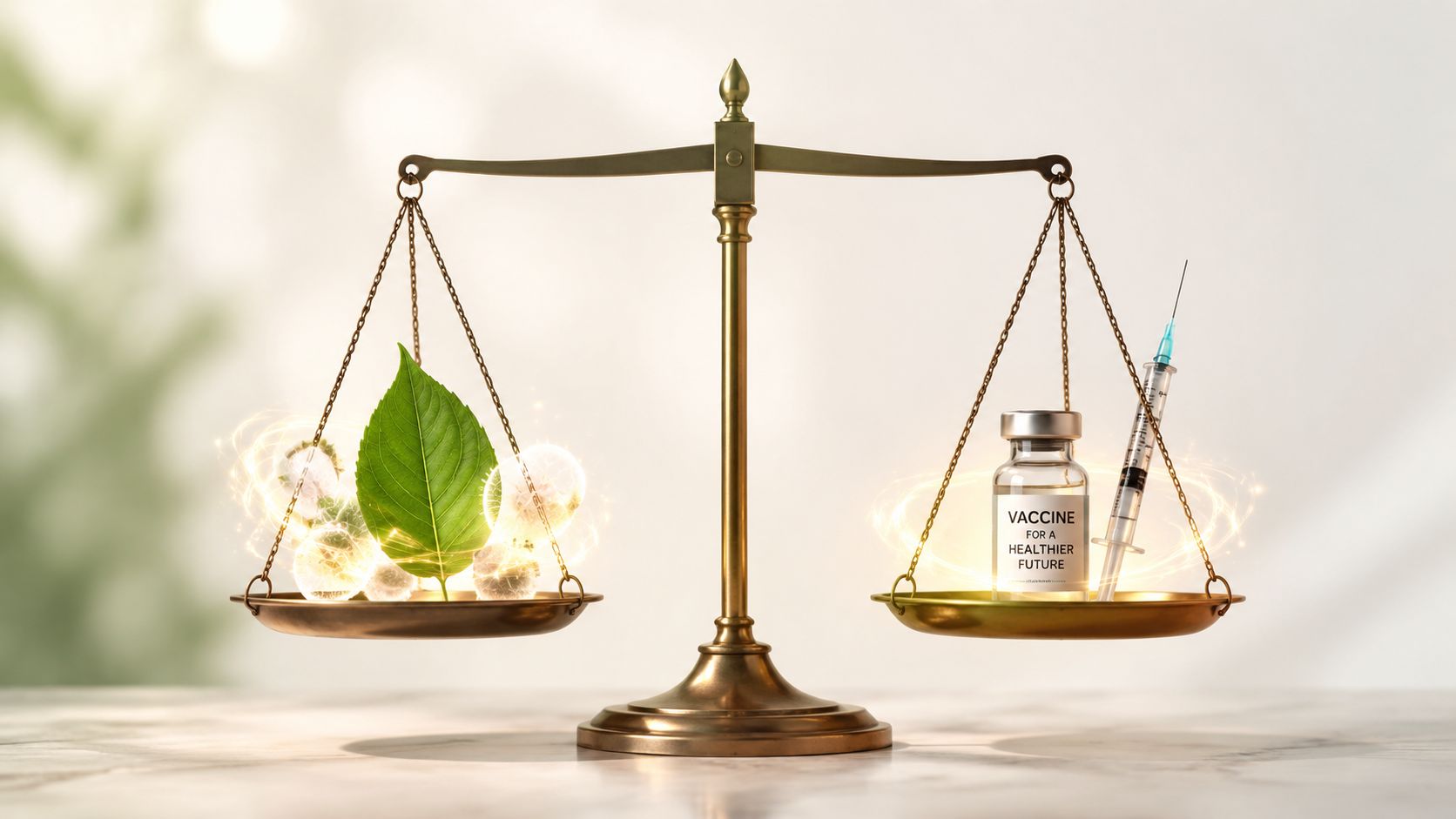
The question commonly posed regarding natural immunity versus vaccination is often flawed.
They ask, “Which is stronger?” when the more useful question is, “Which path gives protection with the least harm?”
That gap matters. Immunity isn't a trophy you win after exposure. It's your body's record of a past encounter, and there are different ways to create that record. One way is infection. The other is vaccination. Both can train the immune system. They don't train it under the same conditions, and they don't carry the same risks.
A lot of public confusion comes from mixing up several separate ideas: how strong protection is, how long it lasts, how broad it is against changing viruses, and what a person has to go through to get it. COVID-19 made those distinctions impossible to ignore. Early arguments often treated natural immunity and vaccine-induced immunity as if one had to be absolutely better in every respect. The evidence pushed the conversation in a more careful direction.
For viruses in general, the core principle is straightforward. Your immune system can learn from a dangerous real-world encounter, or it can learn from a controlled medical one. The details vary by virus, but the public health verdict is much more stable than online debates suggest: the safest path to protection is vaccination, because it teaches immune memory without requiring you to pay the price of the disease itself.
The Immunity Debate An Introduction
The phrase natural immunity vs vaccination sounds like a simple head-to-head contest. It isn't. It's really a comparison of two different training methods for the same immune system.
Natural immunity develops after infection. Vaccine-induced immunity develops after a vaccine presents the immune system with a controlled target. In both cases, the body may produce antibodies, activate T-cells, and build memory that helps during future encounters. That shared biology is why the debate can sound confusing. People hear that both create immunity and assume they are interchangeable.
They aren't interchangeable because the route matters.
If you get immunity from infection, you had to get infected first. For some viruses, that might mean a brief illness. For others, it can mean severe complications, lasting damage, or death. Vaccination was built around a different idea: create immune memory first, so the body is prepared before the full virus appears.
Here's a quick comparison that helps separate the main issues.
| Feature | Natural immunity | Vaccination |
|---|---|---|
| How it begins | After actual infection | After controlled immune training |
| Immune target | Often multiple parts of a virus | Usually a selected viral target |
| Main advantage | Can produce robust immune memory | Safer path to protection |
| Main drawback | Requires facing the disease itself | Protection can change over time and may require updated doses |
| Public health value | Unpredictable at population scale | More reliable for broad prevention programs |
Bottom line: The real comparison isn't only about immune strength. It's about protection, timing, and risk.
That's why COVID-19 became such an important case study. It forced scientists, clinicians, and the public to distinguish between surviving infection and avoiding infection's worst consequences in the first place.
How Your Body Builds a Viral Defense
Your immune system works like a layered security system. The first layer reacts fast and broadly. The second layer learns, adapts, and remembers.

The first response is fast but general
When a virus enters the body, the innate immune system responds first. Think of it as the building alarm and the first security guards on site. It doesn't identify the exact intruder right away. It reacts to signs that something dangerous is happening.
This early response can slow viral spread, trigger inflammation, and call in more specialized immune cells. It's important, but it's not the system that gives lasting protection against the next exposure.
The second response learns the intruder
That longer-term protection comes from adaptive immunity. This is the part people usually mean when they talk about immunity after infection or vaccination.
Two cell types matter most:
- B-cells make antibodies. You can think of them as factories that produce highly specific tools designed to stick to a virus.
- T-cells do several jobs. Some help coordinate the immune response, and others recognize and destroy infected cells.
When this system works well, the body doesn't start from zero the next time it sees the same virus. It recognizes the pattern much faster.
For a plain-language overview of this process, VirusFAQ's guide to the immune response to viral infection is a useful companion.
Immune memory is the real prize
The most important product of both infection and vaccination is memory.
After the immediate fight settles down, some B-cells and T-cells remain. They act like archived files plus an emergency response plan. If the virus returns, those memory cells can react far faster than they did the first time.
That's why someone may still get exposed later but avoid serious illness. Immunity doesn't always block every infection. Often, its biggest job is reducing the chance that an infection turns into something dangerous.
Practical rule: Antibodies are only part of the picture. A drop in antibody levels doesn't mean the immune system has forgotten everything.
This is one place readers often get tripped up. They hear that antibody levels fall and assume protection has disappeared. In reality, the body also relies on memory cells that can ramp up when needed. The exact mix of antibodies, T-cells, and memory differs by person, by virus, and by how the immune system was trained.
That's why the next question isn't just whether immunity forms. It's how much risk you accept in order to form it.
Natural Immunity Strength and Significant Risks
If infection can leave behind meaningful protection, why not let the virus teach the immune system directly?
That question sounds reasonable. For many viruses, infection does expose the body to a wide range of viral parts, not just one selected target. In plain terms, the immune system gets a full view of the intruder. That broad exposure can produce lasting protection after recovery, including antibodies, memory B cells, and T cells that respond if the virus shows up again.

Why natural immunity can seem persuasive
Natural immunity is not a myth. It is a normal result of surviving infection, and COVID-19 made that visible to the public in a way few other viruses have. Researchers repeatedly found that prior infection reduced the risk of future severe disease for many people, at least for a period of time.
That point matters because good public health guidance should start with an honest premise. Infection-acquired protection exists.
But immunology and public health ask a second question. What did it cost to get that protection?
A natural infection is less like a scheduled fire drill and more like learning fire safety during a real house fire. The lesson may be memorable. The damage can also be permanent.
The problem is the route, not the existence of immunity
The main weakness in the "just get infected" argument is not that infection fails to teach the immune system. It is that the teaching happens through uncontrolled disease.
With vaccination, clinicians choose the timing and offer a measured exposure to a viral target. With infection, the virus chooses the dose, the tissues it reaches, and the amount of inflammation it triggers. That difference applies far beyond COVID-19. It is the same basic immunologic principle behind vaccines for measles, hepatitis B, rubella, influenza, and other viral diseases.
The Children's Hospital of Philadelphia page on the immune system and vaccines explains this clearly. Infection can produce immunity, but the infection itself can also cause severe complications, including pneumonia from chickenpox, birth defects from rubella, liver cancer from hepatitis B, and death from measles. Vaccination aims for the immune training without requiring patients to absorb those risks first.
That is the core public health verdict. Protection gained through illness is real. Protection gained without first risking the illness is safer.
Why infection is an unreliable teacher
People often hear "natural immunity is strong" and assume that means "natural infection is a good strategy." Those are different claims.
Infection outcomes vary widely, even within the same age group. One person has a mild illness. Another develops pneumonia, myocarditis, neurologic complications, or prolonged symptoms that last for months. Before infection, no one can choose which path they will get.
COVID-19 illustrated that uncertainty. Some people recovered quickly and did develop substantial protection afterward. Others were hospitalized or died during the first infection that was supposed to provide that protection. For public health, that tradeoff is the central issue.
A virus is also a moving target. Immunity from infection is shaped by which variant caused the illness, how severe it was, and how each person's immune system responded. That means infection-acquired protection can be uneven across a population, even when it is meaningful at the individual level.
A clearer way to judge natural immunity
Three facts can be true at the same time:
- Natural infection can produce broad immune recognition.
- The strength and duration of that protection vary by virus, variant, and person.
- Getting that protection requires accepting the medical risks of the disease itself.
For readers who want a plain-language comparison of the safer training route, this overview of how vaccines work against viruses explains why public health programs try to prepare the immune system before infection arrives.
So the debate is not whether natural immunity exists. It does. The more useful question is which path gives people and communities the best chance of protection with the least avoidable harm. On that question, infection is the riskier route.
Vaccine Induced Immunity Benefits and Limitations
Vaccination trains the immune system without making a person run the same biological obstacle course as a full infection. That is its main advantage.
Instead of exposing the body to the entire disease process, a vaccine presents a controlled immune target. Depending on the vaccine platform, that may be an inactivated virus, a weakened form, a viral vector, or instructions that help the body briefly make a viral protein such as the spike protein. The immune system studies that target, responds to it, and stores memory for later use.
For a broader explainer on the mechanics, VirusFAQ's article on how vaccines work against viruses breaks down the major vaccine approaches in plain language.
What vaccines do especially well
Vaccines are a medical rehearsal. They let the immune system practice before a natural encounter.
That matters for three reasons:
- Control: A vaccine gives a measured exposure rather than the uncontrolled spread of an active infection.
- Timing: People can get vaccinated when they're well, instead of waiting for a virus to arrive at the worst possible moment.
- Population benefit: Vaccination can be organized at scale. Infection cannot be managed safely at scale because the harm is built into the process.
This is why immunization programs exist for both children and adults across many countries. The objective isn't immunity at any price. It's safer immunity.
What vaccines don't promise
Vaccines aren't magic shields that stop every infection forever. Protection can change with time, with viral evolution, and with a person's age or immune status.
Some readers get frustrated when they hear that immunity may wane or that booster doses may be recommended. But that's not a sign the basic strategy failed. It reflects how immune systems and viruses behave. A vaccine can still do the most important job, which is reducing the risk that an infection becomes severe.
A good vaccine doesn't need to be perfect to be valuable. It needs to shift risk in your favor.
Why the limitations matter less than the alternative
A fair comparison should include vaccine limitations. A vaccine-induced response may be more targeted than the response after a whole-virus infection. Antibody levels can decrease with time. Recommendations may change as viruses mutate.
Those are real limitations. They're still different from the limitations of natural infection, which include pneumonia, organ damage, prolonged symptoms, and death. In public health, those aren't side notes. They are the deciding factor.
So when people say natural immunity might be strong, the right reply isn't to deny it. The right reply is to ask what the person had to survive to get it.
A Comparative Analysis of Protection
What does “better protection” mean. Longer-lasting antibodies, lower odds of hospitalization, broader immune recognition, or the safest way to get there in the first place.
That question matters because the phrase natural immunity vs vaccination often mixes several different comparisons into one argument. Immunology is less confusing once you separate outcome from pathway. One asks how the immune system performs after exposure. The other asks what price the body had to pay to get that protection.

A side by side view
| Criterion | Natural immunity | Vaccination |
|---|---|---|
| How protection starts | After surviving infection | After planned immune training |
| Consistency | Varies with infection severity and individual response | More standardized across populations |
| Risk profile | Includes the harms of the disease itself | Designed to avoid the full disease process |
| Durability pattern | Can be durable in some settings | Can wane and may need updated doses |
| Public health use | Not a safe prevention strategy | Core tool for large-scale prevention |
A useful analogy is fire training. You can learn a lot by escaping a real house fire, but that lesson comes with obvious danger. A fire drill can be less dramatic and sometimes less broad, yet it prepares people without burning down the house. Viral immunity works on a similar principle. Infection can teach the immune system a great deal. Vaccination is designed to teach many of the same defensive lessons with much less risk.
What the COVID-19 evidence changed
COVID-19 forced researchers to compare these paths carefully rather than rely on slogans. Earlier in the pandemic, public debate often treated immunity as a single score. In reality, immune protection has several parts, including neutralizing antibodies that can block infection, memory B cells that can make new antibodies later, and T cells that help limit severe disease when the virus gets past the first line of defense.
That helps explain why different studies seemed to point in different directions. Some research found that prior infection could provide substantial protection against reinfection or severe outcomes for a period of time. Other studies showed that vaccine protection could decline against infection while still holding up better against hospitalization and death. Those findings are not in conflict. They are measuring different layers of immune defense at different times.
As noted earlier, reviews of COVID-19 evidence found that prior infection sometimes performed similarly to vaccination on certain outcome measures after recovery. But that does not erase the central public health difference. One route begins after illness has already done whatever damage it was going to do. The other route aims to prepare the immune system before that test arrives.
Readers who want a clearer framework for interpreting these comparisons can review what vaccine efficacy means in practice. It explains why similar percentages do not always represent the same real-world tradeoff.
The most useful verdict
The clearest comparison is this: natural infection can leave behind meaningful immune memory, and vaccination offers the safer planned route to build protection.
That conclusion applies beyond COVID-19. Across many viruses, the immune system can learn from either infection or vaccination. The deciding question for individuals and public health is not whether infection teaches the immune system. It does. The deciding question is whether people should have to face pneumonia, organ stress, long recovery, or death just to get the lesson.
Key takeaway: If you are judging immune protection only after someone has already recovered, natural immunity can be strong. If you are choosing the safest path before infection happens, vaccination is the better option.
Hybrid Immunity The Strongest Defense
The natural immunity vs vaccination debate often misses a third category that explains much of the observed evidence: hybrid immunity.
Hybrid immunity means a person has immune experience from both infection and vaccination. Immunologically, that can combine broader viral recognition with the safer priming that vaccines provide. In practice, it often produces the most resilient protection among the three categories people discuss.

Why the combination matters
A vaccinated immune system is already prepared when infection occurs later. A previously infected immune system may also be sharpened by vaccination afterward. Either sequence can deepen immune memory and improve protection against serious outcomes.
That doesn't mean infection should be sought out. It means that when infection has already happened, vaccination can add important protection rather than being redundant.
What recent COVID-19 data showed
A 2024 analysis summarized by Nebraska Medicine reported that prior infection alone provided 74% protection against hospital admission or severe illness at 12 months, while protection against reinfection declined to 24%. In the same summary, hybrid immunity was reported at 97% protection against hospital admission or severe disease at 12 months after primary vaccination and 95% at six months after a first booster, with reinfection protection of 41% at 12 months and 46% after the booster.
Those numbers answer a question many people still ask after recovering from COVID-19: “If I've already had it, does vaccination add anything?” Based on that analysis, yes. It appears to add meaningful protection, especially against severe outcomes.
The practical interpretation
Hybrid immunity is best understood as an observation, not a recommendation to get infected.
If infection has already occurred, vaccination can strengthen the immune response beyond infection alone. If infection has not occurred, vaccination remains the safer first step. The data don't support chasing infection for immune advantage. They support using vaccination to reduce the odds that an infection becomes medically serious.
That's the resolution of the debate. The strongest defense often comes from both exposures. The safest planned route still starts with vaccination.
Guidance and Public Health Implications
For individuals, the message is simple. Natural infection can produce immunity. Vaccination is the safer way to build protection. Those two facts can coexist without contradiction.
For public health, the conclusion is even clearer. No health system wants a population to earn immunity by absorbing the full burden of disease. Infection brings absenteeism, complications, hospital strain, and preventable deaths. Vaccination exists because communities need a way to build immune protection without accepting all that damage as the entry fee.
A practical approach looks like this:
- Choose prevention first: Vaccination gives your immune system a head start before exposure.
- Reduce transmission opportunities: Good hygiene, staying home when sick, and cleaning high-touch surfaces help lower the chances that viruses spread through households, schools, and workplaces.
- Treat prior infection as information, not invincibility: Recovery may leave meaningful immune memory, but it doesn't guarantee permanent or complete protection.
- Follow updated medical guidance: Recommendations can change because viruses and immune responses change.
Protection isn't just a personal issue. Every prevented infection removes one more chance for a virus to spread.
The safest verdict in the natural immunity vs vaccination discussion isn't complicated. If your goal is to protect yourself and the people around you with the least avoidable harm, vaccination is the better path.
If you want more clear, evidence-based explanations about viruses, transmission, immunity, and practical prevention, explore more educational guides at VirusFAQ.com.
Leave a Reply