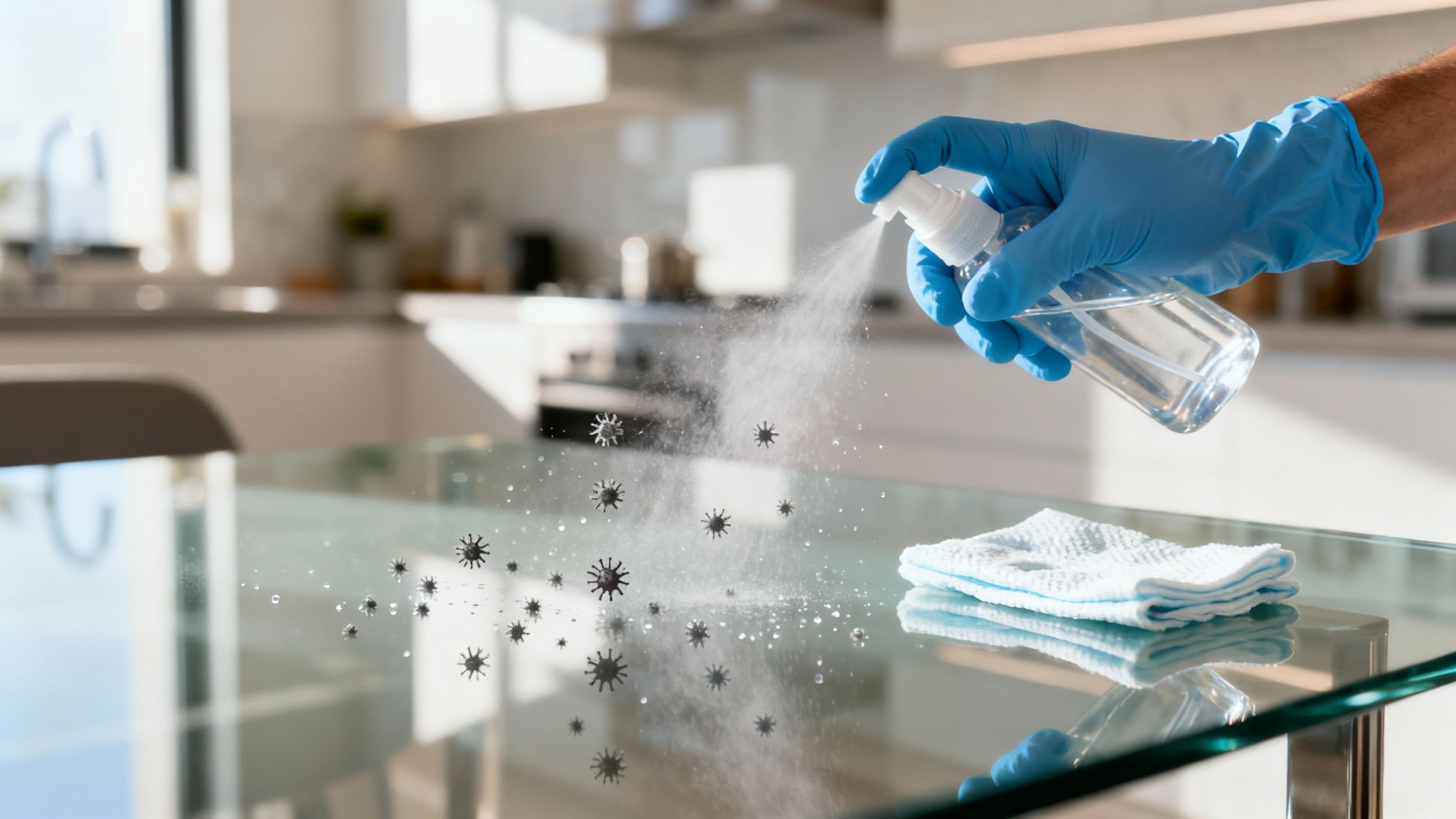
From household cleaners and bleach to good old-fashioned sunlight, plenty of things can kill viruses on surfaces. But the secret isn't just what you use—it's using the right tool for the job and giving it enough contact time to work. That's why convenient options like disinfecting wipes are so popular; they're designed to tackle common viruses on the doorknobs, counters, and remotes we touch every day.
Your Quick Guide to Eliminating Viruses
When a virus lands on your phone screen or kitchen counter, it doesn't just disappear. Many common pathogens, from Rhinovirus (the common cold) to the notoriously tough Norovirus, can remain infectious for hours or even days. Knowing how to effectively wipe them out is your first line of defense in keeping your home or workplace healthy.
The trick is that not all viruses are created equal. How well a disinfectant works often comes down to the virus's basic structure. Viruses generally fall into two categories, and this difference changes everything when it comes to killing them.
Enveloped vs. Non-Enveloped Viruses
Think of an enveloped virus like a delicate soap bubble. These viruses—such as Influenza A Virus (H1N1), Human Immunodeficiency Virus Type 1 (HIV-1), and SARS-Related Coronavirus 2 (SARS-CoV-2)—are wrapped in a fragile, fatty outer layer. This lipid membrane is their weak spot. Soaps, detergents, and alcohol-based cleaners easily break it down, causing the virus to fall apart and become completely harmless.
On the other hand, non-enveloped viruses are like tiny, hard-shelled nuts. They don't have that vulnerable outer layer. Instead, they’re protected by a tough protein shell called a capsid, which makes them much more resistant to disinfectants. Human Rotavirus and Norovirus (Norwalk Virus) are perfect examples. These resilient pathogens can survive on surfaces for weeks if you don't hit them with a powerful cleaner.
Knowing what you're up against is half the battle. Enveloped viruses like Influenza (H1N1, H2N2, H5N1) and Hepatitis B Virus (HBV) are relatively easy to deal with. But non-enveloped ones like Norovirus demand stronger disinfectants and a much more thorough cleaning strategy to be truly eliminated.
The Role of Contact Time
Simply swiping a surface and walking away won't cut it. The disinfectant needs time to do its job. This is called contact time (or dwell time), and it’s the amount of time a surface must stay visibly wet with the cleaning solution to kill all the germs.
Depending on the product and the virus it’s targeting, this can be anywhere from 30 seconds to 10 minutes. Rushing this step is probably the biggest cleaning mistake people make, and it can leave active viruses behind. This is where pre-saturated disinfecting wipes are a game-changer—they're engineered to deliver just the right amount of cleaning solution to keep the surface wet long enough to get the job done right.
To make things simpler, here’s a quick breakdown of the most effective ways to inactivate viruses.
Top Virus Inactivation Methods at a Glance
| Method | Primary Target | Best For |
|---|---|---|
| Alcohol (60-70%+) | Enveloped Viruses (Influenza A, SARS-CoV-2) | High-touch electronics, quick hand sanitation |
| Bleach (Sodium Hypochlorite) | Non-Enveloped Viruses (Norovirus, Human Rotavirus) | Hard, non-porous surfaces like countertops & toilets |
| Hydrogen Peroxide | Broad-Spectrum (Enveloped & some Non-Enveloped) | Multi-surface disinfecting, especially in healthcare |
| Quaternary Ammonium Compounds | Enveloped Viruses (Herpes Simplex Virus, Human Coronavirus) | General-purpose cleaning on floors, walls, and furniture |
| Soap and Water | Enveloped Viruses | Handwashing and initial surface cleaning (removes, doesn't kill) |
This table highlights why you can't just grab any cleaner off the shelf. Different viruses have different weaknesses, and matching the right disinfectant to the right target is what truly keeps surfaces safe.
The Science of How Disinfectants Work
To really understand what kills viruses on surfaces, it helps to think of disinfectants as microscopic wrecking balls. Each active ingredient is engineered to attack a specific weak point in a virus's structure, taking it apart piece by piece until it can no longer function.
This is easiest to picture with enveloped viruses like Influenza A (H1N1), Hepatitis C Virus (HCV), and SARS-CoV-2. Imagine their outer lipid envelope is like a fragile bubble made of fat. Disinfectants with alcohol or detergents act like a pin to that bubble—they dissolve the fatty layer, and the virus just falls apart. It’s completely neutralized.
Attacking the Viral Structure
Now, non-enveloped viruses like Norovirus and Rhinovirus Type 14 are a different beast. They don't have that soft, fatty bubble. Instead, they’re protected by a tough protein shell called a capsid, which makes them much harder to kill.
These stubborn viruses require more aggressive chemical attackers that can crack that protein shell or go straight for the genetic material inside.
The core principle of disinfection is targeted destruction. A good disinfectant doesn't just wipe a virus away; it chemically demolishes it at the molecular level, ensuring it can no longer infect anyone. This is why using the right tool for the job is so critical.
Key Chemical Agents and How They Work
Knowing the "how" behind common disinfectants helps you pick the right product with confidence. It’s the difference between grabbing a random disinfecting wipe and knowing you’ve got the right weapon for the specific germ you're fighting.
Here’s a breakdown of the most common active ingredients and their battle plans:
- Quaternary Ammonium Compounds (Quats): Often the workhorse in everyday disinfecting wipes, Quats are fantastic against enveloped viruses like Herpes Simplex Virus 1 (HSV-1) and many coronaviruses. They carry a positive charge that latches onto the negatively charged viral envelope, ripping it open and causing the contents to spill out.
- Sodium Hypochlorite (Bleach): This is the heavy-hitter for tough non-enveloped viruses. Bleach is a powerful oxidizing agent, which is a scientific way of saying it chemically burns and mangles the proteins in the viral capsid. To see it in action, you can explore our guide on how bleach kills germs.
- Hydrogen Peroxide: Just like bleach, hydrogen peroxide is an oxidizer. It unleashes highly reactive free radicals that launch a multi-pronged attack on a virus, hitting its proteins and its genetic blueprint (DNA or RNA) all at once.
- Alcohol (Ethanol or Isopropyl): At concentrations of 60-90%, alcohol is incredibly good at denaturing proteins, especially in enveloped viruses. It essentially makes the proteins unravel and clump together, completely shutting the virus down.
These chemicals are the muscle behind the products we rely on. For everyday cleaning, products with Quats strike a great balance between power and safety, making them a reliable first choice for high-touch spots like doorknobs, remote controls, and countertops. They are specifically designed to take down the common enveloped viruses we encounter daily. A little science makes it clear why a simple wipe can be such a powerful tool in keeping your home healthy.
Matching the Disinfectant to the Surface
You wouldn't use a sledgehammer to fix a watch, right? The same logic applies to disinfection. The surface material itself—whether it's hard plastic or soft fabric—completely changes the game for how long a virus can survive and what it takes to get rid of it.
The biggest difference comes down to two simple categories: non-porous and porous surfaces. Each one needs a slightly different battle plan.
Non-Porous Surfaces: The Virus Hotspot
Non-porous surfaces are the smooth, solid materials that don't let liquid or air pass through. Think stainless steel, glass, plastic remote controls, and glazed tile. For a virus, these surfaces are the perfect place to hang out.
Because there’s nowhere for moisture to go, the respiratory droplets that carry a virus evaporate very slowly. This keeps the virus viable and infectious for a lot longer. Some tough customers, like Norovirus or Human Rotavirus, can survive for days or even weeks on these materials, making them the most critical spots to disinfect regularly.
Think of a virus on a non-porous surface like a puddle on pavement. It just sits there, fully exposed, until someone cleans it up or it finally dries out. That long survival window is exactly why doorknobs, phones, and faucets are ground zero for stopping transmission.
How Porous Surfaces Naturally Fight Back
Porous surfaces, on the other hand, are absorbent materials like wood, fabric, carpet, and cardboard. When a virus lands here, the surface itself actually starts working against it.
These materials are filled with tiny microscopic pores that act like sponges. The CDC found that these pores pull moisture away from the virus through a process called capillary action, which causes the virus to dry out and fall apart much more quickly. As a result, viruses often become inactive on porous surfaces in just minutes or hours, a huge difference from the days they might last on plastic or steel.
This handy chart breaks down the basic decision-making process for tackling different viruses.

As you can see, fragile enveloped viruses are relatively easy to "pop," while the tough-as-nails non-enveloped viruses need a more powerful disinfectant to break them down.
Choosing the Right Tool for the Material
Using the right disinfectant isn't just about killing germs; it's also about protecting your stuff. The wrong chemical can easily damage sensitive materials, causing anything from discoloration to corrosion over time.
- For Stainless Steel, Glass, and Plastics: Most EPA-registered disinfectants work great here. Products with alcohol, Quats, or hydrogen peroxide are generally safe and effective. This is where disinfecting wipes really shine, as they're made for these common, hard-wearing surfaces.
- For Wood Surfaces: Wood can be a bit tricky. Unsealed wood is porous, but a sealed or varnished floor acts like a non-porous surface. Harsh chemicals like bleach can strip away finishes and damage the wood itself. It's always a good idea to research effective and safe disinfection methods for wood floors before you start cleaning.
- For Fabrics and U upholstery: Your best bet here are disinfectant sprays specifically designed for soft surfaces. Trying to use a standard liquid cleaner will just oversaturate the fabric and might not even work. For items like clothing and bedding, the easiest and most reliable method is still a hot water laundry cycle.
In the end, it’s all about picking a product that kills the virus you’re worried about without harming the surface it’s on. Since the vast majority of our daily high-touch points are non-porous, a good disinfecting wipe is often the most convenient and powerful tool for the job.
How Nature Helps Inactivate Viruses
While powerful disinfectants are a go-to for killing viruses, they aren’t the only tool in your arsenal. Your environment itself is a silent, natural ally. Factors like temperature, humidity, and even sunlight are constantly working to neutralize pathogens, making your home a far less friendly place for germs to hang out.
When you understand how these natural forces work, you can make small, strategic tweaks to your indoor spaces. These simple adjustments add a powerful, passive layer of defense to your regular cleaning routine, helping to weaken viruses before they even get a chance to spread. It’s all about making your environment work for you, not for the germs.
Temperature: The Double-Edged Sword
Temperature has a massive impact on how long a virus stays infectious on a surface. As a general rule, viruses love cool, dark conditions. Low temperatures help preserve the delicate structures they need to survive, like the fatty outer layer on an influenza virus or the tough protein shell on norovirus.
But once you turn up the heat, those structures start to fall apart. Heat basically unravels the key proteins a virus needs to function, rendering it useless.
A fascinating study from Australia's CSIRO put this to the test with SARS-CoV-2. At a typical room temperature of 20°C (68°F), the virus remained infectious for a staggering 28 days on smooth surfaces like glass and phone screens. But when the temperature was cranked up to 40°C (104°F), its survival time dropped to less than 24 hours. You can dig into the official research to see just how vulnerable viruses are to heat.
This gives us a crucial takeaway: even a modest increase in room temperature can drastically shorten the lifespan of many viruses on household surfaces. While it's no substitute for cleaning, it's a factor that is always working in your favor.
Of course, how long a virus can survive is a complex topic with many variables. To learn more, check out our detailed guide on how long viruses live on surfaces.
Humidity: The "Goldilocks Zone" for Viral Inactivation
Humidity—the amount of moisture in the air—also plays a huge role in a virus's ability to survive and travel. It turns out that both very dry and very humid air can be problematic, but there's a "Goldilocks zone" that viruses absolutely hate.
Scientific evidence shows that keeping indoor relative humidity between 40% and 60% is ideal for suppressing viruses. Here’s a quick breakdown of why:
- Below 40% (Too Dry): Tiny respiratory droplets carrying viruses become even smaller and lighter. This lets them float in the air much longer and travel farther. Dry air also weakens our own natural defenses in our noses and throats, making us more likely to get sick.
- Above 60% (Too Humid): While larger droplets fall out of the air faster, all that extra moisture can actually help preserve viruses on surfaces. It also creates a breeding ground for mold and bacteria, which is a whole other problem.
- The 40-60% Sweet Spot: In this range, droplets are heavy enough to fall from the air quickly, and the balanced moisture level helps destabilize viruses by disrupting their outer layers.
Using a humidifier during the dry winter months or a dehumidifier in the sticky summer can help you maintain this optimal range. When you combine these environmental controls with regular disinfection, you create a seriously robust defense system.
Mastering Your Disinfection Technique

Having a powerful disinfectant is a great start, but it's only half the battle. How you use it is what really counts. Just spraying a surface and wiping it down won't guarantee you've eliminated every threat. Mastering the right technique is what turns a good product into a reliable defense against viruses.
This is about more than a quick spray and swipe. You need to think about pre-cleaning, targeting the right spots, and respecting the science of "contact time." Those are the things that separate a superficial wipe from true disinfection.
First Clean, Then Disinfect
People often use "cleaning" and "disinfecting" as if they mean the same thing, but they are two totally different—and equally essential—steps. Here’s the bottom line: you can't disinfect a dirty surface. Grime, dust, and gunk act like a shield for viruses, blocking the disinfectant from getting to them.
Think of it like trying to paint a dusty wall. The paint won’t stick right. It's the same with disinfectants; they can't kill what they can't touch.
The rule is simple yet critical: Clean first, then disinfect. This two-step process clears the way for your disinfectant to reach the microscopic enemies you're targeting, ensuring it can do its job at full strength.
Start with soap and water or a basic cleaner to get rid of all the visible dirt. Once the surface is clean and dry, you’re ready for the real work. For a complete walkthrough, check out our guide on how to disinfect surfaces, which breaks down the entire process.
The Power of Contact Time
If there’s one thing to get right, it’s contact time. This is the amount of time a surface must stay visibly wet with disinfectant to actually kill the germs. If it dries too soon, you might as well not have bothered.
This crucial window can be anywhere from 30 seconds to 10 minutes, depending on the chemical and the virus you’re fighting. For instance, a disinfectant might need four minutes to take down a tough non-enveloped virus but only one minute for an enveloped one like influenza. Always read the label.
This is where most people mess up. A quick spray followed by an immediate wipe-down renders the disinfectant useless before it has a chance to work.
Your High-Touch Zone Checklist
Viruses don’t spread out evenly; they hang out on the surfaces we touch all the time. Focusing your efforts on these “high-touch zones” is the smartest way to stop them from spreading. For a deeper dive into protecting busy spaces, it's worth reviewing proven strategies for sanitizing high-traffic areas.
Here’s a practical checklist to get you started:
- Entryways and Hallways: Doorknobs, light switches, railings, and security keypads.
- Kitchens: Faucet handles, refrigerator and microwave doors, cabinet pulls, and countertops.
- Bathrooms: Toilet handles, faucet taps, light switches, and doorknobs.
- Living and Work Areas: Remote controls, keyboards, computer mice, phone screens, and table surfaces.
Get in the habit of hitting these spots daily—especially if someone is sick—and you’ll dramatically cut down the number of germs in your environment.
The Advantage of Disinfecting Wipes
Making sure a surface stays wet for the full contact time can be tricky. Sprays often evaporate before the clock runs out. That’s exactly the problem pre-saturated disinfecting wipes are designed to fix. They deliver a controlled dose of liquid, keeping the surface wet for the required time without you having to think about it.
When you use a quality wipe, you're not just cleaning. You're applying a targeted dose of virus-killing power and ensuring it stays wet long enough to work. It takes the guesswork out of the equation, making wipes a convenient and reliable tool for keeping those high-touch surfaces safe.
Your Top Questions About Killing Viruses, Answered
Even when you know the basics of disinfection, a few specific questions always pop up. It's totally normal to wonder if your go-to cleaning habits are actually working or what a term like "contact time" really means in practice.
Let’s clear up the confusion. This section tackles the most common questions we hear about getting rid of viruses on surfaces, so you can feel confident you’re keeping your space safe.
Does Soap and Water Actually Kill Viruses?
This is a great question. Soap and water are your first line of defense, but they work mostly by removing germs, not killing them outright. Think of them as the bouncers at the club—they grab the troublemakers (dirt, grime, and viruses) and kick them out so they can be washed down the drain.
This cleaning combo is especially good against enveloped viruses like Influenza, Human Coronavirus, or Herpes Simplex Virus 2 (HSV-2). The soap molecules literally break apart the virus's fragile, fatty outer shell, causing it to disintegrate. But it's way less effective against tough guys like Norovirus, a non-enveloped virus protected by a hard protein coat.
For a true one-two punch against viruses, always use a two-step process. First, clean with soap and water to get rid of the gunk and a good chunk of the germs. Then, follow up with an EPA-registered disinfectant to take out any stragglers left behind.
What is "Contact Time" and Why Should I Care?
Contact time, sometimes called dwell time, is probably the single most important—and most ignored—part of disinfecting. It’s the amount of time a disinfectant needs to stay visibly wet on a surface to kill the germs listed on its label.
If you spray a counter and wipe it dry instantly, you’re not giving the disinfectant a chance to work. It’s like trying to cook a steak in 10 seconds—it just won’t happen. Those chemicals need that time, whether it's 30 seconds or 10 minutes, to break through the virus's defenses and destroy it from the inside out.
This is where disinfecting wipes have a real advantage. They’re designed to be saturated with just the right amount of solution to keep the surface wet for the required contact time, taking all the guesswork out of it.
Can I Use the Same Disinfecting Wipe on a Few Different Surfaces?
It’s tempting, but reusing a wipe is a classic cleaning mistake that leads to cross-contamination.
Picture this: you wipe down a contaminated doorknob. The wipe picks up germs. If you then move on to wipe your kitchen counter with that same wipe, you’re not disinfecting anymore. You’re just giving those germs a free ride to a new home.
You could easily transfer nasty pathogens from a germy spot to a place you want to keep clean, like a dining table or your kid’s high chair.
The golden rule is simple: one wipe, one area. Use a fresh one for the bathroom sink, grab another for the kitchen counters, and a new one for your desk. This simple habit ensures you’re actually getting rid of viruses, not just spreading them around.
Do Natural Cleaners Like Vinegar Work on Viruses?
In the cleaning world, you'll hear a lot about using vinegar or essential oils as natural disinfectant alternatives. And while they can be great for light, everyday cleaning, they just don't have what it takes to kill dangerous viruses.
The key thing to remember is that these products are not registered with the EPA as disinfectants. That means they haven't gone through the tough scientific testing needed to prove they can kill specific pathogens, including small non-enveloped viruses like Rhinovirus Type 39 or norovirus surrogates like Feline Calicivirus. Relying on them for disinfection, especially when someone in the house is sick, gives you a false sense of security.
When health is on the line, stick with products that have been tested and approved. An EPA registration is your guarantee that a disinfectant actually does what it says it will do—protect you and your family from viruses.
Leave a Reply