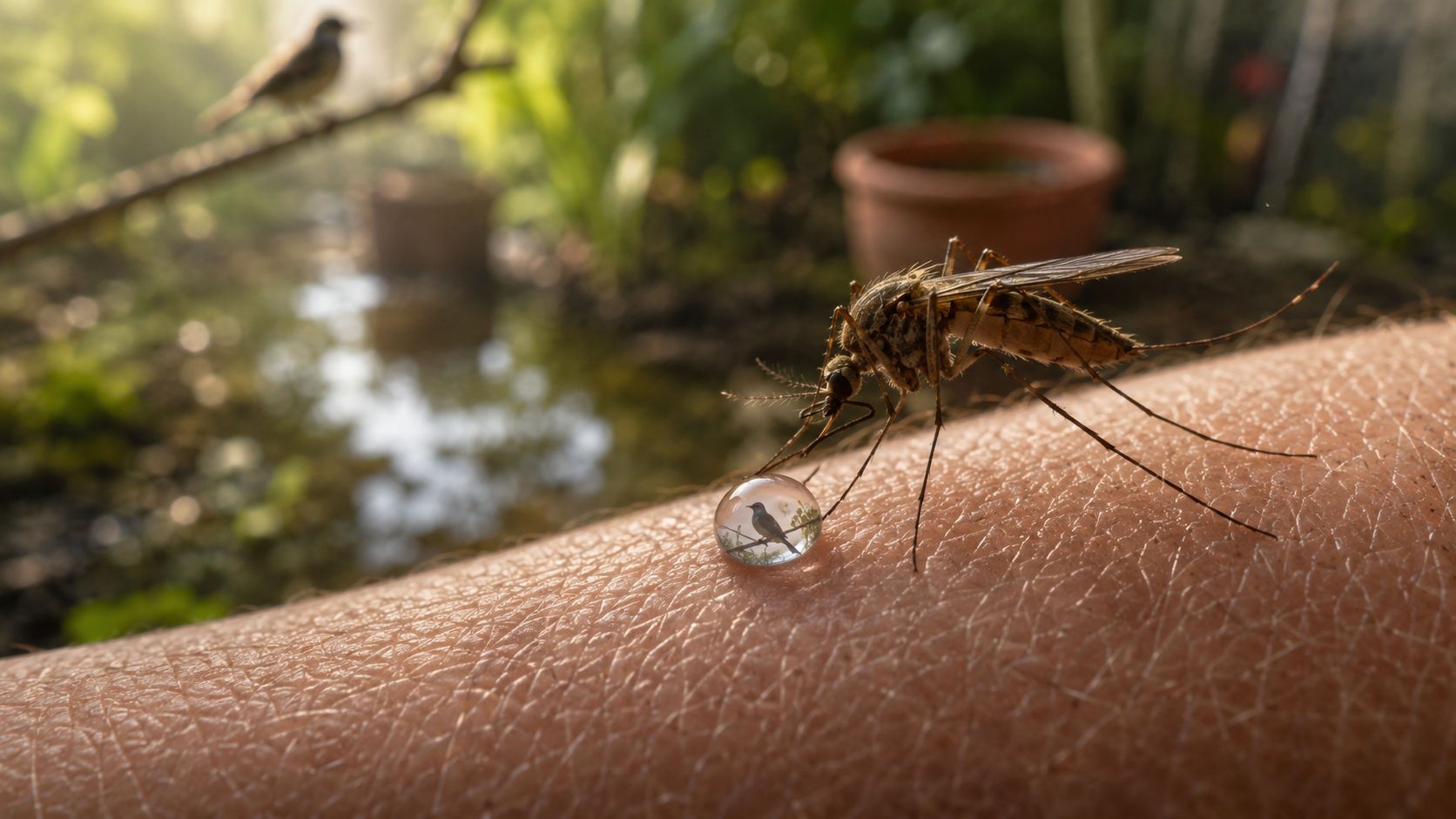
A summer evening can feel ordinary right up to the moment it changes. You step outside to water the plants, trade a few words with a neighbor, or sit on the patio as the air cools. Then comes the thin whine near your ear, a quick swat, and a new bite on your arm.
That small moment is where West Nile virus begins to make sense.
A mosquito bite is never just about the mosquito. It reflects what happened earlier in the local bird population, which mosquito species are active nearby, how warm the past few weeks have been, and what kind of habitat surrounds your home. A retention pond, storm drain, irrigated yard, or stretch of hot weather can change the odds in ways that are easy to miss if you focus only on the bite itself.
West Nile virus transmission works like an outdoor chain reaction. Birds and mosquitoes keep the virus circulating in nature, and people enter that cycle only by accident. That is why risk rises and falls by season, by region, and even by neighborhood.
Once that pattern becomes clear, public health advice sounds much less generic. “Use repellent” and “avoid bites” are still useful messages, but they mean more when you understand why a wetter spring, a hotter summer, or changes in land use can shift mosquito activity and bird contact in the first place.
This article helps connect that buzzing sound to the bigger ecological story behind it.
That Buzzing Sound and the Bite That Follows
The part that confuses many people is simple: if mosquitoes are everywhere in warm weather, why aren't all bites equally risky?
Because a mosquito has to become infected first. The insect doesn't generate West Nile virus on its own. It has to feed on the right host in the right setting, survive long enough for the virus to develop inside its body, and then bite again. That means risk depends on place and timing, not just on whether mosquitoes are present.
Why one bite is different from another
Think of mosquito bites the way you'd think about rain puddles in a parking lot. They may look similar, but some are harmless shallow spots and some hide a deep pothole underneath. A bite can be ordinary irritation, or it can be the last step in a larger ecological chain.
That's why people sometimes feel confused by public health messaging. They hear “avoid mosquito bites,” but they want to know why one neighborhood, one month, or one unusually warm spell seems to matter more than another.
West Nile risk is shaped by the local bird population, the local mosquito population, and the local conditions that help both interact.
Why understanding transmission is empowering
This isn't a virus that spreads casually from chatting with a neighbor, sharing a bench, or touching a doorknob. The important question is whether infected mosquitoes are active where you are.
Once you frame it that way, prevention becomes much more practical:
- Your evening habits matter: Time outdoors during periods of mosquito activity can change your exposure.
- Your yard matters: Containers, clogged gutters, and neglected bird baths can support mosquito breeding.
- Your local environment matters: Heat, rainfall, and land use can shift where mosquitoes thrive and where virus activity builds.
That's good news in a public health sense. It means risk can often be lowered with informed, ordinary actions.
The Primary West Nile Virus Transmission Cycle
West Nile virus transmission runs on a bird-mosquito cycle. Humans are not the main characters in that cycle. Birds and mosquitoes are.

The relay race between birds and mosquitoes
A useful way to picture this is a relay race. One runner carries the baton for a stretch, then passes it to the next runner. In West Nile ecology, the “baton” is the virus. Birds carry it in the environment, and mosquitoes pass it onward.
The CDC describes this as an enzootic bird-mosquito cycle. Mosquitoes become infected when they feed on birds with virus in their blood. The virus then replicates inside the mosquito and reaches the salivary glands, so a later bite can inject virus into another host CDC explanation of West Nile transmission.
If you've ever wondered what a reservoir host is, birds are the central example here. They help maintain the virus in nature.
Why birds matter so much
Birds act as the ongoing source that keeps the cycle alive. Mosquitoes feed on them, pick up the virus, and then spread it again when they feed later. If that bird-mosquito loop continues efficiently in a region, local transmission can build.
A few details matter here:
- Birds are the main amplifier hosts: They allow the virus to circulate in the system that sustains it.
- Mosquitoes are the vector: They move the virus from one blood meal to the next.
- The cycle is self-reinforcing: More infected birds can infect more mosquitoes, and more infected mosquitoes can infect more birds.
This is why West Nile virus transmission is really an ecological story. It's not just about a pathogen floating around in the abstract. It depends on living relationships between species.
Why mosquitoes are more than flying needles
People often think of mosquitoes as tiny syringes that directly transfer whatever they just drank. That isn't quite right. After feeding on an infected bird, the virus has to establish itself inside the mosquito before that insect becomes infectious.
So the mosquito is not a passive straw. It's a biological stage in the cycle.
Practical rule: If you want to understand West Nile virus transmission, start with birds and mosquitoes. Human illness is a spillover from that larger system.
That shift in perspective clears up a lot. West Nile virus is maintained in nature without needing humans at all.
How Humans Get West Nile Virus
A summer evening can feel harmless until a mosquito that fed on an infected bird earlier in its life lands on a person instead.

That is how human infection usually begins. The virus is already moving through the local bird and mosquito system, and a person gets pulled into that cycle by chance. Humans are incidental hosts, not part of the machinery that keeps West Nile virus going in nature.
People are incidental hosts
Public health specialists often describe humans as dead-end hosts. The term sounds blunt, but the idea is simple. A person can be infected by a mosquito bite, yet the amount of virus in human blood is usually too low to pass the infection back to another mosquito. In practical terms, the chain usually stops with us.
A clearer way to picture it is to focus on where the virus travels efficiently. Its main route runs between birds and mosquitoes. Humans sit off that main route. We can be reached, but we usually do not send the virus back into regular circulation.
That distinction matters because it changes how you think about risk. West Nile virus is not spreading through communities the way a cold or flu virus does. Human cases are better understood as spillover from an ecological system that is active outdoors.
What happens after infection
Illness after infection varies a lot. As noted earlier, many people infected with West Nile virus never develop symptoms, some develop a feverish illness, and a much smaller group develops serious neurologic disease.
That wide range can be confusing at first. Two people in the same neighborhood may be bitten during the same season and have very different experiences. One may never know they were infected. Another may become sick enough to need medical care.
A simple summary looks like this:
| Outcome after infection | General pattern |
|---|---|
| No symptoms | Many infections cause no noticeable illness |
| West Nile fever | Some people develop fever and other flu-like symptoms |
| Neuroinvasive disease | A much smaller group develops severe neurologic illness |
Age, underlying health, mosquito abundance, and the timing of local transmission all shape who gets exposed and how severe the consequences may be. This is also where environmental change matters. Warmer temperatures can lengthen mosquito season in some places, while irrigation patterns, stormwater, drought, and suburban development can change where birds and mosquitoes come into contact with people.
What this means for person-to-person spread
For daily life, the practical takeaway is reassuring. Casual contact is not the usual concern. Sitting near someone with West Nile virus, sharing food, or talking face to face does not drive routine transmission.
Your real exposure risk depends more on place and season. A wet summer, a hot spell, standing water near homes, or land use that brings bird habitat close to neighborhoods can all shift local risk upward. That is why public health warnings often rise and fall by county, month, and weather pattern rather than by human contact.
If you want a local example of how prevention advice changes with regional mosquito conditions, this guide to preventing mosquito illnesses in Indiana shows how geography shapes practical steps.
A useful rule is this. If you are asking how humans get West Nile virus, start by asking what the mosquitoes, birds, weather, and built environment are doing in your area.
Uncommon Ways the Virus Spreads
A reader might wonder about the exceptions after learning that West Nile virus usually moves through mosquitoes. The short answer is yes, a few uncommon routes have been documented. They matter in medicine and public health, but they do not explain the pattern of cases seen across neighborhoods, counties, or seasons.
West Nile virus spreads through rare non-mosquito routes such as blood transfusion, organ transplantation, laboratory exposure, and transmission from mother to child. Those situations are better understood as special pathways that appear under specific conditions, not as drivers of ordinary community spread.
The rare exceptions people ask about
One way to make sense of this is to separate community ecology from clinical settings. In the outdoor transmission cycle, birds and mosquitoes keep the virus circulating. In a hospital or laboratory, exposure can happen through direct contact with blood, tissues, or infected specimens. That is a very different chain of events.
These rare routes also help explain why public health responses are adapted to setting. Blood banks and transplant programs pay close attention during periods of local virus activity. Laboratories use biosafety rules because staff may handle materials that the general public never encounters.
Why these routes stay uncommon
Medical transmission stays uncommon because safety systems are designed to catch risk before exposure happens. Screening, donor deferrals, surveillance alerts, and clinical precautions all reduce the chance that infected blood or organs will be used.
Laboratory exposure is uncommon for a similar reason. It is largely an occupational issue tied to specimen handling, not a routine household or workplace risk.
Mother-to-child transmission has been reported, but it is also unusual. For pregnant patients or anyone with a special medical concern, the right source of advice is a clinician who can interpret individual circumstances rather than general mosquito guidance.
A simple comparison helps:
- Mosquito transmission: The main route behind community cases and seasonal outbreaks.
- Blood transfusion or organ transplantation: Rare, medically specific, and addressed through screening.
- Laboratory exposure: Rare, occupational, and limited by biosafety procedures.
- Mother-to-child transmission: Uncommon and handled in clinical care.
Why knowing this still matters
Knowing about unusual routes keeps the topic accurate. It also prevents a common misunderstanding. If a case appears after a transfusion or transplant, that does not mean West Nile virus has shifted into easy person-to-person spread.
For everyday decisions, the practical question is still local ecology. Are infected mosquitoes active in your area? Have weather, irrigation, stormwater, drought, or land use created better conditions for mosquito breeding and bird-mosquito contact? Those factors can raise or lower risk far more than casual contact with another person.
Where and When Is the Risk Highest
Risk is highest when the ecology favors both mosquitoes and virus development inside them. That's why West Nile virus transmission has such a strong seasonal pattern.

Why late summer matters
The European Centre for Disease Prevention and Control notes that transmission occurs when mosquitoes are active, typically from spring to autumn, with most human and equid infections observed between July and September in Europe. Illinois public health guidance adds a useful technical detail: the mosquito extrinsic incubation period is about 2 weeks, and it depends on temperature Illinois guidance on temperature and mosquito infectivity.
That term sounds technical, but the idea is simple. After a mosquito takes an infectious blood meal, the virus needs time inside the mosquito before that mosquito can transmit it later. If the mosquito dies too soon, transmission stops there.
Warm conditions can make this process more favorable. More mosquitoes survive and feed. The virus also develops more efficiently inside them. That's one reason human cases often cluster in late summer and early autumn.
How weather and land use shape local hotspots
A recent detailed analysis reported in 2025 found that temperature, precipitation, and land use significantly influence WNV transmission, with warmer temperatures increasing mosquito populations and viral replication, and in some regions expanding risk windows beyond what people think of as the usual summer season 2025 analysis of climate, precipitation, and land use effects.
That changes how we should think about exposure.
A very warm season can extend mosquito activity. Rain can leave behind containers and low spots full of standing water. Urban and suburban patterns can also create micro-habitats where mosquitoes do well, especially where water collects repeatedly.
A practical way to read your surroundings
Instead of asking only, “Is it summer?” ask these questions:
- Has the weather stayed unusually warm? Longer warmth can support mosquito activity for more of the season.
- Has there been recent rainfall or irrigation runoff? Standing water creates breeding opportunities.
- Are there built environments that trap water? Gutters, planters, storm drains, and neglected containers can matter.
- Are you outdoors during mosquito-active periods? Exposure patterns shape real-world risk.
Risk doesn't sit still on a calendar. It moves with temperature, water, and habitat.
That's the part many older explainers miss. West Nile virus transmission is seasonal, but it's also environmentally responsive.
Practical Prevention To Reduce Your Risk
Good prevention works on three levels at once. Protect your body, reduce mosquito habitat around your home, and pay attention to community conditions.

Personal protection outdoors
Start with the steps that lower the chance of being bitten in the first place.
- Use repellent consistently: EPA-registered insect repellents remain a standard tool. If you prefer plant-based options, this guide to all-natural bug repellent can help you compare approaches.
- Dress for the setting: Long sleeves and long pants can help, especially during mosquito-active parts of the day.
- Think about timing: Shortening outdoor exposure when mosquitoes are most active can reduce risk without canceling outdoor life altogether.
Make your yard less mosquito-friendly
Prevention often becomes more effective than people expect. Mosquitoes don't need a pond. Small amounts of standing water in ordinary household items can be enough to support breeding.
Try this home routine:
- Walk the property after rain. Check buckets, saucers, toys, tarps, wheelbarrows, and clogged gutters.
- Empty and refresh water sources. Bird baths and pet bowls need regular attention.
- Check screens and doors. A good window screen turns indoor space into real protection.
- Clean surfaces where water collects. Patio furniture, railings, and outdoor play equipment can hold grime and moisture in creases and seams.
That last step sounds minor, but it helps you notice problem spots. A quick wipe-down of outdoor touch surfaces with a disinfecting wipe can be part of normal household hygiene while also helping you spot pooled water, residue, or hidden containers that need to be emptied.
Community action matters too
Some mosquito problems are bigger than one yard. Drainage patterns, vacant lots, neighborhood retention areas, and unmanaged standing water can support wider mosquito activity.
If you live in an area where professional timing matters, local guidance can be useful. For example, homeowners comparing treatment schedules may find this explanation of the ideal mosquito spraying in Tampa Bay helpful because timing is part of control, not just product choice.
You can also keep an eye on educational resources that summarize virus prevention basics. VirusFAQ.com, for example, publishes accessible articles on transmission and prevention topics that can help readers compare mosquito-borne risks across different viruses.
Home habit worth keeping: The best mosquito control often starts with a weekly walk around the yard, not with a last-minute response after bites begin.
The Bigger Picture on WNV Surveillance
Individuals experience West Nile prevention as personal advice. Public health teams experience it as pattern recognition.
How health departments watch the ecosystem
Health departments and mosquito control programs don't wait only for people to get sick. They look for signs that the virus is active in the environment. That can include monitoring mosquito populations, testing mosquito pools, and paying attention to bird-related indicators.
This makes sense once you understand the ecology. If birds and mosquitoes sustain the virus, those are the places where early warning signals appear.
Why surveillance changes action
Surveillance helps officials decide when to intensify messaging, where to focus vector control, and when communities may need stronger reminders about standing water and bite prevention. It turns scattered environmental clues into a usable risk picture.
For readers who want the public health term behind that process, this overview of epidemiological surveillance gives the broader framework.
A simple summary looks like this:
| What gets watched | Why it matters |
|---|---|
| Mosquito activity | Shows where vectors are abundant and potentially infectious |
| Bird-related signals | Helps identify viral activity in the natural cycle |
| Human illness reports | Confirms spillover into people and guides response priorities |
The most useful takeaway
West Nile virus transmission can sound complicated because it is complicated. It depends on animal hosts, insect vectors, weather, and human behavior all at once.
But the practical lesson is straightforward. Risk rises when infected mosquitoes are active, and communities can respond by watching the environment carefully and lowering opportunities for bites and breeding. That combination of surveillance and everyday prevention is what makes this virus concerning, but also manageable.
If you want fewer surprises from mosquito season, build a routine before bites become common. Repellent, clothing, intact screens, less standing water, and regular outdoor cleanups all work better as habits than as emergency fixes.
Leave a Reply