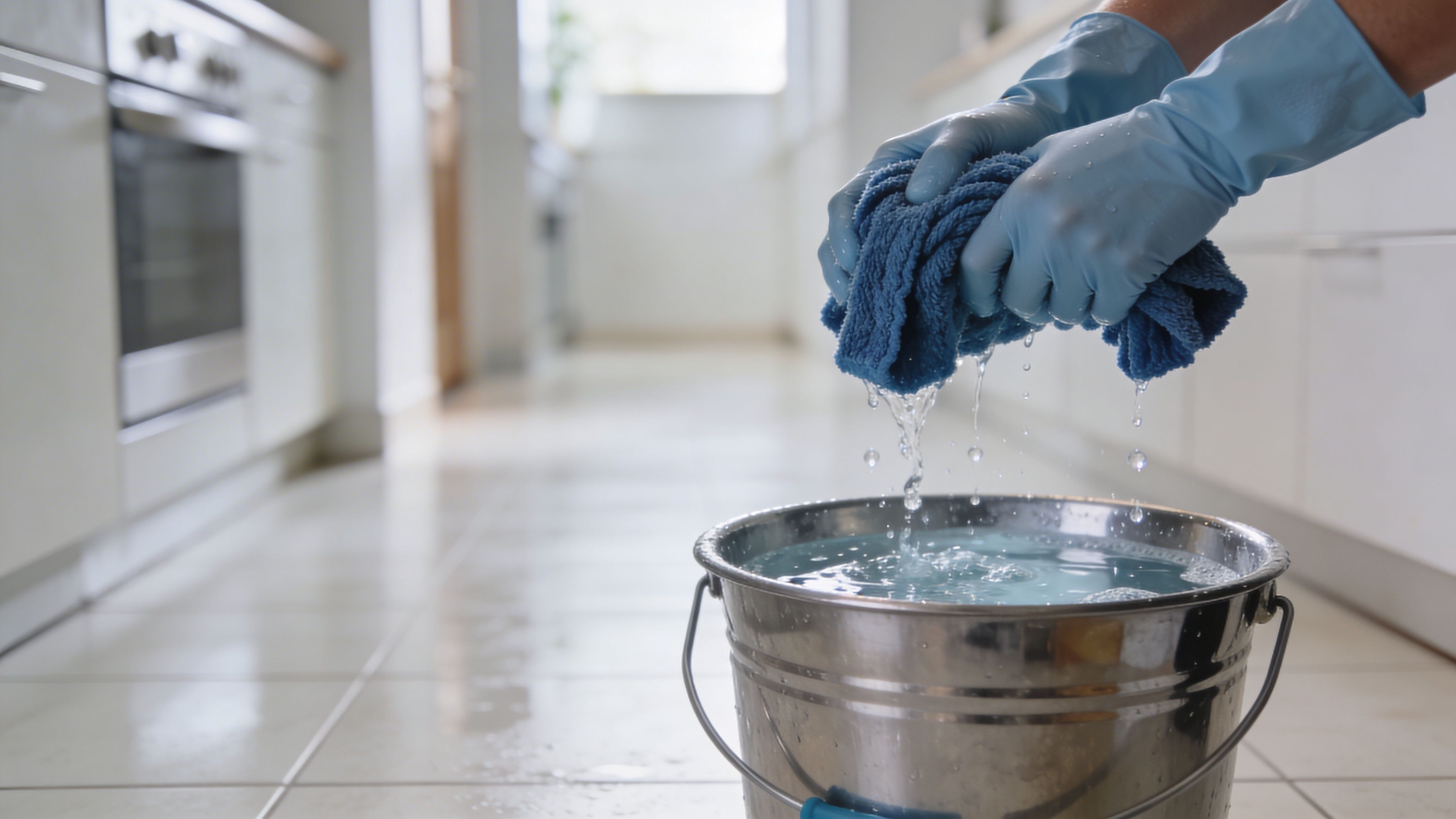
You finish mopping, the floor looks clean, and the bucket goes back into the closet with a quick rinse. That routine feels harmless. In homes where someone has vomiting, diarrhea, or another contagious illness, it can turn the bucket into the part of the cleaning setup that keeps spreading contamination instead of removing it.
That matters because a cleaning mop bucket doesn’t merely hold water. It holds diluted soil, organic residue, and whatever the mop head picked up from the floor. If the bucket stays dirty, every later pass can redeposit what you meant to remove.
For everyday dust, that’s largely a nuisance. For tough viruses, especially norovirus, it’s a preventable hygiene failure. The bucket, wringer, and mop head need to be treated as a single infection-control system.
Beyond a Grimy Appearance Why a Clean Mop Bucket Matters

People often judge a mop bucket by sight and smell. If there’s no sludge in the bottom and it doesn’t stink, it seems fine to reuse. That standard is too low for infection prevention.
A used bucket can act as a fomite, meaning an object that carries contamination from one place to another. The problem isn’t just the dirty water. It’s the cycle of dipping a contaminated mop back into the same container, then spreading that liquid over fresh floor area.
Why visible clean isn’t enough
Advice about mop buckets usually focuses on dirt separation, convenience, or floor finish. Far less attention goes to virus-specific sanitation. That gap matters because norovirus can survive on surfaces up to 7 days and requires 1000 to 5000 ppm bleach for a 1-minute contact time, based on the verified data provided from CDC guidance summarized in this source: video summary of mop bucket sanitation and norovirus disinfection considerations.
The same verified data also notes that a 2023 study found microfiber mops reduced norovirus by only 1.5-log if they weren’t paired with EPA-approved virucides, and efficacy dropped by 60% in reused dirty water in that same source. That’s the practical lesson homeowners need. Better tools help, but dirty solution can cancel out the benefit.
Practical rule: If the bucket water looks used, assume its ability to support hygienic cleaning has already dropped.
The bucket is part of the public health chain
In homes, we tend to separate “housekeeping” from “health protection.” Professionals don’t. They treat cleaning tools as part of exposure control.
That mindset is useful far beyond hospitals. If you want a simple primer on understanding why health and safety is important in the workplace, the same logic applies at home: tools, routines, and storage practices shape whether people remove hazards or keep recirculating them.
Rinsing a bucket under the tap after mopping frequently leaves behind residue on the walls, base, handle joints, and wringer surfaces. Once that residue dries, the bucket may look acceptable while still carrying contamination. A proper routine has to do four things in order: remove soil, wash surfaces, apply a suitable disinfectant correctly, and let everything dry fully before storage.
The Unseen Threats Lurking in Your Mop Bucket

The mop bucket became standard for good reasons. Charles Wheeler’s 1876 patent for the first modern mop and bucket set helped standardize floor cleaning, and by the mid-20th century the mop bucket was indispensable in over 90% of institutional cleaning protocols, as summarized in this history of the mop bucket from Allied Facility Care. The tool improved hygiene. It didn’t remove the need to maintain the tool itself.
A dirty bucket creates a wet, nutrient-rich environment. Floors contribute dust, skin cells, food residue, bathroom splashes, and outdoor grime. The mop transfers all of that into the bucket. Once it’s there, contamination spreads across plastic surfaces, wringer parts, and the mop head.
What tends to persist inside the bucket
Some threats are easy to picture. Mud. Hair. Gray water. Others aren’t.
Viruses don’t multiply in the bucket the way bacteria can, but they can remain present in the organic mess left behind after cleaning a contaminated area. Bacteria can also settle into residue and produce the slimy film people frequently notice around bucket seams or under removable inserts.
That film is commonly called a biofilm. In practical terms, it’s a sticky layer that shields contamination from casual rinsing. If you only swish water around the bucket and dump it out, you frequently leave that layer in place.
Why this matters for viral spread
Hardy non-enveloped viruses such as norovirus and rotavirus are especially relevant in household cleanup after vomiting or diarrheal illness. Enveloped viruses such as SARS-CoV-2 are generally more vulnerable to disinfectants, but they should not be treated casually. Soil and residue interfere with disinfection across the board.
For homeowners, a key question is persistence. How long can contamination stay where you can’t see it. This guide on how long viruses live on surfaces helps explain why damp tools and storage areas deserve more attention than they usually get.
Residue protects contamination. That’s why washing comes before disinfecting, not instead of it.
The usual failure points
Certain spots get missed again and again:
- Bucket lip and pour spout because people focus only on the inside basin.
- Wringer hinges and gears because they trap splash-back and dry slowly.
- Handle sockets and wheel mounts on larger buckets.
- The bottom exterior because it touches the floor during use and storage.
If the goal is health protection, not appearance, every one of those surfaces counts.
The Definitive Protocol for Cleaning and Disinfecting

A reliable cleaning mop bucket routine is simple, but it has to be done in the right order. Skip soil removal and the disinfectant works poorly. Skip drying and the bucket goes back into storage still wet, which invites odor and regrowth.
Phase 1 Pre-clean and empty
Start by emptying the bucket carefully. Pour dirty water into an appropriate drain without splashing.
If the water contains visible debris, remove that first with disposable paper towels or another disposable material and discard it. For small, highly soiled residues around the rim or wringer, many homeowners do better with disinfecting wipes as a first pass because wipes let you lift and remove material instead of smearing it around a larger surface.
Wear gloves if you’re cleaning after illness or handling strong disinfectants. Then give the bucket a quick rinse to knock loose residue before the main wash.
Phase 2 Wash with detergent and friction
Use warm or hot water plus a detergent. This stage is physical. You’re breaking up film, not sterilizing.
Scrub these areas deliberately:
- Inner basin including the bottom corners.
- Outer walls and base because contaminated drips run down the outside.
- Wringer or spinner assembly where dirty liquid collects.
- Handle, grips, and carrying points that people touch with wet hands.
A stiff brush works better than a cloth for creases and molded plastic joints. If the bucket has removable parts, separate them and wash each part on its own.
Best practice: If you can still feel slime or see a dull film, the bucket is not ready for disinfectant yet.
Phase 3 Rinse completely
Soap residue interferes with some disinfectants and can leave the bucket tacky. Rinse every surface with clean water until the detergent is gone.
Don’t rush this step. A bucket that looks clean but still feels slippery frequently needs another rinse.
Phase 4 Disinfect correctly
Choose a disinfectant that is appropriate for the contamination you’re concerned about and follow the product label. For norovirus concerns, the verified data in the earlier section highlights bleach-based protocols as a key benchmark.
If you use bleach solutions, mix and handle them carefully. This VirusFAQ guide on disinfectant solution bleach is a useful reference for safe preparation and use in household settings.
Cover all surfaces, not just the inside bowl. The disinfectant must remain visibly wet for the required contact time on the label, or in the verified data where applicable. Drying too early cuts efficacy.
Disinfectant Comparison for Mop Bucket Sanitation
| Disinfectant | Effective Against | Required Contact Time | Pros | Cons |
|---|---|---|---|---|
| Bleach solution | Relevant for norovirus-focused sanitation based on the verified data above | 1 minute for the CDC-based norovirus guidance summarized in the verified data | Strong option for virus-focused cleanup, widely familiar | Can irritate skin and surfaces if used incorrectly, requires careful handling |
| EPA-approved virucidal disinfectant | Appropriate when the label includes the target virus or virus class | Follow the product label | Clear use instructions, often easier for routine household use | Efficacy depends on exact label claims and correct dwell time |
| Hydrogen peroxide-based disinfectant | Useful in contamination-control settings | Follow the product label | Can fit modern floor-care systems | Product-specific instructions matter |
| Quaternary ammonium disinfectant | Common for general disinfection use | Follow the product label | Familiar in many cleaning products | The verified data notes reuse limitations with cotton string mops in specific professional protocols |
Phase 5 Air dry fully
Turn the bucket upside down in a well-ventilated area if the design allows it. Dry removable pieces separately.
Drying is not cosmetic. Moisture left in seams, wheels, wringers, or spinner cages supports odor and contamination problems. A damp bucket stored in a dark closet undoes good cleaning habits.
Phase 6 Store as a clean tool
Store the dry bucket away from food areas and away from clean textiles. Keep the mop head clean and dry as well. If the mop head is still wet or heavily stained, the bucket will be recontaminated as soon as you put the system back together.
When to repeat the full protocol sooner
Do the full clean-and-disinfect routine immediately if:
- You cleaned up after vomiting or diarrhea
- The bucket water became heavily soiled
- The bucket has a sour or musty odor
- The wringer or spinner has visible buildup
For routine floor care, the bucket should be washed after each use and disinfected on a regular schedule that matches the level of risk in the home.
Adapting Your Technique for Modern Mop Systems

Not every cleaning mop bucket behaves the same way. A single plastic pail, a dual-compartment flat-mop system, and a spin mop each fail in different places. The right protocol stays the same. The weak points change.
Traditional single-bucket systems
These are still common because they’re cheap and simple. They’re also the easiest to contaminate because clean solution and dirty rinse water often become the same thing during use.
If you use one, keep the session short and don’t treat the water as clean once the mop has been re-dipped repeatedly. The bucket itself is easy to wash, but the method is the least forgiving.
Good fit:
- Small spaces
- Low-soil jobs
- Situations where you can change water frequently
Poor fit:
- Illness cleanup
- Large floor areas
- Homes where you’re trying to control cross-contamination carefully
Dual-compartment and flat-mop systems
These systems are better at separating fresh solution from dirty recovery water. That’s one reason they’re popular in settings where floor hygiene matters.
The mop head also matters. Microfiber flat mops remove up to 14 percent more soil per pass than conventional cotton mops and achieve 14 to 16 percent cleaner surface results when measured by luminometers, according to this Unger microfiber case study PDF. The same verified data notes a trade-off: microfiber pads can retain excess cleaning solution, which can increase drying time and slip risk.
That means your cleaning routine has to include better wringing and better pad management. Don’t leave a soaked microfiber pad sitting in the bucket after use.
A more advanced mop system doesn't fix bad maintenance. It only gives you more parts to clean properly.
If you’re deciding between manual mopping and machine-based floor care for larger areas, this article on a surface cleaning machine can help frame the trade-offs.
Spin mops and wringer baskets
Spin systems solve one problem well. They reduce hand contact with dirty water. But they introduce another challenge: the rotating basket or pedal assembly traps splash and residue in awkward spots.
For spin mops, pay attention to:
- The spinner basket underside where droplets dry into film
- Pedal or drive housing where grime builds around moving parts
- Drain plugs and seams that hold residual water
- Center columns and sockets where the mop handle locks in
If the mechanism isn’t removable, use a brush with narrow bristles and rinse thoroughly from multiple angles. Then let it dry open, not snapped shut.
Professional Standards for Maximum Pathogen Control
A homeowner doesn’t always need a professional workflow. In a home with a medically fragile person, frequent gastrointestinal illness, or shared bathrooms, borrowing professional standards makes sense.
The strongest upgrade is the triple-bucket system. It exists for one reason: stop the cleaning solution from turning into rinse water.
How the three-bucket method works
The verified data identifies the triple-bucket system as industry best practice, with surfaces ending up 14 to 16 percent cleaner than single-bucket methods in bio-residue measurements, according to Cleanroom Technology’s explanation of coverage, buckets, and validation.
Each bucket has one job:
- Bucket one holds the disinfectant or cleaning solution.
- Bucket two holds clean rinse water.
- Bucket three receives waste drainage after rinsing.
The workflow is specific. Dip into solution, mop the floor area, rinse in clean water, wring into the waste bucket, then reload from the solution bucket. That separation is what preserves the usefulness of the disinfectant.
When solution should be replaced
The same verified data notes that qualification protocols frequently set coverage limits, including replacing solution after 22 square meters, about 240 square feet, to maintain efficacy in controlled programs at the source above.
For households, you don’t need to measure every room with institutional precision. You do need the underlying rule. If the rinse water is visibly dirty or the waste bucket shows heavy contamination, refresh the system sooner rather than trying to stretch one batch across the whole house.
Cleaner water isn’t a luxury in floor disinfection. It’s the condition that makes the disinfectant worth using.
Who should consider this standard
This approach is especially useful for:
- Homes with immunocompromised residents
- Daycares and home child-care settings
- Shared living spaces during outbreaks
- Small clinics or treatment rooms
If the task feels beyond what you can safely manage, it can be reasonable to look at local professional cleaning services that understand disinfection workflows rather than basic cosmetic cleaning. The key is asking how they control cross-contamination, not just whether they mop and sanitize.
Troubleshooting Odors Stains and Mechanical Failures
A mop bucket that smells sour, looks permanently stained, or stops wringing correctly typically has one of three problems. Residue was left behind, the plastic has absorbed grime, or the moving parts are jammed with buildup.
The bucket smells bad after drying
That frequently means organic residue remained after the last wash.
Do this:
- Rewash with detergent and a brush instead of trying to mask odor with fragrance.
- Scrub seams and undersides because odor frequently comes from hidden residue, not the main basin.
- Disinfect after washing and let the bucket dry completely upside down.
If the smell returns quickly, inspect the mop head too. A clean bucket paired with a sour mop head won’t stay clean.
The plastic looks stained
Stains aren’t always a sign of active contamination, but they make inspection harder and frequently indicate old buildup. Avoid harsh abrasion that damages plastic and creates more surface roughness.
Use a detergent wash first. Then reassess. If staining sits around a wringer hinge or molded corner, the issue is usually trapped residue rather than permanent discoloration.
The wringer or spinner doesn’t work well
Thomas W. Stewart’s 1893 wringer patent transformed cleaning by eliminating manual wringing and boosting cleaning speed by an estimated 40 to 50 percent, according to this history from SupplyLand on janitorial product development. The practical takeaway today is simple: wringers work best when they stay clean, aligned, and dry between uses.
Check these points:
- Remove string, hair, and grit from hinge lines and rotating parts.
- Rinse the mechanism after each use so dirty solution doesn’t dry into the joints.
- Look for cracked plastic or bent metal if pressure feels uneven.
- Replace the bucket if the mechanism can’t be cleaned or no longer wrings consistently.
For small, highly contaminated messes, don’t force the mop system to do every job. A wipe-based first pass can remove surface material before you bring out the bucket, which lowers the contamination load on the whole setup.
Transforming Your Mop Bucket From Hazard to Hygiene Tool
A mop bucket is not clean just because it is used for cleaning. It can either spread contamination or help stop it. The difference is the routine.
The core sequence is steady: remove soil, wash, disinfect, rinse when needed, and dry fully. Keep the bucket, wringer, and mop head in the same mental category. They work as one hygiene system, and they fail as one too.
That shift matters most when illness is in the house. Good floor care then becomes part of infection control, not just housekeeping.
For more practical virus-prevention guides and evidence-based cleaning advice, visit VirusFAQ.com and explore the latest articles on surface contamination, disinfectants, and safer home hygiene.
Leave a Reply