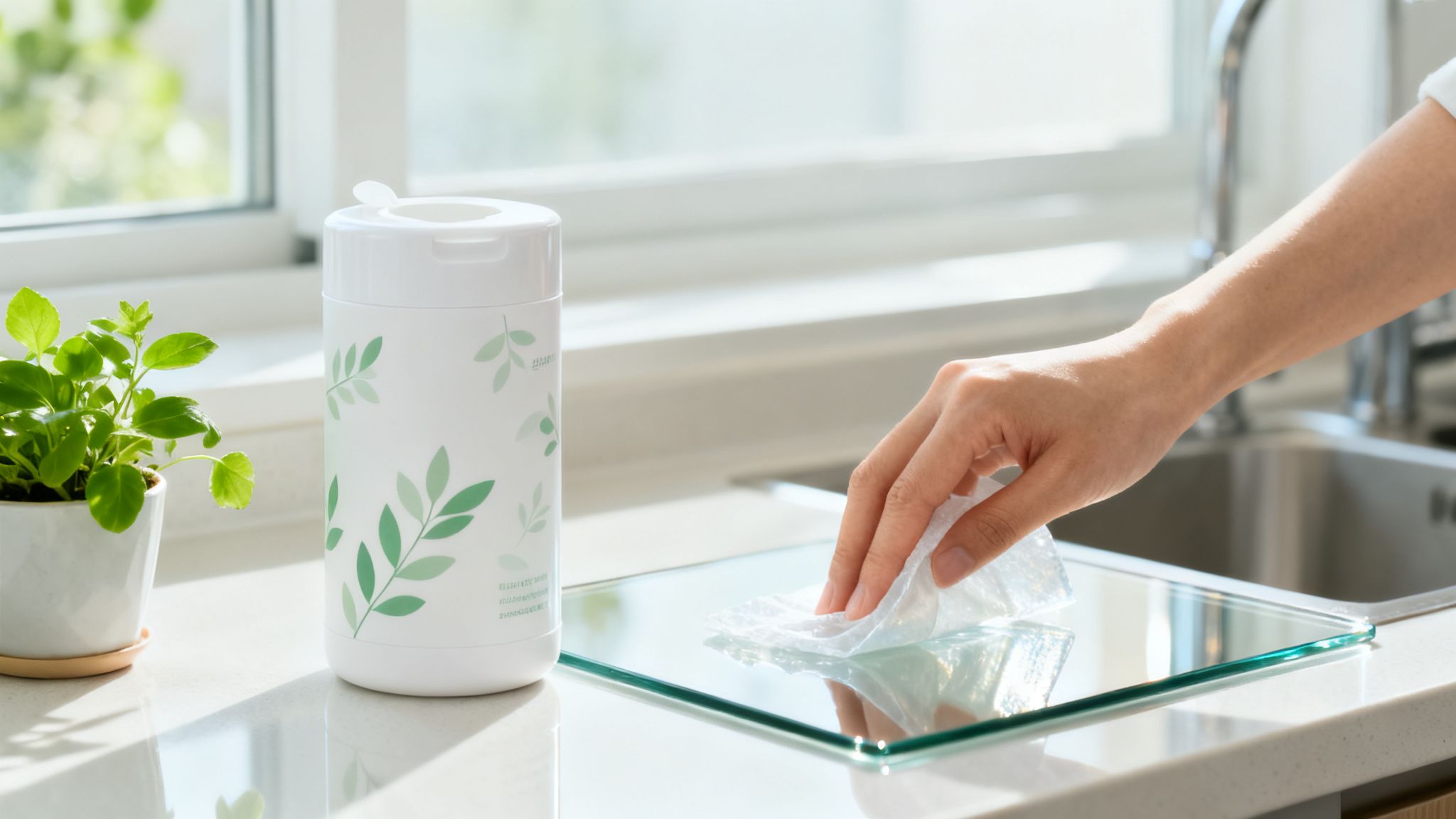
Non-toxic disinfectant wipes are smart, powerful cleaning tools that kill viruses and bacteria using active ingredients like citric acid or hydrogen peroxide. These are much gentler than the old-school chemicals like bleach or ammonia.
They offer a scientifically proven way to disinfect your home’s surfaces—neutralizing threats from common viruses like Influenza A Virus (H1N1) to more resilient pathogens like Norovirus—all while keeping your family, pets, and living space safe.
How Do Non-Toxic Wipes Actually Work?
The cleaning aisle can be an overwhelming place, filled with aggressive chemical smells and bold promises. For years, we were led to believe that harsher chemicals meant a cleaner, safer home.
But non-toxic disinfectant wipes prove that's not the case. They use a smarter, more targeted approach to take down dangerous pathogens, including common culprits like Influenza A and Human Coronavirus.
A Targeted Approach to Killing Viruses
Think of a virus as a tiny, locked puzzle box.
Traditional disinfectants, like those with bleach or quaternary ammonium compounds (quats), are like a sledgehammer. They use a brute-force chemical assault to smash the box, destroying the virus but often damaging the surface underneath or leaving behind harsh, sticky residues.
Non-toxic disinfectant wipes work more like a skilled locksmith. Instead of a chemical battering ram, they use active ingredients designed to find and dismantle the virus’s defenses.
- Breaking Down the Outer Shell: Many viruses, including SARS-Related Coronavirus 2 (SARS-CoV-2) and Herpes Simplex Virus 1 (HSV-1), are "enveloped," meaning they're protected by an outer fatty layer. Ingredients like citric acid and hydrogen peroxide get to work by dissolving this lipid shield, causing the virus to fall apart and become harmless.
- Disrupting Essential Functions: Once the outer defenses are gone, these gentle but powerful agents disrupt the virus's internal machinery. This stops it from replicating and spreading, effectively neutralizing the threat without resorting to overwhelming chemicals.
To help you see the difference clearly, here’s a quick comparison:
Traditional Wipes vs. Non-Toxic Wipes Comparison
This table offers a clear, at-a-glance comparison to help you quickly understand the fundamental differences between traditional and non-toxic disinfectant wipes.
| Feature | Traditional Wipes (e.g., Bleach, Quats) | Non-Toxic Wipes (e.g., Citric Acid, Hydrogen Peroxide) |
|---|---|---|
| Active Ingredients | Sodium hypochlorite, Quaternary Ammonium Compounds (Quats) | Citric acid, hydrogen peroxide, thymol, hypochlorous acid |
| Mechanism of Action | Broad-spectrum, non-specific cell destruction (brute force) | Targeted breakdown of viral envelopes and cell membranes |
| Residue | Often leave behind harsh, sticky, or corrosive residues | Typically leave minimal to no residue; may require a water rinse |
| Fumes & Odors | Strong, harsh chemical fumes requiring good ventilation | Low to no harsh fumes, often with light or no scent |
| Safety Concerns | Can cause skin/eye irritation, respiratory issues, surface damage | Generally safer for use around children, pets, and on sensitive surfaces |
| Environmental Impact | Ingredients can be harmful to aquatic life and slow to biodegrade | Active ingredients often break down into harmless elements (e.g., water, oxygen) |
As you can see, the "non-toxic" approach isn't about being weaker—it's about being smarter and safer for your home.
The EPA Registration: Your Guarantee of Effectiveness
So, how can you be sure a "non-toxic" wipe is actually strong enough to protect your family from viruses like Avian Influenza Virus (H5N1) or Hepatitis B Virus (HBV)?
The answer is simple: look for an EPA registration number right on the label. This isn't just marketing fluff; it's a legal guarantee that the product works.
The Environmental Protection Agency (EPA) puts disinfectant products through rigorous scientific testing to verify their claims. An EPA registration number confirms that a wipe is proven to kill the specific viruses and bacteria listed on its packaging.
This registration is the bridge between gentle ingredients and proven power. It tells you that the non-toxic wipes you're holding have met strict government standards for actually killing germs.
When you choose an EPA-registered product, you're picking a solution that is both intelligently designed and scientifically validated. You get peace of mind knowing your home is truly clean and safe—without having to introduce unnecessary toxins into your space.
The Science Behind Safe and Effective Ingredients
To really get why non-toxic disinfectant wipes are such a game-changer, you have to look past the marketing claims and dig into the science. It's pretty fascinating. Unlike traditional wipes loaded with harsh, scorched-earth chemicals, these newer options use smart, targeted ingredients that take out viruses with precision.
Think of these active ingredients as the engine of the wipe. They’re specifically chosen for their ability to dismantle nasty pathogens like Human Immunodeficiency Virus Type 1 (HIV-1) or Hepatitis B Virus (HBV) without coating your home in a film of aggressive chemical residue. Let's pull back the curtain on the powerhouses you'll find on the label.
The Key Players in Non-Toxic Disinfection
A few core ingredients do the heavy lifting in modern non-toxic disinfection. Each one works a little differently, but they all offer a powerful—yet surprisingly gentle—way to stop viruses in their tracks.
- Citric Acid: Yep, the same stuff found in lemons and oranges. This organic acid is an incredibly effective virucide. It works by dramatically lowering the pH on a surface, creating an acidic environment that quickly breaks down a virus's protective protein coat. Once that coat is gone, the virus is toast—inactive and unable to infect anything.
- Hydrogen Peroxide: When used in newer, stabilized formulas at low concentrations, hydrogen peroxide is a beast against germs. It releases oxygen radicals that essentially punch holes in the cell walls and envelopes of viruses, destroying them from the outside in. The best part? It breaks down into just water and oxygen, leaving nothing behind.
- Thymol: This powerhouse ingredient comes from thyme oil and has been a go-to antimicrobial for centuries. Thymol messes with the viral membrane, disrupting its structure until it falls apart. It's so effective that it’s recognized by the EPA as a reliable disinfectant against viruses like Influenza A2/305/57 Virus (H2N2).
- Hypochlorous Acid (HOCl): Honestly, this is one of the coolest disinfectants out there. It’s the very same substance your own immune system produces to fight off infections. HOCl is brutally effective against a huge range of viruses, oxidizing and destroying them on contact, yet it’s incredibly safe for people and surfaces. You can dive deeper into its cleaning power in our detailed guide on the benefits of hypochlorous acid.
This simple flowchart shows how these plant-based ingredients kick off a chain reaction that knocks out the virus.

As you can see, it's a clear path from the wipe's formula to the targeted takedown of viral threats. It’s all about smart science, not just brute chemical force.
Efficacy Against Different Viral Structures
Here's something most people don't realize: not all viruses are built the same. Their structure dictates how hard they are to kill, which is why the active ingredient in your wipe is so important.
Viruses generally fall into two camps: enveloped and non-enveloped.
Enveloped Viruses: Think of these as the "easy" targets. Viruses like Influenza A Virus (H1N1), SARS-CoV-2, and Herpes Simplex Virus 2 (HSV-2) are wrapped in a soft, fatty outer layer called an envelope. This layer is their Achilles' heel. Ingredients like citric acid and thymol are great at dissolving this fatty membrane, making the virus fall apart almost instantly.
Non-Enveloped Viruses: These are the tough guys of the viral world—the ones that are notoriously hard to kill. Viruses like Norovirus (Norwalk Virus) and Rhinovirus Type 14 don't have that weak outer envelope. To take them down, you need bigger guns like accelerated hydrogen peroxide or hypochlorous acid that can break through their tough protein shells.
When you're choosing non-toxic disinfectant wipes, always check the label. Make sure the active ingredient is rated to kill the specific germs you’re worried about, especially for kitchen and bathroom surfaces where those tougher pathogens like Human Rotavirus love to hang out. Getting a handle on what makes a good food-safe sanitizer can also help you understand this balance between power and safety.
By understanding the science behind the ingredients, you can read labels like a pro, compare products with confidence, and pick a wipe that truly gets the job done without compromising on safety.
How to Read Labels for Proven Virus Protection
Walking down the cleaning aisle can feel like trying to decipher a foreign language. With words like "natural," "green," and "eco-friendly" slapped on every bottle, it's hard to tell which non toxic disinfectant wipes actually get the job done.
The good news? All the critical information is right there on the label. You just need to know what to look for. Think of a disinfectant wipe's label as its resume—it tells you exactly what the product is qualified to do and offers proof. Once you learn how to read it, you can cut through the marketing fluff and choose a product that's both safe for your home and proven to kill viruses.
Your First Checkpoint: The EPA Registration Number
The single most important thing to find on any disinfectant product is the EPA Registration Number. This is your non-negotiable guarantee that the product works as advertised.
An EPA number (you'll see something like "EPA Reg. No. 12345-67") means the product has passed rigorous scientific testing. The U.S. Environmental Protection Agency has verified its claims to kill specific germs. It’s solid proof that the wipe can take out the viruses and bacteria listed on its packaging, from Influenza A Virus (H1N1) to Bovine Viral Diarrhea Virus (BVDV).
If a wipe doesn’t have an EPA registration number, it can't legally claim to disinfect. It might wipe up dirt, but it hasn’t been proven to kill viruses. Always find this number before you even think about putting it in your cart.
Understanding Contact Time: The Secret to Full Disinfection
Once you've spotted the EPA number, the next critical detail is the contact time, sometimes called "dwell time." This is how long a surface must stay visibly wet with the disinfectant to actually kill all the germs it claims to.
This is where a lot of people mess up. A quick swipe-and-dry just won't cut it.
- Why It Matters: Active ingredients like citric acid or hydrogen peroxide need time to work—they have to penetrate and break down a virus's structure. If the surface dries before that happens, the job is only half-done, and some viruses could survive.
- What to Look For: Contact times can be anywhere from 30 seconds to 10 minutes. The label will state it clearly, usually right next to the list of viruses it kills.
For example, a label might say, "Effective against Human Coronavirus in 1 minute." That means the surface you wipe has to stay wet for a full 60 seconds. For a big countertop, you might need to use a couple of wipes to keep it wet for the required time. It's the difference between actually disinfecting and just giving something a quick clean. To see how this varies, it's interesting to look at products like alcohol-free disinfectant wipes, which often have different active ingredients and contact time requirements.
Decoding Marketing Terms and Certifications
Labels are often loaded with appealing but unregulated words. It’s crucial to know the difference between a meaningful certification and an empty marketing buzzword.
| Term | What It Often Means | What to Look For Instead |
|---|---|---|
| "Natural" | This term isn't regulated by the EPA. It could mean anything from plant-derived ingredients to simply not containing certain synthetic chemicals. | Look for a specific list of active ingredients (e.g., Citric Acid, Thymol). |
| "Green" | A vague marketing term that implies an environmental benefit. It has no standard definition and can be misleading. | Seek out third-party certifications like the EPA's Safer Choice or Green Seal for real verification. |
| "Chemical-Free" | This is scientifically impossible—everything, including water, is a chemical. It's just a misleading marketing gimmick. | Focus on phrases like "free from" specific chemicals you're concerned about, such as bleach, ammonia, or phthalates. |
Ultimately, the power to pick effective and truly safe non toxic disinfectant wipes is in your hands. By focusing on the EPA registration number and the required contact time, you can confidently choose a product that will protect your home against viruses like Rhinovirus Type 39 and Hepatitis C Virus (HCV). If you're curious about how other common wipes stack up, you can see our breakdown on whether alcohol wipes effectively kill germs for a comparison.
Choosing the Right Wipes for Every Room in Your Home

Alright, now that you can read a disinfectant wipe label like a pro, it’s time to put that skill to use. Let's be real—the challenges in your kitchen are completely different from those in the nursery. Choosing the right non toxic disinfectant wipes for each space means you’re getting smart, targeted protection exactly where it matters most, without bringing in chemicals you don't need.
It’s all about matching the tool to the job. A wipe that’s a powerhouse in the bathroom isn't necessarily the best pick for a high chair tray. This simple, room-by-room approach helps you build a healthier home, especially if you've got kids, pets, or family members with sensitive skin or allergies.
Kitchens and Dining Areas
The kitchen is where the family gathers, but it's also a prime spot for germs to hang out. Surfaces like countertops, cutting boards, and high chair trays come into direct contact with your food, so safety is everything. You need a wipe that can knock out nasty pathogens like Norovirus and Human Rotavirus but won't leave behind any sketchy chemical residues.
When shopping for kitchen wipes, keep an eye out for these must-have features:
- Food-Contact Safe: This is non-negotiable. The label must explicitly say the product is safe for food-contact surfaces.
- No Rinse Required: The best non-toxic options, especially those with citric acid or hypochlorous acid, disinfect and then simply evaporate or break down into harmless stuff like salt and water. No need to follow up with a water rinse.
- Fast Action: In a busy kitchen, who has time to wait? A wipe that disinfects in 60 seconds or less is a game-changer for quick cleanups between chopping veggies and serving dinner.
Making a careful choice here ensures your kitchen is not just clean, but truly safe for everyone.
Nurseries and Children's Playrooms
When it comes to spaces designed for babies and little kids, our definition of "safe" gets a lot stricter. Toddlers explore the world with their hands and mouths, touching everything in sight. This makes it absolutely critical to use non toxic disinfectant wipes that are gentle enough for sensitive skin and all those chewable toys.
The massive shift toward non-toxic, eco-friendly disinfectant wipes isn’t just a fad; it’s a reflection of what parents want. The market for natural wipes is expected to grow at a 2.96% CAGR through 2031. This trend really took off after 2020, with surveys revealing that 70% of consumers now actively look for 'non-toxic' labels on their household cleaners. Smart parents are choosing hypoallergenic, alcohol-free wipes that can handle germs on toys and high chairs without triggering allergies. A quick wipe-down of a shopping cart or phone can even slash flu transmission by up to 80%. You can explore more data on the growing wipes market to see these trends for yourself.
Key Takeaway for Nurseries: Go for wipes that are free of fragrances, dyes, alcohol, and harsh preservatives like parabens. When in doubt, the gentlest formula is almost always the right choice for everything from changing tables to plastic blocks.
Electronics and High-Touch Gadgets
Think about it: our phones, tablets, and remote controls are some of the grimiest things we own, making them perfect homes for viruses like Rhinovirus. But you can't just douse your electronics with any old cleaner. You need wipes that disinfect effectively without wrecking sensitive screens or leaving a sticky, streaky mess behind.
For your gadgets, here's what to hunt for:
- Residue-Free Formula: The label should promise a streak-free, residue-free finish. Wipes with a hydrogen peroxide base are fantastic for this, as they break down cleanly into just water and oxygen.
- Ammonia-Free: This is a big one. Ammonia can strip the protective coatings right off your expensive electronic screens, so stay far away from it.
- Lint-Free Material: The wipe itself should be high-quality so it doesn’t leave behind a trail of tiny fibers on your devices.
By matching the right non-toxic wipe to each room, you’re moving beyond generic cleaning and into a smarter, more effective strategy for keeping your home healthy. This ensures every surface is not only free from harmful viruses but also truly safe for your family.
Why Healthcare Is Embracing Non-Toxic Disinfection
Beyond household countertops and playroom floors, the true test for any disinfectant is in environments where lives are on the line. Healthcare settings—from bustling hospital wards to quiet clinics—are ground zero in the fight against dangerous pathogens. Here, non-toxic disinfectant wipes are becoming an indispensable tool for protecting both patients and staff.
In these critical spaces, every surface can be a hot zone for viruses. Bed rails, call buttons, and sensitive medical equipment are all potential transmission points for pathogens like Feline Calicivirus (a surrogate for norovirus) or Duck Hepatitis B Virus (DHBV) (a surrogate for HBV). That’s why preventing hospital-acquired infections (HAIs) is a top priority, and where non-toxic wipes are showing their true strength over harsher, traditional chemicals.
Balancing Power with Patient Safety
In a hospital, disinfection can't come at the cost of a patient's well-being. Many patients are already immunocompromised, dealing with respiratory conditions, or are just plain sensitive to strong chemicals. The fumes from bleach or quaternary ammonium compounds (quats) can easily trigger adverse reactions, making a tough recovery even harder.
Non-toxic disinfectant wipes solve this dilemma. They deliver powerful, broad-spectrum disinfection without pumping harsh volatile organic compounds (VOCs) into the air. This makes them perfect for use in occupied patient rooms and highly sensitive areas like neonatal intensive care units (NICUs), creating a safer environment for the most vulnerable.
This shift represents a move towards a more holistic view of patient care. A disinfected room is only truly safe if the disinfection process itself doesn't introduce new risks. Non-toxic solutions allow for aggressive cleaning protocols without compromising air quality or patient comfort.
The need for effective yet gentle solutions has driven serious growth in the clinical space. Non-toxic disinfectant wipes have played a key role in tackling the persistent threat of HAIs, which are linked to over 99,000 deaths in the U.S. each year. Healthcare facilities now make up nearly 30% of the surface disinfectant wipe market, with a clear preference for options that work against viruses like SARS-CoV-2 and Norovirus without damaging expensive equipment. As a result, the medical disinfectant wipes market is projected to hit $11.47 billion by 2030, a surge driven by regulations that demand EPA-registered, non-toxic solutions. You can discover more insights about the surface disinfectant wipes market and its projected growth.
Protecting High-Tech Medical Equipment
Modern healthcare runs on sophisticated, expensive electronics. Monitors, infusion pumps, and diagnostic tools are all high-touch surfaces that need constant disinfection. But using corrosive chemicals like bleach on these devices is a recipe for disaster—it leads to damaged screens, brittle plastics, and outright equipment failure.
This is another area where non-toxic wipes really shine.
- Material Compatibility: Formulations built around ingredients like hydrogen peroxide or hypochlorous acid are far less corrosive. They're often designed specifically to be compatible with the wide range of materials found in medical devices.
- No Residue: They clean without leaving behind a sticky or hazy film that can mess with touchscreens and sensors.
- Fast Contact Times: Many non-toxic options get the job done quickly—often in 60 seconds or less. This is crucial in a fast-paced clinical setting where equipment needs to be turned over rapidly between patients.
By adopting non-toxic disinfectant wipes, hospitals and clinics can maintain the strictest infection control standards while preserving the integrity and lifespan of their vital medical technology. This real-world application shows their power not just in our homes, but in the most demanding environments imaginable. To learn more about this critical topic, check out our guide on strategies for hospital-acquired infection prevention.
Making an Environmentally Conscious Choice

The convenience of a disposable wipe is tough to beat, but that ease comes with an environmental price tag. Most traditional disinfectant wipes are made from synthetic fibers like polyester and polypropylene—basically, tiny threads of plastic that don't break down.
When we toss them, they end up in landfills where they can stick around for hundreds of years. That reality has, rightly, pushed people to ask for better options. Thankfully, the industry is starting to listen. The need for effective disinfection doesn't have to clash with environmental responsibility, and innovative brands are stepping up with smarter alternatives.
The Rise of Plant-Based and Biodegradable Wipes
The biggest change we're seeing is in the wipe material itself. Instead of relying on plastic, forward-thinking companies are turning to plant-based fibers that are tough on germs but gentle on the planet.
- Plant-Based Substrates: Many new non toxic disinfectant wipes are now made from materials like viscose, bamboo, or wood pulp. These fibers are sourced sustainably and, most importantly, are designed to break down after use.
- Compostable Options: Some brands go a step further, offering wipes that are certified compostable. This means they can be processed in a commercial composting facility, turning back into soil instead of just sitting in a landfill.
This shift in materials means you can tackle viruses like Influenza and Human Coronavirus without leaving behind a plastic footprint. Choosing a wipe made from 100% plant-based fibers is a simple but powerful way to match your cleaning routine with your environmental values.
This dual demand for hygiene and sustainability is a major driver of growth in the disinfectant wipes market, which is projected to hit USD 8.07 billion by 2032. Innovations like citric acid disinfectants on plant-based wipes are hitting that sweet spot of killing viruses without harsh chemicals. If you're interested in the market trends, you can discover more insights on the disinfectant wipes market and its evolution.
Smarter Packaging Solutions
Of course, the wipe itself is only half the story. The packaging plays a huge role in a product's overall environmental impact. Smart brands get this and are moving toward lower-waste designs.
Look for features like refillable canisters. These let you buy wipes in bulk pouches and reuse the main plastic dispenser again and again. You'll also see more companies using post-consumer recycled (PCR) materials in their packaging, which cuts down on the need for new plastic. By opting for these, you’re helping support a more circular economy—minimizing waste while keeping your home safe.
Got Questions About Non-Toxic Wipes? We've Got Answers.
It’s completely normal to have questions when you're trying to choose the right cleaning products for your home or workplace. Let's clear up some of the most common ones so you can feel confident you’re making the best choice.
Are Non-Toxic Wipes Really as Strong as Bleach on Tough Viruses?
Absolutely. Many EPA-registered non-toxic disinfectant wipes are proven to be just as effective against tough-to-kill viruses like Norovirus. It all comes down to the science behind the active ingredients.
Formulations using accelerated hydrogen peroxide, for example, are specifically engineered to take down both small non-enveloped viruses (the really stubborn ones) and large non-enveloped viruses. The key is to check the product label for its EPA registration number and the list of viruses it’s certified to kill. Always follow the contact time listed—that's the amount of time the surface needs to stay wet to do its job.
Can I Safely Use These Wipes on My Phone or Laptop?
In many cases, yes, but you have to check the fine print first. Some non toxic disinfectant wipes are designed to be safe on electronics, but it's crucial to confirm this on the manufacturer's label. Look for wipes that are explicitly marked as "electronics-safe" and are free of ammonia and bleach, which can damage screens and special coatings.
A good rule of thumb is to power down your device completely, wipe the surface gently, and be extra careful not to let any moisture seep into ports or openings. When in doubt, it’s always safest to use a wipe specifically made for electronics.
What’s the Difference Between Sanitizing and Disinfecting?
This is a really important distinction. Think of it this way: sanitizing lowers the number of germs on a surface to a level considered safe by public health standards. It's focused on bacteria and usually means killing 99.9% of them.
Disinfecting, on the other hand, is the next level up. It’s about completely destroying or inactivating both the bacteria and the viruses listed on the product’s label. If you're trying to protect against viruses like Influenza A (H1N1) or SARS-CoV-2, you need a product that is labeled as a "disinfectant" and is registered with the EPA.
Are Wipes with Essential Oils Actually Disinfecting Anything?
While some essential oils do have real antimicrobial power—thyme oil (thymol) is a great example and is used as an active ingredient in some EPA-registered disinfectants—a product that simply lists essential oils on its ingredient list isn't a guaranteed virus-killer.
For reliable protection, the product needs to be scientifically tested and officially registered with the EPA. That registration is your proof that it can effectively kill the specific germs claimed on the label. Without it, you’re just hoping for the best.
Leave a Reply