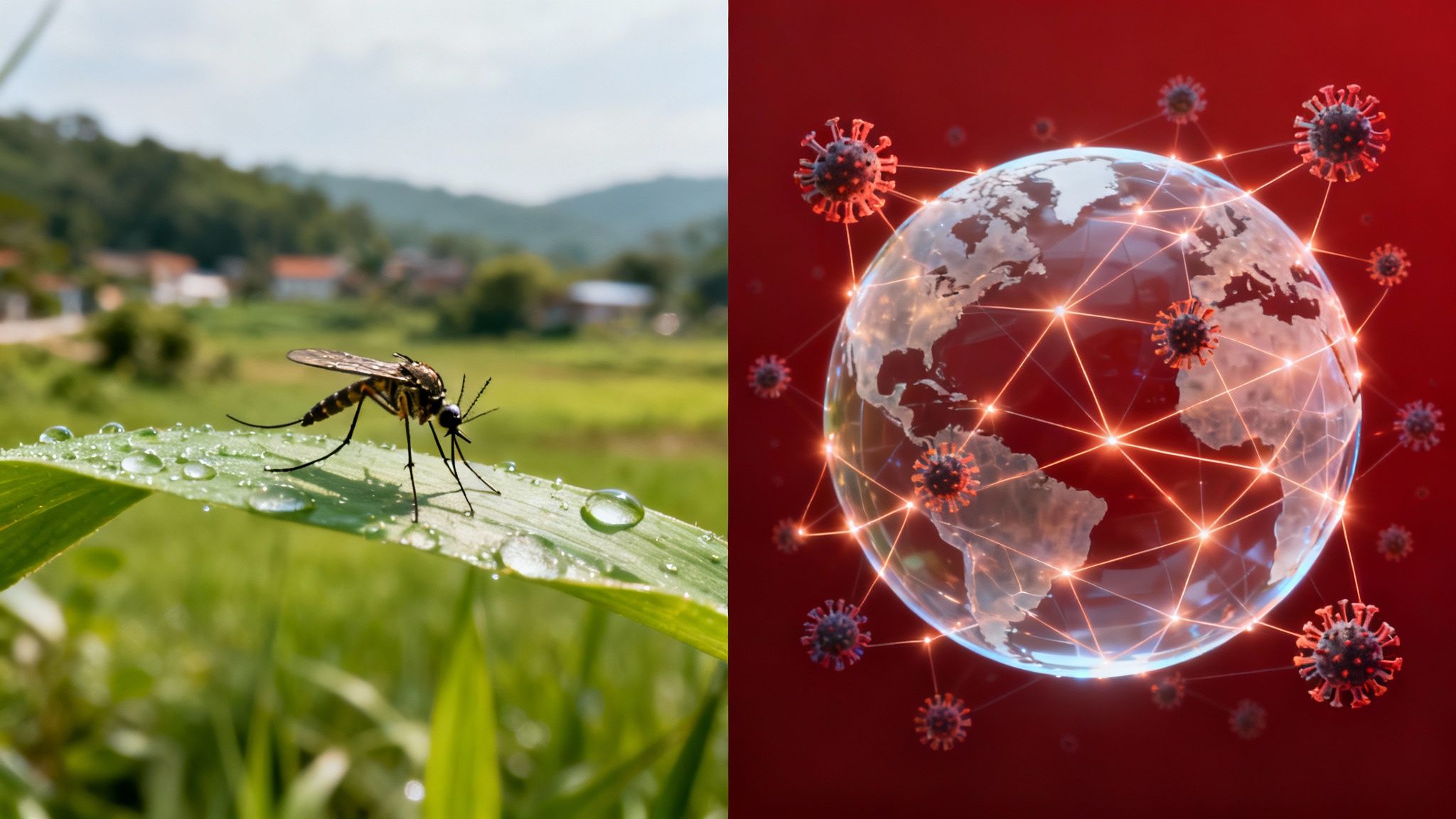
When you hear terms like endemic and pandemic thrown around in public health discussions, it's easy to get them mixed up. The core difference really boils down to two things: scale and predictability.
Think of an endemic disease as a low, steady simmer. It's consistently present in a specific region or population, but it spreads at an expected, almost predictable rate. A pandemic, on the other hand, is when that pot boils over and spills across the entire stove—it’s an outbreak that crosses continents and affects a massive number of people worldwide, often caused by a novel pathogen like SARS-CoV-2 or a new Influenza A virus strain.
Comparing Endemic and Pandemic Diseases
When public health experts classify a disease, they're not just looking at how sick it makes people. The most critical distinction between an endemic disease and a pandemic isn't severity; it's all about geographic reach and the speed of new infections.
An endemic disease, like malaria in certain parts of Africa or Dengue fever in Southeast Asia, follows a known pattern within a community that has often built up some level of immunity. A pandemic, however, is usually sparked by a new or novel pathogen—like the SARS-Related Coronavirus 2 (SARS-CoV-2) virus—that spreads rapidly through a global population with little to no prior immunity.
Getting these terms right is more than just semantics. It shapes everything from local prevention campaigns to globally coordinated response efforts.

This visual gets right to the point: an endemic disease is geographically contained (the map pin), while a pandemic has a global footprint (the globe). This simple difference in scale drives every single public health decision that follows.
Key Differences Endemic vs Pandemic at a Glance
For a quick side-by-side look, this table breaks down the defining features of endemic and pandemic diseases. It's a handy reference for understanding the core distinctions at a moment's notice.
| Characteristic | Endemic | Pandemic |
|---|---|---|
| Geographic Scope | Confined to a specific region or population. | Widespread, crossing international boundaries. |
| Infection Rate | Stable and predictable baseline level of disease. | Rapid and exponential growth in new cases. |
| Population Immunity | The population often has some level of immunity. | Little to no pre-existing immunity in the population. |
| Example | Influenza A virus (seasonal), Rhinovirus Type 14, Dengue Fever. | COVID-19 (SARS-CoV-2), 1918 Influenza (H1N1). |
The key takeaway here is that "endemic" doesn't mean "harmless." It simply means the disease's presence is predictable and geographically limited. Whether a virus is endemic or pandemic, pathogens like Herpes Simplex Virus 1 (HSV-1) or Norovirus pose serious health risks, making ongoing hygiene and vigilance essential.
What Does It Mean for a Disease to Be Endemic?
When we say a disease is endemic, we mean it has settled in for the long haul. It's now a constant, predictable presence in a specific region or population. Think of it as the baseline level of an illness—it hasn't been eradicated, but its spread is stable and contained, not exploding uncontrollably.
This isn't a random occurrence. It’s the result of a delicate truce between the pathogen, its human hosts, and the surrounding environment. This consistent presence is why something like the seasonal flu, caused by strains like Influenza A (H1N1), is considered endemic; we expect it to show up every year at relatively low, predictable rates.
For a disease to reach this state, a few key factors usually have to fall into place, creating the right conditions for it to stick around without causing a massive, out-of-control outbreak.
What Keeps a Disease Endemic?
The shift from an explosive outbreak to a persistent, low-level threat is driven by a mix of biological and environmental forces.
- Population Immunity: This is a big one. Once enough people in a community have some level of immunity, either from getting sick before or from vaccination, it gets much harder for the virus or bacteria to find new people to infect. This acts like a natural brake, keeping transmission rates low and steady.
- Climate and Geography: Some environments are just perfect for certain diseases. For example, the mosquitoes that spread malaria and Dengue fever love the warm, humid climates found in sub-Saharan Africa and Southeast Asia. This makes these diseases a persistent, endemic problem in those regions.
- Local Vectors: The presence of specific animals or insects that carry a disease is crucial. Rodents, for instance, can act as a natural reservoir for pathogens, keeping them circulating in the environment and causing small, localized flare-ups from time to time.
The most important thing to remember is that "endemic" doesn't mean "harmless." An endemic disease can still cause severe illness and death. It just means its presence is geographically limited and follows a predictable pattern.
Take the plague, for instance. It remains endemic in places like Madagascar, which saw a major outbreak in 2017 with 2,417 cases and a case fatality rate of 8.6%. Because its spread is tied to local rodent populations, it stays contained within these zones, defining it as endemic. You can explore more historical data about endemic disease patterns to get a better sense of these distinctions.
This constant presence means the threat never really goes away, even without a pandemic. It's why daily habits like regular handwashing and cleaning surfaces are so vital. Using disinfecting wipes can effectively break the chain of transmission for many common endemic viruses, like the Rhinovirus Type 14 that causes the common cold. Managing these persistent, everyday risks requires constant vigilance.
Understanding the Global Impact of a Pandemic
If an endemic disease is a constant, smoldering fire in a community, a pandemic is a wildfire that jumps continents. It's a global health emergency defined by explosive, widespread transmission that crosses international borders and hits multiple regions all at once.
The defining trait of a pandemic isn't necessarily how deadly it is, but its sheer geographic scale. This usually happens when a new virus—or a new strain of an old one, like an Avian Influenza Virus (H5N1) jumping to humans—emerges. With little to no pre-existing immunity in the global population, the pathogen can spread like crazy.
When organizations like the World Health Organization (WHO) declare a pandemic, it's a signal to the world that this is no longer a regional problem. That declaration triggers a massive, coordinated international response, from travel restrictions and resource mobilization to a full-court press on developing treatments and vaccines. The goal shifts from containment to global crisis mitigation.
The Overwhelming Force of a Pandemic
The true impact of a pandemic is felt in the way it cripples societies and healthcare systems. Unlike the predictable rhythm of endemic diseases, pandemics often crash over us in successive waves of infection. Each wave puts an unbelievable strain on hospitals, supply chains, and public services, often pushing them right past their breaking point.
History gives us some brutal examples of this overwhelming force. The infamous 1918 influenza pandemic, better known as the Spanish Flu, was caused by an H1N1 virus and infected about one-third of the world’s population at the time, killing tens of millions.
A key difference is that pandemics introduce a novel threat on a massive scale. This novelty means healthcare systems are often unprepared for the sudden surge in patients requiring specialized care, leading to overwhelmed infrastructure and tragic outcomes.
The Human Immunodeficiency Virus Type 1 (HIV-1) crisis, which exploded in the early 1980s, is another powerful reminder of a pandemic's devastating, long-term global impact. These events don't just come and go; they reshape economies, societies, and public health strategies for generations.
Historical Perspective on Pandemic Mortality
History books are filled with pandemics that caused staggering death tolls, far beyond the predictable mortality of endemic illnesses. The Black Death, caused by the bacterium Yersinia pestis between 1347-1351, killed an estimated 200 million people—wiping out up to 60% of Europe's population.
More recently, the ongoing HIV/AIDS pandemic has been responsible for roughly 44 million deaths worldwide. You can read the full research about historical pandemic mortality for more context. This catastrophic scale is precisely why global preparedness and a rapid, coordinated response are so critical.
How a Pandemic Can Become an Endemic Disease
The line between a pandemic and an endemic disease isn't set in stone. It’s a blurry boundary that shifts over time as a virus, our immunity, and public health efforts all adapt. A global health crisis doesn't just end one day; it transitions into something more predictable and manageable.
This is exactly the journey we’re watching with SARS-CoV-2, the virus behind COVID-19. It started as a local outbreak, exploded into a devastating pandemic, and is now gradually settling into an endemic pattern. Understanding this process is key—the threat doesn't vanish, it just finds a new rhythm.

Key Drivers of the Endemic Transition
Several powerful forces have to come together to tame a pandemic and guide it toward becoming endemic. The whole transition really hinges on reaching a balance where the virus keeps circulating but no longer causes the massive, unpredictable waves of infection we see in the early stages.
One of the biggest factors is population immunity. As more people build up protection from vaccines and natural infection, the virus has a much harder time finding susceptible hosts. This widespread resistance puts the brakes on transmission, slowing the spread and often reducing how sick people get. If you want to go deeper, you can learn more about how herd immunity works in our detailed guide.
Another critical piece of the puzzle is the evolution of the virus itself. Over time, pathogens like influenza and coronaviruses tend to mutate. While new variants can sometimes be more contagious, they often evolve to cause less severe disease. It's a survival strategy—a virus that kills its host too quickly can't spread as far. This gradual adaptation helps the virus persist at lower levels without completely overwhelming our healthcare systems.
A pandemic begins its shift toward an endemic state when its spread becomes more predictable and its societal impact less disruptive. This doesn't mean the virus is gone; it means we have collectively learned to live with it, managing its presence through ongoing public health measures.
Finally, sustained public health interventions play a huge role. Things like targeted vaccination campaigns, antiviral treatments, and better hygiene habits all help manage the virus's circulation. These efforts ensure that even as a virus settles into an endemic pattern, we have the tools to control flare-ups and protect the most vulnerable people. This is also where ongoing management becomes crucial, highlighting why routine disinfection remains important since surfaces can still harbor pathogens like Human Coronavirus or Feline Calicivirus long after a pandemic has peaked.
How Scientists Measure the Spread of Disease
To really get a handle on the difference between an endemic and pandemic disease, scientists have to look at the numbers. They rely on a few key metrics that cut through the noise and show how a virus is actually behaving in a population. These numbers are what tell us why some pathogens just simmer in the background while others explode across the globe.
Two of the most important yardsticks are the basic reproduction number (R₀)—often called "R-naught"—and the Case Fatality Rate (CFR). R₀ tells us, on average, how many new people a single infected person will pass the virus to in a totally unprotected population. The CFR, on the other hand, measures how deadly a disease is by calculating the percentage of confirmed cases that end in death.
R₀ and CFR in Action
Looking at these two numbers side-by-side reveals the stark difference between an endemic nuisance and a full-blown pandemic threat.
If a disease has an R₀ value above 1, the outbreak is growing. If it’s below 1, it's on its way out. A value hovering right around 1 means the disease has hit a steady state—it’s likely become endemic. Each infected person is only passing it on to one other person, keeping the disease present without causing a massive surge.
The R₀ value is the engine of an outbreak. A high R₀, like we saw in the early days of the SARS-CoV-2 pandemic, is what allows a virus to spread exponentially before public health interventions can slow it down.
When you look at the statistics, the contrast becomes even clearer. Endemic diseases tend to have a stable R₀ right around 1. For instance, seasonal patterns of endemic plague show an R₀ of roughly 1.73, enough to sustain it but not cause a worldwide crisis.
Pandemics are a different beast entirely. They often have much higher R₀ values, which is what fuels their rapid-fire transmission across borders. The 2009 H1N1 influenza pandemic went global in just a few months because it was so transmissible. It ultimately caused an estimated 148,000 to 249,000 deaths worldwide, hitting younger people particularly hard. You can find more details on similar events in this list of historic disease outbreaks on Wikipedia.
This kind of data doesn't just appear out of nowhere. It's collected through constant monitoring, a process we explain in our article on what is epidemiological surveillance. This ongoing intelligence-gathering is absolutely critical for tracking how a disease is behaving and helps leaders make the right public health calls—whether they're dealing with a localized endemic threat or a global pandemic.
Protecting Yourself in Any Scenario
Knowing the difference between an endemic virus and a pandemic one isn't just a trivia question—it's what guides public health policy on a massive scale. A disease’s status can trigger anything from global travel restrictions to local vaccination drives.
But when it comes down to protecting yourself and your family, the message is much simpler. The fundamental rules of hygiene are your best defense, no matter what’s going around.
Whether you're dealing with a novel global threat or the same old seasonal bug, the practical steps you take to reduce transmission don't really change. The best strategies are the ones you can stick with every day.
Universal Principles of Viral Protection
It doesn't matter how widespread an outbreak is; stopping an infection always comes back to the same core habits. These simple actions interrupt the pathways viruses use to travel from surfaces to you, or from person to person.
- Consistent Hand Hygiene: This is non-negotiable. Washing your hands often with soap and water, or using a good alcohol-based sanitizer, is the number one way to remove or kill pathogens you pick up from contaminated surfaces.
- Effective Surface Disinfection: Viruses like Hepatitis B Virus (HBV) and Human Rotavirus love to hang out on high-touch spots like phones, doorknobs, and countertops. Wiping these down regularly with a disinfectant wipe breaks a critical link in the chain of transmission.
- Awareness of Personal Space: Keeping a little distance from people who are sick is common sense. It helps you avoid the respiratory droplets that carry viruses like influenza straight from them to you.
Of course, being well-informed helps you make smarter choices, especially during periods of higher risk. Taking the time for things like understanding different mask types like N95s can make a real difference.
The ultimate takeaway is this: your personal health safety doesn't need a massive overhaul depending on whether a virus is endemic or pandemic. Strong, everyday hygiene is the bedrock of protection against any viral threat, predictable or not.
By focusing on these universal precautions, you’re building a solid defense that works just as well against the seasonal flu as it does against the next big global health scare. It’s all about being proactively prepared, all the time.
Of course. Here is the rewritten section, crafted to sound like a human expert, following the provided style guide and examples.
Common Questions About Disease Classifications
Even when you know the definitions, it's easy to get tripped up by the terms used to describe disease outbreaks. Let's clear up some of the most common points of confusion.
Epidemic vs. Pandemic: What's the Real Difference?
A lot of people use "epidemic" and "pandemic" as if they mean the same thing, but for public health experts, the difference is huge. It all comes down to geography.
An epidemic is a sudden, unexpected spike in disease cases within a specific, contained area. Think of it as a regional fire. A pandemic, on the other hand, is what happens when that fire jumps borders and goes global, spreading across multiple countries or continents and impacting a huge portion of the world’s population.
The easiest way to remember it is that an epidemic is localized, while a pandemic is international. An outbreak has to become an epidemic before it can ever be declared a pandemic.
Can a Pandemic Disease Be Completely Eradicated?
Yes, it’s possible—but it's incredibly rare and one of the most difficult feats in public health history. So far, smallpox is the only human disease we've managed to completely wipe off the face of the earth, thanks to a massive, coordinated global vaccination effort.
For nearly every other pathogen, total eradication just isn't a realistic goal. Instead, the strategy shifts from eradication to control. Most pandemic viruses, like the influenza strains that circle the globe, eventually settle into an endemic pattern, sticking around at lower, more predictable levels.
What Does an Endemic COVID-19 Mean for Daily Life?
When a virus like SARS-CoV-2 transitions from pandemic to endemic, it’s a major turning point. It doesn't mean the virus is gone; it means it has become a permanent, circulating part of our environment, much like the seasonal flu. We expect to see it, often with predictable peaks during certain times of the year.
This shift also changes the public health playbook. The focus moves away from crisis-level emergency measures and toward long-term management. This new normal includes:
- Continuous surveillance to keep an eye on new variants and track seasonal flare-ups.
- Routine vaccinations and booster shots, especially for those who are most vulnerable.
- Accessible treatments to help people who get sick avoid severe illness.
For most of us, it means folding prevention into our regular routines—like practicing good hygiene with disinfecting wipes and staying home when sick—instead of living under sweeping public health orders.
Leave a Reply