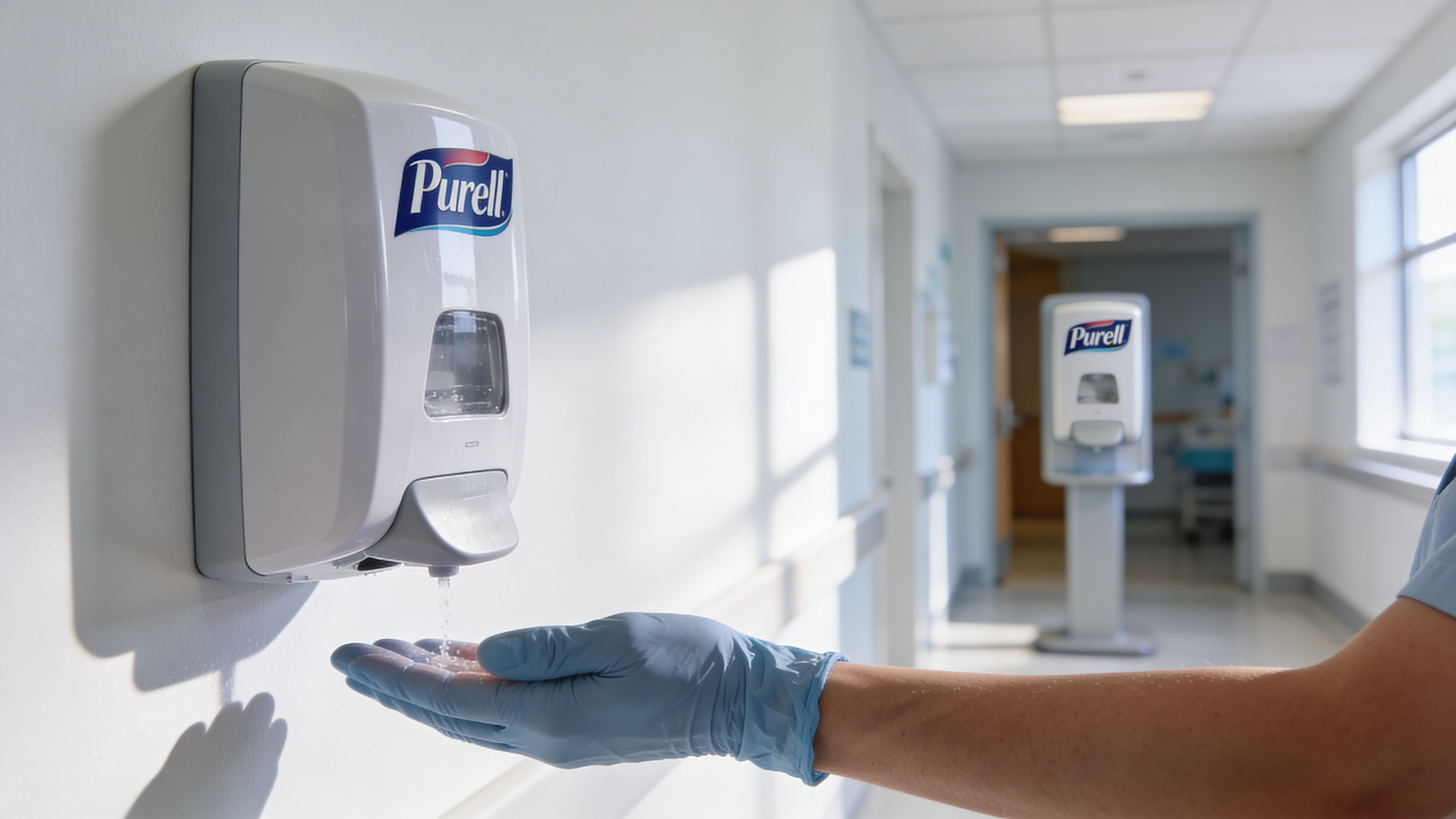
You walk into a school office, a clinic hallway, or the entrance of a busy workplace and see a Purell dispenser mounted near the door. It is often registered as background equipment, like a trash can or light switch. In infection control, it’s closer to a checkpoint.
That dispenser helps decide what travels with people from one room to the next. If hands are cleaned at the right moment, fewer viruses hitch a ride onto doorknobs, desks, elevator buttons, phones, and shared counters. If the dispenser is empty, badly placed, leaking, hard to use, or paired with poor surface cleaning, the whole system weakens.
That’s the key idea many buyers miss. Purell soap dispensers are not just containers for soap. They’re part of a larger hygiene system that includes the product inside, the refill method, where the unit sits, how often staff maintain it, and whether nearby surfaces are cleaned often enough to stop viral spread. For organisms such as influenza and norovirus, that system matters more than the brand name alone.
Beyond the Pump A First Line of Defense
A dispenser near a doorway can look simple. In practice, it acts like a gatekeeper. People move from restrooms to lunch areas, from waiting rooms to exam rooms, from classrooms to shared devices. Their hands carry whatever they touched last.
That’s why facilities that take infection control seriously don’t treat hand hygiene as a decorative add-on. They build it into traffic flow. The dispenser becomes the first thing a person can do right before contact spreads outward.
Purell’s history helps explain why these systems became so common. GOJO Industries created early hand-cleaning products long before modern sanitizer stations became familiar, and Purell’s alcohol-based gel was patented in 1998. Early Army use showed why convenient hand hygiene mattered in shared environments. In that setting, use of Purell was associated with an approximately 45% reduction in gastrointestinal and respiratory illnesses among troops, according to this history of Purell and GOJO.
Practical rule: A hand hygiene station works best when people encounter it before they touch shared spaces, not after.
In public health terms, a dispenser lowers friction. It removes excuses. No one has to hunt for a sink, wonder where supplies are stored, or skip cleaning because they’re in a hurry. That’s especially important in buildings where many users won’t know the local routine, such as schools, outpatient clinics, reception areas, and event venues.
A common point of confusion is the word “soap” in this discussion. Some Purell dispensers are designed for hand soap, some for hand sanitizer, and some families of dispensers look similar while serving different products. The outside shell may look nearly identical, but the role in infection control can differ. Soap matters most where people can wash and rinse. Sanitizer matters where quick access is needed between tasks. The strongest programs use both.
The Anatomy of a Purell Dispenser
A dispenser seems like a small box on a wall. Inside, it’s a controlled delivery system. To understand why some units hold up better than others, it helps to break the device into a few basic parts.

The three parts that matter most
Most purell soap dispensers have three functional layers:
- Outer housing protects the refill and pump, gives users a clear press point or sensor area, and helps staff access the inside for refill changes.
- Pump or dispensing mechanism controls how the product leaves the unit. This is the part that turns a hand push or sensor trigger into an actual dose.
- Refill reservoir or cartridge stores the soap product in a sealed package designed for that dispenser family.
Think of the housing as the cabinet, the refill as the fuel tank, and the pump as the engine. If the pump is unreliable, the rest of the unit doesn’t matter much.
Manual works like a light switch
A manual push dispenser is the easiest model to understand. You press the front panel or a push bar, and your force drives the mechanism. The pump creates pressure and moves a small amount of soap out through the nozzle.
That’s why manual models often appeal to facilities that want direct mechanical action with fewer electronic parts. They’re simple in the same way a light switch is simple. Press, release, reset, repeat.
The PURELL ES4 Manual Soap Dispenser was tested to exceed 50,000 push cycles, which matters because repeated use is where weak dispensers fail. The same product description notes that its reinforced actuator helps prevent air ingress that can contribute to bacterial biofilm growth inside the unit, according to the ES4 dispenser specifications.
That durability matters in a school restroom, a pediatric office, or a breakroom where hundreds of small interactions add up. Every successful push is one more chance to keep hygiene behavior easy.
For readers comparing hands-free options, our guide to an automatic hand sanitizer dispenser explains the sensor-based side of the equation in more detail.
Touchless works like a motion light
A touchless dispenser does the same job through a different chain of events. A sensor detects a hand under the nozzle. The unit then activates a motor or powered mechanism to release product.
That’s similar to a motion-sensor light. You don’t touch the switch. The device watches for presence and responds.
The main public health advantage is obvious. Fewer users touch the same exterior surface. That doesn’t make the outside of the dispenser irrelevant, because staff still need to clean it, but it can reduce one repeated contact point in high-use spaces.
The best dispenser is the one people can use correctly, quickly, and without hesitation.
Why dosing matters
Users often think more soap means cleaner hands. In reality, what matters is consistent dosing. The dispenser should deliver enough product to cover hands well, without flooding the sink area or encouraging waste.
A good dispenser works like a measuring spoon, not an open bottle. It gives a repeatable amount each time, which helps facilities predict refill needs and helps users develop a routine. In infection control, consistency beats improvisation.
Exploring Wall-Mounted and Freestanding Dispensers
Choosing between wall-mounted and freestanding units isn’t just a design decision. It changes how people encounter hand hygiene in a building. One format builds a habit into a fixed location. The other lets you create a hygiene checkpoint wherever traffic shifts.

A restroom outside a cafeteria has predictable traffic. A vaccination clinic set up in a gymnasium doesn’t. That difference shapes the right dispenser format.
Purell Dispenser Type Comparison
| Dispenser Type | Primary Format | Best For | Key Advantage |
|---|---|---|---|
| Wall-mounted manual | Fixed on wall | Restrooms, exam rooms, staff sinks | Reliable and straightforward |
| Wall-mounted touchless | Fixed on wall | Hallways, entrances, clinical areas | Reduces shared touch on the unit |
| Freestanding manual | Portable floor unit | Temporary stations, events, overflow areas | Flexible placement without installation |
| Freestanding touchless | Portable floor unit | Lobbies, large entrances, changing traffic patterns | Easy to move and convenient for public use |
When wall-mounted makes the most sense
Wall-mounted dispensers are the backbone of most permanent hygiene programs. They work well when the location of hand cleaning shouldn’t change, such as beside sinks, outside patient rooms, near breakroom doors, or in restroom exit paths.
Their strength is predictability. People learn where the unit is. Staff learn when to refill it. Housekeeping learns what nearby surfaces need routine attention.
The PURELL ES8 Push-Style Soap Dispenser fits this kind of environment well because it uses a 1200 mL refill and provides approximately 800 to 1000 hand washes, according to the ES8 dispenser product listing. That capacity matters in busy areas because larger refills reduce interruption. The same model also includes a “LOCK OR NOT” feature that offers tamper resistance, which is especially useful in public-facing settings.
Why portability changes behavior
Freestanding units serve a different purpose. They let a facility put hand hygiene where walls can’t help. Think of a registration table at a community event, a temporary respiratory screening area, or a school assembly entrance.
Portable stations can also solve a common human problem. People often clean their hands when the prompt is directly in front of them. A freestanding dispenser placed in the middle of a traffic path can create that prompt better than a wall unit tucked off to the side.
Facility insight: If people have to turn away from their walking path to find a dispenser, use usually drops.
That said, freestanding units need more supervision. They can drift out of position, become visual clutter, or end up placed where no one naturally pauses. In crowded settings, they also need enough surrounding space so they don’t create bottlenecks.
Manual or touchless within each format
The next choice sits inside the first one. You can have a wall-mounted manual dispenser, a wall-mounted touchless dispenser, a freestanding manual unit, or a freestanding touchless station. None is universally best.
Use these questions to guide the decision:
- Will users have wet or soiled hands already? Manual push units near sinks are often intuitive in handwashing areas.
- Is shared surface contact a major concern? Touchless operation can help in entrances and clinical transition zones.
- Will the unit move often? A freestanding station should be simple for staff to relocate and monitor.
- Is tampering a concern? A locking option can matter in schools, transit-adjacent spaces, and unsupervised public areas.
For spaces where a permanent installation is likely, this guide to a hand sanitizer dispenser wall mount can help readers think through fixed placement in more detail.
Real-world matching by setting
Different buildings create different hand hygiene patterns.
- School restrooms and nurse offices usually benefit from wall-mounted soap dispensers because handwashing should happen at a known sink location.
- Medical waiting areas often do well with wall-mounted touchless sanitizer or soap-adjacent stations placed near transitions.
- Events and temporary clinics often need freestanding units because the flow changes by the hour.
- Office entries and shared collaboration zones may use either format, depending on whether the building manager wants permanence or mobility.
The mistake I see most often is choosing only by appearance. A sleek dispenser won’t fix poor placement, missed refills, or confusing user flow. A plain unit in the right spot usually does more to interrupt viral spread than a stylish unit in the wrong one.
Refill Systems The Sealed Cartridge vs Bulk Fill Debate
The refill system is one of the least visible parts of hand hygiene, and one of the most important. Most users never think about what happens when the soap runs low. Infection control staff have to.
A sealed cartridge system keeps the product enclosed from manufacture to use. Staff remove the empty unit and click in a fresh refill. An open bulk-fill system requires workers to pour soap into a reservoir that remains in service.
Those two methods don’t carry the same hygiene risk.
Why sealed matters
When a facility uses sealed cartridges, the product stays protected until the refill is installed. Staff don’t expose the soap to the room while topping off a tank. They also don’t have to handle an open container and an in-use reservoir during the refill step.
That matters because handwashing systems can fail in quiet ways. If the product itself becomes contaminated, the station no longer supports the infection-control goal it was meant to serve. The dispenser still looks functional, but the hygiene chain has been weakened.
This is why many modern commercial systems favor enclosed refills. They reduce handling, standardize compatibility, and make it easier to know what product is inside the unit.
The hidden problem with bulk fill
Bulk-fill systems can look economical at first. The reservoir is reused, and staff can pour in more product as needed. But open filling introduces more opportunity for mistakes.
Common trouble points include:
- Topping off old product instead of fully replacing the contents
- Mixing incompatible formulations if staff use whatever container is available
- Leaving refill openings exposed during maintenance
- Poor cleaning of internal components between fills
In practical terms, bulk-fill is like refilling a drinking bottle without ever fully washing it out. The outside may look fine, but what happens inside is harder to control.
For readers weighing volume and logistics, our explainer on hand sanitizers in bulk covers the purchasing side of high-volume supply decisions.
A dispenser should protect the product until the moment it reaches the user’s hand. If the refill method compromises that, the system is doing the opposite of what you want.
The better question to ask
Instead of asking, “Which refill is cheapest?” ask, “Which refill preserves product integrity with the fewest handling steps?” In schools, clinics, food-adjacent areas, and public buildings, that’s the safer question.
Cost matters. Reliability matters too. But when the goal is preventing viral spread, hygiene control inside the dispenser deserves more attention than it usually gets.
Strategic Placement for Maximum Infection Control
A well-designed dispenser in the wrong place doesn’t do much. Placement determines whether people use the station before they contaminate shared surfaces or after. That timing is the heart of infection control.

Think about a typical path through a facility. Someone enters the building, opens a door, checks in on a screen, signs a form, sits in a chair, uses a restroom, touches a rail, then heads into a meeting or exam room. Every one of those transitions creates a chance for hands to pick up or deposit viruses.
Place dispensers at transition points
The best locations are usually not random blank walls. They’re decision points in the flow of movement.
Good examples include:
- Entrances and exits where people move between the outside world and shared indoor space
- Outside restrooms or at sinks where handwashing should happen naturally
- Near food service areas before eating or food handling
- Elevator banks and stairwell entries where many hands meet the same surfaces
- Outside patient rooms, classrooms, and meeting rooms where one group mixes with another
Many facilities often get stuck on a particular issue. They install a unit where maintenance finds wall space, not where users naturally pause. In practice, those aren’t always the same places.
Hand hygiene opportunities are measurable
In large healthcare environments, some systems don’t rely on guesswork alone. GOJO’s PURELL SMARTLINK Technology uses connected dispensers to monitor usage. According to Microsoft’s report on GOJO’s connected hygiene system, roughly 25,000 connected dispensers across more than 100 health facilities track millions of hand-cleaning opportunities each month.
That phrase, hand-cleaning opportunities, is useful even outside hospitals. It means the moments when a person should clean their hands because they’re entering, leaving, touching, serving, or switching tasks. Once you look at a building that way, dispenser placement becomes much more strategic.
Build a full barrier, not a single station
Hands aren’t the only route viruses use. If a dispenser sits beside a push plate, check-in counter, shared pen cup, or door handle, those nearby surfaces need attention too. Otherwise, people clean their hands and then immediately touch a contaminated object.
That’s why the strongest setups pair hand hygiene with regular surface disinfection of high-touch points near the station.
Clean hands and dirty nearby surfaces work against each other.
This matters especially for viruses that spread readily through contaminated environments, such as norovirus, and for seasonal respiratory viruses like influenza that move easily through a mix of hands, surfaces, and close contact. In practical terms, a dispenser is one layer. Wiping shared touchpoints is another. Neither should replace the other.
A placement checklist that works
When evaluating where to put purell soap dispensers, ask:
- Will people see it before touching shared objects?
- Can they use it without blocking traffic?
- Is it close to the behavior you want, such as entering, eating, washing, or leaving?
- Will staff notice quickly if it’s empty or damaged?
- Are nearby high-touch surfaces being disinfected on a routine schedule?
Facilities that answer all five questions well usually get better real-world performance from the same hardware.
Hand Soap or Hand Sanitizer Which Is Better for Viruses
This is the question many people care about. If the concern is viruses, should you choose soap or sanitizer?
The short answer is that both matter, but not in the same situations. The right choice depends on what’s on the hands and which type of virus you’re trying to interrupt.
Why soap and sanitizer work differently
Soap works mainly through mechanical removal. When you lather, rub, and rinse, you help lift dirt, oils, and microbes off the skin so water can carry them away.
Alcohol-based sanitizer works differently. It acts directly on susceptible organisms on the skin and is especially useful when a sink isn’t available and hands aren’t visibly dirty.
That distinction matters for viruses. Some are easier to disrupt with alcohol-based products, especially enveloped viruses such as influenza and coronaviruses. Others are tougher.
Why norovirus changes the conversation
For non-enveloped viruses such as norovirus, soap has an important advantage because the act of washing physically removes particles from the hands. According to School Health’s discussion of Purell handwash and viral prevention, soap washing can achieve a 2 to 3 log10 reduction in viruses like norovirus through mechanical removal, while alcohol sanitizers can be less effective against such non-enveloped viruses.
That’s why a soap dispenser near a sink is not old-fashioned backup. In some outbreak settings, it’s the stronger frontline tool.
A simple decision guide
Use soap and water when:
- Hands are visibly dirty
- Someone may have contact with vomit, stool, food residue, or heavy grime
- Norovirus is a concern
- A sink is readily available
Use hand sanitizer when:
- A sink isn’t nearby
- Hands are not visibly soiled
- You need quick cleaning between contacts
- The main concern is a virus more susceptible to alcohol-based products, such as influenza
If norovirus is part of the risk picture, don’t let sanitizer replace handwashing where sinks are available.
The strongest facilities don’t force a false choice. They place soap dispensers at sinks and sanitizer at transitions. That way users have the right tool for the moment in front of them.
Maintenance Compliance and Long-Term Reliability
A dispenser only helps if it works every time. Empty units, dead sensors, sticky push bars, and dirty exteriors all undermine trust. Once users encounter a broken dispenser a few times, many stop trying.
That’s why maintenance is not housekeeping trivia. It’s part of infection prevention.

Keep the unit clean, not just full
People often focus only on refills. The outside of the dispenser matters too because users touch or approach it repeatedly, and nearby splash, dust, and residue can build up.
A practical maintenance routine should include:
- Checking product level before the dispenser runs dry
- Inspecting the nozzle area for buildup or leakage
- Cleaning exterior touchpoints on manual units
- Wiping nearby wall and sink surfaces that collect drips
- Removing damaged units from service quickly so users aren’t trained to ignore the station
In many facilities, it’s also sensible to wipe the exterior of dispensers and adjacent high-touch surfaces with an appropriate disinfecting wipe as part of routine environmental cleaning. That step matters because hand hygiene stations sit inside a larger surface-contact environment.
Power management for touch-free systems
Touchless dispensers introduce a different maintenance task. They need power.
For touch-free models like the ES6, a set of C batteries typically lasts for about 35,000 doses, according to the video-based product discussion of ES6 and newer ES8 power systems. Newer ES8 models with Energy on Refill technology eliminate the need for battery changes, which helps facilities avoid downtime tied to depleted batteries.
That detail is more important than it sounds. A dead touchless dispenser often fails unannounced. Staff may not notice immediately, and users may wave a hand once, get nothing, and walk away.
Reliability is behavioral
A dependable dispenser changes user behavior over time. People return to stations that work. They stop trusting stations that don’t.
To support long-term reliability, train staff to look for these signs:
- Slow or inconsistent product release
- Dripping after dispense
- Loose mounting or wobble
- Sensor delay in touchless units
- User confusion about where to place hands
The user should never have to guess where the soap comes from or whether the dispenser will respond.
Accessibility and real-world use
Compliance also includes accessibility. A dispenser should be mounted where a wide range of users can reach it comfortably, including children, older adults, and people with disabilities. The operating motion should be clear, and the area around the unit should stay unobstructed.
Even when a manufacturer offers a strong design, a poor installation can ruin usability. A dispenser mounted too high, too close to a corner, or behind a swinging door may technically exist without being practically usable.
For public settings, a good long-term standard is simple:
- Place it where people can reach it easily
- Keep it filled
- Keep it clean
- Replace malfunctioning parts fast
- Disinfect surrounding touchpoints routinely
That’s what turns hardware into a functioning hygiene program.
Purell soap dispensers make the biggest difference when you treat them as one part of a complete barrier against viruses. The dispenser, the refill system, the location, the maintenance schedule, handwashing behavior, and surface disinfection all work together. If you’re building or improving a hygiene plan for a school, clinic, office, or shared facility, keep that full system in view.
For more practical virus prevention guidance, outbreak-focused explainers, and facility hygiene education, visit VirusFAQ.com’s virus prevention articles.
Leave a Reply