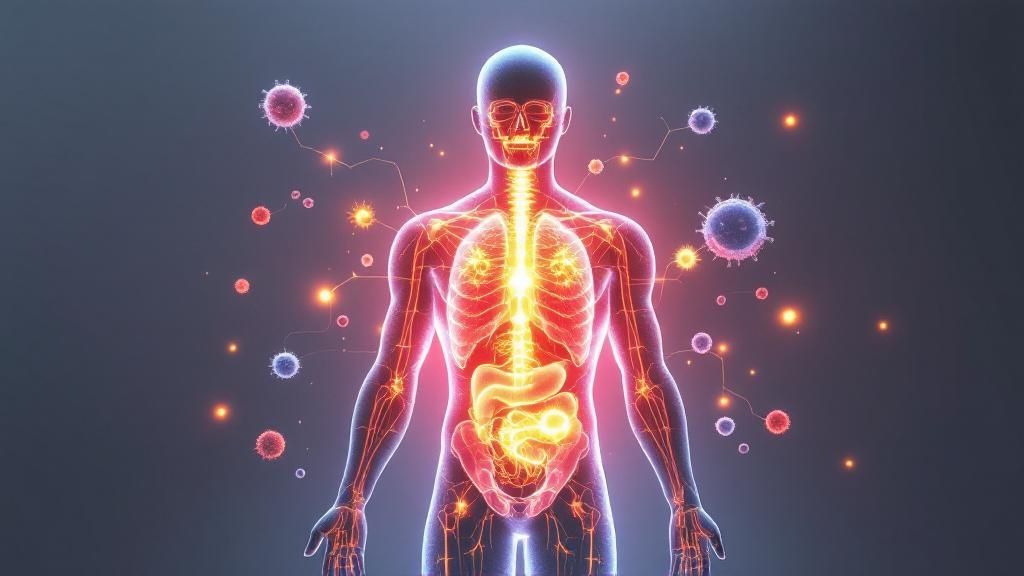
If you want to understand your body’s sophisticated defense network, a diagram of the immune system is the perfect roadmap. It shows you exactly how specialized cells, tissues, and organs all work together—much like a fortress staffed with different units, each assigned a specific protective duty.
Mapping Your Body's Defense Network

Think of your body as a castle under constant siege from invaders like viruses and bacteria. Your immune system is its standing army, a highly coordinated force built to spot and destroy these threats before they can cause real harm.
To make sense of this complex system, it helps to see it as two main branches:
- Innate Immunity: This is your fortress’s frontline guard. It’s always on duty, ready to launch a rapid, general-purpose attack against any intruder it finds.
- Adaptive Immunity: These are the special forces. This system learns to recognize specific enemies, builds custom weapons (antibodies) to take them down, and, most importantly, remembers them to prevent future attacks.
Getting this big-picture view first gives you a solid framework for understanding how all the different pieces fit together to keep you safe.
A Quick Look Back in Time
The idea that our bodies could fight off disease isn't new; it actually dates back thousands of years. The Greek historian Thucydides noted in the 5th century BC that people who survived the plague seemed to be protected from getting it again.
But modern immunology really kicked off with Edward Jenner's groundbreaking work on the smallpox vaccine in 1798. If you're curious, you can discover more about the history of immunology and see how far we've come.
Understanding the immune system isn't just for scientists. It’s the key to knowing how vaccines work, why you get sick with some things only once, and how simple actions—like using disinfecting wipes to reduce the viral load on surfaces—give your body a crucial head start in any fight.
Meet the First Responders: Your Innate Immunity

Your innate immune system is the rapid-response team you were born with. It’s always on patrol and ready to spring into action within minutes of detecting a threat.
Think of it as a city’s emergency services—the police and firefighters who react instantly without needing to study the specifics of a crisis beforehand. This system is your body's first and most immediate line of defense, a blunt instrument designed for speed.
This defense starts with physical barriers, like your skin acting as a fortress wall. But if a pathogen like a virus or bacterium manages to breach those walls, a team of specialized cells immediately mobilizes. These cells don't need prior training; they're genetically programmed to recognize common patterns found on invaders.
Key Cellular Players
The innate response relies on a few key cell types, each with a distinct job in containing an infection before it can spread. They are the foot soldiers of your immune defense, swarming any breach to neutralize threats quickly.
- Neutrophils: These are almost always the first to arrive at an infection site. Acting as aggressive foot soldiers, they engulf and destroy pathogens in a process called phagocytosis.
- Macrophages: Think of these as the versatile "clean-up crew." Macrophages not only devour invaders but also clear away dead cells and debris, helping to manage inflammation and kickstart the healing process.
- Natural Killer (NK) Cells: These are your elite sentinels. NK cells are unique because they can identify and eliminate your own body cells that have been compromised by viruses or have turned cancerous, stopping threats from the inside.
The sheer speed of the innate response is its greatest advantage. By launching an immediate, non-specific counterattack, it buys precious time for the more specialized adaptive immune system to prepare a targeted assault.
Keeping this frontline defense in top shape is critical. Exploring the ways you can support your immune system naturally can help ensure these first responders are always ready for duty. When these cells can't handle an invasion alone, they send out signals for reinforcements, activating the next powerful branch of your defenses.
Deploying the Elite Forces: Your Adaptive Immunity
While the innate system is a fantastic first line of defense, it's your adaptive immune system that brings the real firepower. It delivers a targeted, powerful, and lasting response to specific threats.
If innate immunity is the castle guard—always on patrol but with a standard set of weapons—then adaptive immunity is the elite special forces. These are the highly trained specialists who gather intel, learn from every battle, and develop custom tools to take down specific enemies with absolute precision.
This "intelligent" branch of your immune system is run by two star players: B cells and T cells. These cells start from the same place in your bone marrow but mature into very different, highly specialized soldiers. They're a bit slower to get going than their innate counterparts, often taking a few days to fully mobilize, but the wait is worth it. Their attack is far more effective because it's tailored to the exact germ they're fighting.
This diagram shows how these elite cells (the lymphoid line) branch off from the same original stem cells that create the myeloid cells of your innate immunity.

It’s a great visual reminder that both the rapid-response innate cells and the specialized adaptive cells all trace their origins back to a single type of hematopoietic stem cell. It’s one big, interconnected defense network.
Meet the Specialists: B and T Cells
The adaptive system’s strength comes from the unique jobs these two cell types perform. They work together to coordinate a devastatingly effective response against invaders like Human Immunodeficiency Virus Type 1 (HIV-1) or Influenza A Virus (H1N1).
- B Cells (The Weapons Engineers): When a B cell meets a specific invader, it kicks into high gear and transforms into a factory that pumps out antibodies. Think of antibodies as tiny, guided missiles designed to lock onto a specific pathogen, either neutralizing it on the spot or tagging it for other immune cells to destroy.
- Helper T Cells (The Field Commanders): These are the master coordinators. Helper T cells don’t fight invaders directly. Instead, they activate and direct other immune cells—including B cells and cytotoxic T cells—making sure the entire army works as a single, unified force.
- Cytotoxic T Cells (The Expert Assassins): Once activated, these cells become expert hunters. Their mission is to find and destroy any of your own body cells that have already been infected by a virus, stopping the enemy from replicating and spreading.
But the most incredible feature of the adaptive immune system is immunological memory. After it defeats a pathogen, it doesn't just forget. It leaves behind memory B and T cells that remember the enemy's signature. If that same invader—like a Rhinovirus Type 14 or SARS-Related Coronavirus 2 (SARS-CoV-2)—ever shows up again, these memory cells launch a much faster and stronger counter-attack, often wiping it out before you even feel sick. This is the exact principle that makes vaccines so powerful.
The Immune System's Command Centers

To pull off such a complex defense, your immune system needs a network of specialized organs acting as command centers and forward operating bases. These are the physical locations where your immune cells are born, trained, and deployed.
Think of these hubs as the key locations on the diagram of the immune system—a tangible network spread throughout your body.
Every single soldier in this internal army starts its life in the bone marrow. This is the main recruitment depot and central barracks, where special stem cells produce every type of immune cell you have, from the frontline grunts to the highly specialized B and T cells.
But making the cells is just step one. Certain cells, like T cells, need advanced training. That happens in the thymus, a small organ just behind your breastbone. It functions like an elite training academy where T cells learn to distinguish foreign invaders from your own healthy tissues. It’s a tough school—only the best graduate.
Surveillance Outposts and Deployment Hubs
Once produced and trained, immune cells need strategic spots to hang out, monitor for threats, and launch a rapid response. These are your secondary lymphoid organs, and they’re positioned like surveillance outposts all over your body.
-
Lymph Nodes: These small, bean-shaped structures are the major meeting points. Immune cells gather here to swap intel and screen the lymph fluid for troublemakers like Feline Calicivirus or Norovirus (Norwalk Virus).
-
Spleen: This organ filters your blood, not the lymph. It’s like a massive quality control center, pulling out old red blood cells and identifying any pathogens that have made it into your bloodstream.
-
Tonsils and Adenoids: Positioned like sentinels at the back of your throat and nasal passages, they form a critical first line of defense against anything you breathe in or swallow.
Together, these command centers and outposts make sure your immune cells are always in the right place at the right time. But this system isn't static; it’s constantly learning and adapting. In fact, over 1,600 genes are involved in shaping your immune responses as you age. This complex genetic blueprint allows your defenses to evolve from a basic state at birth into the powerful, memory-driven system that protects you as an adult. You can discover more about the evolution of human immunity on royalsocietypublishing.org.
Anatomy of an Immune Response to a Virus
So, how does the immune system actually spring into action? Let's walk through it. Imagine a run-of-the-mill bug, like a Rhinovirus Type 39, managing to sneak past your first line of defense—the mucus in your nose. The invasion is on.
Almost instantly, the innate immune system sounds the alarm. Patrolling cells called macrophages, the clean-up crew of your body, stumble upon the virus and start gobbling up the invaders. As they do, they shoot out chemical flares called cytokines. These signals are a call to arms, pulling in more first responders like neutrophils to the scene. This is inflammation kicking in; that redness and swelling you feel is just proof that your team is on the job.
But macrophages aren't just muscle; they're also intelligence agents. After swallowing a virus, they chop it up and stick little pieces of it—called antigens—on their own surface like a trophy.
Activating the Elite Forces
This is where the hand-off to your adaptive immunity happens, and it's a critical moment. The macrophage, now wearing the viral antigen, travels to the nearest lymph node. Think of it as a military command center, packed with highly specialized T cells and B cells just waiting for orders.
Inside, the macrophage presents the antigen to a specific Helper T cell—one that's uniquely programmed to recognize that exact threat.
Once it's activated, this Helper T cell becomes the field commander, calling the shots for a much more targeted attack. It starts cloning itself rapidly and sending out orders for other elite cells to join the fight.
The adaptive response is slower to get going, but it's incredibly precise. It builds a custom-made defense designed specifically for that one virus, which means maximum impact on the intruder with minimal damage to your own healthy tissues.
This coordinated attack unfolds in two powerful ways:
- The Humoral Response: Helper T cells give the green light to B cells, which then transform into tiny antibody factories. These antibodies flood your system, acting like guided missiles that lock onto any free-floating viruses, either neutralizing them on the spot or tagging them for other cells to destroy.
- The Cell-Mediated Response: At the same time, Helper T cells activate the assassins of the immune system: Cytotoxic T cells. Their mission is to hunt down and eliminate any of your own body cells that have already been hijacked by the virus. This stops the virus from making copies of itself and spreading any further.
This play-by-play of an immune reaction to common virus infections shows just how crucial a multi-layered defense is. From the first breach to the final, targeted takedown, every single component has a vital job to do. It also shows why environmental hygiene matters so much. Using a disinfectant wipe to clear viral particles off a surface lessens the initial load your innate system has to deal with, giving your body a huge head start from the get-go.
Common Questions About Your Immune System
Even with a diagram, the immune system can feel like a complex web of moving parts. Let's tackle some of the most common questions to help bring all these concepts together.
Think of this as a quick debrief after the main tour—clearing up a few key points so you can walk away with a solid understanding of your body’s incredible defense network.
What Is the Difference Between an Antigen and an Antibody?
This is a classic point of confusion, but a simple analogy helps. Think of an antigen as the enemy's uniform—it’s a specific molecule on the surface of a pathogen, like Hepatitis B Virus (HBV), that your body instantly recognizes as foreign. It’s the unique flag that screams, "Invader!"
An antibody, on the other hand, is a highly specialized weapon built by your B cells. It’s like a custom-made smart key designed to fit perfectly into the antigen’s lock. When an antibody binds to its target antigen, it either neutralizes the threat on the spot or tags it for destruction by other immune cells.
How Do Vaccines Train the Immune System?
Vaccines are basically a boot camp for your adaptive immune system. They introduce a safe, harmless piece of a pathogen—like a single protein from the SARS-Related Coronavirus 2 (SARS-CoV-2) virus—to your body.
This controlled exposure lets your immune system "study" the enemy's uniform without you ever getting sick. It then creates an army of powerful memory B and T cells. If the real, live pathogen ever shows up, your body is already prepped and ready to launch a fast, overwhelming counter-attack, either preventing the infection entirely or drastically reducing its severity.
Why Do Autoimmune Diseases Happen?
Autoimmune diseases are a case of mistaken identity. The immune system’s sophisticated targeting system goes haywire and starts identifying the body's own healthy tissues—like joints, skin, or nerve cells—as dangerous invaders.
This "friendly fire" triggers chronic inflammation and damage. The specific condition that develops, like rheumatoid arthritis or lupus, depends entirely on which part of the body the immune system has incorrectly targeted for attack.
Can You Really Boost Your Immune System?
The whole idea of "boosting" your immune system is more marketing hype than scientific reality. A healthy immune system is all about balance, not being permanently stuck in overdrive. An overactive immune system is what causes allergies and autoimmune diseases, after all.
The best thing you can do is support its normal, healthy function through proven lifestyle habits. Getting enough sleep, managing stress, eating a nutritious diet, and staying active—these are the things that give your immune cells the resources they need to work effectively. You aren't supercharging your defenses; you're just making sure your army is well-supplied and ready to fight when called upon.
Part of that support is also knowing when your body is fighting something off. Recognizing the signs of an active immune response helps you know when to rest and recover. You can learn more about identifying common virus symptoms in our detailed guide.
Leave a Reply