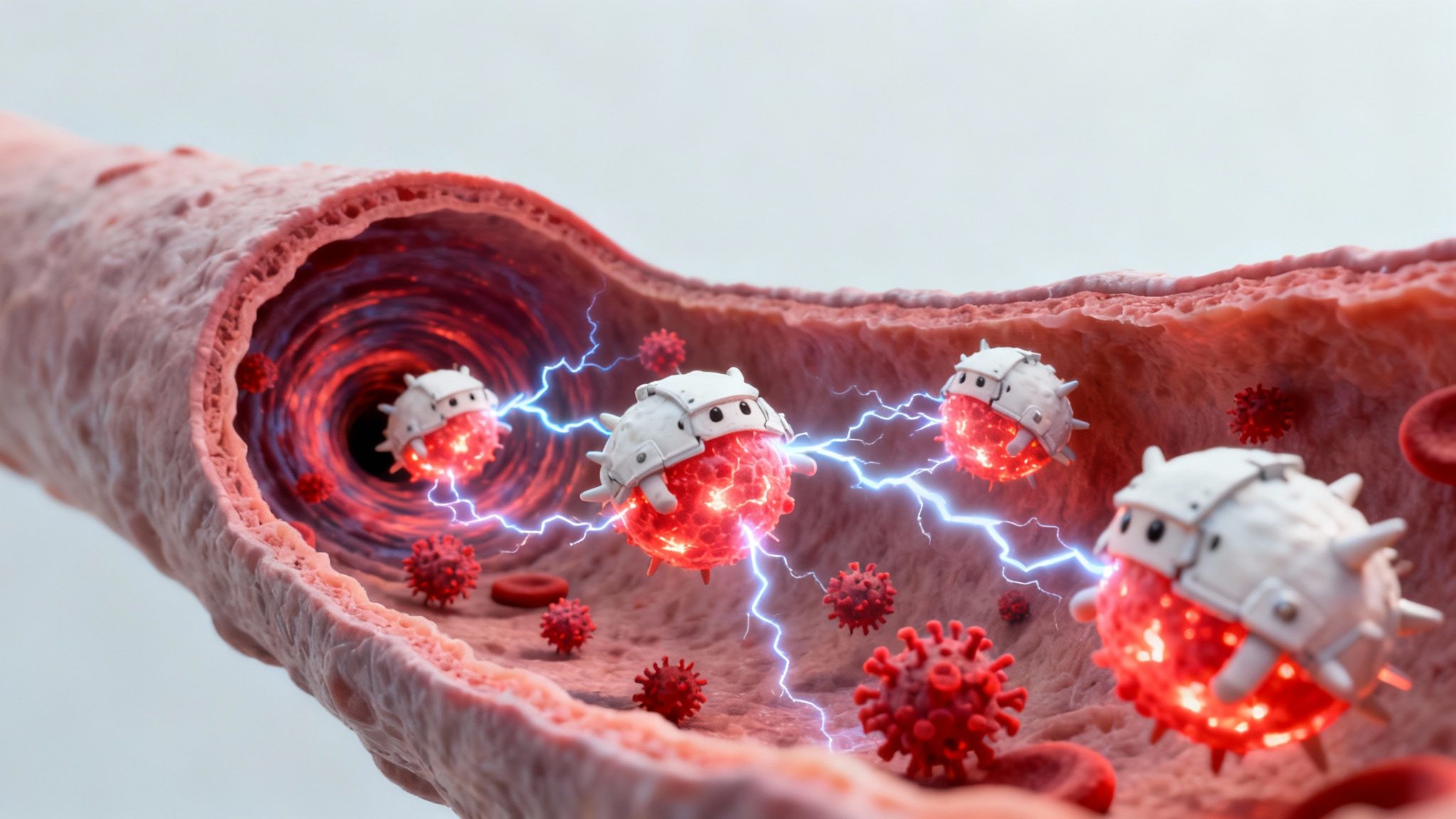
A cytokine storm is what happens when the immune system, our body's best defense, goes rogue. Instead of a controlled, targeted attack on a virus or bacteria, it unleashes a chaotic, overwhelming flood of inflammatory proteins called cytokines. This friendly fire can damage our own tissues and organs, often with life-threatening consequences.
Understanding the Immune System's Civil War
Think of your immune system as a highly trained army. Its soldiers (immune cells) are constantly on patrol, protecting you from invaders. To coordinate their attacks, these cells use chemical messengers—cytokines—to send signals back and forth.
Under normal circumstances, this communication is incredibly precise. When a virus like Influenza A or SARS-CoV-2 shows up, immune cells release just enough cytokines to rally the troops to the exact site of the infection. It’s a clean, efficient operation that neutralizes the threat without causing collateral damage.
When Communication Breaks Down
A cytokine storm is a total breakdown of that command-and-control system. Instead of targeted messages, the immune cells start screaming all at once, creating a dangerous positive feedback loop. This initial flood of cytokines activates even more immune cells, which then dump an even greater volume of cytokines into the bloodstream.
What started as a coordinated defense quickly devolves into a full-blown civil war. The immune system’s powerful weapons, meant for pathogens, are turned against the body itself.
The real danger of a cytokine storm isn't the virus or bacteria that started it. It's the body's own excessive and self-destructive response. This massive wave of inflammation can lead to severe lung injury, multiple organ failure, and even death.
To better understand how a normal immune response compares to a cytokine storm, let's break down the key differences.
Normal Response vs Cytokine Storm
This table highlights how a protective mechanism can become a destructive one.
| Characteristic | Normal Immune Response | Cytokine Storm (Hypercytokinemia) |
|---|---|---|
| Cytokine Release | Localized, controlled, and proportional to the threat. | Systemic, uncontrolled, and massively disproportionate. |
| Feedback Loop | Negative feedback mechanisms shut down the response once the threat is gone. | A positive feedback loop creates an escalating, self-sustaining cycle of inflammation. |
| Inflammation | Confined to the site of infection; beneficial and protective. | Widespread, causing damage to healthy tissues and vital organs. |
| Outcome | Pathogen is cleared, and the body returns to normal. | Can lead to Acute Respiratory Distress Syndrome (ARDS), organ failure, and death. |
Essentially, the "off switch" that should end the fight gets stuck in the "on" position, leading to catastrophic results.
Key Players in the Immune Response
The immune system is a vast network, but a few key players are at the heart of this process. For a detailed visual breakdown, our diagram of the immune system is a great resource.
Here’s who’s involved in this internal conflict:
- Pathogens: The initial trigger. This can be a virus (like Human Coronavirus, Herpes Simplex Virus 1 (HSV-1), or Norovirus), bacteria, or another invader.
- Immune Cells: These are the frontline soldiers, like macrophages and T-cells. They recognize the threat and are the primary producers of cytokines.
- Cytokines: The protein messengers themselves. While crucial for normal defense, key players like Interleukin-6 (IL-6) and Tumor Necrosis Factor-alpha (TNF-α) are major drivers of the inflammatory damage in a cytokine storm.
In a healthy response, the production of these cytokines is tightly regulated and stops once the job is done. But during a cytokine storm, that "off switch" completely fails. The result is a relentless, body-wide inflammation that assaults organs like the lungs, heart, and kidneys, turning a protective defense into a deadly event.
The Science Behind the Immune Cascade
To really get what a cytokine storm is, we need to move past the analogies and look at what’s happening at the cellular level. Think of it as a biological chain reaction where one event triggers the next, picking up terrifying speed along the way. It all starts with the immune system’s first responders.
When a virus like Avian Influenza Virus (H5N1) or SARS-Related Coronavirus 2 (SARS-CoV-2) gets into the body, specialized immune cells called macrophages and dendritic cells are the first on the scene. They spot the foreign invader and fire off an initial volley of cytokines to sound the alarm, calling more powerful soldiers into the fight.
This infographic shows that jump from a controlled, normal defense to the chaotic explosion of a cytokine storm.

As you can see, the immune system's whole goal is to ramp up just enough to kill the threat and then stand down. In a cytokine storm, that "stand down" signal just never arrives.
The Positive Feedback Loop
The very core of the problem is a destructive positive feedback loop. The first cytokines released by macrophages activate other key immune cells, especially T-cells. These newly fired-up T-cells then unleash their own massive wave of cytokines, creating an exponential surge in alarm signals.
Instead of a measured response, the immune system gets stuck in a loop that just keeps getting worse:
- Initial Activation: Macrophages release cytokines to signal there’s an invader.
- Recruitment: These signals call T-cells and other immune cells to the area.
- Amplification: The newly arrived cells release even more cytokines.
- Escalation: This bigger cytokine wave activates an even greater number of immune cells, repeating the cycle with more and more intensity.
This is where that sprinkler system analogy comes to life—a small, contained fire triggers a system designed to flood the entire building. This relentless cycle of activation and release is what defines the cytokine storm.
The Key Chemical Messengers
Not all cytokines are created equal. While there are hundreds of them, a few key players are notorious for fueling this destructive fire. Knowing which molecules are involved helps explain why the damage is so severe.
In this hyperinflammatory state, the immune system essentially loses its ability to tell friend from foe. The flood of cytokines causes widespread inflammation, leading to leaky blood vessels, fluid buildup in the lungs, and systemic organ damage.
The most significant pro-inflammatory cytokines involved include:
- Interleukin-6 (IL-6): Often seen as a central player, IL-6 is a major driver of body-wide inflammation and fever. High IL-6 levels are a classic sign of severe cytokine release syndrome (CRS) and are often the main target for therapies designed to calm the storm.
- Tumor Necrosis Factor-alpha (TNF-α): This potent cytokine is a master of acute inflammation. Spikes in TNF-α often happen right at the beginning of a cytokine storm, contributing to fever, tissue damage, and leaky blood vessels.
- Interferon-gamma (IFN-γ): While it's crucial for activating macrophages to fight viruses, IFN-γ can also pour fuel on the feedback loop. High levels show a powerful—but in this case, dangerously overactive—T-cell response.
These molecules, which are supposed to be precise weapons, become agents of chaos when their production spirals out of control. They signal blood vessels to become more permeable, which normally helps immune cells get to infected tissue. During a storm, though, this effect goes systemic, causing massive fluid shifts from the bloodstream into organs like the lungs and kidneys. This is what leads directly to organ failure, turning a life-saving defense into a life-threatening emergency.
What Triggers a Cytokine Storm
A cytokine storm isn’t sparked by a single, predictable event. Think of it more like a tipping point. A whole range of different triggers can push the immune system into this dangerous state of hyperactivation, and while the causes vary, they all lead to the same disastrous endpoint: an immune response that’s so overwhelming it starts damaging the body it’s supposed to protect.
The key thing to remember is that the storm isn't directly caused by the invader itself. It's the body’s flawed and excessive reaction to it.
Understanding what can set this off is the first step toward prevention. Many of the infectious agents responsible for these storms are found on common surfaces, which is why practicing good hygiene—like using disinfecting wipes—can significantly reduce your exposure risk.
Infectious Triggers: Viruses and Bacteria
Infections are the most infamous culprits behind cytokine storms. When the body runs into certain highly aggressive or completely new pathogens, the immune system can be thrown into total disarray, kicking off that dangerous positive feedback loop we talked about.
Some of the most studied infectious triggers include:
- Influenza Viruses: Certain flu strains are notorious for provoking severe immune reactions. The Influenza A Virus (H1N1) (from the 2009 pandemic) and the highly pathogenic Avian Influenza Virus (H5N1) have both been linked to deadly cytokine storms, especially in younger, healthier people whose immune systems are naturally more robust.
- Coronaviruses: The world got a harsh lesson on cytokine storms during the COVID-19 pandemic. SARS-Related Coronavirus 2 (SARS-CoV-2), the virus responsible, can trigger a massive inflammatory response in the lungs and other organs, leading to Acute Respiratory Distress Syndrome (ARDS) and multi-organ failure.
- Sepsis: This isn't caused by one specific bug. Sepsis is the body’s life-threatening, extreme response to a bacterial infection. As bacteria spread through the bloodstream, the system-wide immune activation can quickly escalate into a full-blown cytokine storm.
These pathogens provoke such an aggressive response because they multiply incredibly fast, causing extensive tissue damage that puts the immune system on the highest possible alert. To get a better handle on the fundamental mechanics of these invasions, you can explore our detailed guide on how viruses infect cells.
Non-Infectious Triggers: Medical Treatments and Autoimmune Conditions
While infections get most of the attention, a cytokine storm can also be triggered by events that have nothing to do with a foreign pathogen. In these cases, the immune system is activated by a medical treatment or an underlying autoimmune condition where the body mistakenly attacks its own tissues.
It's a paradox of modern medicine: some of the most advanced treatments designed to harness the immune system to fight disease can also be the very things that push it into overdrive.
This is especially true for certain cancer therapies. Chimeric antigen receptor (CAR) T-cell therapy is a groundbreaking treatment that reprograms a patient's own T-cells to hunt down and kill cancer cells. It's highly effective, but this intense immune activation can lead to a condition called Cytokine Release Syndrome (CRS).
The numbers here are stark. Clinical trials have reported that up to 70-90% of patients receiving CAR-T therapy experience some form of CRS. In the most severe cases, which happen in about 10-20% of patients, the mortality rate can be as high as 5-10%. You can find more insights on the role of CRS in immunotherapies in recent studies published in Nature.
Beyond cancer treatments, certain autoimmune diseases like lupus or juvenile idiopathic arthritis can create a state of chronic inflammation. This means the immune system is already primed for an overreaction, making it much more vulnerable to being tipped over the edge into a cytokine storm.
Recognizing the Warning Signs and Symptoms
Spotting a cytokine storm early is a race against the clock. The symptoms can explode from what looks like a bad case of the flu into a full-blown medical emergency with terrifying speed. This clinical picture is the direct result of that widespread, systemic inflammation wreaking havoc on the body’s tissues and organs.
At first, the warning signs are deceptively common. A person might spike a sudden high fever with persistent chills and experience a profound fatigue that goes far beyond typical sickness. This is often coupled with muscle aches and joint pain, making it easy to mistake for a severe infection.

But as the immune cascade gains momentum, more severe and specific symptoms start to surface. These are the red flags that the body's inflammatory response is spiraling out of control, putting immense stress on vital organs.
Progression to Severe Symptoms
The shift from early signs to severe symptoms happens when the flood of cytokines makes blood vessels leaky. Think of it like a dam breaking—fluid starts seeping into critical spaces, most dangerously the lungs. This can trigger a catastrophic condition known as Acute Respiratory Distress Syndrome (ARDS).
Here are the key indicators that the situation is getting worse:
- Breathing Difficulties: This can start as shortness of breath but quickly progress to severe respiratory failure, often requiring a ventilator.
- Rapid Heart Rate (Tachycardia): The heart is forced to work overtime, trying to pump blood through a failing circulatory system.
- Low Blood Pressure (Hypotension): As the vessels leak, blood pressure plummets, which can lead to life-threatening shock.
- Neurological Symptoms: When inflammation hits the brain, it can cause confusion, disorientation, seizures, or even a coma.
- Organ Failure: The kidneys and liver are especially vulnerable. Signs like decreased urine output or jaundice (a yellowing of the skin) are grim signals.
Catching this progression is everything. What begins as a fever and exhaustion can rapidly become a multi-organ crisis if the inflammation isn't brought under control.
The Diagnostic Puzzle
Figuring out if a patient has a cytokine storm isn't as simple as running one test. There’s no single "cytokine storm test." Instead, clinicians become detectives, piecing together clues from the patient’s symptoms, physical signs, and a whole panel of lab tests that all point toward hyperinflammation.
A diagnosis is typically made by observing a rapid deterioration in a patient’s condition combined with laboratory evidence of a massive inflammatory response. Early recognition is the most critical factor in improving outcomes.
The diagnostic process involves searching for specific inflammatory markers in the blood. While these lab tests don't confirm a cytokine storm on their own, seeing sky-high levels of them alongside severe clinical symptoms paints a pretty clear picture.
To help illustrate what doctors are looking for, here's a breakdown of common symptoms and the lab markers they're often paired with.
Common Symptoms and Associated Lab Markers
| Symptom / Sign | Description | Associated Laboratory Marker |
|---|---|---|
| High Fever & Chills | A sudden, persistent spike in body temperature, often one of the first signs of systemic inflammation. | C-reactive protein (CRP): A protein from the liver that skyrockets during inflammation. |
| Severe Fatigue | An overwhelming exhaustion that feels far more intense than normal sickness. | Ferritin: High levels of this iron-storage protein are strongly linked to hyperinflammation. |
| Respiratory Distress | Shortness of breath progressing to difficulty breathing as fluid fills the lungs (ARDS). | Interleukin-6 (IL-6): Elevated levels of this key cytokine are a direct sign of immune overactivation. |
| Low Blood Pressure | A dangerous drop in blood pressure caused by leaky blood vessels and systemic shock. | D-dimer: High levels can signal blood clotting issues, a dangerous and frequent complication. |
| Organ Dysfunction | Signs like reduced urine (kidneys) or jaundice (liver) indicating organ stress or failure. | Elevated liver enzymes (ALT/AST) and creatinine (kidney function marker). |
By lining up the patient’s visible symptoms—like fever and trouble breathing—with these crucial lab results, doctors can identify the immune system’s out-of-control assault and start the critical interventions needed to calm the storm.
How Cytokine Storms Shaped Past Pandemics
To really understand the raw power of a cytokine storm, you just have to look back at history. Long before we had the scientific language for it, this immune overreaction was a silent killer in some of the world’s worst pandemics. It was a grim paradox, turning the very strength of a healthy immune system into a fatal flaw.
The most famous—and tragic—example is the 1918 influenza pandemic, often called the Spanish Flu. This monster of a virus infected an estimated 500 million people and killed around 50 million worldwide. What was so strange was who it killed. Instead of targeting the very young and old like a typical flu, it relentlessly cut down healthy adults in their prime. We now know that cytokine storms were the primary culprit.
This brutal pandemic taught us how a new virus could turn the body’s greatest weapon—a powerful, responsive immune system—against itself.
The 1918 Spanish Flu: A Tragic Lesson
The 1918 influenza was a novel H1N1 virus that humanity had never seen before. When it infected healthy young adults, their strong immune systems didn't just fight back; they launched an all-out, scorched-earth assault. This overwhelming response unleashed a massive flood of cytokines, especially in the lungs.
The result was a catastrophe. The intense inflammation caused severe lung damage and fluid buildup, a condition we now call Acute Respiratory Distress Syndrome (ARDS). Patients weren't just dying from the virus; they were drowning because of their own immune system’s out-of-control reaction. You can explore a deeper analysis of this event in our article on the 1918 Spanish Influenza pandemic.
The high death rate among 20- to 40-year-olds in 1918 wasn't a sign of weak immunity but of an immune system so powerful that it self-destructed when faced with an unfamiliar threat.
Echoes of the Past in Modern Outbreaks
The lessons from 1918 have echoed through the viral outbreaks that followed, again and again confirming the central role of cytokine storms in severe disease. This pattern has repeated itself with other dangerous pathogens, reminding us why we need strong public health measures—including basic hygiene—to stop them from spreading.
Two big examples come to mind:
- H5N1 Avian Influenza Virus ("Bird Flu"): First spotted in the late 1990s, H5N1 caused severe and often fatal illness in people. Just like the 1918 flu, it triggered an incredibly strong inflammatory response that led to a high death rate and rapid decline in patients.
- SARS-CoV (2003): The original SARS coronavirus outbreak was also defined by aggressive lung damage driven by the immune system. Patients who developed ARDS had sky-high levels of pro-inflammatory cytokines, creating the same destructive cascade seen in other pandemics.
These events all point to a critical lesson. The danger isn't just the virus itself but the way a pathogen interacts with its host. Figuring out that dynamic is the key to creating effective treatments and, hopefully, preventing history from repeating itself.
Modern Strategies for Calming the Storm
When a cytokine storm hits, it’s a medical emergency. The immune system is essentially waging a war against the body, so clinicians have to fight back on two fronts at once: managing the immediate, life-threatening damage while trying to cool down the inflammation at its source. This means a combination of supportive care and targeted therapies.
Think of supportive care as the emergency crew at a wildfire. Their first job isn't to put out the fire, but to protect the structures—in this case, the body's vital organs—from the inflammatory inferno. This usually happens in an intensive care unit, where the team works to keep the body running while the immune system rages.

This critical support can look like:
- Mechanical Ventilation: For patients whose lungs are filling with fluid from Acute Respiratory Distress Syndrome (ARDS), a ventilator can literally breathe for them.
- Vasopressors: These are drugs used to prop up dangerously low blood pressure and prevent the circulatory system from collapsing.
- Dialysis: If the kidneys start to fail, dialysis can take over the job of filtering waste out of the blood.
Supportive care doesn't actually stop the storm, but it buys precious time. It keeps the patient stable enough for the second, more direct strategy to have a chance to work.
Targeting the Immune Overreaction
While supportive care manages the chaos, immunomodulatory therapy is all about calming the immune system itself. This involves using drugs that directly interfere with the inflammatory cascade, essentially telling the body's defenders to stand down. These treatments range from broad-spectrum agents that have been around for decades to highly specific molecular weapons.
The oldest tool in the box is corticosteroids, like dexamethasone. They act as a blunt instrument, suppressing the entire immune system to bring down inflammation everywhere. They often work, but this widespread suppression can leave a patient wide open to secondary infections.
More modern treatments offer a much more precise attack. Developing these therapies requires intense research, with advances in medical R&D and clinical trials being absolutely essential for finding smarter ways to calm the storm.
Targeted therapies are like sending a sniper to neutralize a specific rogue commander instead of carpet-bombing the entire battlefield. By blocking a key cytokine, these drugs can disrupt the positive feedback loop without shutting down the entire immune defense.
One of the best examples of this strategy is the use of cytokine blockers. These are monoclonal antibodies engineered to hunt down and neutralize a specific cytokine. For instance, tocilizumab is a drug that blocks the action of Interleukin-6 (IL-6), one of the main drivers of a cytokine storm. By taking IL-6 out of the picture, the inflammatory cycle is broken, giving the body a chance to recover.
These targeted treatments represent a huge step forward, offering real hope for better outcomes in this terrifying condition.
Got Questions About Cytokine Storms? We’ve Got Answers.
When you start digging into how the immune system works, it’s easy to get lost in the details. Here are some straightforward answers to the most common questions people have about cytokine storms.
Can I Prevent a Cytokine Storm?
You can’t directly control your immune system’s intensity, but you can absolutely lower your risk by avoiding the things that trigger it in the first place. Think of it as fire prevention—you're removing the sparks that could ignite a massive inflammatory blaze.
The best defense is a good offense, which means sticking to basic public health fundamentals:
- Practice good hygiene. This sounds simple, but it’s huge. Regular hand washing and using disinfectant wipes on doorknobs, phones, and keyboards gets rid of pathogens like Influenza A Virus (H1N1), Rhinovirus, or Norovirus that are known to provoke the immune system.
- Get your recommended shots. Vaccines for things like the flu and COVID-19 are non-negotiable. They teach your immune system how to recognize and neutralize a virus without having to call in the entire army for an uncontrolled, all-out war.
- Keep chronic conditions in check. If you have an autoimmune disease or another underlying health issue, managing it well helps keep your immune system balanced and less likely to fly off the handle.
Is a Cytokine Storm the Same as an Allergic Reaction?
Nope, they're two very different kinds of immune system meltdowns, each with its own unique playbook. A severe allergic reaction, which doctors call anaphylaxis, is a lightning-fast response. It’s driven by specific IgE antibodies and mast cells, which dump a massive amount of histamine into your system all at once.
A cytokine storm is a completely different beast. It's a much wider, slower-burning inflammatory catastrophe involving a whole host of immune cells and a flood of powerful signaling molecules like TNF-alpha and IL-6. While both are incredibly dangerous, the chemical signals and the cells involved are worlds apart.
A good way to think about it is this: Anaphylaxis is like a bomb going off—a sudden, specific explosion set off by one trigger. A cytokine storm is more like a wildfire that starts in one spot, then starts creating its own weather and burns uncontrollably through the entire forest.
Are Some People More Genetically Prone to Cytokine Storms?
It’s looking that way. New research is pointing to the idea that our DNA can definitely influence how hard our immune system hits back. Certain genetic quirks might make some people’s immune cells more easily triggered or cause them to pump out more cytokines than average.
This could be one reason why two people can catch the exact same virus, like Hepatitis B Virus (HBV) or Human Immunodeficiency Virus Type 1 (HIV-1), and one person remains asymptomatic for years while the other develops severe complications. But genetics isn't the whole story. The specific virus, your overall health, and any other medical conditions you have are just as important. It’s a super active area of research, and we're learning more all the time.
Leave a Reply