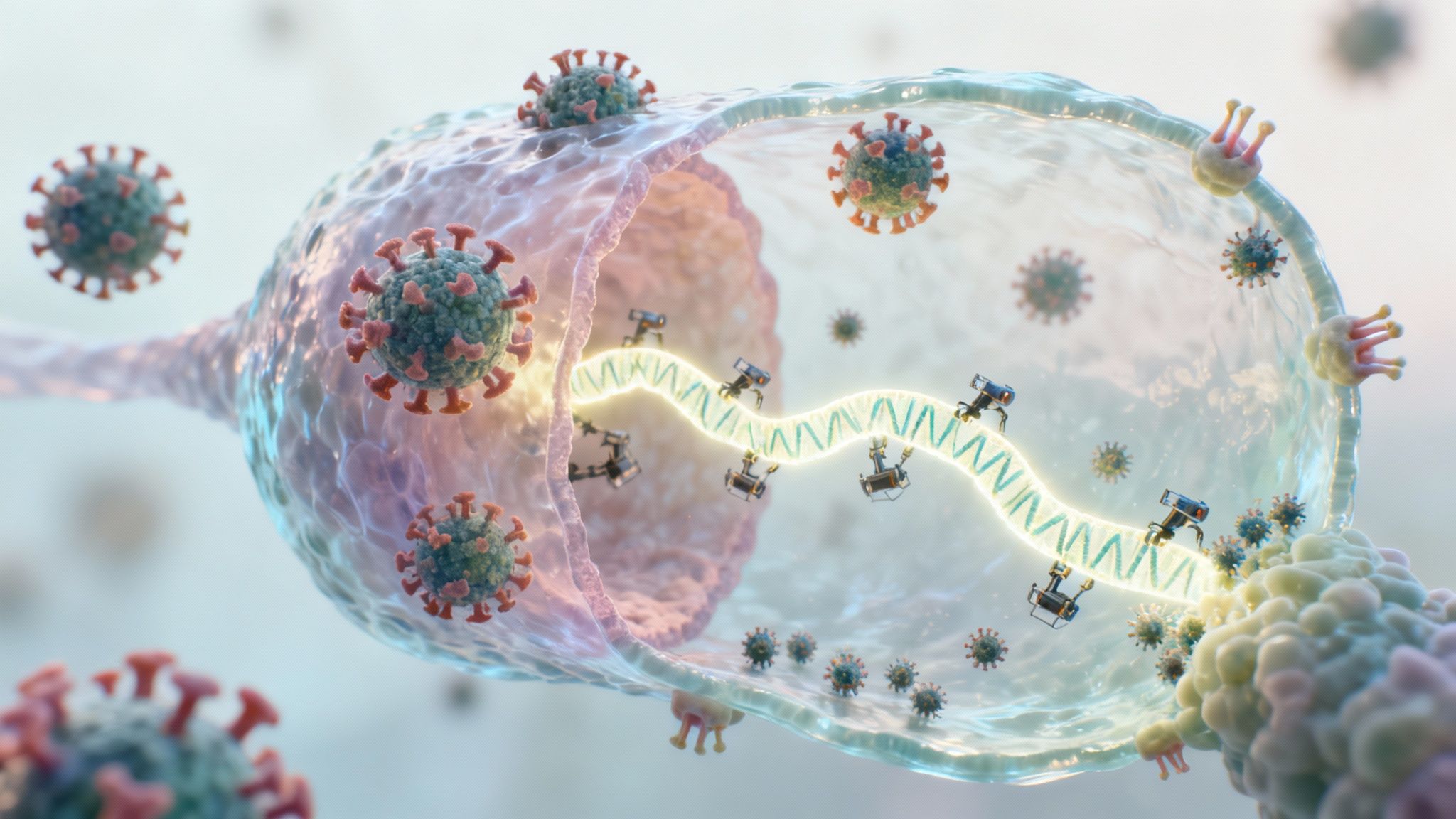
To understand how viruses multiply, picture them as microscopic hijackers. They lack the ability to build their own ships, so they must seize a fully equipped vessel—the host cell. Viruses are obligate intracellular parasites, a scientific term meaning they are completely helpless without a host. They must take over a cell's internal machinery to reproduce.
The Universal Strategy of Viral Replication
At its core, a virus is just a snippet of genetic code (DNA or RNA) wrapped in a protein shell. By itself, it’s completely inert. It can’t move, it can’t eat, and it certainly can’t make copies of itself. To activate, it needs to get inside a living cell.
This absolute dependency dictates every single move a virus makes. The whole process is a hostile takeover on a microscopic level. A virus must find the right cell, latch on, break in, and then release its genetic blueprints. We cover this initial break-in in our guide on how viruses infect cells.
Turning a Cell Into a Virus Factory
Once the viral genes are inside, they immediately reprogram the cell. The host cell is forced to abandon its normal functions—like producing energy or its own proteins—and focus on a single new task: building more viruses.
Its own machinery gets co-opted. The cell's ribosomes, enzymes, and raw materials are all put to work churning out thousands of copies of the viral genome and necessary protein parts. Think of it like a computer virus that doesn't just crash your machine but forces it to do nothing but manufacture more copies of the malicious code.
These freshly made viral parts are then assembled into new, complete viruses, ready to launch. Finally, these brand-new viral armies must escape the cell to infect others, starting the cycle all over again.
The core principle of viral replication is elegantly simple yet brutally effective: a virus hijacks the host cell's resources to create progeny, ensuring its own survival at the expense of the host.
This six-stage process is the universal playbook for all viruses, but different types add their own unique twists. Viruses like Influenza A Virus (H1N1), Human Immunodeficiency Virus Type 1 (HIV-1), and SARS-Related Coronavirus 2 (SARS-CoV-2) each use distinct tactics to pull off this cellular invasion. Understanding these six universal stages—from attachment to release—is the key to appreciating both the cleverness of these pathogens and the science we use to stop them.
To make it simple, here's a quick breakdown of the core steps every virus follows.
The Six Universal Stages of Viral Replication
| Stage | Description |
|---|---|
| Attachment | The virus locks onto specific receptors on the surface of a host cell. |
| Entry/Penetration | The virus or its genetic material gets inside the host cell. |
| Uncoating | The virus sheds its protective protein coat, releasing its genetic material. |
| Replication & Synthesis | The host cell's machinery is hijacked to copy the viral genome and build viral proteins. |
| Assembly | All the newly made viral parts are put together to create new virus particles. |
| Release | The new viruses exit the host cell, often killing it, and go on to infect more cells. |
From finding the right door to busting out with a new army, these six steps define the life of a virus.
A Closer Look: The Seven Stages of the Viral Life Cycle
To really understand how viruses work, you have to appreciate their method. It’s not a random attack; it's a systematic, step-by-step takeover of a host cell. Think of it less like a chaotic brawl and more like a crew of pirates executing a perfect plan to seize a ship.
This process, known as the viral life cycle, unfolds in seven distinct stages. Each step has a clear goal, all leading to one outcome: turning a healthy cell into a virus-making factory. Let's walk through how these microscopic hijackers pull it off.
Stage 1: Attachment – Making First Contact
Everything starts with attachment, sometimes called adsorption. A virus can't just infect any cell it bumps into. It has to find the right one.
This process is like a key fitting a specific lock. The virus uses proteins on its outer surface—its capsid or envelope—to bind to very specific receptor molecules on the host cell's membrane.
This is why certain viruses only infect certain species, or even just specific tissues. For instance, the SARS-Related Coronavirus 2 (SARS-CoV-2) uses its infamous spike protein to latch onto the ACE2 receptor, which is found all over cells in our respiratory tract. This first "handshake" is non-negotiable; without it, the invasion is a non-starter.
Stage 2: Penetration – Breaching the Walls
Once locked on, the virus has to get inside. This is the penetration stage, where it breaks through the cell's outer defenses. Viruses have a few clever tricks up their sleeves for this.
- Direct Fusion: Enveloped viruses like Human Immunodeficiency Virus Type 1 (HIV-1) and Herpes Simplex Virus 1 (HSV-1) can literally merge their outer membrane with the host cell's membrane. This allows them to dump their contents directly into the cell's cytoplasm.
- Endocytosis: Many others, including Influenza A Virus, trick the cell into swallowing them whole. The cell membrane wraps around the virus and pulls it inside in a little bubble called a vesicle.
This is the point of no return. Once inside, the virus is safe from the immune system and ready to start its hostile takeover.
Stage 3: Uncoating – Releasing the Blueprints
After sneaking in, the virus needs to release its "battle plans"—its genetic material. During the uncoating stage, the viral capsid breaks apart, freeing the viral DNA or RNA inside the host cell.
For some viruses, this happens right away in the cytoplasm. For others, like adenoviruses, it happens after the virus travels all the way to the cell's nucleus, its command center. The viral genome is now exposed and ready to be read.
Uncoating is the critical moment when the virus shifts from being an inert particle to an active infectious agent, poised to seize control of the cell.
This simple diagram shows the core process of this viral hijacking, from the initial attachment to the final release of new viral clones.

As you can see, it boils down to three key actions: find and attach, hijack the cell's machinery to replicate, and then break out to continue the cycle.
The Next Four Steps: From Blueprint to Army
With the viral genes free, the cell’s fate is pretty much sealed. The last four stages happen in quick succession, turning the cell into a production powerhouse.
- Replication & Gene Expression: The host cell's machinery is forced to copy the viral genome thousands of times. At the same time, the cell's enzymes transcribe the viral genes into messenger RNA (mRNA).
- Synthesis: The viral mRNA is translated into viral proteins using the cell's own ribosomes. The cell is now busy churning out all the parts needed for new viruses—capsid proteins, enzymes, and envelope spikes.
- Assembly: The newly made viral genomes and proteins start to self-assemble into new virus particles, called virions. It's like a tiny, automated assembly line building thousands of new viral soldiers from scratch.
- Release: Finally, it's time for the great escape. Non-enveloped viruses like Rhinovirus often cause the cell to burst open in a process called lysis, releasing all the new virions at once. Enveloped viruses, like influenza, typically exit via budding, wrapping themselves in a piece of the host cell’s membrane on the way out. Budding doesn't kill the cell immediately, allowing it to act as a factory for a longer, sustained release.
Each new virus is now armed and ready to find its own host cell, repeating this seven-stage cycle and amplifying the infection exponentially. Understanding these steps is the key to figuring out how we can throw a wrench in the works and stop viruses dead in their tracks.
Exploring Different Viral Replication Strategies
Once a virus breaches a cell's defenses, it doesn't just follow a single, universal battle plan. The specific strategy it uses to replicate is dictated entirely by its most fundamental component: its genetic material.
Think of the viral genome as the core software that runs the takeover. Whether that software is written in DNA or RNA determines exactly how the virus will command the host cell to make more of it.
To make sense of this diversity, scientists use a system called the Baltimore classification. This framework groups viruses into seven classes based on their genome type (DNA or RNA, single-stranded or double-stranded) and how they replicate it. This is key to understanding why different viruses behave so differently and, more importantly, how we can design specific ways to stop them.

DNA Viruses: The Nuclear Commandos
Viruses with DNA genomes, like Herpes Simplex Virus 1 (HSV-1) and Hepatitis B Virus (HBV), often take a more direct route. Their goal is to get their DNA into the host cell's nucleus—the cellular command center where all the host's own DNA is stored and read.
Once inside, these viruses can use the cell’s own enzymes—like DNA polymerase—to make copies of their viral DNA. The cell essentially treats the viral DNA just like its own, transcribing it into mRNA and then translating that mRNA into viral proteins. It's a clever, straightforward hijacking because the virus is using a system the cell already has in place.
- dsDNA Viruses (Double-stranded): Viruses like Herpes Simplex Virus 2 (HSV-2) and Adenovirus use this method. They integrate almost seamlessly into the cell's existing DNA-to-protein workflow.
- ssDNA Viruses (Single-stranded): These viruses, like parvoviruses, have an extra step. They must first use the host's machinery to create a complementary DNA strand, turning their genome into dsDNA before they can begin replication.
RNA Viruses: Masters of Cytoplasmic Warfare
RNA viruses are a completely different breed. Most of them have no interest in the cell’s nucleus. Instead, they set up shop right in the cytoplasm, the main body of the cell. This group includes some of our most well-known pathogens, such as Influenza A Virus, Hepatitis C Virus (HCV), and SARS-Related Coronavirus 2 (SARS-CoV-2).
Because our cells don't have a built-in mechanism to make RNA from an RNA template, these viruses have to bring their own special tools for the job. They carry the genetic code for an enzyme called RNA-dependent RNA polymerase (RdRp), which allows them to make copies of their RNA genome right there in the cytoplasm.
The ability of RNA viruses to replicate in the cytoplasm makes their life cycle incredibly fast and efficient. They bypass the nucleus entirely, quickly turning the cell into a production hub for new virions.
This rapid replication, however, comes with a trade-off: it’s often sloppy. The RdRp enzyme doesn't have the proofreading capabilities of DNA polymerases, which leads to a high rate of mutations. This is exactly why viruses like influenza and SARS-CoV-2 can evolve so quickly, creating new variants that constantly challenge our immune systems.
Retroviruses: The Ultimate Infiltrators
Then there are the retroviruses, a truly unique class of RNA viruses. The most infamous member of this group is the Human Immunodeficiency Virus Type 1 (HIV-1). Retroviruses carry out a remarkable form of genetic espionage.
Instead of copying their RNA directly, they do something completely backward—they reverse-transcribe it. They use a special enzyme they carry with them, called reverse transcriptase, to write a DNA copy of their RNA genome. This new piece of viral DNA is then escorted into the host cell's nucleus and permanently stitched into the host's own chromosomes.
Once integrated, this viral DNA—now called a provirus—becomes a permanent part of the cell's genetic code. It can lie dormant for years until activated, at which point the cell treats it like any of its own genes, producing viral RNA and proteins. This is what makes infections like HIV lifelong; the viral blueprint is literally written into the host's DNA.
Viral Genome Types and Their Replication Pathways
The table below breaks down these core strategies, showing how a virus's genetic starting point determines its path to replication.
| Genome Type | Example Virus | Key Replication Step |
|---|---|---|
| dsDNA | Herpes Simplex Virus 1 (HSV-1) | Viral DNA enters the nucleus and uses the host's DNA polymerase to replicate. |
| ssDNA | Parvovirus | Viral DNA is converted to double-stranded DNA in the nucleus before replication. |
| +ssRNA | SARS-Related Coronavirus 2 (SARS-CoV-2) | Viral RNA acts directly as mRNA for protein synthesis; copied by viral RdRp. |
| -ssRNA | Influenza A Virus (H1N1) | Viral RNA must first be transcribed into a positive-sense strand by viral RdRp. |
| dsRNA | Human Rotavirus | The viral RNA is transcribed into mRNA within the viral capsid by RdRp. |
| Retrovirus | Human Immunodeficiency Virus Type 1 (HIV-1) | Viral RNA is reverse-transcribed into DNA, which then integrates into the host genome. |
Each pathway represents a different evolutionary solution to the same problem: how to hijack a cell. Understanding these differences is fundamental to virology and the development of targeted antiviral therapies.
At the cellular level, replication is a complex battle. For RNA viruses like SARS-CoV-2, viral proteins clash with the host cell's defense systems, especially the interferon response. Research shows that in severe SARS-CoV-2 infections, an impaired interferon response is linked to worse outcomes.
By June 2021, SARS-CoV-2 had caused over 180 million infections and 3.9 million deaths worldwide, with these individual immune variations playing a huge role in mortality. For comparison, seasonal influenza causes between 290,000 to 650,000 deaths globally in a typical year. This stark difference highlights just how much a virus's replication strategy can impact public health.
Viral Replication in Action: Three Case Studies
The textbook stages of viral replication give us a solid blueprint, but the real story is in how different viruses put those steps into practice. To truly get a feel for this, we need to look at a few notorious examples in action.
Let's break down the unique playbooks of three major league pathogens: Influenza A Virus, Human Immunodeficiency Virus Type 1 (HIV-1), and SARS-Related Coronavirus 2 (SARS-CoV-2). Each one has a distinct strategy that makes it such a formidable threat to human health.
Seeing how these viruses operate in the real world connects their replication mechanics to the diseases they cause. It also highlights why simple hygiene is so powerful. For enveloped viruses like these, a good disinfectant wipe can shred their protective outer layer, making it impossible for them to attach to a host cell. The whole cycle stops before it can even start.
Influenza A Virus: The Master of Disguise
Influenza is a negative-sense, single-stranded RNA (-ssRNA) virus, but its most defining feature is a clever trick up its sleeve: a segmented genome. Instead of having one long ribbon of RNA, its genetic code is chopped up into eight separate segments. This detail is the secret to its incredible ability to adapt and evade our immune systems.
Once influenza gets inside a respiratory cell, it uses its own viral enzyme to make positive-sense copies of each of the eight segments. These copies pull double duty—some act as mRNA to build viral proteins, while others serve as templates to create new negative-sense genomes for the next generation of viruses.
But the real magic happens when two different flu strains, like Avian Influenza Virus (H5N1) and a human strain, infect the same cell at the same time. During assembly, the eight RNA segments from each virus can get mixed and matched, creating a completely new hybrid virus. This process is called antigenic reassortment (or antigenic shift). Think of it like taking parts from two different cars to build a third, unrecognizable model. This is exactly how pandemic flu strains are born, catching our immune systems completely off guard.
Influenza's segmented genome is its greatest weapon. It allows for rapid evolution through antigenic shift, creating novel strains that can evade population immunity and cause widespread pandemics.
This constant potential for reinvention is why we need a new flu shot every single year. The virus is a moving target, perpetually changing its disguise to outsmart our defenses.
Human Immunodeficiency Virus Type 1 (HIV-1): The Permanent Resident
HIV-1 is a retrovirus, and its replication strategy is one of the most insidious known to science. As an RNA virus, it carries its genetic code in RNA, but its ultimate goal is to become a permanent, inseparable part of the host’s own DNA.
To pull this off, it brings a special tool with it: an enzyme called reverse transcriptase.
After entering a host cell (usually a crucial immune cell like a T-helper cell), HIV uses reverse transcriptase to rewrite its single-stranded RNA genome into a double-stranded DNA copy. This is the complete opposite of how our cells normally work, which is why it's called a "retrovirus."
This newly minted viral DNA is then escorted into the cell's nucleus, where another viral enzyme called integrase stitches it directly into the host's chromosomes. Once it's in, this viral DNA—now called a provirus—is a permanent fixture. It can lie dormant for years, hiding in plain sight from the immune system.
When activated, the host cell’s own machinery reads the provirus just like any other gene, cranking out the viral RNA and proteins needed to assemble new HIV particles. This permanent integration is why HIV infection is lifelong; the virus is literally written into our cells.
SARS-Related Coronavirus 2 (SARS-CoV-2): The Efficient Invader
SARS-CoV-2, the virus behind the COVID-19 pandemic, is a positive-sense, single-stranded RNA (+ssRNA) virus. Its strategy is a masterclass in speed and efficiency, driven by its genomic structure and its infamous spike protein.
Because it's a +ssRNA virus, its genome can be read directly by the host cell's ribosomes—it's essentially "plug-and-play." As soon as the virus uncoats, the cell's machinery starts making viral proteins immediately, no extra steps needed. One of the very first things it builds is its own replication enzyme, RNA-dependent RNA polymerase (RdRp).
The virus then hijacks parts of the cell's internal membranes to build protected replication "factories." Inside these bubbles, it can churn out thousands of copies of its RNA genome at an astonishing rate. But this rapid, high-volume process is messy and prone to errors, which leads to a high mutation rate.
We saw this play out in real-time early in the pandemic. Between January 2020 and March 2021, researchers tracked new mutations by analyzing over 383,500 complete SARS-CoV-2 RNA sequences. While only about 10 mutations were common by April 2020, that number skyrocketed to between 77 and 100 by January 2021—a trend seen across 10 different countries. You can read more about how this rapid evolution affected vaccination efforts and learn about the study findings.
This ability to evolve on the fly is precisely why we saw the emergence of new variants like Alpha, Delta, and Omicron, each with slightly different traits affecting how it spread and how sick it made people.
How We Interrupt the Viral Replication Cycle
Mapping out the intricate steps of viral replication isn't just a science project—it's the blueprint for modern medicine and public health. Every stage of a virus's life cycle, from that first grab onto a host cell to its final escape, presents a potential weak point. By targeting these moments, we can design powerful ways to stop an infection cold.
This knowledge is behind everything from cutting-edge antiviral drugs to the simple, life-saving act of using disinfecting wipes. The goal is always the same: throw a wrench in the viral machinery before it builds momentum.

Antiviral Drugs as Precision Tools
Think of antiviral medications as tiny, highly specialized tools. They’re designed with incredible precision to jam a single, critical step in a specific virus's game plan. These aren't broad-spectrum sledgehammers; they’re more like a key designed to break off inside one particular lock.
Take Human Immunodeficiency Virus Type 1 (HIV-1), for example. Some of the most effective drugs against it are entry inhibitors. These molecules physically block the virus from fusing with our T-cells, stopping the attachment and penetration stages right at the door. If the virus can't get in, the game is over.
Other drugs target different steps. For the Influenza A Virus, a well-known class of drugs called neuraminidase inhibitors sabotages the very last step: release. They prevent newly made flu viruses from cutting themselves free from the host cell, trapping them and stopping the infection from spreading. You can dive deeper into these mechanisms in our guide on how antiviral drugs work.
Vaccines: Your Body's Proactive Defense
Vaccines get ahead of the problem by training your own immune system to be the disruptor. They work by introducing a harmless piece of a virus—like the spike protein of SARS-CoV-2—to your body. This gives your immune system a chance to study the enemy's uniform and develop a specific counter-attack.
In response, your body produces antibodies perfectly shaped to recognize and bind to that viral protein. When the real virus shows up later, those antibodies are already on patrol.
A vaccine essentially gives your immune system a "most wanted" poster for a virus. It learns to recognize the intruder on sight and neutralize it before it can even complete the first stage of replication: attachment.
By swarming the virus and coating its surface proteins, antibodies physically block it from latching onto your cells. This pre-emptive strike neutralizes the threat before the viral life cycle can even get started, offering one of our most powerful forms of protection.
Physical Disruption: The Power of Disinfection
While antivirals and vaccines are sophisticated biological weapons, we can also stop viral replication with much simpler, physical methods. This is where basic hygiene—like washing your hands and using disinfectants—becomes a critical line of defense. These actions don't target a complex biological process; they attack the virus’s very structure.
This approach is especially effective against enveloped viruses, a group that includes many of our most common adversaries:
- Influenza viruses (Influenza A Virus H1N1, H5N1)
- Coronaviruses (SARS-Related Coronavirus 2)
- Herpes Simplex Viruses (HSV-1, HSV-2)
- Hepatitis B and C (HBV, HCV)
- Human Immunodeficiency Virus Type 1 (HIV-1)
These viruses are all wrapped in a delicate outer layer made of lipids—a fatty membrane. This envelope is studded with the very proteins the virus needs to attach to a host cell.
Soaps and alcohol-based disinfectants are brilliant at dissolving fats. When you wash your hands or wipe a counter with a disinfecting wipe, you are physically shredding this protective envelope. Without it, the virus is crippled. Its attachment proteins are lost, leaving it unable to bind to or enter a host cell. The chain of infection is broken right there, stopping replication before it even has a chance to begin. For small non-enveloped viruses like Norovirus or Rhinovirus, while more resilient, proper disinfection is still crucial for reducing their presence on surfaces.
Frequently Asked Questions About Viral Replication
Once you start digging into how viruses work, a lot of questions come up. It's one thing to know the steps, but another to understand what it all means in the real world. Here are some clear, straightforward answers to the most common questions we hear.
Why Can't Viruses Replicate on Their Own?
Think of a virus as the ultimate minimalist—it's basically just a blueprint (DNA or RNA) inside a protective shell. It's missing all the essential machinery for life. There are no ribosomes to build proteins, no mitochondria to generate energy, and no way to make copies of itself.
To get anything done, a virus has to hijack a living host cell and take over its internal factory. Without a host, a virus is just an inert particle, completely dormant until it finds a cell to invade.
How Quickly Do Viruses Replicate?
The speed of viral replication varies wildly depending on the virus. Some are incredibly fast. The influenza virus, for example, can force a single cell to pump out thousands of new viral particles in just a handful of hours.
Others, like HIV-1, have a more complicated and sometimes slower cycle. A huge factor in this speed is how well the host's immune system fights back and tries to shut down the viral takeover.
This reproductive speed is a critical number in public health. For SARS-CoV-2, scientists used the basic reproduction number (R0) to estimate how many people one infected person would likely infect. A review of 29 different R0 calculations landed on a mean estimate of 3.32, which shows just how efficient that virus was at replicating and spreading. You can dive deeper into how these numbers help understand the spread of viruses on cebm.net.
Viral replication isn't just about making copies; it's a numbers game. The faster a virus can multiply, the better its odds of overwhelming the host’s defenses and spreading to the next person.
Does the Host Cell Always Die After Replication?
Most of the time, yes—but not always in the same way. The fate of the host cell really depends on how the new viruses make their exit.
-
The Explosive Exit (Lysis): In this classic scenario, the cell becomes so packed with new viruses that it literally bursts open. This process, called lysis, kills the cell instantly and unleashes a flood of viral particles all at once. Viruses like Norovirus and Rhinovirus Type 14 often use this method.
-
The Sneaky Escape (Budding): Enveloped viruses like influenza and HIV often take a stealthier approach. New viruses exit one by one, wrapping themselves in a small piece of the host cell's membrane as they leave.
While budding still damages the cell and eventually leads to its death, it allows for a slower, more sustained release of viruses. This effectively turns the infected cell into a long-term factory, continuously churning out new particles to spread the infection over time.
Leave a Reply