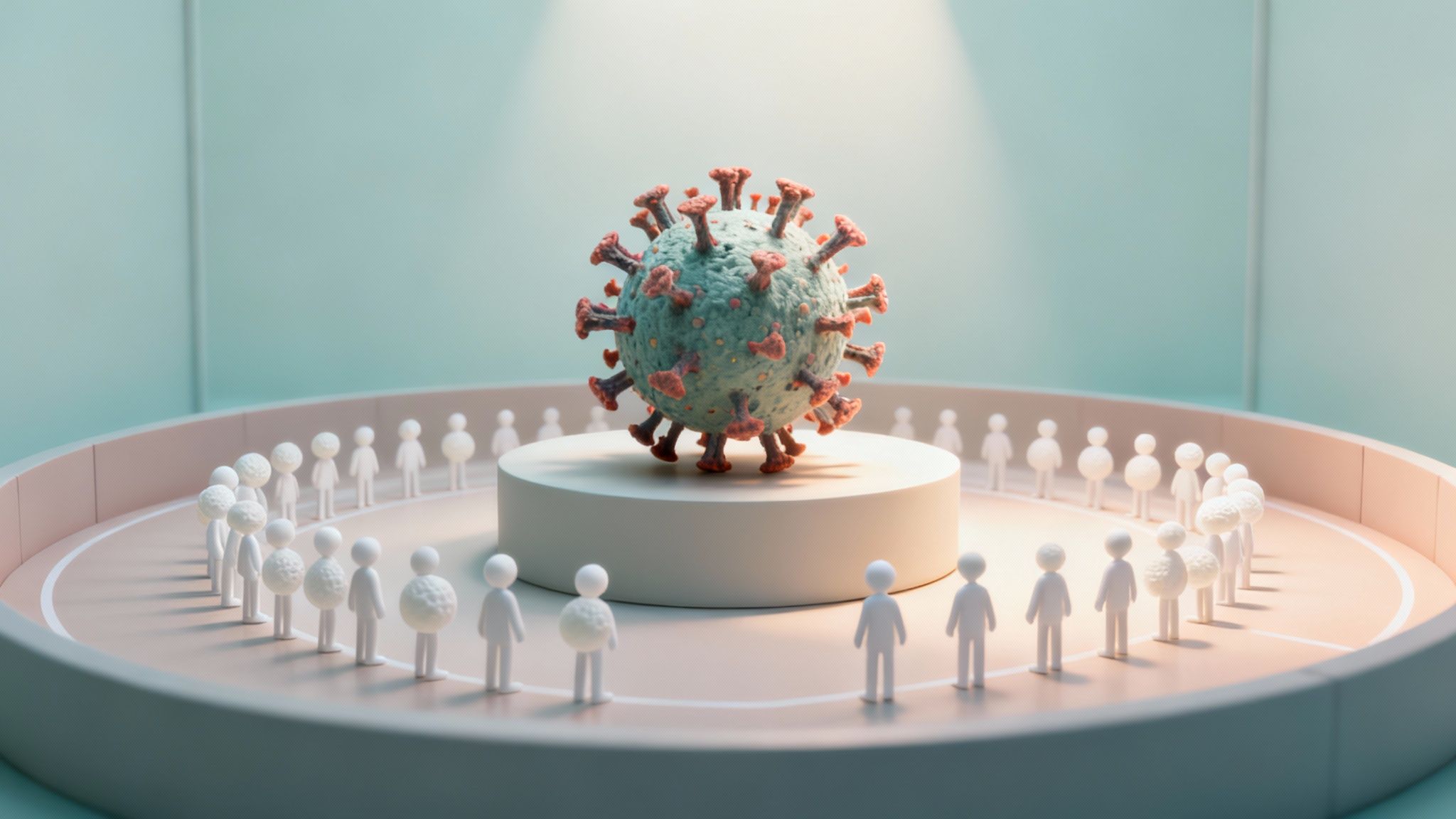
Live attenuated vaccines are one of our most powerful tools in public health. They work by introducing a live but weakened version of a virus or bacterium into your body. This deliberately hobbled germ can't cause serious illness, but it's just active enough to kick your immune system into high gear.
The result? You build strong, long-lasting immunity, almost as if you'd recovered from the actual infection, but without having to get sick first.
Understanding What Live Attenuated Vaccines Are
Think of it like a training simulation for your immune system. Instead of throwing a rookie pilot into a real dogfight, you put them in a flight simulator. The experience feels real and teaches them all the right moves, but there's no actual danger.
That's exactly what a live attenuated vaccine does. It contains a "tamed" version of a pathogen that can still multiply a little. This controlled, limited replication is the key—it gives your body a full-scale rehearsal for fighting off the real enemy, allowing it to build a robust defense system of antibodies and memory cells.
Here's the basic idea:
- Live but Weakened: The pathogen is alive, but it’s been modified in a lab to be far less powerful.
- Mimics Natural Infection: The vaccine prompts a response that's incredibly similar to what would happen if you were naturally infected, leading to powerful, long-term protection.
- Builds Immune Memory: Just one or two doses are often enough to create a lasting memory, so your body is ready to pounce if it ever encounters the real pathogen.
A High-Stakes Training Ground for Your Immune System

The global reliance on these vaccines speaks volumes about their effectiveness. The market for live attenuated vaccines was valued at around USD 28.97 billion in 2024 and is projected to hit USD 32.17 billion by 2025. Experts predict it will continue growing at a CAGR of 11.05%, reaching nearly USD 82.63 billion by 2034.
A live attenuated vaccine is the closest thing we have to the immunity you'd get from a natural infection, but it achieves it safely.
Live Attenuated Vaccines At a Glance
For a quick summary, this table breaks down the core features of these remarkable vaccines.
| Characteristic | Description |
|---|---|
| Pathogen Type | A live version of a virus or bacterium that has been intentionally weakened. |
| Immune Response | Triggers a strong and comprehensive immune reaction, involving both antibodies and T-cells. |
| Dosing | Usually just one or two doses provide lifelong or very long-term immunity. |
This powerful response is why these vaccines have been so successful at controlling devastating diseases for decades.
What This Guide Covers
To really understand how these vaccines work, we need to peel back the layers. In this guide, we're going to break it all down.
We'll look at:
- The clever methods scientists use to weaken pathogens.
- How our immune system builds such a durable memory from these vaccines.
- Real-world examples you've probably heard of, like the MMR and chickenpox vaccines.
- The balance of benefits, potential risks, and their massive impact on public health.
This foundational knowledge is crucial, as it builds on a legacy of groundbreaking successes like the original vaccines for yellow fever and smallpox. These early triumphs demonstrated the sheer power of this approach, paving the way for a century of disease control.
Our goal here is to give you clear, practical information, much like you'd find in other comprehensive patient education resources.
Next up, we’ll dive into specific examples to see these principles in action.
How Do You Weaken a Bug Without Killing It?
Creating a live attenuated vaccine is a bit like taming a wild animal. The goal is to weaken a virus or bacterium just enough so it can’t make you sick, but it's still "alive" enough to give your immune system a serious workout. This delicate balancing act is called attenuation.
For decades, the classic method was surprisingly low-tech. Scientists would take a "wild" pathogen and force it to grow in an unfamiliar place, like inside chicken eggs or animal cells in a lab. Think of it as sending the pathogen to a foreign country where it has to learn a new language and new customs to survive.
They repeat this process over and over, sometimes for hundreds of generations. Each time the pathogen is transferred to a new culture of cells, it adapts a little more to its new home. For example, a virus might be passed through a long series of chicken embryo cells.
As it gets better at living in chicken cells, it loses its knack for causing trouble in human cells. The pathogen essentially becomes "domesticated." It’s still recognizable to our immune system, but it has lost the aggressive traits needed to cause a full-blown infection. This old-school technique is how we got some of our most important vaccines, including the ones for measles and mumps.
The Traditional Method: Survival of the Weakest
This classic approach boils down to a process called passaging—basically, moving the pathogen from one cell culture to the next, again and again.
- Step 1: Pick a New Home. Researchers select a non-human host, like chicken embryo or monkey kidney cells. The pathogen can grow there, but it’s not a perfect environment for it.
- Step 2: Force It to Adapt. The pathogen is grown in these cells and then a small sample is transferred to a fresh batch. This cycle is repeated dozens or even hundreds of times.
- Step 3: Let Nature Take Its Course. Tiny genetic mutations happen naturally over time. The versions of the pathogen that are better at surviving in the new environment start to dominate.
- Step 4: Create a "Tamed" Strain. The mutations that helped the pathogen thrive in animal cells end up making it much weaker in humans. The result is a safe, attenuated strain that’s ready to be used in a vaccine.
Modern Genetic Engineering: A More Precise Approach
While the traditional method works, it’s a bit of a guessing game and can take a very long time. Today, scientists have much more precise tools at their disposal. Using modern genetic engineering, they can weaken a pathogen with surgical precision in a process known as reverse genetics.
Instead of waiting for random mutations, scientists can go straight into the pathogen's genetic code. They can pinpoint the exact genes that make it dangerous—its virulence genes—and simply delete or tweak them.
You can think of it as a form of genetic surgery. Scientists carefully remove the harmful parts of the pathogen while leaving all the important signals that our immune system needs to see and remember.
Take the Influenza A Virus (H1N1), for instance. Researchers can now target and alter the specific genes that allow it to replicate so quickly in our lungs. This creates a weakened version that is far more predictable and controlled, paving a much faster and more reliable path to developing the next generation of live attenuated vaccines against viruses like Influenza A, Hepatitis C Virus (HCV), and even SARS-Related Coronavirus 2 (SARS-CoV-2).
Unlocking a Powerful Immune Response
The real magic of a live attenuated vaccine is how it mimics a natural infection, essentially putting your immune system through a full-scale training exercise. Because the weakened pathogen can still multiply a little bit, it presents a far more realistic "threat" than a completely inactivated (killed) virus. This realism is the secret to building a powerful and lasting defense.
Think of it as a sophisticated, two-pronged counter-attack. The moment the weakened virus is detected, your immune system’s most elite units are deployed to handle the situation.
This process is what makes these vaccines so effective.

The infographic breaks down the core idea: a harmful pathogen is scientifically hobbled, then used in a vaccine to teach the body how to fight it off without causing real disease.
The Two Pillars of Your Immune Defense
The first wave of defense comes from your B-cells. These are your body’s intelligence operatives. They identify the weakened intruder and immediately start producing highly specific "wanted posters" called antibodies. If you're curious about the details, you can learn more in our guide on antibodies and antigens. These antibodies then patrol your system, ready to tag and neutralize the real deal if it ever shows up.
At the same time, a second, more direct response kicks in. This is where your T-cells come into play—they’re the special forces. Certain T-cells are trained to hunt down and eliminate any of your own body's cells that have been compromised by the virus, stopping the infection right where it starts.
It's this coordinated attack—using both B-cells and T-cells—that really sets live attenuated vaccines apart. They don’t just create antibodies; they build a multi-layered defense system that remembers the enemy for years, often for a lifetime.
This dual-action strategy stimulates both humoral (antibody-based) and cell-mediated (T-cell-based) immunity, making these vaccines incredibly effective. They work against a whole range of diseases, from bacterial infections—which make up about 56% of global cases preventable by vaccines—to viral illnesses like measles, mumps, and chickenpox. It’s this comprehensive immune training that’s the secret behind their durable, long-lasting protection.
Common Examples in Modern Medicine
All this science about weakening viruses feels a bit abstract until you realize you’ve probably encountered these vaccines firsthand. They’re the workhorses of modern immunization schedules, protecting millions of people from diseases that were once terrifyingly common.
Think of them as a controlled fire drill for your immune system. By looking at a few real-world examples, you can see just how powerful this technique is.
The MMR Vaccine (Measles, Mumps, and Rubella)
If there’s one live attenuated vaccine almost everyone has heard of, it’s the MMR vaccine. This single shot protects against three viral illnesses that used to be a standard, and often dangerous, part of childhood.
- Measles: A super-contagious virus that isn't just about a rash. It can lead to serious complications like pneumonia and even brain swelling.
- Mumps: Famous for causing puffy, swollen cheeks, mumps can also trigger more severe problems like meningitis.
- Rubella (German Measles): While typically mild in kids, a rubella infection in a pregnant woman can cause devastating birth defects in her baby.
The MMR vaccine contains weakened, live versions of all three of these viruses. Before it was introduced in the 1970s, getting measles was practically a rite of passage for kids. Today, thanks to the vaccine, these diseases are rare in many parts of the world.
Other Widespread Live Attenuated Vaccines
The MMR shot is in good company. Several other essential vaccines use the same “tamed but alive” approach to train our bodies to fight off nasty invaders, especially in young children who are most at risk.
Live attenuated vaccines (LAVs) represent a critical segment of the global vaccine market. This vaccine category includes products for the prevention of diseases like measles, mumps, rubella, influenza, chickenpox, yellow fever, and rotavirus. Discover more about the vaccine market landscape.
Here are a few other key players:
-
Varicella (Chickenpox) Vaccine: Before this vaccine came along in 1995, chickenpox was an itchy, miserable, and almost unavoidable part of growing up. Sometimes, it led to nasty skin infections or pneumonia. The live attenuated varicella vaccine has all but wiped it out in vaccinated populations.
-
Rotavirus Vaccine: Rotavirus, which includes viruses like Human Rotavirus, is a primary culprit behind severe, dehydrating diarrhea in infants and toddlers worldwide. Given orally, the rotavirus vaccine introduces a weakened form of the virus to the gut, providing critical protection when children are most vulnerable.
-
Nasal Spray Flu Vaccine (LAIV): Not a shot! The live attenuated influenza vaccine is a nasal spray containing weakened flu viruses, including strains like Influenza A Virus (H1N1). It’s designed to kickstart an immune response right where the virus tries to enter the body—in the nose and throat.
To really get a feel for how these vaccines work, it helps to see them side-by-side with their counterparts: inactivated, or "killed," vaccines.
Comparing Live Attenuated vs. Inactivated Vaccines
| Feature | Live Attenuated Vaccines | Inactivated Vaccines |
|---|---|---|
| Pathogen State | Weakened (attenuated), but still alive and can replicate | Killed (inactivated) with heat or chemicals; cannot replicate |
| Immune Response | Strong and long-lasting; mimics natural infection, often provides lifelong immunity | Weaker response; often requires multiple doses and boosters to maintain immunity |
| Type of Immunity | Generates both antibody (humoral) and T-cell (cellular) immunity | Primarily generates an antibody (humoral) response |
| Administration | Usually requires just one or two doses | Typically requires multiple initial doses plus regular boosters |
| Safety | Extremely safe, but not recommended for people with weakened immune systems | Safe for almost everyone, including immunocompromised individuals |
| Examples | MMR (Measles, Mumps, Rubella), Chickenpox, Rotavirus, Nasal Flu Spray | Inactivated Polio, Hepatitis A, Rabies, most standard Flu Shots |
Each type of vaccine has its place. The choice depends on the disease we’re fighting, the strength of the immune response we need, and who is receiving the vaccine. Live attenuated vaccines are amazing for building robust, long-term immunity, while inactivated vaccines offer a safer option for more vulnerable populations.
Understanding the Benefits and Risks
When we talk about any medical tool, a clear and balanced conversation is crucial for building trust. Live attenuated vaccines are incredibly powerful, but just like any other medical intervention, they come with a specific set of pros and cons. Understanding this balance is the key to appreciating their role in public health.
The biggest benefit is their unmatched ability to provide strong, durable, and often lifelong immunity. Because they mimic a natural infection so well, they usually only require one or two doses to create a lasting immune memory. That kind of long-term protection is a total game-changer for controlling infectious diseases.
The Power of a Robust Immune Response
The main advantage comes from the comprehensive immune reaction they kickstart in your body. Unlike some other vaccine types that mostly focus on stimulating antibody production, live attenuated vaccines trigger a two-pronged attack. They get both B-cells (the antibody factories) and T-cells (the infected-cell destroyers) involved.
This full-spectrum training exercise for your immune system leads to some serious benefits:
- Long-Lasting Protection: Immunity is often for life, which means no need for frequent boosters for diseases like measles and mumps.
- High Effectiveness: Because they imitate a real infection so closely, they provide a very high degree of protection. You can learn more about how this is measured in our detailed guide on what vaccine efficacy means.
- Rapid Immunity: A strong immune response can develop pretty quickly after you get the shot.
Important Safety Considerations
However, because these vaccines contain a live (though seriously weakened) organism, there are a few important things to keep in mind. The very thing that makes them so effective—their ability to replicate—is also the source of their main limitation.
For the vast majority of people with healthy immune systems, this tiny amount of replication is completely harmless. It just serves to train the body. The weakened bug is easily controlled and cleared out.
The central trade-off is clear: live attenuated vaccines offer exceptionally strong and durable immunity but require a competent immune system to safely manage the weakened pathogen.
This is why they are typically not recommended for certain individuals. This includes:
- People with compromised immune systems (also known as immunocompromised).
- Individuals undergoing treatments like chemotherapy that suppress the immune system.
- Pregnant women, which is a precautionary step to protect the developing fetus.
For these groups, an immune system that’s already working overtime might not be able to effectively control even a tamed pathogen. This poses a small but serious risk of the vaccine actually causing illness. In these specific cases, doctors will recommend safer alternatives, like inactivated vaccines.
For most of the population, however, the benefits of the powerful protection offered by live attenuated vaccines are simply overwhelming.
A Two-Layer Strategy for Total Protection

Live attenuated vaccines are an incredible tool, essentially building an internal security force inside your body. They train your immune system to recognize and neutralize specific invaders like measles or mumps, giving you a powerful, always-on defense. This is your first and most important layer of protection.
But a truly solid health strategy doesn't stop there. It’s not just about being ready for a fight; it's about avoiding the fight altogether. This is where external hygiene comes in, creating a crucial second layer of defense against germs in your environment.
Combining Internal and External Defenses
Think of it like this: your vaccine gives you a well-trained army, while good sanitation builds a fortress wall around you. One protects you from the inside, the other from the outside. Both are essential.
Viruses like Human Coronavirus, Norovirus (Norwalk Virus), and Rhinovirus Type 14 are sneaky. They can survive on everyday surfaces for hours, or in some cases, even days. All it takes is touching a contaminated doorknob, phone, or countertop to pick them up. Even more robust viruses, like Feline Calicivirus, a stand-in for norovirus in many lab settings, demonstrate just how persistent these threats can be.
Combining internal immunity from vaccination with external protection through sanitation offers a powerful, two-pronged approach to safeguarding your health.
When these two layers work together, you create a formidable barrier against infection. Your internal "army" is always on alert, but by cleaning up the environment, you reduce the number of enemies that ever make it to your fortress gates.
Practical Steps for a Safer Environment
Routinely disinfecting high-touch surfaces is one of the simplest and most effective ways to break the chain of transmission. You're taking germs out of the equation before they even have a chance to get inside your body.
A complete game plan looks like this:
- Vaccination: Build that strong, long-term internal immunity against major diseases.
- Surface Disinfection: Regularly wipe down germ hotspots where viruses love to hang out.
- Hand Hygiene: Wash your hands often and thoroughly with good old soap and water.
This combined strategy is hands-down the best way to protect yourself and those around you. For more actionable tips, check out our guide on how to protect yourself from viruses.
Answering Your Questions
Once you get a handle on the science, a few common questions usually pop up about live attenuated vaccines. Let’s clear up some of the most frequent ones.
Can a Live Attenuated Vaccine Actually Give Me the Disease?
For anyone with a healthy, functioning immune system, the risk is practically zero. The germs in these vaccines are intentionally weakened so they can’t cause a full-blown illness.
You might feel a little off—maybe a low fever or some mild aches—but that’s actually a good sign. It means your immune system is awake, learning, and building its defenses. The chance of the vaccine causing the actual disease is tiny compared to the very real dangers of getting sick from a natural infection.
Why Can't People with Weak Immune Systems Get These Vaccines?
It all comes down to a person's ability to fight back. An immunocompromised person’s immune system might not be strong enough to handle even a weakened germ. For them, there's a small but serious risk that the live virus or bacterium could multiply enough to cause illness.
This is why doctors are so careful. They recommend safer alternatives, like inactivated vaccines, for anyone with specific health conditions. The goal is to make sure everyone gets the right kind of protection for their body.
The core principle here is safety first. The type of vaccine recommended is always matched to the individual's health status to maximize protection while minimizing risk.
How Long Does the Protection Last?
This is where live attenuated vaccines really shine: they offer incredibly long-lasting immunity.
Because they mimic a real infection so well, they create a durable "memory" in your immune system. For many of these vaccines, like the ones for MMR (measles, mumps, and rubella) and chickenpox, the protection is considered lifelong after you’ve had all the recommended doses. This lasting power is a huge reason they’ve been so successful in controlling—and in some cases, nearly eliminating—devastating diseases.
Leave a Reply