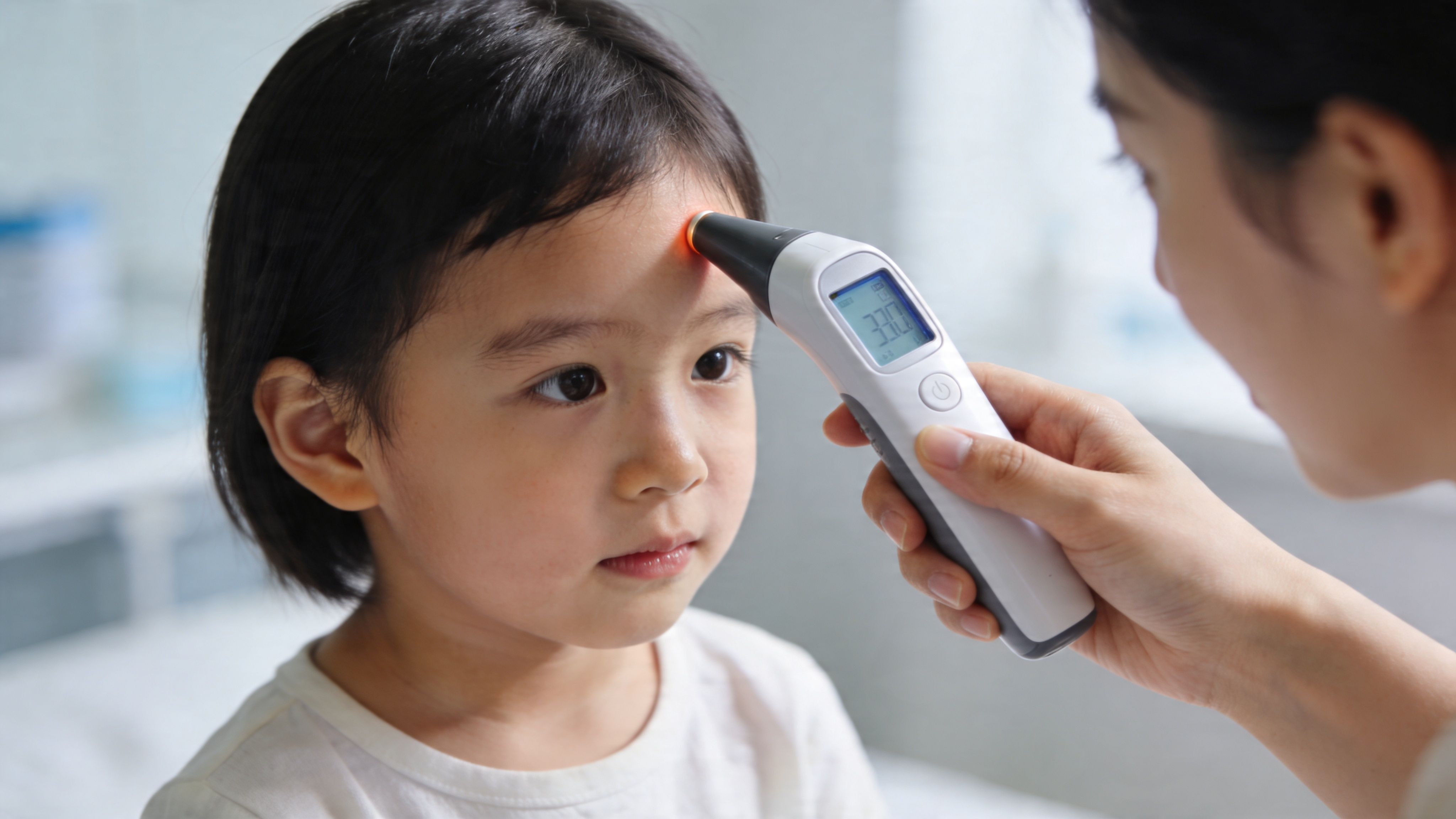
A child wakes up hot and glassy-eyed at 2 a.m. You don't want to turn on bright lights, wrestle with an uncomfortable thermometer, or guess whether this is a mild overnight virus or the start of something that needs a call to a clinician. So you reach for the forehead scanner.
That moment is why people care so much about the accuracy of temporal thermometers. A temperature reading isn't just a number. It often decides whether someone stays home, gets checked again in an hour, isolates from others, or seeks urgent care. Fever can be an early signal in viral illnesses, and it's one of the symptoms families watch most closely alongside the signs covered in this common virus symptoms guide.
Temporal thermometers are popular because they're fast, easy, and far less disruptive than rectal or oral methods. But convenience creates a reasonable question. Can you trust the reading enough to act on it? The best answer is nuanced. In some settings, these thermometers are very useful. In others, they can miss fevers or give a reading that needs confirmation.
The Search for a Fast and Accurate Temperature
A lot of families buy a temporal thermometer for one reason. It lets them check a sleeping child without waking them up. In clinics, nurses use them because they speed up intake and reduce discomfort. In both places, the same tension shows up. People want something that's quick and gentle, but they also need a reading they can rely on.

That tension matters most during viral illness. Fever often drives the next decision. Do you monitor at home? Call a pediatrician? Keep a child out of school? Put more distance between a sick family member and a grandparent? If the reading is wrong, every downstream choice can drift off course.
Why the question matters
A temporal thermometer doesn't need body-fluid contact, and that's a major advantage when someone is tired, fussy, or contagious. But "easy to use" isn't the same as "always precise." A screening tool can still be useful even if it isn't the best confirmatory tool.
Practical rule: A forehead reading is often a good first check. It shouldn't be your only answer when the result doesn't match how sick the person looks.
Parents often get confused because they hear two messages at once. One person says temporal thermometers are accurate and modern. Another says only core methods count. Both contain some truth. The key is understanding when the method performs well, when it struggles, and when to double-check.
How Temporal Thermometers Scan for Fever
A temporal artery thermometer is basically reading heat from blood flowing through the superficial temporal artery, which runs across the forehead. That artery is useful because it reflects internal body heat more closely than random skin surface temperature does.
Think of the device as a tiny thermal camera aimed at a blood vessel rather than at the whole forehead. It doesn't just take one snapshot. It samples rapidly while you move it across the skin, then uses its internal programming to decide which signal most likely reflects body temperature.

What the sensor is actually doing
Technical descriptions can sound intimidating, so it helps to simplify them. The thermometer's sensor detects infrared heat coming off the skin over the artery. It then picks out the hottest area in that scan path.
A clinical report from Lehigh Valley Health Network notes that TAT infrared sensors scan the superficial temporal artery at 2 to 3 mm depth and at 1000+ Hz, averaging peak vascular signals to minimize motion artifacts, while also noting that for infants, TAT exceeds tympanic accuracy and tolerance over rectal methods in the summarized evidence from that report's discussion of published literature (Lehigh Valley Health Network clinical report).
That sounds abstract, but the takeaway is simple:
- It samples fast. Rapid sampling helps when the person moves.
- It tracks an artery, not just skin. That's why it can approximate internal temperature better than a plain surface scan.
- It uses the warmest relevant signal. The thermometer tries to avoid being fooled by cooler surrounding skin.
Why technique still matters
Even good technology depends on how you use it. If hair blocks the scan path, if the forehead is sweaty, or if the device isn't moved correctly, the signal can shift. The thermometer can only work with the heat data it captures.
A temporal thermometer isn't measuring "the forehead" in a broad sense. It's trying to measure heat over a specific blood vessel.
That distinction clears up a common misunderstanding. People sometimes think all forehead thermometers work the same way. They don't. A temporal artery thermometer uses contact scanning over an artery. A non-contact forehead device reads surface heat from a short distance away. Those methods are related, but they aren't interchangeable.
What Clinical Studies Say About Accuracy
A parent checks a sleepy child with a forehead scanner and gets a number that looks reassuring. A nurse repeats the temperature with a rectal or oral method and gets a different answer. Both readings can be real measurements. They are just measuring heat from different places, with different levels of agreement to core temperature.

Clinical studies show a pattern rather than a simple verdict. Temporal thermometers are often close enough to be useful for screening and routine checks. They are less dependable when a small difference changes the decision, such as confirming fever in a young child, evaluating a frail older adult, or making treatment choices near a threshold.
What the larger evidence base found
One helpful way to read this research is to separate average performance from individual misses. A 2018 meta-analysis reviewing 159 studies found that temporal artery thermometers had a pooled mean difference of 0.25°C from core temperatures, yet they did not meet the clinical benchmark of staying within ±0.5°C of core temperature 95% of the time, which rectal thermometers did meet. The same evidence summary also described a 2012 pediatric emergency department study of 52 children younger than 4 years. In that study, the temporal thermometer showed a bias of -0.46°C ± 0.50°C versus rectal, with 15% of readings differing by more than ±1.0°C and 6% differing by more than ±1.5°C (Children's Mercy evidence summary on thermometer accuracy).
For parents, "pooled mean difference" can sound more reassuring than it is. It means the average gap was small across many studies. Average is not the same as reliable for each person. A class can have an average score of 85, while several students still fail the test. Temperature devices work the same way. A decent average can coexist with readings that miss the mark in the moments that matter most.
That is why temporal thermometers fit screening better than confirmation.
Why clinicians still worry about borderline readings
A temporal reading can be close to core temperature and still miss a fever cutoff in an individual patient. That matters because fever is often treated as a yes-or-no threshold. If the true temperature is near that line, even a modest drift can change what happens next.
This becomes especially important in real clinical settings, not just research protocols. Emergency departments, pediatric clinics, and hospital floors care about speed, comfort, and infection control. They also care about not missing fever in the small group of patients where precision matters more than convenience. Medical students learn this early. Agreement with a reference method and consistency across repeated use are not the same thing.
If you are looking at how clinicians confirm infection, temperature measurement is one piece of the larger diagnostic process, alongside symptom assessment and the laboratory diagnosis of viral infections.
Accuracy also depends on who is being measured
The practical question is less "Are temporal thermometers accurate?" and more "Accurate enough for whom, and in what setting?" A calm school-age child being screened at home is different from a newborn, a bundled infant, a patient just brought in from outdoors, or someone whose care depends on a strict fever definition.
There is also an often-missed equity issue. Forehead-based methods can perform differently across patient groups because skin temperature and heat transfer at the surface are influenced by more than core temperature alone. In practice, that means clinicians should be careful about assuming one forehead reading carries the same confidence for every patient. The safest approach is to treat unexpected or high-stakes readings as signals to verify, not as final answers.
Clinical takeaway: Temporal thermometers are useful screening tools. Confirm unexpected, borderline, or high-consequence readings with a more definitive method.
Common Factors That Cause Inaccurate Readings
Most inaccurate readings don't happen because the device is broken. They happen because body temperature measurement is more fragile than people think. A temporal scan depends on skin conditions, blood flow near the skin, environment, and operator technique all lining up reasonably well.
User and technique problems
The scan path matters. If you miss the artery's path, lift off the skin too early, or slide too quickly, the thermometer may capture cooler or inconsistent heat patterns.
Common errors include:
- Scanning over hair: Hair blocks clean contact and can alter the heat signal.
- Using it on damp skin: Sweat cools the surface through evaporation.
- Rushing the pass: The device needs a proper glide, not a quick tap.
- Ignoring the manual: Some devices are designed for a forehead sweep, not a stationary point check.
These problems are easy to overlook because the thermometer still gives a number. A displayed number feels authoritative even when technique was poor.
Patient and body factors
The human body complicates things. A child who just came in from the cold may have a cool forehead and a warm core. A person with flushed skin may look febrile without having a high internal temperature. A hat, hood, blanket, or recent sweating episode can change the scan surface.
That explains a frequent point of confusion. People assume the forehead should always reflect the body's internal state immediately. It often doesn't. Skin is exposed to air, clothing, motion, perspiration, and room conditions.
A practical troubleshooting list helps:
- Check the forehead first. If it's wet, dry it gently.
- Move hair aside. Don't scan through bangs or a hat line.
- Wait after outdoor exposure. Let the person settle indoors.
- Repeat only after fixing the issue. Repeating the same flawed technique won't help.
Demographic and equity concerns
One of the most important and least discussed issues is that accuracy may not be uniform across patient groups. Research highlighted by Emory University found 26 percent lower odds of detecting fevers in Black patients using temporal artery thermometers compared with oral thermometers, and the same report notes that many clinical recommendations don't address this equity concern (Emory Magazine summary of the research).
That's not a minor footnote. Fever detection shapes triage, sepsis recognition, and decisions about follow-up. If a method underdetects fever in some populations, clinicians need to know that. Parents should know it too, especially when a child looks ill but the forehead reading seems normal.
A "normal" temporal reading should never outweigh the overall clinical picture when someone appears sick.
Environmental effects
Room conditions can also distort readings. Direct sunlight, a cold hallway, or a device moved from one temperature environment to another can change performance. Even without citing a precise figure, it's fair to say that these devices work best when the person and the thermometer have adjusted to the room.
In short, a temporal thermometer is not a magic wand. It's a useful instrument with real limits, and many of those limits show up in ordinary everyday use.
How to Use a Temporal Thermometer Correctly
Good technique won't make a temporal thermometer perfect, but it can make it much more dependable. Most mistakes are preventable. If you use the device the same careful way each time, you'll get readings that are easier to trust and easier to compare over time.

Before you scan
Start by checking the person's forehead, not the display. If the skin is sweaty, wipe it dry. If hair is covering the forehead, move it aside. If they just came in from outside or were bundled under heavy covers, give them a little time to settle to room conditions.
The thermometer itself also needs basic care. If it's been stored in a colder or warmer place than the room where you're using it, let it sit for a bit before measuring. A device that hasn't adjusted to the room may not read as expected.
The scanning method
For most contact temporal artery thermometers, the motion matters more than force. Use the method recommended in the product instructions, but the general workflow looks like this:
- Place the probe at the center of the forehead.
- Keep contact with the skin. Don't hover unless your model is specifically designed for no-touch use.
- Glide across the forehead toward the hairline.
- Keep the motion smooth. Don't jerk or stop halfway unless the manufacturer says otherwise.
- Read the result once the scan is complete.
Many users make one of two opposite mistakes. They either press too hard and drag awkwardly, or they barely touch the skin and move too quickly. A gentle, steady pass is usually best.
When to repeat or confirm
You don't need to obsess over every tenth of a degree. You do need to notice when the result doesn't make sense.
Repeat the reading if:
- The child feels much warmer than the number suggests
- The forehead was sweaty or covered the first time
- You think you missed the proper scan path
- The reading is borderline and the decision matters
Confirm with another method if the person is very young, medically fragile, visibly ill, or if the result will influence whether you seek urgent care.
Use judgment, not just the screen: A thermometer is one data point. Symptoms, behavior, breathing, hydration, and age matter too.
Cleaning the device after use
Cleaning matters for two reasons. First, residue on the sensor can affect future readings. Second, if one household member has a contagious virus, the thermometer becomes a high-touch object that moves from person to person.
A sensible home routine includes:
- Wipe the contact area as directed by the manufacturer
- Clean the outer body of the device after use on a sick person
- Store it in a clean, dry place
- Disinfect nearby high-touch surfaces like bedside tables, doorknobs, phones, and light switches when someone in the home has fever and viral symptoms
That last point gets missed. Temperature checking tells you someone may be infectious. It doesn't reduce spread by itself. Once fever appears, households should also focus on hand hygiene, ventilation, and regular cleaning of shared surfaces with appropriate disinfecting wipes or other suitable disinfectants.
When to Prefer Other Thermometer Types
Temporal thermometers are useful, but they aren't the answer for every patient or every question. The better question isn't "Which thermometer is best?" It's "Which thermometer is best for this situation?"
Temporal versus non-contact devices
The clearest comparison is between temporal artery thermometers and non-contact infrared thermometers. A 2020 study in the American Journal of Infection Control found that when temperatures were above 99.5°F (37.5°C), non-contact infrared thermometers missed five out of every six fevers identified by temporal artery thermometers, according to this summary of the AJIC study.
That finding explains why so many pandemic-era entrance screenings felt shaky. A no-touch check can be fast and appealing, but if it misses fever often at the temperatures you most care about, speed becomes a false comfort.
A practical comparison table
| Thermometer Type | Accuracy | Best For | Potential Issues |
|---|---|---|---|
| Temporal artery | Good for routine screening and serial checks, but not the strictest confirmatory method | Sleeping children, quick home checks, clinic intake | Technique-sensitive, affected by sweat, hair, environment, and may miss fever in some patients |
| Rectal | Best when core accuracy matters most | Very young infants, high-stakes confirmation | Invasive, uncomfortable, less practical for frequent checks |
| Oral | Useful when the person can cooperate well | Older children and adults | Affected by recent eating, drinking, or mouth breathing |
| Tympanic | Fast and familiar in many settings | Cooperative patients when ear technique is good | Ear canal fit and positioning can affect readings |
| Non-contact infrared | Convenient for rapid surface screening | Situations where physical contact isn't practical | More vulnerable to surface and environmental effects, weaker fever detection in key screening scenarios |
This table isn't saying temporal thermometers are weak. It says they occupy a middle ground. They are often better than superficial no-touch scans, but they still don't replace core methods when the consequences of a miss are high.
When another type makes more sense
Choose another method when:
- The patient is a newborn or very young infant. In that situation, clinicians often want the most dependable core estimate available.
- The symptoms and reading don't match. An ill-appearing patient with a normal temporal reading deserves confirmation.
- You need exactness, not convenience. Diagnostic decisions sometimes depend on tighter precision.
- The forehead isn't a good site. Sweating, skin coverage, or poor cooperation can make the scan less useful.
If you're comparing thermometers for another purpose, such as fertility tracking rather than fever detection, this guide to choosing, using, and interpreting a thermometer for BBT is a helpful example of how thermometer choice changes based on what you're trying to measure.
The simplest decision rule
Use temporal thermometers for fast screening and trend monitoring. Use rectal or another confirmatory approach when age, symptoms, or clinical stakes raise the cost of being wrong.
That framework keeps families from overreacting to a single imperfect reading. It also keeps clinicians from underreacting when convenience tools conflict with the bedside picture.
Implications for Home and Clinical Practice
At home, temporal thermometers are often a good first-line tool. They are fast, less stressful, and practical for repeated checks during a viral illness. For many families, that's enough to make them worth having.
But a good screening tool can still mislead if it's used as the final word. If a child is lethargic, poorly hydrated, breathing hard, or looks much sicker than the reading suggests, the number shouldn't reassure you by itself. That's when it helps to confirm the temperature and review broader warning signs in this guide on when to worry about fever.
What this means for families
The home message is straightforward:
- Use the temporal thermometer early. It's a sensible first check.
- Look for patterns. Repeated readings over time are often more informative than one isolated number.
- Confirm when something feels off. Borderline or surprising readings deserve another method.
- Act on infection control. If fever shows up in the house, reduce spread with isolation where possible, hand hygiene, and consistent cleaning of shared surfaces.
What this means for clinicians and public health teams
In clinical and screening settings, the limitations of no-touch devices deserve special attention. A study of 265 adults found that non-contact thermometers had a sensitivity of 16.13% for detecting fevers at or above 37.5°C compared with temporal thermometers, with important implications for false reassurance during outbreak screening, as reported in this open-access study on non-contact versus temporal thermometry.
That doesn't mean temporal artery thermometers are flawless. It means that among quick, noninvasive options, some methods are clearly weaker than others for fever detection. In triage, occupational screening, emergency intake, and viral surge settings, staff need to know what their chosen device is good at and where it falls short.
Better temperature practice doesn't start with buying the fanciest device. It starts with matching the method to the patient and the decision.
Frequently Asked Questions About Temporal Thermometers
Can I use a temporal thermometer on a newborn
You can use one for a quick check, but many clinicians prefer a more confirmatory method when a newborn may have fever. In very young infants, the potential risks are greater, and precision matters more. If a newborn seems unwell or has a concerning reading, contact a clinician promptly rather than relying on repeat forehead scans alone.
Why does my thermometer show an error message
An error message usually points to a practical problem. The sensor may be dirty, the device may be too cold or too warm from storage, the battery may be weak, or the scan may not have been completed correctly. Check the manual for your model, clean the sensor as directed, allow the thermometer to adjust to room temperature, and try again.
Should I take more than one reading
Yes, if the first reading seems inconsistent with how the person looks or feels. Don't take multiple scans the exact same wrong way. Fix the likely issue first. Dry the forehead, move hair, let the person settle indoors, then repeat.
What's the right way to clean a temporal thermometer
Follow the manufacturer instructions for the sensor and body of the device. In general, keep the scanning surface free of residue and clean the outside after it's used on someone who may be contagious. If one person in the household has a virus, clean the thermometer and also disinfect nearby high-touch surfaces with appropriate disinfecting wipes or another suitable disinfectant. That's what helps reduce spread from one family member to the next.
Are temporal thermometers good enough
Often, yes. They are usually good enough for quick screening and home monitoring. They are not the best choice when a tiny difference could change urgent medical decisions.
If you want more evidence-based guides on fever, viruses, transmission, and household prevention, explore the latest educational articles at VirusFAQ.com.
Leave a Reply