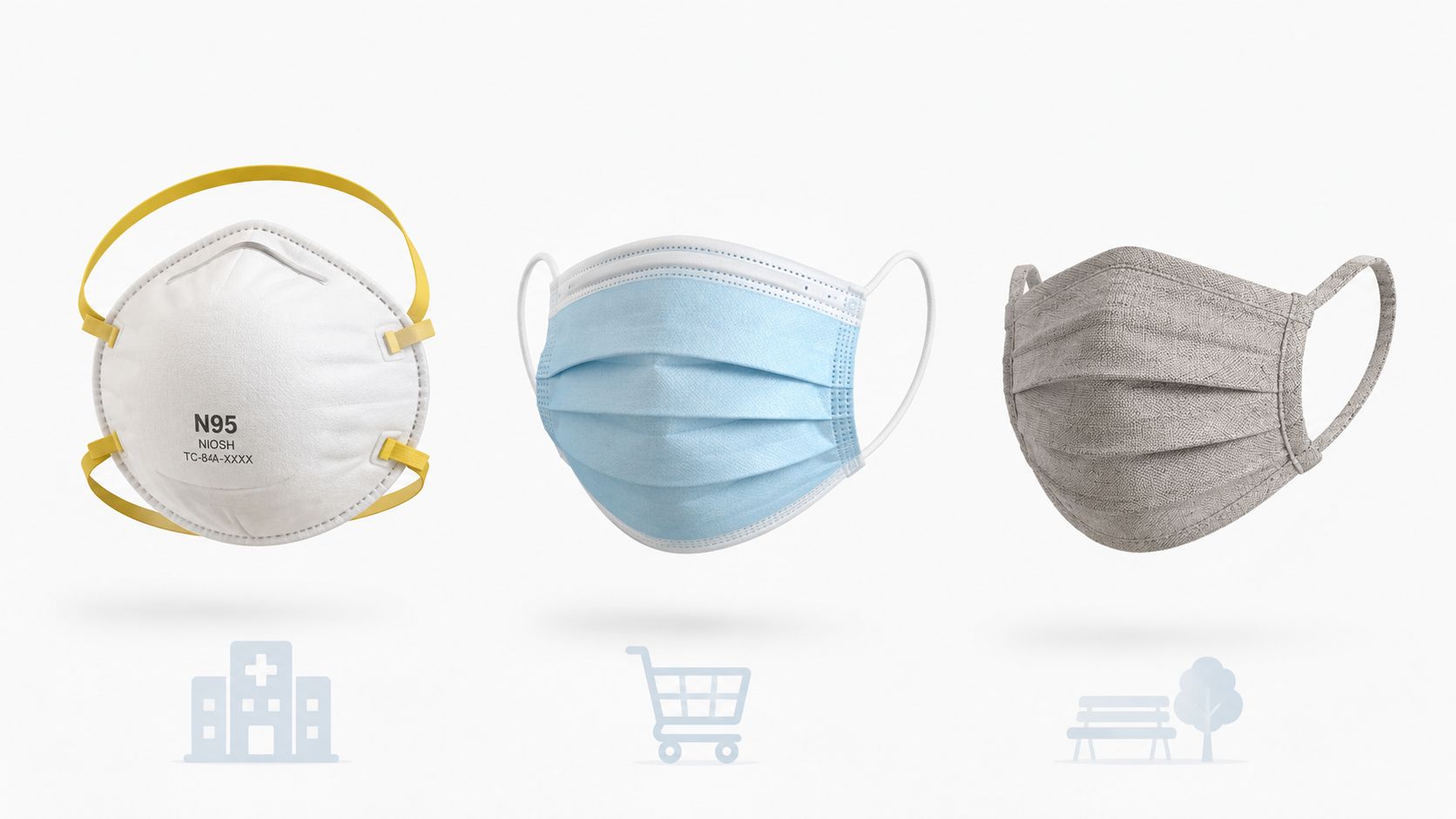
A respirator can filter above 99% of particles as a material, while common cloth face coverings in the same laboratory comparison ranged from 1.4% to 36%. That spread is too large to reduce mask choice to a simple question of whether someone is wearing “a mask.” The decisive variables are mask type, face seal, filtration method, and the setting in which the mask is worn. CDC laboratory data makes that hierarchy visible.
For readers evaluating respiratory protection against viruses such as SARS-CoV-2, influenza, RSV, or other airborne pathogens, the practical conclusion is direct: a well-fitting N95-class respirator generally provides the strongest protection, a medical mask offers a useful but weaker compromise, and cloth masks vary so widely that their performance can't be inferred from appearance alone. The comparison below focuses on fitted filtration, source control, and the particle range that matters for airborne protection.
Why Mask Type Matters More Than You Might Expect
The strongest evidence in the supplied research doesn't support treating all masks as interchangeable. A 2022 comparative effectiveness review found that wearing an N95 or equivalent respirator was associated with a lower risk of coronavirus infection, with an odds ratio of 0.30 and a 95% confidence interval of 0.20–0.44. The review concluded that N95-class respirators were the most effective mask type, while evidence for medical or surgical masks was weaker. Read the comparative effectiveness review.
That result changes the central question. “Did the person wear a mask?” is less informative than “What kind of mask did the person wear, and how well did it seal?” A loose face covering may intercept some exhaled droplets, yet still allow substantial inward and outward leakage around the cheeks, nose, and chin.
Four measures produce a more useful ranking
A serious comparison needs four separate criteria:
- Material filtration efficiency: How effectively the filter medium captures particles under laboratory conditions.
- Fitted filtration efficiency: How much protection remains when the complete mask is worn on a face or headform.
- Source-control performance: How much exhaled aerosol or virus a mask blocks before it enters shared air.
- Use-case fit: Whether the mask can be worn correctly for the duration and exposure level involved.
These criteria explain why a product with respectable filter material can perform poorly on a person. A surgical mask may contain effective media, but its loose edges can allow air to bypass that material. A respirator may have excellent filtration, but poor adjustment, facial hair, or an incompatible shape can undermine its seal.
Practical rule: Mask effectiveness by type is a hierarchy, not a binary label. The mask must both filter particles and control the air path through the face seal.
Public guidance often compresses this distinction into “wear a mask.” That advice is easy to communicate, but it leaves readers unable to judge why an N95, surgical mask, and cloth covering should not be treated as equivalent. The evidence supports a more precise conclusion: mask wearing matters, but mask design and fit determine how much protection the wearer and nearby people receive.
How Mask Performance Is Actually Measured
The 0.3 micron particle is widely used as a demanding benchmark because it is close to the most penetrating particle size for many mechanical filter media. Particles larger than this are often captured through interception or impaction, while smaller particles can be captured through diffusion and other mechanisms. The benchmark therefore tests a difficult part of the filter's operating range, rather than representing a claim that viruses themselves travel only as particles of that size.
Two measurements must be kept separate.
Material filtration efficiency tests the filter medium in a laboratory holder. The test challenges a cut section of the fabric or filter under controlled airflow and records how much particulate material passes through. In the CDC comparison, respirator materials had mean filtration efficiencies above 99%, medical masks ranged from 80% to 93%, and cloth masks, neck gaiters, and bandanas ranged from 1.4% to 36%. Review the CDC comparison of mask materials.
Fitted filtration efficiency measures the complete mask on a human subject or headform. This measurement includes the filter and the edges, straps, nose bridge, facial contours, and movement. A laboratory material result can therefore look strong while real-world protection remains limited by leakage.

Certification labels aren't interchangeable
N95, KN95, and FFP2 labels refer to different certification systems and testing protocols. A filtration claim should therefore be interpreted alongside the standard under which the product was tested, the quality of the certification, and the fit of the finished mask.
A high filter rating also creates a practical trade-off. Dense media can increase breathing resistance, and a respirator that feels uncomfortable may be adjusted incorrectly or removed during exposure. Breathability and seal integrity aren't secondary details. They determine whether the stated filtration performance survives actual use.
The most useful question isn't just “What percentage does the filter capture?” It is “How much contaminated air reaches the wearer through the filter and around the mask during the intended activity?” That question leads directly to fitted filtration.
Comparing Respirators, Surgical Masks, and Cloth Masks
Material filtration at the 0.3 micron range does not determine protection by itself. The comparison must include the face seal, because particles can enter around a mask even when its filter performs well in laboratory testing. Respirators are built to direct inhaled air through filter media. Surgical masks are loose-fitting barriers used mainly for source control and splash protection. Cloth masks vary most widely because fabric, layers, construction, and fit differ substantially.
| Mask Type | Material Filtration at 0.3 micron | Fitted Filtration | Fit Method | Certification Standard |
|---|---|---|---|---|
| N95-class respirator | Above 99% in the CDC laboratory comparison | N95 and CaN99 masks measured 97% to 98% in one fitted-filtration study | Two-strap headband and seal check | N95 or equivalent national certification |
| FFP2-class respirator | Generally positioned in the respirator category, with performance dependent on certification and product quality | Requires a proper facial seal | Headbands or approved securing system | Relevant FFP certification |
| Surgical or medical mask | 80% to 93% in the CDC material comparison | Level 1 masks measured 52% to 60%, and Level 3 masks 60% to 77% without fit testing | Loose fit, ear loops or ties | Medical-mask standard |
| Cloth mask | 1.4% to 36% for the cloth coverings and similar items tested by CDC | A cloth mask measured 47% to 55% in one fitted study, while other human-subject testing found low fit factors | Ear loops, ties, nose wire, or no engineered seal | Varies widely, often without respirator certification |
The fitted results in PLOS ONE show a wide separation between respirators and medical masks. Respirators approached the high end of fitted performance, while medical masks depended much more on leakage at the edges. Their material results cannot therefore be treated as wearer protection.
Cloth masks require the most cautious interpretation. Multiple layers or a filter insert may improve a particular design, but the category does not guarantee a consistent result. A review found that some cloth masks filtered less than 20% of tested aerosols, while an experimental paper found that none of the tested cloth masks exceeded 25% filtration for particles sized 0.3 to 0.374 microns. Examine the review of cloth-mask filtration.
Readers comparing a particular respirator shape can consult this guide to the N95 duckbill mask, which discusses how design, straps, and the nose seal affect use. The practical hierarchy is clear: respirators combine high-performing filter media with a face seal, surgical masks provide an intermediate barrier with more edge leakage, and cloth masks show the greatest performance variability. For airborne protection near the 0.3 micron range, fitted filtration matters more than a marketing-grade category label.
The Fit Factor That Changes Every Comparison
Filter material answers only half the protection question. Fit factor describes the relationship between particle concentration outside a mask and concentration inside it. A higher fit factor means less inward leakage, while a low fit factor indicates that air is bypassing the filter through gaps.
One fitted-filtration study reported that a properly fitted N95 can achieve fit factors over 100, whereas typical surgical masks often measured below 3. See the fitted filtration and fit-factor evidence. Those values illustrate why a filter's laboratory rating can't be transferred directly to the wearer.
| Mask Type | Typical Fit Factor | Estimated Inward Leakage | Test Method |
|---|---|---|---|
| Properly fitted N95 | Over 100 | Approximately 1% under the reported fit-factor relationship | Human fit testing |
| Typical surgical mask | Below 3 | Substantial leakage around the face seal | Human fit testing |
| Cloth mask | Fit factors of 1.0 to 4.0 in one human-subject study | High and highly variable | Human-subject fit testing |
The cloth-mask fit-factor range comes from human-subject research on cloth masks. A factor of 1.0 indicates that the mask provides little separation between ambient and inhaled particle concentration in that test setup. A factor of 4.0 is better, but still far from the seal associated with a well-fitted respirator.
Leakage changes the meaning of filtration
A mask can contain efficient material and still perform poorly if air finds an easier route around it. Common leak points include the upper nose, cheek area, lower chin, and gaps created by ear loops that don't pull the mask firmly against the face.
Readers can perform a basic seal check by breathing in and out while feeling for escaping air, checking whether the nose wire follows the face, and observing whether glasses fog from upward leakage. These checks don't replace formal fit testing, but they can identify obvious failures.
For practical context on protective equipment selection and use, consult this guide to how to use personal protective equipment. The analytical takeaway is decisive: a well-sealed respirator with slightly less impressive material performance may protect better than a higher-rated mask that leaks around the edges.
Source Control and Blocking Exhaled Virus
Mask effectiveness has two directions. Inhaled protection concerns the air entering the wearer's breathing zone. Source control concerns air leaving an infected or potentially infected person and entering the surrounding environment.
A human source-control study tested several mask types by measuring exhaled viral load. A duckbill N95 reduced exhaled viral load by 98%, and it reduced fine aerosol viral particles by 99%. The same study found that the N95 reduced coarse particles by 94%, while cloth masks reduced fine and coarse particles by 92% and 74%, surgical masks by 81% and 54%, and KN95 masks by 79% and 48%, respectively. Review the source-control study.
These results matter because source control isn't identical to wearer protection. A mask can block large exhaled droplets while allowing smaller aerosol particles to escape through fabric gaps or around the face. Conversely, a respirator's seal helps prevent both outward and inward leakage, which is why the duckbill N95 led the tested options in this experiment.
The result also resists an overly simple conclusion that weaker masks have no value. The study found that all tested masks and respirators significantly reduced exhaled viral load without fit tests or training, and the N95 still performed best. The PubMed record summarizes the source-control findings.
A medical or cloth mask can reduce emission, but the strongest source-control option in the tested comparison was the fitted N95-class respirator.
In shared indoor air, this distinction affects everyone nearby. A person who may be infectious can reduce the amount of virus released by choosing a respirator, while another person can reduce inhaled exposure by wearing a well-sealed respirator of their own. Mask type therefore changes both personal protection and the background exposure faced by others.
Matching Mask Type to Real-World Situations
The evidence supports a risk-based approach rather than a universal rule. The higher the exposure, the longer the contact, and the poorer the ventilation, the more valuable a respirator's seal becomes.
Healthcare and household exposure
For a clinic visit, emergency-room environment, or prolonged care of someone with a confirmed or suspected respiratory infection, choose a fit-tested N95 or an appropriately certified FFP2 or FFP3 respirator when available. The source-control evidence gives duckbill N95s a particularly strong position, but fit remains essential because the product must seal on the individual face.
Caring for a sick family member creates repeated exposure rather than a single brief encounter. A respirator is therefore more defensible than a cloth mask, especially during close conversation, cleaning, feeding, or other activities that keep people in the same indoor air.
Readers working around industrial hazards can also consult guidance on managing PPE in industrial sites, where selection, fit, storage, and worker compliance are treated as connected parts of protection.
Crowded indoor settings
Public transit, airports, conferences, and other crowded indoor environments favor N95-class or KN95 respirators that meet a relevant certification standard. Check the markings, packaging, manufacturer information, and fit before relying on a product, because a label alone doesn't guarantee a genuine or well-fitting respirator.
For a more detailed distinction between airborne and droplet controls, see airborne vs droplet precautions. The practical point is that prolonged exposure increases the value of reducing inward leakage.
Short errands and lower-density settings
For a quick indoor trip where distancing is possible and exposure time is limited, a well-fitting medical mask is a reasonable step above a cloth covering. Improve its performance by molding the nose wire, ensuring the lower edge reaches beneath the chin, and replacing it if it becomes wet or damaged.
A multilayer cloth mask can serve as a fallback when a respirator or medical mask isn't available or tolerable. It shouldn't be treated as equivalent protection, particularly if it has loose edges, thin fabric, no nose wire, or visible gaps.
Use these checks before entering an exposure setting:
- Nose bridge: The wire should conform closely without leaving an upper gap.
- Chin: The lower edge should stay beneath the chin rather than lifting during speech.
- Glasses: Fogging often signals upward leakage, although it can also reflect temperature and humidity.
- Breathing: Excessive resistance may indicate a blocked, wet, or poorly maintained mask.
- Movement: Talk, turn the head, and open the mouth. The seal should remain stable.
A Practical Decision Framework for Choosing a Mask
Choose the mask by combining four inputs: exposure risk, duration, fit skill, and tolerance for breathing resistance. No single category wins every situation because the most protective mask is useful only if the wearer can keep it sealed and on.
| Situation | Primary choice | Reasonable fallback |
|---|---|---|
| Healthcare exposure or close care of a sick person | Fit-tested N95 or certified FFP2/FFP3 | Well-fitting medical mask if a respirator isn't available |
| Prolonged crowded indoor exposure | N95-class or certified KN95 respirator | Medical mask with careful edge adjustment |
| Short indoor errand | Well-fitting surgical or medical mask | Multilayer cloth mask |
| Outdoor or low-density indoor setting | Respirator when risk is elevated | Multilayer cloth mask if needed |
A simple decision rule follows:
- Start with exposure. Healthcare settings and close household care justify the strongest available respirator.
- Add duration. A brief encounter and a long indoor stay aren't equivalent. As contact lasts longer, reducing inward leakage becomes more valuable.
- Test your fit. If you can't achieve a stable seal, the nominal category won't tell you the actual protection.
- Account for comfort. If heat or breathing resistance causes repeated removal, choose a design you can wear consistently, then improve the seal as much as possible.
Children may need different respirator shapes and sizes. Facial hair can interfere with a tight seal, and people with respiratory limitations should discuss mask choice with a qualified clinician rather than treating discomfort as a test of endurance.

The upgrade threshold is practical: move to an N95-class respirator when exposure is prolonged, close, crowded, poorly ventilated, or medically consequential. Keep a medical mask as the intermediate option, and reserve cloth masks for situations where stronger choices aren't available or tolerated. That hierarchy reflects filtration and fit evidence rather than marketing language.
Common Questions After the Comparison
Can an N95 be reused?
Reuse depends on the respirator's condition, contamination risk, storage, and applicable workplace or clinical policy. Discard it if it is wet, visibly dirty, damaged, difficult to breathe through, or no longer seals. Store a reusable respirator in a clean, breathable container, not a sealed damp space, and handle it by the straps.
How can someone spot a counterfeit respirator?
Check the manufacturer and model information, NIOSH markings where applicable, and certification details through the relevant approval system. Missing markings, inconsistent packaging, vague claims, or untraceable certification should raise concern. A marketplace listing does not establish authenticity.
Does double-masking always improve protection?
Two loose surgical masks can still leak. An extra layer may interfere with fit, increase discomfort, or shift the inner mask. Prioritize a stable seal, then consider layering only if it preserves that seal.
What matters in 2025 and 2026?
Recent evidence continues to find protective effects across mask types, study designs, and settings. A systematic review reported benefit in 77% to 100% of studies by mask type, while 85% of masking-policy studies reported benefit. Read the recent systematic review.
Those findings support a practical test: verify certification, check the nose and chin seal, and replace a compromised respirator rather than relying on its label. For additional virus education, VirusFAQ.com offers accessible overviews and detailed articles on transmission and prevention.
Before a crowded indoor trip, prepare the mask you intend to wear and test its seal. In a household, classroom, clinic, or workplace, share the comparison before the next respiratory-virus exposure so people can make decisions in advance. Choose a respirator when risk is high, and address fit problems before relying on filtration claims.
Leave a Reply