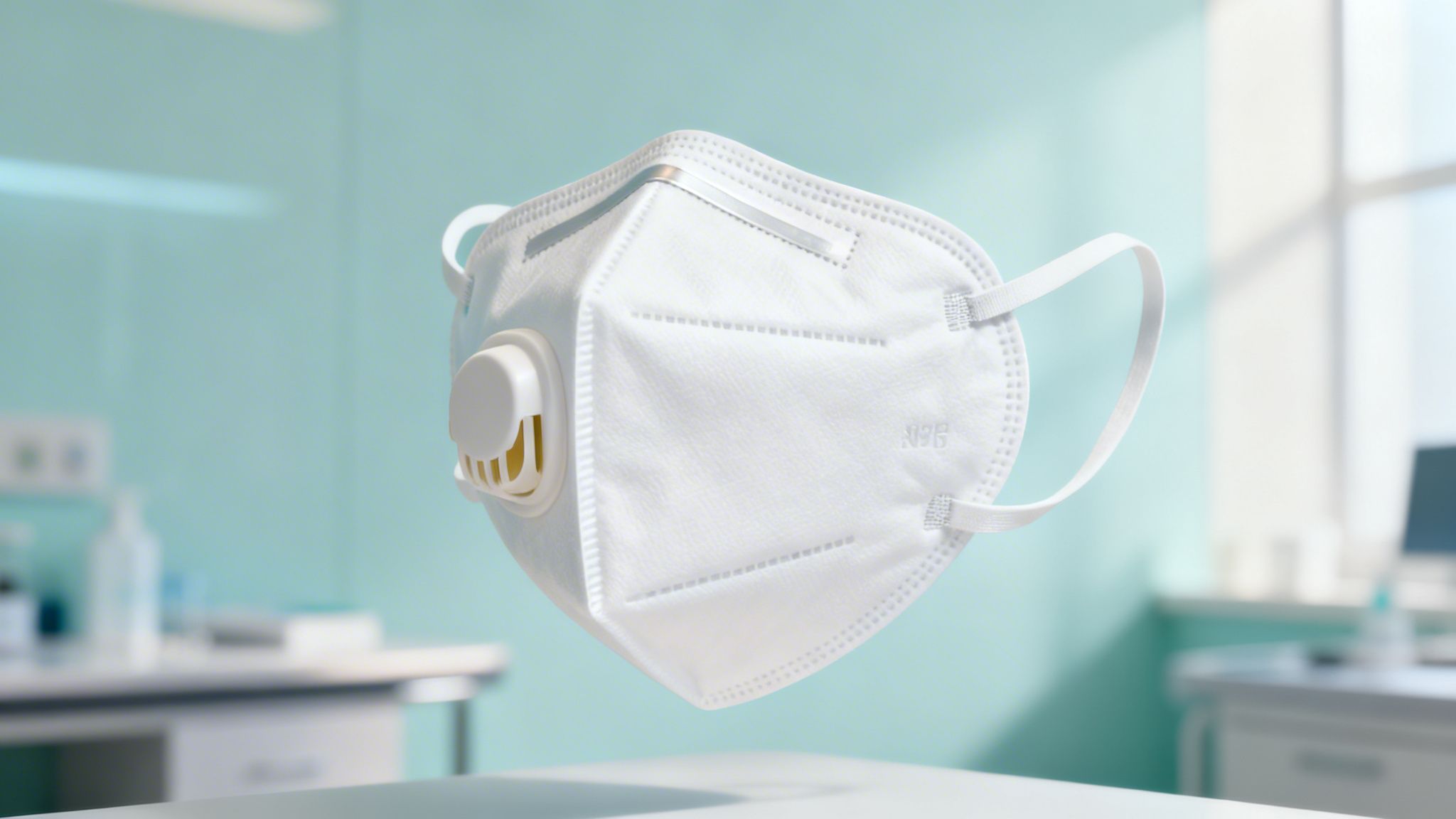
You’ve probably seen them—the respirators that jut out from the face like a pouch or, well, a duck's bill. This is the N95 duckbill mask, and its unique shape is the secret to its popularity in both hospitals and public settings. It's designed to provide serious protection without sacrificing comfort, especially during long hours of wear.
The design creates a large breathing chamber that keeps the mask away from your face, which is a huge advantage. This space makes it much easier to talk and breathe, all while delivering the at least 95% filtration efficiency you expect from an N95 against viruses like Influenza A (H1N1), SARS-CoV-2, and Rhinovirus.
Why the N95 Duckbill Mask Is So Effective

It helps to think of a duckbill N95 less like a mask and more like your own personal air filter. Its power comes from combining high-grade filtration material with a smart design that puts function and comfort first.
The "N95" part isn’t just a name—it's a certification from the National Institute for Occupational Safety and Health (NIOSH). This stamp of approval means the respirator is proven to filter at least 95% of tiny, non-oily airborne particles. That includes everything from common dust and pollen to the microscopic respiratory droplets that carry viruses like SARS-CoV-2 and influenza.
The real game-changer with the duckbill shape is the spacious air pocket it creates. By keeping the filter material off your mouth, it stops the mask from getting damp, which makes breathing and speaking feel surprisingly natural.
This isn’t just about comfort, either. A moist mask can actually lose some of its filtration power. The duckbill's design helps the filter stay dry and effective for much longer than a standard flat mask, providing a more reliable barrier against respiratory pathogens.
Design and Protection Combined
A duckbill N95's true strength is how its unique form boosts its protective function. The breathing chamber is the most obvious feature, but other parts work together to create a formidable barrier against airborne threats.
- Secure Seal: Duckbills use dual head straps—one that goes over the crown of your head and another at the base of your neck. This creates a tight, secure seal around the entire edge of the mask, preventing contaminated air from leaking in.
- Adjustable Fit: A flexible metal strip across the nose bridge lets you mold the mask perfectly to the contours of your face. This closes the gaps around your nose and cheeks, which are common failure points for lesser masks.
This all-in-one design is why the N95 duckbill is trusted by people who need serious protection from viral particles. When you understand how airborne transmission can further clarify why this level of protection is crucial, it's easy to see why this design is a top choice. The duckbill shape isn't just for show; it's a smart feature that makes the mask safer and easier to wear.
The Science Behind Its Superior Filtration

So, how does an N95 duckbill mask actually catch invisible threats like the flu virus or SARS-CoV-2 before they get into your lungs? It’s a lot more sophisticated than just being a simple screen. The real magic is in its multi-layered construction and the hidden power of static electricity.
The mask's filter material is made from several layers of a non-woven polymer called polypropylene. You can think of the outer layers as a first line of defense, catching bigger stuff like dust and pollen. But the real workhorse is the inner layer.
This middle layer is "melt-blown" and holds a powerful electrostatic charge. Imagine it as a tiny, powerful magnet for anything floating in the air. When you breathe in, microscopic particles aren't just physically blocked by the fibers—they are actively pulled from the air and stuck to the filter by this charge. This one-two punch of mechanical filtering and electrostatic attraction is what lets an N95 hit that certified 95% filtration efficiency.
The Advantage of the Breathing Chamber
One of the best things about the duckbill design is its large breathing chamber. This isn't just about comfort; it's a huge deal for performance. By keeping the mask material off your nose and mouth, the design does two critical things.
- Stops Moisture Buildup: When a mask gets damp from your breath, its effectiveness plummets. Moisture can kill the electrostatic charge and weaken the filter material. The duckbill's air pocket helps keep the filter dry and working properly.
- Makes Breathing Easier: That pocket of air also makes it feel less stuffy and restrictive than tighter-fitting masks. It's a small change that makes a big difference when you have to wear it for hours.
This smart design is why these respirators remain so essential. In fact, projections show the N95 market is expected to jump from USD 4.10 billion in 2025 to USD 7.44 billion by 2032. You can dig into additional market forecasts that confirm just how vital N95 technology continues to be for safety.
The combination of an airtight seal, advanced filtration media, and a functional breathing chamber is the key to true N95 protection. Each element works in concert to protect the wearer from inhaling hazardous particulates.
Getting that protection depends on the whole system working together. The dual head straps pull the mask securely against your face, while the metal nosepiece lets you mold a tight seal to prevent leaks. Without that seal, even the world's best filter won't do you any good. This is why the structure of the N95 duckbill is just as important as the materials it’s made from.
Duckbill Masks Versus Other N95 Shapes
Not all N95s are created equal. While any NIOSH-approved N95 respirator is certified to filter at least 95% of airborne particles, the shape can make a world of difference in comfort, breathability, and—most importantly—fit. Choosing between an N95 duckbill mask, a classic cup-style, or a portable flat-fold often comes down to your face shape and what you need it for.
Think of it like buying a pair of jeans. They all serve the same basic function, but the right cut and fit for your body type makes all the difference. What works perfectly for one person might be uncomfortable or leaky for another.
Head-to-Head Respirator Comparison
The core differences between these N95 styles come down to their physical design. Duckbill masks have a large, flexible breathing chamber. Cup-style masks are rigid and pre-molded. Flat-folds are designed to be folded up and stuck in a pocket. Each design creates a completely different experience for the wearer.
So, how do they stack up against each other? We've broken down the key features that matter most when you're wearing a respirator for hours at a time.
Comparison of N95 Respirator Styles
This table breaks down the main pros and cons of the three most common N95 respirator shapes, helping you see at a glance which one might work best for you.
| Feature | N95 Duckbill Mask | N95 Cup-Style Mask | N95 Flat-Fold Mask |
|---|---|---|---|
| Breathability | Excellent; large chamber creates more surface area and airflow. | Good; rigid structure prevents collapse during inhalation. | Varies; can feel restrictive if it sits close to the mouth. |
| Seal Consistency | High; flexible edges conform to a wide variety of face shapes. | Moderate; rigid shape may cause gaps on certain facial structures. | Moderate; requires careful unfolding and placement for a good seal. |
| Communication | Good; chamber keeps material off the mouth, reducing muffled speech. | Fair; rigid shell can muffle voice and impede jaw movement. | Poor to Fair; material often rests on the lips, muffling speech. |
| Portability | Fair; can be flattened but is bulkier than a flat-fold. | Poor; rigid shape is bulky and cannot be easily stored in a pocket. | Excellent; folds flat for easy storage in a pocket or bag. |
As you can see, each style has its trade-offs. The right choice depends on balancing these factors with your own needs for protection, comfort, and convenience.
The Duckbill Advantage: Fit and Flexibility
The standout feature of an N95 duckbill mask is its incredible flexibility. Since it isn't locked into a rigid, pre-formed shape, it can mold itself to a much wider range of facial structures, from narrow and long to wide and round. For many, this translates to a more consistent and reliable seal.
For many wearers, the duckbill’s soft, pliable edges are the key to eliminating the frustrating air leaks commonly found with rigid cup-style masks, especially around the cheeks and jawline.
This adaptability is a huge reason why duckbills have become a favorite in healthcare, where a solid, dependable fit is an absolute must. After all, a respirator's seal is fundamental to its effectiveness against viruses like Hepatitis C Virus (HCV) or Herpes Simplex Virus 1 (HSV-1), which can be present in healthcare settings. To dig deeper into how a proper fit protects you from different hazards, check out our guide on airborne versus droplet precautions.
On the other hand, flat-fold masks—while you can’t beat them for portability—can be finicky. The creases required for folding can sometimes create tiny channels for air to leak in if the mask isn't positioned just right. The traditional cup style is tough and durable, but its rigidity makes it a "love it or hate it" choice. If its fixed shape doesn't match your face, you're out of luck.
At the end of the day, the best N95 is simply the one that fits you best.
How to Achieve a Perfect Seal Every Time
All the high-tech filtration in an N95 mask means absolutely nothing without a perfect seal. Even the tiniest gap can let airborne particles sneak in, completely defeating the purpose of wearing one. The duckbill's design gives you a great head start, but learning how to get the fit just right is non-negotiable.
First things first, start with clean hands. Hold the mask in your palm with the nosepiece up, letting the straps hang down. Pull the top strap over your head so it rests high on the back of your head, almost like a crown. Then, pull the bottom strap over and position it at the base of your neck, below your ears. A critical tip: the straps should never be crisscrossed. Crossing them creates weird pressure points and can actually break the seal you're trying to create.
Fine-Tuning Your Fit
With the straps in place, it’s time to focus on the single most important part of the fit: the nosepiece. Using the fingertips of both hands, press the metal strip down firmly to mold it to the bridge of your nose. Continue pressing down and outwards along your cheeks to create a snug, complete seal. A common mistake is to just pinch the nosepiece with one hand, which creates a sharp "V" shape and leaves gaps on either side.
This infographic shows a quick comparison of different N95 styles, and you can see how the duckbill's unique shape often makes achieving a good seal a little easier.

The duckbill's large surface area, which contributes to its fantastic breathability, also provides more edge contact with your face. Now that the mask feels secure, it's time to test your work with a user seal check.
A user seal check is a quick, mandatory test you must perform every single time you put on a respirator. It is your only confirmation that you have created an effective barrier against airborne contaminants before entering a hazardous environment.
Here's how to do it. It only takes a few seconds:
- Positive Pressure Check: Gently exhale into the mask. If you feel air escaping from around the edges, the seal isn't tight. Go back and readjust the straps and nosepiece, then try again.
- Negative Pressure Check: Now, gently inhale. The mask should suck inward slightly against your face. If it doesn’t, or if you feel air leaking in, you still have a gap somewhere.
Common Pitfalls to Avoid
Even if your technique is perfect, a few things can still sabotage your seal. The biggest culprit? Facial hair. Even a day or two of stubble can create tiny channels that prevent the mask's edge from making direct contact with your skin, rendering the seal ineffective.
If your glasses are fogging up, that's a dead giveaway that you have an air leak, usually around the nosepiece. Learning how to prevent mask fogging not only makes wearing a mask more comfortable but also helps you get a better seal.
For a deeper dive into fitting and using respirators and other gear, check out our comprehensive guide on how to use personal protective equipment. By sidestepping these common mistakes and making the seal check a habit, you can be confident your N95 duckbill is giving you the full protection it was designed for.
N95 Applications and Market Insights for 2026
When you think of an N95 respirator, you probably picture a hospital or a doctor's office. But the demand for N95s, including the popular duckbill style, extends far beyond healthcare settings. These respirators are a critical piece of safety gear in a ton of different industries, each facing its own unique airborne threats.
Take construction, for example. An N95 duckbill mask is an absolute necessity on most job sites. Workers are constantly exposed to nasty airborne particles like silica dust from cutting concrete, sawdust, and other debris that can cause serious, long-term lung damage. In manufacturing plants and industrial shops, they protect workers from inhaling metal fumes, chemical dusts, and other harmful byproducts.
Key Market Drivers and Trends
The demand from all these different users is what shapes the N95 market, and the latest data points to some clear trends. For starters, respirators without exhalation valves—a category that includes most N95 duckbill mask models—are expected to make up the biggest slice of the pie, projected at a 77.0% revenue share in 2026. This makes a lot of sense, as valve-free designs offer two-way filtration, protecting both the person wearing the mask and everyone around them from viruses like Human Rotavirus or Norovirus.
When you break down the market by who’s using them, the numbers tell a clear story:
- Leading Sector: The construction industry is the single largest user, set to account for a massive 30.5% of the market share in 2026, driven by those constant on-the-job exposure risks.
- Distribution Channels: Old-school offline sales still rule the day, making up 51.9% of all revenue. This is because big institutions like hospitals, industrial safety suppliers, and government agencies tend to buy in bulk.
If you want to dive deeper into the numbers, you can explore more detailed N95 market data and see what’s driving this consistent growth.
A Comprehensive Protection Strategy
While a high-quality N95 is the cornerstone of respiratory protection, it’s only one piece of the puzzle. Viruses like the flu or SARS-CoV-2 don't just travel through the air; they also hang out on surfaces. Someone could wear their respirator perfectly but still get sick by touching a contaminated doorknob and then touching their face.
True safety lies in a multi-layered approach. Airborne protection from a well-fitted N95 must be paired with diligent surface hygiene to minimize all potential transmission routes.
This is where other good habits become so important. Regularly using disinfecting wipes to clean high-touch surfaces—think tools, equipment handles, and light switches—is crucial for cutting down the risk of picking up a virus from a contaminated object. When you combine strong airborne defense with smart surface disinfection, you create a much tougher barrier against threats in any environment, from a hospital ward to a factory floor.
How to Spot Counterfeits and Verify NIOSH Approval
With the market flooded with respirators, it's easy to accidentally grab a fake. How can you be sure your N95 duckbill mask is the real deal and not a dangerous counterfeit? Your protection depends on it.
The only way to be certain is to look for the stamp of approval from the National Institute for Occupational Safety and Health (NIOSH). A genuine NIOSH approval means the mask has passed rigorous government testing for filtration and fit. Anything less is just giving you a false sense of security when facing airborne hazards like influenza or SARS-CoV-2.
What to Look for on a Legitimate N95
Every authentic NIOSH-approved N95 duckbill will have specific information printed directly on the mask itself—not just on the box. Think of it as the mask's ID card. If any of this is missing, you're looking at a major red flag.
Here's exactly what to check for:
- The NIOSH Name or Logo: The letters "NIOSH" must be easy to spot.
- Manufacturer's Name: The company that made it, like 3M, Moldex, or Halyard.
- TC Approval Number: This is the most important part. It looks like TC-84A-XXXX. You can punch this number into the NIOSH Certified Equipment List to instantly verify the mask.
- Model Number: The specific product number for that mask style.
- Filter Class: The "N95" designation must be clearly printed.
Checking for these markings is your first and best defense against fakes. If a mask is missing even one of these details, don't trust it.
The Telltale Signs of a Counterfeit
Beyond the official markings, counterfeit masks often have obvious design flaws that give them away. Keep an eye out for these common tricks:
- Ear Loops Instead of Headbands: This is the easiest giveaway. A real N95 respirator always uses two headbands that go around the back of your head. Ear loops simply can't create the tight seal needed for N95-level protection, so no N95 with ear loops is NIOSH-approved.
- Claims of "FDA Approval" for General Use: NIOSH is the agency that approves N95s for workplace and respiratory protection. The FDA only gets involved to clear surgical N95s for fluid resistance in medical settings. If a non-surgical mask boasts about "FDA approval," it's a misleading claim designed to confuse you.
- Decorative Fabric or Other Add-ons: Real N95s are serious safety equipment, not fashion accessories. If a mask has sequins, decorative prints, or other attachments that weren't part of its original NIOSH-approved design, it's almost certainly a fake.
By taking a few seconds to check these details, you can make sure the N95 duckbill you're wearing is providing the life-saving protection you expect.
Frequently Asked Questions About Duckbill Masks
Once you've got a duckbill N95, you'll probably have a few practical questions. How you use it, store it, and fit it makes all the difference. Let’s clear up some of the most common ones.
Can I Reuse My N95 Duckbill Mask?
If you're using it outside of a healthcare setting, yes, you can get more than one use out of an N95 duckbill mask as long as you're careful. The goal is simple: keep the respirator clean and don't damage its shape.
Always grab it by the straps—never touch the front of the mask where it filters the air. When you take it off, store it in something that breathes, like a paper bag with your name on it. This lets any moisture dry out. You absolutely must throw it away if it gets dirty, wet, damaged, or feels harder to breathe through. Those are all red flags that it's no longer protecting you properly.
Will a Duckbill Mask Stop My Glasses From Fogging?
Yes, a duckbill with a solid fit is one of the best ways to keep your glasses from fogging up. Fog is just your warm breath escaping from the top of the mask and condensing on your cooler lenses.
The secret is getting a perfect seal with the metal nosepiece. When you take the time to mold that strip snugly across the bridge of your nose and cheeks, you create a channel that forces your breath down and away from your eyes.
A tight seal doesn't just prevent fog—it’s proof your respirator is working. If your glasses are fogging, air is leaking out, which means air can also leak in. It's a sign you need to stop and readjust the fit.
Is a Duckbill N95 Better Than a KN95?
This isn't really about which one looks better; it's about the standards behind them. While both are designed to filter roughly 95% of particles, the real difference is in the quality control and certification.
NIOSH-approved N95s, the standard in the United States, go through an incredibly strict and consistent testing process. For guaranteed, reliable protection, they are the gold standard. To be sure you're getting the real deal, always check for the NIOSH approval markings printed directly on the mask itself.
Leave a Reply