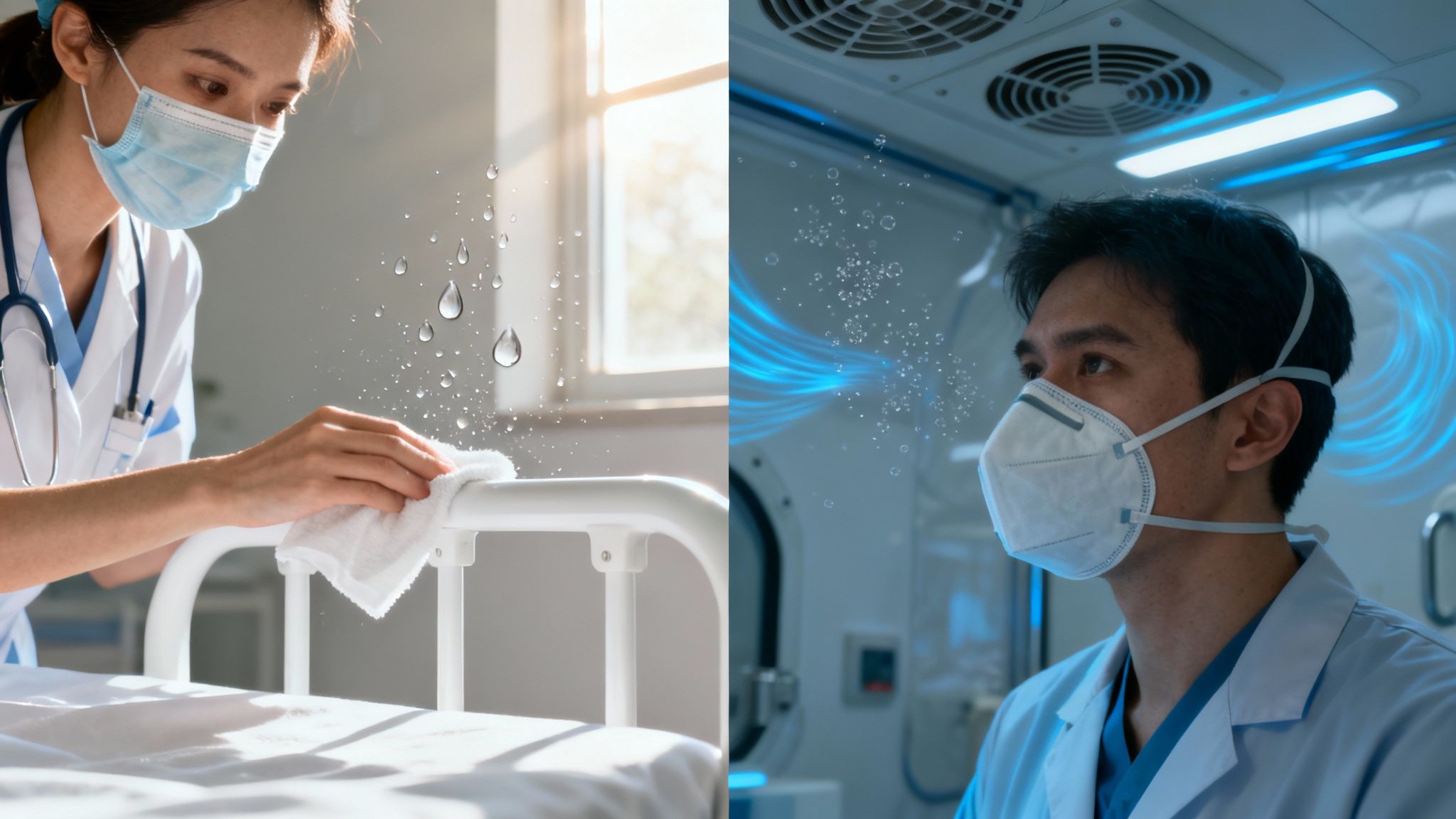
The real difference between airborne vs. droplet precautions boils down to how infectious particles behave in the air. Think of it this way: droplet precautions protect us from large, heavy respiratory droplets that fall out of the air quickly. On the other hand, airborne precautions are designed to defend against tiny, aerosolized particles that can hang around for hours.
Getting this distinction right is the absolute cornerstone of effective infection control, whether you're in a hospital or just trying to stay safe in public.
Understanding Transmission-Based Precautions
When our standard infection control measures just aren't cutting it against a particular bug, we bring in transmission-based precautions. These aren't a one-size-fits-all solution. Instead, they are tailored to the exact way a virus or bacterium travels from one person to the next. The decision to use airborne or droplet protocols comes down to the simple physics of the infectious particles themselves.
Large respiratory droplets, which are typically bigger than 5 micrometers in diameter, get launched into the air when someone coughs or sneezes. But because they're heavy, gravity wins pretty quickly. They usually only travel short distances before landing on people or surfaces nearby, which is why droplet precautions lean heavily on physical distance and wiping down surfaces with effective disinfecting wipes.
In stark contrast, those tiny aerosol particles—smaller than 5 micrometers—are so light they can stay suspended in the air, drifting on currents far from the person who released them.

The Science Behind Safety Distancing
For decades, we've built our infection control rules on the idea that droplets don't travel more than 3 to 6 feet. But new evidence is starting to poke holes in that old assumption. Recent research that analyzed how far droplets actually travel found that in 8 out of 10 studies, they moved well beyond that conventional "safe" distance.
Some documented cases even showed droplets traveling up to 8 meters (that's about 26 feet) from the patient. You can read the full research about respiratory pathogen spread and see how it’s changing modern safety guidelines.
This evolving science shows exactly why it’s so critical to correctly identify how a pathogen spreads. It has a direct impact on crucial safety decisions, like:
- Personal Protective Equipment (PPE): It tells us if a standard surgical mask is enough, or if we need to step up to a specialized N95 respirator.
- Environmental Controls: It determines whether we need special ventilation systems, like negative pressure isolation rooms, to stop airborne spread in its tracks.
- Patient Placement: It guides our choices on whether a patient needs a private room or can safely share a space with others.
The Science of Airborne vs. Droplet Transmission
To really get a handle on the difference between airborne and droplet precautions, we have to look at the physics. When someone coughs, sneezes, or even just talks, they're sending a spray of respiratory particles into the air. The size of those particles dictates how they move, and that single factor changes everything about how we stop them.
The magic number here is 5 microns (μm). A micron is tiny—about 1/25,000th of an inch. Particles larger than 5 microns are called droplets. Anything smaller is considered an aerosol, or what clinicians often call a droplet nucleus.
The Behavior of Large Respiratory Droplets
Think of large respiratory droplets (over 5 microns) like tiny cannonballs. They get shot out of someone’s mouth or nose with some force, but gravity wins out pretty quickly. They’re heavy, so their trip is short—usually no more than six feet before they crash-land on a surface or another person.
This is the entire basis for droplet transmission. It's how pathogens like Influenza A virus (H1N1), Rhinovirus Type 14, and other enveloped viruses get around. Because these particles settle fast, they contaminate the immediate area, which makes cleaning surfaces with disinfecting wipes a huge part of stopping the spread. If you want to dive deeper, our complete guide on what is droplet transmission breaks it all down.
The Persistence of Small Aerosol Particles
Now, let's talk about the small stuff. Aerosol particles (under 5 microns) are a completely different animal. They’re so light that they defy gravity, behaving more like smoke than a projectile. They can just hang out in the air, sometimes for minutes, sometimes for hours.
These tiny particles get carried on air currents, traveling far beyond that initial six-foot bubble. They can drift across a room, down a hallway, or even get pulled into the ventilation system. This is airborne transmission, and it’s what makes pathogens like tuberculosis (Mycobacterium tuberculosis) and the measles virus so incredibly contagious. Someone can get sick just by breathing the air in a room where an infected person was hours ago.
Key Takeaway: It really boils down to simple physics. Droplets are heavy and fall, contaminating a small area. Aerosols are light and float, contaminating the air over a much wider space and for a much longer time.
This isn't just a textbook distinction; it drives every decision we make in infection control. It explains why a simple surgical mask, which is great at blocking incoming droplets, does very little to protect you from inhaling microscopic aerosols that are already floating in the air.
To make these differences crystal clear, let's compare them side-by-side.
Comparing Particle Behavior in Airborne vs Droplet Transmission
This table highlights the physical properties of infectious particles, showing exactly why we need different precautions for each.
| Characteristic | Droplet Transmission | Airborne Transmission |
|---|---|---|
| Particle Size | Greater than 5 microns in diameter. | Less than 5 microns in diameter. |
| Behavior in Air | Behaves like a projectile; falls quickly due to gravity within seconds to minutes. | Remains suspended and floats in the air for minutes to several hours. |
| Travel Distance | Typically travels short distances, generally less than 6 feet from the source. | Can travel long distances on air currents, well beyond 6 feet. |
| Primary Risk | Inhaling droplets at close range or touching contaminated surfaces (fomites). | Inhaling microscopic aerosol particles that are widely dispersed in the air. |
| Classic Pathogens | Influenza, Rhinovirus, Rubella, Pertussis, Mycoplasma pneumoniae. | Measles (Rubeola), Varicella (Chickenpox), Mycobacterium tuberculosis. |
| Environmental Control | Focuses on routine cleaning and disinfecting of high-touch surfaces. | Requires specialized engineering controls like negative pressure rooms and HEPA filtration. |
Getting these scientific basics down is the first step. It shows that infection control protocols aren't just a set of arbitrary rules—they’re a direct response to the physical nature of the threat.
When we move from the science of tiny particles to the reality of patient care, the rules for airborne and droplet precautions become critically important. These aren't just suggestions—they are strict, non-negotiable protocols that dictate everything from where a patient is placed to the specific gear healthcare workers must wear.
Understanding the "why" behind each rule is key for anyone in healthcare. It clarifies exactly why these safety measures are so specific and why getting them right is essential for patient and staff safety.
This infographic breaks down the core differences in how these pathogens travel, which is the entire reason for the two distinct protocols.

As you can see, droplet transmission is a close-range problem caused by large, heavy particles that fall quickly. Airborne transmission, on the other hand, involves tiny particles that can float around and travel much farther.
Patient Placement and Environmental Controls
The first major difference is patient placement. This decision is all about containing infectious particles and keeping them from escaping the immediate care area.
For droplet precautions, a private room is ideal. If that’s not possible, patients infected with the same pathogen can sometimes be housed together, as long as they are kept at least three to six feet apart. Because the droplets don't travel far, standard room ventilation is usually enough.
Airborne precautions are a completely different story. They require a special Airborne Infection Isolation Room (AIIR), also known as a negative pressure room.
An AIIR is engineered to have lower air pressure than the surrounding areas. This design pulls air into the room and prevents it from escaping into hallways. The contaminated air is then safely vented outside or passed through a high-efficiency particulate air (HEPA) filter.
In high-risk settings, advanced air purification and monitoring systems are often used to supplement these engineering controls and further reduce the risk of pathogen spread.
Personal Protective Equipment Mandates
The required PPE is another critical distinction, and it's directly tied to the size of the particles you're trying to block.
-
Droplet Precautions PPE: A standard surgical mask is the main requirement for anyone entering the room. It acts as a fluid-resistant barrier to block large respiratory droplets. Goggles or a face shield are also recommended to protect the eyes.
-
Airborne Precautions PPE: A surgical mask simply won't cut it here. Anyone entering the room must wear a fit-tested N95 respirator or an equivalent. An N95 creates a tight seal around the face and is designed to filter out at least 95% of tiny airborne particles, offering a much higher level of protection.
Of course, choosing the right gear is only half the battle. Using it correctly is just as crucial. You can find detailed guides on the proper procedures in our article on how to use Personal Protective Equipment.
Patient Transport Rules and Surface Disinfection
Even moving a patient or cleaning the room involves different rules, highlighting the unique risks each type of transmission poses.
If a patient under droplet precautions needs to be moved, they must wear a surgical mask to contain their own respiratory droplets. A huge focus here is surface cleaning. Since droplets land on nearby surfaces, things like bed rails, doorknobs, and IV poles become high-risk for transmission. Rigorous, frequent disinfection with high-quality wipes is key to breaking the chain of infection.
For patients under airborne precautions, transport should be limited to only what's medically essential. If they must be moved, the patient wears a surgical mask to minimize aerosol spread, and the destination department must be notified ahead of time. This ensures they can be moved quickly to a private area, limiting exposure in shared spaces.
These protocols are not interchangeable. Using droplet precautions for a patient with measles, for example, would create a massive risk for an outbreak. The clinical reasoning is straightforward: each rule is a direct response to the specific behavior of the infectious particles.
Real-World Pathogens: Where Theory Meets Practice
To really understand the difference between airborne and droplet precautions, you have to see them in action. This isn't just a theoretical exercise—it's a direct response to how specific viruses and bacteria behave in the real world.
Think about classic droplet-spread viruses like influenza (e.g., Influenza A2/305/57 Virus H2N2) or the common cold rhinoviruses (Rhinovirus Type 39). We manage them with a focus on close-range protection and surface hygiene. Why? Because their infectious particles are large and heavy, so they drop out of the air quickly onto nearby surfaces or are easily blocked by a simple barrier. This is why a surgical mask and consistent surface disinfection work so well.
But airborne pathogens are a different beast entirely. They demand a much more aggressive approach because they use the air itself as a vehicle, making them incredibly difficult to contain.
The Classic Airborne Threats
Some pathogens are notorious for their ability to hang in the air for long periods and travel far beyond the immediate space of an infected person.
- Measles (Rubeola): This is one of the most contagious viruses we know. Its tiny aerosolized particles can linger in a room for up to two hours after an infected person leaves. This is why an N95 respirator and a negative pressure room are non-negotiable for containment.
- Tuberculosis (TB): Caused by the bacterium Mycobacterium tuberculosis, this infection spreads when someone talks or coughs, releasing tiny droplet nuclei. These can be inhaled by anyone in the room, even if they aren't in close contact.
- Varicella (Chickenpox): While you can get chickenpox from direct contact with the skin lesions, the varicella-zoster virus is also highly transmissible through the air. In a hospital, you absolutely need full airborne precautions to stop an outbreak.
For these classic airborne diseases, the rules are clear and have been for a long time. Trying to manage them with just droplet precautions would be dangerously ineffective because it misses the main transmission route: the air we share.
The SARS-CoV-2 Game-Changer
If one pathogen ever forced us to rethink our neat categories, it was SARS-CoV-2, the virus behind COVID-19. Its arrival on the scene made the global health community adapt its understanding of viral transmission in real-time.
At first, major health organizations like the World Health Organization (WHO) and the Centers for Disease Control and Prevention (CDC) focused on droplet and contact spread. This made sense based on what we knew about similar coronaviruses. The initial guidance revolved around six-foot distancing, hand hygiene, and wiping down surfaces.
But then the evidence started pouring in. We saw superspreader events happening in poorly ventilated indoor spaces—choir practices, restaurants, crowded offices—where simple droplet spread just didn't explain the scale of the outbreaks. Scientific studies soon confirmed that SARS-CoV-2 could spread via much smaller aerosol particles that travel well beyond six feet and build up in stagnant indoor air.
This shift in understanding drove home a critical point: transmission isn't a simple "airborne or droplet" switch. It’s a spectrum. The real risk depends on the pathogen, the environment (especially ventilation), and what people are doing, like just breathing versus an aerosol-generating procedure.
This new reality led to updated guidelines recommending better ventilation, air filtration, and higher-quality masks like N95s, especially for healthcare workers and in any high-risk indoor setting. The SARS-CoV-2 pandemic was a powerful, and humbling, lesson. It showed us that infection control has to be dynamic and driven by evidence, not dogma. It proved that risk assessment is a continuous process, not a one-time decision.
Managing High-Risk Aerosol-Generating Procedures
Some medical procedures have a knack for blurring the lines between droplet and airborne transmission, creating a real headache in the airborne vs droplet precautions debate. These interventions are known as Aerosol-Generating Procedures (AGPs), and they can mechanically churn larger respiratory droplets into fine, lightweight aerosols—even from pathogens that aren't typically considered airborne. This creates a high-stakes scenario where your standard droplet precautions just won't cut it.
So what counts as an AGP? Think of any procedure that induces a strong cough or involves high-pressure airflows that can aerosolize particles straight from the respiratory tract. Common culprits include intubation, bronchoscopy, suctioning, and even certain dental work using high-speed tools. The physics is straightforward but absolutely critical: the force from these procedures shatters larger droplets into particles tiny enough (<5 microns) to hang in the air for extended periods.

This process completely changes the risk profile on the fly. A virus that normally spreads via droplets, like influenza, can suddenly become an airborne threat during an AGP. In these moments, the clinical context—not just the pathogen itself—dictates how we protect ourselves.
Upgrading Precautions During AGPs
Deciding when to jump from droplet to airborne precautions is a critical judgment call every healthcare provider has to make. The guiding principle here is simple: when in doubt, or when a procedure is known to generate aerosols, assume a higher risk. Being proactive is the only way to prevent healthcare-associated infections in these situations.
Your decision-making should be grounded in a quick risk assessment that weighs three key factors:
- The Procedure Itself: Is this intervention on the list of known AGPs? Things like intubation, extubation, and non-invasive ventilation are at the top of the high-risk list.
- The Patient's Condition: Do we know or suspect the patient has a respiratory infection? For any undiagnosed patient with respiratory symptoms, it’s always safest to assume the highest level of risk until proven otherwise.
- The Environment: Is this happening in a well-ventilated space or, ideally, an Airborne Infection Isolation Room (AIIR)? Poor ventilation is a recipe for disaster, as it allows infectious aerosols to build up in the air.
The rule of thumb in clinical practice is pretty clear: if an AGP is performed on a patient with a known or suspected respiratory pathogen, full airborne precautions are mandatory. At a bare minimum, that means a fit-tested N95 respirator for everyone in the room.
This kind of situational awareness is what separates good infection control from great infection control. It’s an acknowledgment that transmission risk isn't static; it's dynamic. For instance, a scheduled intubation in a controlled operating room is a world away from an emergency intubation on a coughing patient in a packed ER. That second scenario demands an immediate upgrade to airborne precautions to protect everyone nearby.
Practical Steps for High-Risk Scenarios
When an AGP is on the table, whether planned or unexpected, the healthcare team must kick specific safety measures into gear. These aren't just about PPE; they're designed to minimize aerosol exposure right at the source and contain the spread.
Here are the key actions to take:
- Limit Personnel: Keep only essential staff in the room during the procedure. Fewer people means fewer potential exposures.
- Prioritize Location: If you can, perform AGPs in an AIIR. If that's not possible, find a room with the best ventilation available and keep the door shut.
- Mandate N95 Respirators: Everyone in that room needs a fit-tested N95 or higher-level respirator. No exceptions. This should be paired with proper eye protection, gloves, and a gown.
- Enhance Cleaning Protocols: Once the procedure is over, the room and all equipment need a thorough cleaning and disinfection. Pay extra attention to all the surfaces where those newly generated aerosols might have landed, making sure to use effective disinfecting wipes.
Ultimately, managing AGPs effectively shows us that the line between airborne and droplet precautions is fluid. It’s a powerful reminder that vigilant, real-time risk assessment is a true cornerstone of modern infection control.
Why Surface Disinfection Is Crucial for Droplet Precautions
When we talk about airborne vs. droplet precautions, the conversation usually revolves around masks and air quality. But one of the most critical parts of droplet control has nothing to do with what’s floating in the air—it’s about what lands on surfaces.
Large respiratory droplets are heavy. Pulled down by gravity, they don't hang around in the air for long. Instead, they settle on just about everything in the immediate area, quickly contaminating the environment.
This is how everyday objects become infectious reservoirs, a process known as fomite transmission. A single cough can spray virus-laden droplets onto bed rails, doorknobs, medical equipment, and countertops. Without quick action, these high-touch surfaces turn into silent partners in spreading sickness.
The Role of Fomites in Infection Chains
Viruses like Influenza, Rhinovirus, Hepatitis B Virus (HBV), and even the highly resilient Norovirus can survive on inanimate objects for hours or even days. If someone touches a contaminated doorknob and then touches their face, they can get sick without ever directly breathing in particles from an infected person. This is exactly why droplet precautions are incomplete without a solid surface disinfection plan.
A core principle of droplet precautions is breaking the chain of infection at every possible point. Since these large particles are guaranteed to land on surfaces, cleaning and disinfection are not optional—they are an essential line of defense.
Effective environmental cleaning stops this transmission pathway cold. Norovirus, for instance, is notorious for its ability to survive on surfaces and is primarily managed through meticulous disinfection. You can get a deep dive into these methods in our guide on disinfection and antiseptic protocols.
By consistently using effective disinfectant wipes on high-touch areas, healthcare providers and the public can neutralize the threat posed by settled droplets. It's a simple action that transforms a contaminated environment back into a safe space. Ignoring surfaces means leaving a major transmission route wide open.
Answering Your Key Questions
When you get down to the practical details of airborne vs. droplet precautions, a few common questions always seem to pop up. Whether you're a clinician on the floor or a student trying to connect theory to practice, getting these answers straight is critical for keeping everyone safe.
The whole point of these protocols is to break the chain of infection. By truly understanding how different pathogens move through the air, we can choose the right barriers to protect ourselves and others from viruses like influenza and SARS-CoV-2.
When Should I Use a Surgical Mask Versus an N95 Respirator?
The choice between a surgical mask and an N95 respirator all boils down to the size of the particles you’re trying to block. Think of it as choosing the right tool for the job.
A surgical mask is your go-to for droplet precautions. Its job is to create a simple physical barrier, catching the large respiratory droplets that fly out when someone coughs or sneezes. It's perfectly suited for blocking pathogens like influenza or common rhinoviruses that travel this way.
An N95 respirator, on the other hand, is non-negotiable for airborne precautions. It does two things a surgical mask can't: it forms a tight seal to your face and filters out at least 95% of tiny aerosol particles. This is the level of protection you need for diseases like tuberculosis or when performing aerosol-generating procedures on a patient with an infection like SARS-CoV-2.
Can a Virus Spread Through Both Airborne and Droplet Routes?
Yes, and this is a crucial point that trips many people up. Many respiratory viruses don't fit neatly into one box; they exist on a transmission spectrum.
Pathogens like SARS-CoV-2 and influenza are classic examples. They can absolutely spread via large droplets when you're close to someone. But they can also generate smaller, infectious aerosols that hang in the air, travel farther, and build up in poorly ventilated spaces.
This is exactly why infection control guidance from the CDC and WHO has shifted over time. The modern approach isn't about rigid labels. It’s about a dynamic risk assessment based on the specific situation—the ventilation, the number of people, and the activity taking place.
How Do Room Ventilation and Pressure Help Control Infection?
Ventilation and room pressure are the unsung heroes of infection control, especially when you're dealing with airborne threats. These engineering controls work by either diluting infectious particles or containing them completely.
An Airborne Infection Isolation Room (AIIR) is the gold standard for containment. It uses negative pressure, meaning the air pressure inside the room is lower than in the hallway. This setup constantly pulls air into the room, preventing any infectious aerosols from escaping when the door opens. That contaminated air is then safely vented outside or scrubbed clean with high-efficiency HEPA filters.
But even without a specialized room, improving general ventilation makes a huge difference. Cranking up the air changes per hour (ACH) in an HVAC system or just opening windows can dramatically dilute the concentration of both droplets and aerosols in a space. It's a simple move that lowers the risk for everyone.
Leave a Reply