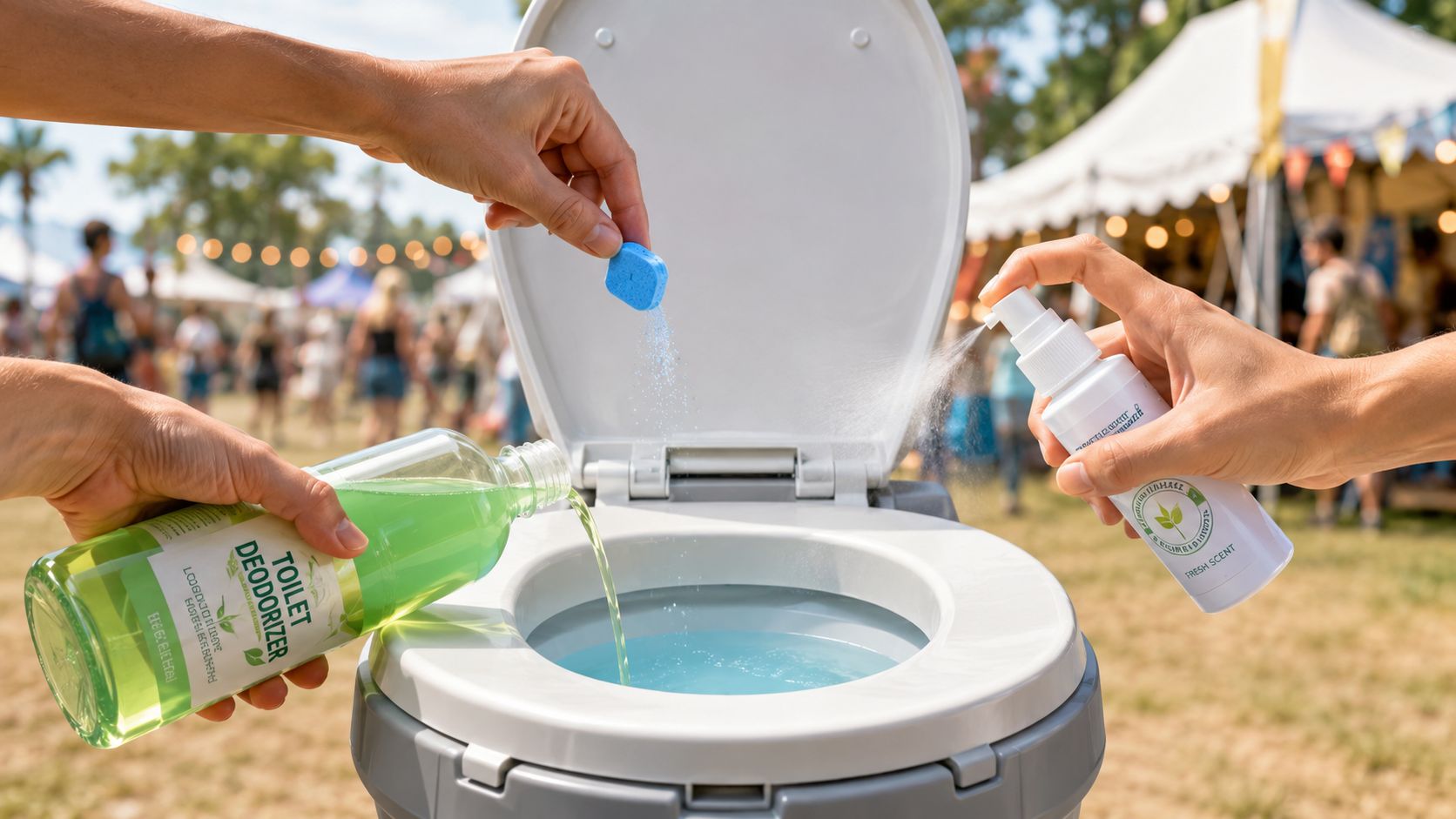
You know the moment. A unit has been sitting in direct sun, traffic keeps coming, and the smell starts drifting before anyone even opens the door. That's when portable toilet deodorizers stop being a background supply and become part of the sanitation plan.
They matter because odor control isn't just about comfort. When a restroom smells bad, people avoid it, service crews have a harder job, and the whole site feels less managed. The portable restroom industry grew from wartime shipyards in the 1940s into a global fleet of more than 3.6 million standard units by 2020, with about 2.1 million units in the United States and Canada (historical account). That scale explains why deodorizer choices became a real product category, not just an extra cleaning step. For a broader sanitation context, see this guide to cleaning public bathrooms.
Introduction to Odor Challenges and Deodorizers
A crowded festival, a construction trailer, and a highway rest stop create the same basic problem in different ways. Waste collects, heat builds, and the air inside the unit can turn unpleasant quickly. People usually notice the smell before they think about the chemistry behind it.
Portable toilet deodorizers changed as the industry moved away from older formaldehyde-based formulas and toward products that had to fit wastewater handling, worker safety, and site conditions better. That shift still matters today, because buyers now compare odor control, tank compatibility, and environmental fit instead of choosing a product only for a strong fragrance. For a broader sanitation context, see this guide to cleaning public bathrooms.
Practical rule: odor control works best when the deodorizer matches the site, the climate, the waste load, and the service schedule. A formula that performs in a cool, lightly used unit can lose effectiveness in a hot, crowded one, just as a small fan can handle a quiet room but struggle in a packed tent.
The job sounds simple, but conditions are not. Portable toilet deodorizers have to control smell in a wet, enclosed, high-use environment without harming plastic tanks, rubber parts, or the people who service them. Dosing matters here. Too little product can leave odor compounds active, while too much can waste chemical, irritate users, or create compatibility problems in the tank. Dilution matters too, because a concentrate that is mixed poorly may never reach the waste at the right strength.
Wastewater compatibility adds another layer. A deodorizer that works well in one tank can behave differently once it mixes with local disposal rules, treatment systems, and the specific waste stream at a site. That is why the first step is not picking the strongest scent. It is matching the product to how the unit is used, what is in the tank, and how the waste will be handled after service.
Understanding Masking Neutralizing and Antimicrobial Action
Portable toilet odor control usually falls into three jobs. Masking covers a bad smell with a stronger one, neutralizing changes the odor compounds themselves, and antimicrobial action tries to stop the odor source from building up in the first place.
Think of masking like lighting a scented candle in a musty room. The room still has the original smell, but your nose notices the stronger fragrance first. Neutralizing is closer to using baking soda in a refrigerator, because the goal is to reduce the odor rather than hide it. Antimicrobial action is different again, because it targets the bacteria and waste breakdown that create odor in the first place.

Why the three approaches don't mean the same thing
A product can smell pleasant and still do a weak job. That's because fragrance and odor control aren't identical. A tank freshener that only perfumes the air may help for a short period, but it won't fix a waste line that's too concentrated or a tank where solids sit above the water line.
Neutralizers aim at odor molecules, while antimicrobial systems try to change what's happening inside the tank. In practice, many products combine methods, which is why labels can feel confusing. A user may see fragrance on the front panel, then biocides or detergents in the technical sheet, and assume they're all doing the same thing. They're not.
Plain-language takeaway: if the tank conditions are poor, no fragrance can fully rescue it. Odor control has to start with the waste environment itself.
For readers who want a related cleaning concept, this germicidal overview helps explain why killing or suppressing microbes changes the cleaning outcome, not just the smell.
Exploring Types of Portable Toilet Deodorizers
Liquid concentrates are the most familiar format. They're easy to pour, easy to scale for large fleets, and often designed for fast tank coverage. The downside is that they depend on the operator measuring correctly, because too little can underperform and too much can create compatibility or cost issues.
Water-soluble pouches or tablets reduce that measuring burden. They're popular because they simplify dosing and storage, especially for teams that want consistent results across many units. Enzyme and biological powders take a different path, since they focus on breaking down waste rather than covering the odor.
Format comparison at a glance
| Format | Key Ingredients | Advantages | Drawbacks |
|---|---|---|---|
| Liquid concentrates | Biocides, dye, fragrance, detergents, sometimes a vapor-phase neutralizer (source) | Fast coverage, easy to scale for large tanks | Needs careful dilution and handling |
| Water-soluble pouches or tablets | Biological or enzyme-style treatment ingredients | Simple dosing, cleaner storage, less measuring | Can depend heavily on water level and service habits |
| Aerosol sprays | Fragrance-forward compounds | Convenient for quick touch-ups | Usually short-lived in a tank environment |
| Enzyme or biological powders | Microbial or enzymatic agents | Good for waste breakdown over time | Needs the right water balance and contact time |
The best choice depends on the use case. A high-traffic event site needs something that can hold up under heavy load, while a remote work crew may care more about storage simplicity and predictable dosing. Liquid products still dominate many fleets because they fit the operational rhythm of servicing, but the biological options are attractive where teams want a less harsh chemical profile.
A lot of confusion comes from assuming every deodorizer is trying to do the same job. One product may be built for quick scent change, another for waste breakdown, and another for compatibility with a tank system that will sit in service for days. If the job is routine servicing, simplicity often wins. If the job is sustained odor control under stress, mechanism matters more than fragrance strength.
Mechanisms of Action for Odor Control
Fragrance works by changing what the nose notices first. The scent molecules interact with olfactory receptors, so the unit seems fresher even if the tank still contains odor-producing waste. That's useful, but it's only one layer of control.
Chemical neutralization goes deeper. Oxidizers or similar compounds can break down odor-causing molecules, while encapsulation systems trap those molecules so they're less likely to reach the air. Think of it as blocking the smell before it can escape from the waste surface. That's especially useful when odor compounds are volatile and keep drifting upward.

Biological systems work on the waste itself
Biological products use microbes or enzymes to break down organic material into less odorous byproducts over time. Manufacturer guidance for a water-soluble pouch system such as Bionetix PORTA-TREAT recommends one pouch per 20 L, and the product sheet lists 1 billion CFU/g bacteria count, plus bulk density and pH ranges that indicate a biologically active treatment rather than a pure fragrance system (product data). That matters because odor isn't only in the air. It's generated by what's happening in the tank.
The easiest way to think about it is this. Fragrance changes perception. Neutralization changes chemistry. Biological action changes the waste environment. If a site has frequent use, heat, or inconsistent servicing, the last two usually matter more than the first.
Odor control is a system, not a spray.
That's the main idea many guides skip. A deodorizer can be chemically advanced, but if the tank conditions let waste sit above the water line, smell will still escape. Performance depends on the product and the environment working together.
Dosing Guidelines Safe Use and Real-World Examples
Dose is where many units succeed or fail. Too little product leaves odor unchecked. Too much can waste money, leave residue, or create compatibility questions with the tank materials. A super-concentrated liquid such as Zep XT-9992 is sold as a non-formaldehyde formula with a recommended mix of 1 pail into 55 gallons of premix, then 1 part premix to 100 parts water for the tank, with a pH of 4.0–5.0 (technical data sheet).
Why water volume changes the result
Portable sanitation guidance repeatedly points to the same practical issue, waste that rises above the water line. When that happens, odor escapes more easily. That's why operators often add enough water before dosing, so the tank contents stay submerged and the deodorizer can work across the full volume.
A field-friendly rule is to treat the tank as a mixed system, not a dry container. If there's too little water, odor concentrates. If there's enough water, odor compounds stay diluted and easier to manage. That's also why service teams often adjust the strength of the product depending on heat and use.
Two site examples
At a busy outdoor festival, the service crew usually needs a stronger maintenance rhythm. Units heat up, foot traffic rises, and smells build faster than they do at a lightly used site. A concentrated liquid or a biologically active treatment can work, but only if it's paired with enough water and frequent servicing.
At a remote construction site, the priorities shift. Storage space is tighter, the crew may want simpler handling, and consistent dosing matters more than fragrance intensity. A pouch or measured liquid can make sense there because workers are less likely to over- or under-dose when the format is built for repeat use.
The operational lesson is straightforward. Good dosing is a control problem, not a guess. Match the product to the water level, the climate, and the number of users, then keep the routine consistent.
Environmental Impact Safety Compatibility and Selection Criteria
Portable toilet deodorizers are often judged by smell first, but that overlooks the most important factor. The better question is whether the product fits the tank, the workers, and the waste stream. That's why bio-based formulas have drawn attention, including industry reporting that says they can reduce chemical runoff by 40% (market report). The exact choice still depends on the site, but the environmental angle is no longer optional.
California's DTSC advises consumers to avoid portable toilet products containing formaldehyde and to prefer biodegradable enzyme- or citrus-based options (DTSC advisory). That advice fits the broader shift away from older chemistries and toward products that are easier on people and disposal systems.
What to check before buying
- Environmental footprint: Look for biodegradable or enzyme-based options when runoff and disposal are important.
- User safety: Read the ingredient list and avoid formulas that rely on outdated harsh chemistries.
- Tank compatibility: Match the product to plastics, rubber parts, and the expected dwell time in the tank.
- Climate fit: Hot weather usually requires a more careful dosing plan.
- Service model: Pick a product that your crew can measure consistently.
For a useful contrast on broader chemical handling habits, the Crown Point pest control safety tips from The Green Advantage are a helpful reminder that reading labels and checking compatibility matters across many kinds of service chemicals, not just restroom products.
One more practical point belongs here. If the tank is hot, crowded, or under-serviced, no product choice can fully compensate for bad field conditions. That's why selection has to balance performance with the actual environment, not with marketing language alone.
Related reading on safer cleaning chemistry is also available in this hypochlorous acid for cleaning guide, which shows how ingredient choice can change both safety and cleaning behavior.
Conclusion and Best Practices
The best portable toilet deodorizers do more than smell pleasant. They work with the tank's water level, the service schedule, and the waste load to control odor at the source. That's why format, dilution, and compatibility matter as much as fragrance.
Keep the checklist simple. Choose a product that fits the climate, follow the dosing directions closely, add enough water to keep waste submerged, and avoid older formaldehyde-based products when safer alternatives are available. If your site has heavy traffic, assume the deodorizer will need support from more frequent servicing, not just a stronger scent.
Use the tank as a system, not a bottle. When the chemistry, biology, and maintenance routine line up, odor control becomes predictable instead of reactive.
If you're comparing products for a route, event, or jobsite, review the ingredient list, match it to your tank materials, and keep your crew on a consistent dosing routine. For more practical sanitation guidance and plain-English cleaning education, visit VirusFAQ.com and keep building a safer, more reliable restroom plan.
Leave a Reply