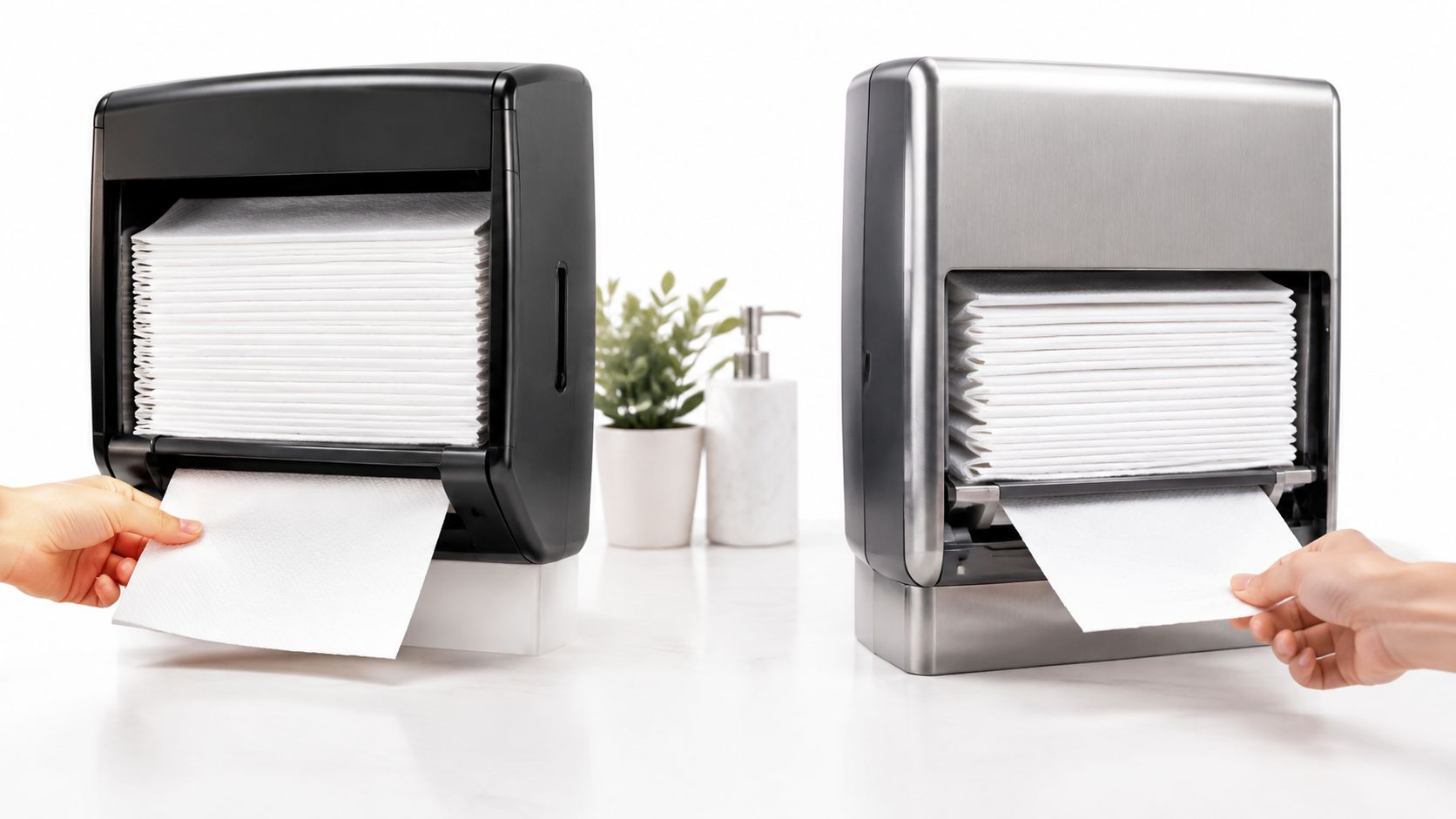
You're standing outside a busy clinic washroom when the dispenser starts behaving strangely. A patient pulls the handle, several towels come out together, and the next user finds a loose pile on the floor. The maintenance worker has loaded the wrong folded format, and a small refill mistake has become a queue, a mess, and a hygiene complaint.
That's the practical issue behind C fold vs multifold. The folds aren't cosmetic. They determine how sheets sit in the dispenser, how many come out per pull, how often staff refill the unit, and how much contact users have with the remaining stock. C-fold towels are older, flat-stacked sheets widely used in commercial settings, while multifold towels interlock to help present one sheet at a time. Industry guidance on C-fold format and dispensing and commercial fold comparisons both point to the same operational distinction.
| Decision factor | C fold | Multifold |
|---|---|---|
| Basic structure | C-shaped sheet, stacked flat | Interfolded or zigzag sheet |
| Sheet presentation | Flat stack, manual separation | Next towel presents automatically |
| Main advantage | Familiar format for compatible dispensers | Better portion control |
| Main risk | Multiple sheets can pull together | Poor performance in an incompatible dispenser |
| Best fit | Existing C-fold hardware and simple public washrooms | Compatible enclosed dispensers and hygiene-focused areas |
Why the Fold You Pick Actually Matters
A folded towel dispenser is a small mechanical system. The stack has to remain aligned, the opening has to release the leading sheet, and the next towel has to move into position without tearing. Change the fold, and you change each of those conditions.
Three operational effects to watch
Clump pulling is the first failure. C-fold towels aren't interlocked, so a user may grip the exposed edge and pull several sheets from the stack. The towels can bunch at the opening, fall forward, or land partly outside the cabinet. Guidance from The Cleaning Station describes the structural difference directly: C-fold sheets lie stacked, while multifold sheets overlap to support one-at-a-time dispensing.
The second effect is user compensation. When people receive a damp or crumpled sheet, they often reach back for another. That response isn't caused only by absorbency. It can begin with poor presentation, a torn edge, or a dispenser opening that makes the first sheet difficult to grasp.
The third effect appears on the cleaning schedule. A dispenser that releases multiple sheets empties faster, especially during busy periods. Staff then make additional refill visits, while discarded towels increase the pressure on waste bins and the floor around the unit.
Practical rule: Treat the towel and dispenser as one operating system. A format that performs well in its intended hardware can fail when loaded into the wrong cabinet.
The decision therefore isn't merely whether multifold is “better.” It's whether the current dispenser, traffic pattern, refill routine, and hygiene requirements support the format you're buying. In a school corridor, a durable existing C-fold unit may be more practical than an immediate hardware replacement. In a clinic, controlled presentation and enclosed storage may justify multifold equipment.
The rest of the decision comes down to three trade-offs: geometry, which controls dispensing; consumption, which affects waste and labor; and hygiene, which depends on how users and staff interact with the unit.
What Each Fold Actually Looks Like
A C-fold towel has two folds that create a C shape, then sits in a flat stack. The sheet is often a larger format, around 30 x 23 cm before folding, as shown in Foremost's comparison of hand-towel folds. Each towel remains separate, so the user pulls directly from the stack. The dispenser does not present a connected successor.
A multifold towel, also called an M-fold in some product descriptions, uses an interfolded or layered arrangement. One sheet overlaps the next, helping position it at the opening after removal. These towels are often smaller in footprint, around 24–27 x 23 cm, so the fold carries more of the portion-control work.

Why the shape changes the user experience
The practical difference appears at the dispenser opening. A C-fold stack resembles separate cards. A careful pull may remove one towel, but an angled grip, loose stack, or narrow opening can bring several sheets forward. In a busy school or office washroom, that turns a fold choice into a consumption and refill issue.
A multifold stack behaves more like a connected chain. Each towel helps position the next one, which is why Tork's explanation of C-fold and Z-fold towels associates interleaved presentation with fewer multiple-sheet touches. The result depends on the cabinet, not the fold alone. Opening width, stack height, loading direction, and towel dimensions all affect feeding.
A partly empty dispenser can expose the same weakness differently. C-fold towels may shift or spread inside the cabinet, while multifold towels may stop feeding if their dimensions do not match the guide.
The useful distinction
C-fold is stacked and independent. Multifold is overlapped and sequential. That structural difference affects how the first towel is gripped, how the next towel appears, and how reliably the stack feeds during active use.
C Fold vs Multifold at a Glance
The table below is a buying reference, but it shouldn't replace a dispenser check. Manufacturers use different sheet sizes and pack configurations, so the exact product specification still controls compatibility.
| Attribute | C Fold | Multifold |
|---|---|---|
| Fold pattern | C-shaped fold | Interfolded, zigzag, or layered fold |
| Sheet arrangement | Flat stack | Overlapping stack |
| Typical unfolded format | Often around 30 x 23 cm before folding | Usually around 24–27 x 23 cm |
| Approximate length examples | C-fold sheets are typically about 32 cm long | M-fold sheets are typically about 32 cm long |
| Presentation | Leading sheet is pulled from a stack | Next sheet partially presents after removal |
| Dispensing behavior | May release several towels at once | Designed for one-at-a-time dispensing |
| Footprint | Generally larger | Usually smaller |
| User grip | Pulls a flat, folded edge | Grasps a presented leading edge |
| Common hardware relationship | Older or universal folded-towel dispensers | Compatible single-sheet-release dispensers |
| Main operational concern | Over-pulling and loose stacks | Jams or poor feeding if the dispenser isn't compatible |
The most important contrast isn't the number of panels. It's the relationship between the sheet and the opening. C-fold towels depend more heavily on the user pulling neatly from a stable stack. Multifold towels use the overlap between sheets to guide presentation.
That difference also affects how a buyer should compare products. A larger C-fold sheet may feel generous in the hand, but a larger sheet doesn't automatically mean lower consumption. If the dispenser releases multiple towels or users take an extra sheet because the first one is awkward, the nominal sheet size tells only part of the story.
Likewise, a multifold towel's smaller footprint isn't evidence that it will always dry hands less effectively. Commercial towel guides describe multifold towels as often slightly more absorbent and capable of drying hands with fewer sheets, but performance still depends on the paper construction and how users dispense it. The Cleaning Station's folded-towel guide also emphasizes that cost per use depends on actual consumption, not just the case price.
Use this table as a checklist. Confirm the opened dimensions, folded dimensions, ply, pack count, and dispenser specification before treating one format as a drop-in substitute for the other.
Dispenser Compatibility and the Switch Question
The most common purchasing error is assuming that “universal” means every folded towel will feed equally well. It doesn't. Some standard dispensers accept both formats, but multifold towels perform best in hardware designed for single-sheet release, while C-fold towels need enough tray space and a suitable opening for a flat stack.
An open-face or recessed folded-towel cabinet may accommodate C-fold stock. The stack sits flat, and the user pulls the exposed fold. As the stack becomes low, the remaining towels can lose support and fall forward, which makes presentation less consistent.
Multifold towels generally suit enclosed dispensers with an opening, valve, or push-bar arrangement that supports sequential feeding. The key is not the brand label alone. Check the dispenser's accepted fold, opening dimensions, maximum stack height, and loading direction. A folded-towel dispenser compatibility guide also highlights the practical gap between theoretical compatibility and reliable real-world dispensing.
What goes wrong during an emergency swap
Loading C-fold towels into a multifold dispenser can create a compressed or bunched stack. The leading sheet may fail to present, tear at the opening, or force the user to pull repeatedly. That encourages handfuls of towels and leaves crumpled sheets around the unit.
The reverse problem is less dramatic but still wasteful. Multifold towels placed in a C-fold tray may slump inside the cabinet, sit below the intended pickup point, or release more than one sheet because the tray doesn't support the interfolded stack correctly.
Don't rely on a verbal product description during a refill emergency. Measure the dispenser opening and interior clearance, then compare those measurements with the supplier's unfolded and folded dimensions. Confirm whether the unit is rated for C-fold, multifold, or both.
| Dispenser type | Compatible fold | Incompatible fold | Failure mode |
|---|---|---|---|
| Open-face flat tray | C fold, where specified | Multifold if the tray doesn't support it | Slumping or multiple-sheet pulls |
| Enclosed folded-towel cabinet | C fold or multifold, depending on model | Any unapproved format | Jams, tearing, or poor presentation |
| Single-sheet-release dispenser | Multifold | Loose C-fold stack | Leading sheet fails to feed cleanly |
| Universal folded-towel dispenser | Check manufacturer specification | Unverified format | Unpredictable dispensing |
| Recessed legacy cabinet | Usually C fold | Multifold without fit confirmation | Stack instability or blocked opening |
Product families such as Tork H1 and H2 equivalents illustrate why model identification matters, while Kimberly-Clark formats also vary by dispenser system. Don't order by a general “folded towel” description. Match the towel SKU to the mounted dispenser documentation, especially when replacing stock from another manufacturer.
For a deeper hardware checklist, review this guide to folding paper towel dispensers. A switch can work, but it should be treated as a controlled compatibility test, not an automatic upgrade.
Absorption, Drying, and Sheets Per Use
A school washroom can show the difference quickly. One visitor pulls a single towel, another takes several after a weak first release, and the next person faces a depleted or untidy stack. Both C-fold and multifold towels can dry hands effectively, but their format influences portion control, handling, and replenishment work.
C-fold towels often provide a larger individual sheet. That surface area can support effective drying, yet the benefit declines when the dispenser releases multiple towels or users take another sheet because the first pull feels inadequate. A larger sheet therefore does not automatically mean lower consumption.
Multifold towels present a defined portion through their interlocked design. The next towel appears at the opening as one sheet is removed, so users can usually begin drying without reaching into the stack. Tork's guidance on dispensing mechanisms connects controlled dispensing with reduced handling and improved hygiene conditions. In active washrooms, that distinction also makes unusual consumption easier for facilities staff to spot.

The hygiene connection
Dispensing affects hygiene through user contact. A jammed opening invites repeated tugging, while a stack that releases several towels may lead users to touch adjacent sheets before discarding the excess. Interleaved formats can reduce that interaction, provided the dispenser feeds them correctly. A poorly fitted unit can reverse the intended benefit through jams and repeated handling.
The towel itself is not a disinfectant. Surface disinfection depends on wipe chemistry and wet contact time. The PREempt wipe reference sheet specifies a 3-minute wet contact time for hard, non-porous surfaces, which applies when staff clean dispenser levers, cabinet fronts, and nearby touchpoints.
A controlled study found that disinfectant wipes with active ingredients achieved about 5.5 to 6.6 log10 inactivation under tested conditions, while a plain cloth transferred about 4 log10 to another carrier. The Frontiers in Public Health study shows why cleaning product and method matter alongside towel format.
Cost and Waste Implications
A facilities manager shouldn't compare C-fold and multifold by carton price alone. The meaningful unit is the cost per completed hand dry, which includes the number of towels dispensed, premature refills, jam clearing, and waste handling.
Verified guidance indicates that C-fold towels may require about three to four times as many per use as M-fold towels in some operating contexts, although actual consumption depends on the dispenser, towel quality, and user behavior. The folded-paper-towel comparison presents that industry claim alongside the dimensional differences between formats.
That range shouldn't be converted into a universal budget promise. A well-maintained C-fold dispenser may perform better than an overloaded or damaged unit, while a poorly matched multifold dispenser can erase the intended advantage through jams and failed presentation.
What to measure before approving a change
Track the variables that your purchasing file usually misses:
- Sheets removed: Compare case depletion with restroom visits or another consistent usage measure.
- Refill events: Record when staff refill early, especially during known busy periods.
- Discarded towels: Look for floor waste, crumpled piles, and towels left beside bins.
- Service time: Log jam clearing and extra inspection rounds.
- Dispenser condition: Check whether the cabinet is bent, overloaded, dirty, or poorly positioned.
| Metric | C-Fold | Multifold | Annual delta |
|---|---|---|---|
| Portion control | More dependent on user behavior | Supported by interlocking design | Depends on observed use |
| Multiple-sheet risk | Higher when the stack is loose or the dispenser is underfilled | Lower in compatible hardware | Measure locally |
| Refill pressure | Can rise when users pull several sheets | Usually easier to control | Compare refill logs |
| Floor and bin waste | Can increase with clumps and over-pulling | Often lower when presentation works correctly | Audit before and after |
| Labor exposure | More opportunities for jam clearing and extra checks | Less dispensing intervention in suitable dispensers | Record service minutes |
A supplier page on hygiene products in bulk can help organize procurement, but the decision should remain site-specific. The strongest business case comes from your own usage audit, not an assumed annual saving.
The hidden cost is operational friction. A towel that looks cheaper on the invoice can consume more staff attention when it falls from the stack, jams at the opening, or empties before the scheduled round. Conversely, replacing compatible C-fold stock with multifold may not be sensible if the hardware is old, damaged, or incapable of supporting the new feed pattern.
Matching the Right Fold to the Right Setting
The best format depends on what the washroom asks users and staff to do. A private office restroom, a public school corridor, a clinic waiting area, and a food-preparation station don't create the same dispensing problem.
A setting-by-setting decision
| Setting | Recommended format | Key rationale |
|---|---|---|
| Home | Either, based on available hardware | Low complexity makes familiarity and fit more important than maximum control |
| Office | Multifold in compatible dispensers | Clean presentation and controlled dispensing suit shared staff washrooms |
| Healthcare | Multifold in enclosed, compatible dispensers | Reduces multiple-sheet handling and protects the remaining stack |
| Food service | Multifold near handwashing points | Supports controlled access where adjacent sheets should remain untouched |
| Education | C fold in durable existing units, multifold in staff areas | Hardware durability and traffic patterns differ across the building |
In a home, buying a new dispenser for a different fold may add unnecessary complexity. Choose the format that fits the cabinet you already have and that household users can load consistently.
In an office, multifold is usually the more controlled folded option when the dispenser supports it. The interfolded presentation creates a predictable user interaction, and a neat opening makes it easier for staff to spot an empty or misloaded unit.
Healthcare requires a sharper distinction. Use enclosed, compatible multifold dispensers in clinics, patient-facing areas, and other hygiene-sensitive locations where limiting contact with the remaining stack matters. Existing C-fold equipment may still serve a public restroom or break room, but it shouldn't be assumed to provide the same dispensing control.
Food service has two zones. Behind the line, staff need clean, accessible hand-drying supplies that don't invite repeated contact with the stack. In a customer restroom, the priority may shift toward durability, appearance, and reliable replenishment.
Schools often need a building-wide compromise. Student corridors may favor durable existing C-fold cabinets if replacement isn't practical, while staff-only areas can use compatible multifold dispensers. The deciding factors are user behavior, supervision, refill access, and hardware condition, not just the cheaper carton.
For broader facilities routines, see this guide to cleaning public bathrooms. It reinforces the same operating principle: towel selection works best when it supports the whole cleaning and restocking plan.
Making the Call and Beyond the Towel
Use three questions to make the decision:
- What dispenser is already mounted? Confirm the accepted fold, opening, internal clearance, and loading direction.
- What is the traffic pattern? Consider steady office use separately from sharp peaks in schools, clinics, and public venues.
- What is the hygiene priority? If single-sheet presentation and limited contact matter most, choose compatible multifold hardware.
Choose C-fold when an existing C-fold dispenser is reliable, the washroom needs a familiar flat-stack system, and replacing the cabinet would create unnecessary disruption. Choose multifold when the dispenser supports interlocked towels and the facility needs tighter portion control, cleaner presentation, or reduced multiple-sheet handling.
Switching formats without changing dispensers can work in some universal units, but it can also create jams, slumping, tearing, or excess dispensing. Hardware replacement may erase the apparent product saving, so evaluate the full lifecycle rather than approving a carton based on its unit price.
Hand drying also depends on user behavior. People need enough time, friction, and coverage to remove moisture effectively, while staff need the dispenser mounted at a practical height, the waste bin placed close enough to catch used towels, and the unit inspected before peak periods.

Review your current dispensers, record refill and jam events, and test the intended towel under normal use before standardizing across a building. For further virus education, prevention guidance, and evidence-led hygiene content, visit VirusFAQ.com.
Leave a Reply