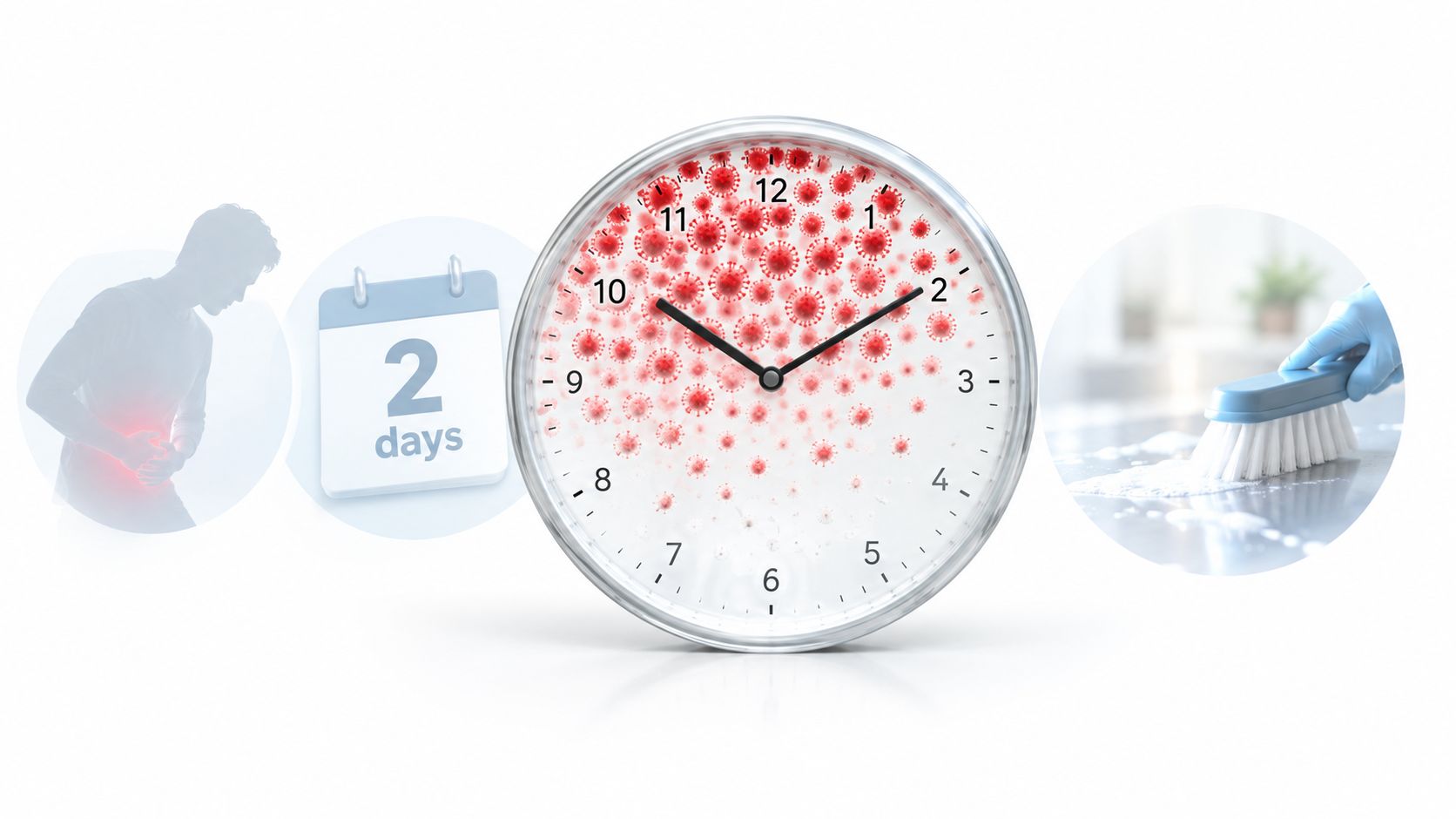
Symptoms usually start 12 to 48 hours after exposure, with a median of 33 to 36 hours in outbreaks. Peak shedding happens 2 to 5 days after infection, and shedding can continue for 2 weeks or more after recovery, which is why people can still spread norovirus after they feel normal again.
You're probably here because someone in your home, clinic, school, or workplace got sick fast, and now everyone is trying to answer the same question: when does norovirus start, and when does it stop being contagious? That question sounds simple, but norovirus rarely follows the single timeline people expect.
Introduction Why Norovirus Timing Catches Everyone Off Guard
A common household version goes like this. One child vomits overnight. By the next evening, a sibling is sick. A parent cleans the bathroom, feels fine, then develops symptoms the following day. By the time the family thinks the worst has passed, the kitchen trash lid, bathroom faucet, and bedroom doorknobs may still be part of the story.

That's why norovirus transmission time is so often misunderstood. People tend to think in one clock: exposure, then symptoms, then recovery. Norovirus uses several clocks at once, and they overlap in ways that make outbreaks feel sudden and stubborn.
The five clocks people miss
To make sense of it, it helps to track five separate timelines:
- Incubation means the wait between exposure and symptoms.
- Peak shedding means when the body is releasing the most virus.
- Post-symptom contagiousness means the tail end, after vomiting and diarrhea stop.
- Environmental persistence means how long virus on surfaces can stay part of the chain.
- Isolation timing means the practical decision point for staying home, returning to work, and handling food.
A cruise ship outbreak makes this even easier to understand. One sick passenger isn't just one sick person. There's the person's symptom window, the cleanup window after vomiting, the contamination window for touched surfaces, and the return-to-shared-space window. Those clocks don't end together.
Why this matters: Feeling better is a symptom milestone, not a transmission milestone.
Clinicians see this in facilities. Families see it in bathrooms and kitchens. School staff see it when one student returns too soon and a second wave follows. The biology is the same in every setting. Norovirus moves quickly at the front end and lingers at the back end.
How Quickly Norovirus Starts After Exposure
A familiar family scenario goes like this: one person feels fine at bedtime, then starts vomiting before sunrise. By the next evening, someone else in the house is sick too. Norovirus creates that whiplash because its first clock, incubation, runs fast.
Incubation is the delay between exposure and the first symptoms. For norovirus, that delay is usually short. CDC-linked outbreak guidance summarized earlier notes a typical window of about 12 to 48 hours after exposure, with many cases clustering around a day to a day and a half. That narrow window helps explain why a shared meal, one bathroom accident, or one cleanup event can seem to turn into an outbreak almost overnight.

Incubation works like a short countdown
With some infections, the first clock stretches out long enough that people lose track of the exposure that started it. Norovirus usually does the opposite. The gap is short enough that the triggering event is often still recent, but not always obvious.
If exposure happened at lunch on Monday, the period to watch most closely is Monday night through Wednesday. Early symptoms can show up within the first half day. More often, people notice sudden nausea, vomiting, stomach cramps, or diarrhea the next day.
| Exposure time | What to watch for |
|---|---|
| First 12 hours | Early edge of the range. Symptoms may start, but many people are still in the waiting period |
| About 1 to 2 days later | Common window for abrupt onset of nausea, vomiting, or diarrhea |
| Around a day to a day and a half | A useful rule-of-thumb midpoint seen in many outbreaks |
That speed creates confusion for a simple reason. Human memory likes one neat cause. Public health timing is messier. If two relatives get sick 24 hours apart, they may have been infected by the same original exposure, or the second person may have been infected during cleanup or bathroom contact soon after the first person became ill.
A short incubation clock is why norovirus feels sudden. It also sets up the mistake that drives many second-wave cases: people assume that once the first symptoms pass, the risk has passed too. It has not. Feeling sick belongs to one clock. Transmission uses several.
If you want a focused explainer on this first clock alone, VirusFAQ has a separate guide on the norovirus incubation period.
When You Are Most Contagious and Why Peak Shedding Matters
A common family scene explains this clock better than any definition. A child vomits at 2 a.m. One parent grabs towels. Another carries the child to the bathroom. Someone strips the bed, wipes a doorknob, then answers a phone. The highest-risk period often begins right there, during the fast, messy minutes when virus is being released and everyone nearby is touching the same small set of surfaces.
People are usually most contagious while symptoms are active, especially during vomiting and diarrhea, and CDC notes that virus shedding can continue for at least 2 days after symptoms stop (CDC overview of norovirus transmission). On the five-clock timeline, this is the peak-shedding clock. It overlaps with symptoms, but it does not match symptoms perfectly.

Peak shedding follows a curve, not a switch
Symptoms feel dramatic, so people naturally treat contagiousness like a light switch. Sick means risky. Better means safe. Norovirus does not behave that neatly.
A widely cited review in CDC's Emerging Infectious Diseases reports that peak viral shedding occurs about 2 to 5 days after infection, stool viral load can become extremely high, and the exact point when someone is no longer contagious is still uncertain (CDC Emerging Infectious Diseases review). A simpler way to picture it is a hill, not a cliff. The amount of virus rises, reaches a high point, and then declines over time. That is why a person can look a little improved while transmission risk is still very real.
Norovirus spreads well through ordinary care activities. Bathroom help, diaper changes, laundry handling, sheet changes, and toilet cleaning all create chances for virus from stool or vomit to move to hands, then to faucets, light switches, door handles, and food.
Vomiting changes the exposure zone
Diarrhea gets much of the attention because stool is a major source of virus. Vomiting adds another problem. CDC's Yellow Book notes that norovirus can spread through aerosols of vomitus and through contaminated objects and surfaces, called fomites (CDC Yellow Book on norovirus).
That means the risk is not limited to what looks dirty. A vomiting event can spread contamination beyond the visible splash area, especially in a small bathroom, bedroom, classroom, or shared cabin. Cleanup speed and technique matter because the room can become part of the transmission chain within minutes.
What peak shedding looks like in real life
Peak shedding is a laboratory term, but the practical meaning is straightforward:
- During active vomiting: contamination can spread beyond the obvious mess
- During diarrhea and toilet use: stool is a major source for hand and surface contamination
- During hands-on caregiving: one pair of hands can quickly connect the patient, linens, bathroom surfaces, and shared items
- During early recovery tasks: someone may feel steady enough to prepare food or return to routine before transmission risk has dropped as much as they assume
One idea helps tie this together. Symptoms are what the patient feels. Shedding is what the virus is doing. Those clocks overlap, but they are not identical.
Outbreaks often expand during caregiving and cleanup, not only during the first moment a person gets sick.
For clinicians, this explains why prompt containment around vomiting events matters so much. For households, it explains why the busiest caregiving hours are often the point when one illness becomes several.
How Long You Stay Contagious After Symptoms Stop
A common family scenario goes like this. Someone is sick overnight, sleeps most of the next day, and by the following morning says they feel normal again. The stomach has settled. The appetite is back. The question comes quickly: can they go to school, work, or back to cooking for everyone else?
With norovirus, the answer depends on which clock you are looking at. The symptom clock may have stopped. The contagiousness clock often has not.
CDC guidance says people can continue to shed norovirus for at least 2 days after symptoms stop, and shedding can continue for 2 weeks or more after recovery (CDC MMWR outbreak guideline). That gap is the reason this part of the timeline catches people off guard. Feeling better measures comfort. It does not reliably measure transmission risk.

Recovery on the couch is different from recovery in the kitchen
The practical problem is easy to miss. A person who no longer feels sick starts doing normal things again. They make toast, help a child in the bathroom, answer a phone, fold laundry, or pack lunches. Those are ordinary recovery-day tasks. They are also the exact hand-to-surface and hand-to-food steps that can keep transmission going.
This is why the third clock in the norovirus timeline matters so much. Symptoms are only one signal. Shedding after symptoms stop is another.
| What feels true | What infection control assumes |
|---|---|
| The stomach is calm again | Virus may still be leaving the body |
| Energy is coming back | Hand hygiene still needs extra attention |
| The person looks recovered | Return to food prep may still be too soon |
| The emergency seems over | The transmission window may still be open |
Why public-health advice uses a 48-hour buffer
People often hear that norovirus shedding can continue well beyond the day they feel well and jump to the wrong conclusion. They assume every later day carries the same risk. That is not how this works.
A better way to picture it is a fading trail of glitter. The biggest spill has already happened, but small amounts can still spread if hands, bathrooms, laundry, or food are handled carelessly. Public-health recommendations focus on the period right after symptoms stop because that is the part of the tail most likely to matter in real life, especially in homes, schools, care settings, and food service.
Practical rule: Keep isolation in place for at least 48 hours after symptoms end.
That advice is especially important for food handlers, caregivers, and anyone sharing a bathroom with others.
The long tail matters, but it does not mean a month of panic
Researchers have documented prolonged detection after recovery, including in outbreak and review literature from CDC and peer-reviewed studies (CDC Emerging Infectious Diseases review). The key point for readers is simpler than the lab language. Norovirus can remain part of the transmission chain after the patient seems well, even though the highest day-to-day risk is not necessarily the same throughout that entire period.
So the safest interpretation is practical, not dramatic. Do not assume “back to normal” means “no longer contagious.” Use the post-symptom window for stricter handwashing, delayed food preparation, and careful bathroom cleaning. That is how you respect the third clock without overreacting to it.
How Long Norovirus Survives on Surfaces and Extends Transmission
The fourth clock sits outside the body. It's the reason a room can stay part of an outbreak after the sick person has already left it.
Peer-reviewed surface survival studies show that infectious norovirus or close surrogates can remain detectable on nonporous surfaces for 14 to 30 days, including stainless steel, glass, ceramic, and plastic. One study found infectious virus still present on some surfaces at day 20, and another detected human norovirus through day 30 under organic-load conditions (surface persistence study summary).
The room can keep the outbreak going
This explains a pattern families recognize. A child gets sick in the bathroom on Monday. The room looks clean by Tuesday. Another person touches the flush handle, faucet, or light switch later in the week and then eats a snack without fully washing up. The transmission chain didn't require fresh symptoms in that moment. The environment carried part of the timeline.
Nonporous surfaces matter because they're common and easy to overlook:
- Bathroom fixtures like toilet handles, faucets, and counters
- Kitchen touchpoints such as refrigerator handles and cabinet pulls
- Shared objects including phones, remote controls, and tablets
- Care surfaces like bed rails, tray tables, and plastic bins
Cleaning timing matters as much as cleaning effort
A fast wipe after a vomiting event may reduce visible mess without interrupting transmission. Norovirus control depends on removing organic material, then disinfecting thoroughly, and then repeating attention to the high-touch surfaces people forget on the first pass.
That's one reason facility managers and infection-control teams treat environmental services as a public-health function, not cosmetic work. A broader discussion of cleaning as a critical service for hygiene helps frame why contaminated environments can extend risk well beyond the acute illness window.
If you want a dedicated breakdown of materials, touchpoints, and survival conditions, this guide on how long norovirus lives on surfaces goes deeper.
What Transmission Timing Means for Isolation and Cleaning
Once you put the five clocks together, the practical decisions become clearer. You're not trying to guess one magical “safe” moment. You're trying to interrupt the handoff points where norovirus usually moves.
Isolation decisions that fit the biology
The shortest useful rule is also the easiest to remember: stay home for at least 48 hours after symptoms end. That doesn't erase the longer shedding tail, but it does cover the period public-health guidance treats with the most caution.
For certain roles, the bar should feel higher in practice:
- Food handlers: Don't prepare food for others during illness or during the immediate recovery window.
- Caregivers: Keep handwashing and glove changes disciplined even after the patient seems better.
- Parents: Treat the first day back to school or childcare as a hygiene test, not a symptom check.
- Clinicians and facility staff: Match return policies to role risk, especially when people handle food, body fluids, or vulnerable patients.
If you only use “I feel okay now” as your return standard, you're using the wrong clock.
Cleaning actions that matter most
After a vomiting or diarrhea event, timing matters. Clean promptly. Focus on the obvious contamination first, then the surfaces hands reach afterward. Soap and water handwashing matters more than relying only on sanitizer during the norovirus window, especially after bathroom use or cleanup.
A practical home sequence looks like this:
- Contain the area. Keep others out during cleanup if possible.
- Remove visible soil first. Disinfection works poorly on a dirty surface.
- Disinfect high-touch surfaces nearby. Think beyond the floor or sink.
- Handle laundry carefully. Anything soiled joins the transmission timeline.
- Repeat handwashing. After glove removal, after laundry handling, and before touching food.
For readers building a household or workplace response plan, VirusFAQ.com has one practical option among many in its step-by-step guide on how to disinfect norovirus, which focuses on cleanup sequence and surface priorities.
Return-to-normal should be gradual, not symbolic
People often make one big “all clear” decision. Norovirus control works better when you make several smaller decisions well. Return to work isn't the same as return to food prep. A child feeling playful isn't the same as a bathroom being low-risk. A wiped counter isn't the same as a disinfected high-touch zone.
That mindset shift helps both households and facilities. You don't need perfection. You need the right actions at the right points on the timeline.
Key Takeaways to Stop Norovirus From Spreading Further
A family member stops vomiting in the morning and feels close to normal by dinner. That is often the moment households make the wrong call. Feeling better closes only one clock. The other clocks can still be running.
The practical lesson is simple. Do not make one big “safe now” decision. Make a few smaller timing decisions based on the role the person is returning to and what they will touch.
A simple return checklist
Use this quick screen before someone resumes normal activities:
- Office work or school attendance: wait until symptoms have fully stopped, then follow the home, school, or workplace policy for return.
- Food handling for others: be stricter. Delay return longer than you would for routine desk work if any recent vomiting or diarrhea raises concern about contamination risk.
- Child care, elder care, or patient care: use the same stricter standard, because hands, bathrooms, laundry, and shared surfaces connect people quickly.
- Shared bathroom use at home: keep cleaning routines intensified for a while after the sick person improves.
- Cooking for the household: restart only when handwashing is dependable and the person is no longer having sudden urgent trips to the bathroom.
This is why norovirus spreads so easily in homes, schools, and care settings. One person may be recovering, while the kitchen, bathroom handles, laundry basket, or caregiving routine is still on a different clock.
A useful rule is to match the precaution to the task. Low-contact tasks come back first. Food prep and hands-on care come back last.
The safest return is staged, not all at once.
For families, that often prevents the second round where another person gets sick just as the first person seems recovered. For clinicians and facility teams, it supports clearer staff assignments, safer meal service, and fewer avoidable exposures during cleanup and handoff.
Good prevention still looks ordinary. Stay home when you are supposed to. Wash hands with soap and water at the right moments. Treat return to cooking and caregiving as separate decisions, not automatic signs of recovery.
Leave a Reply