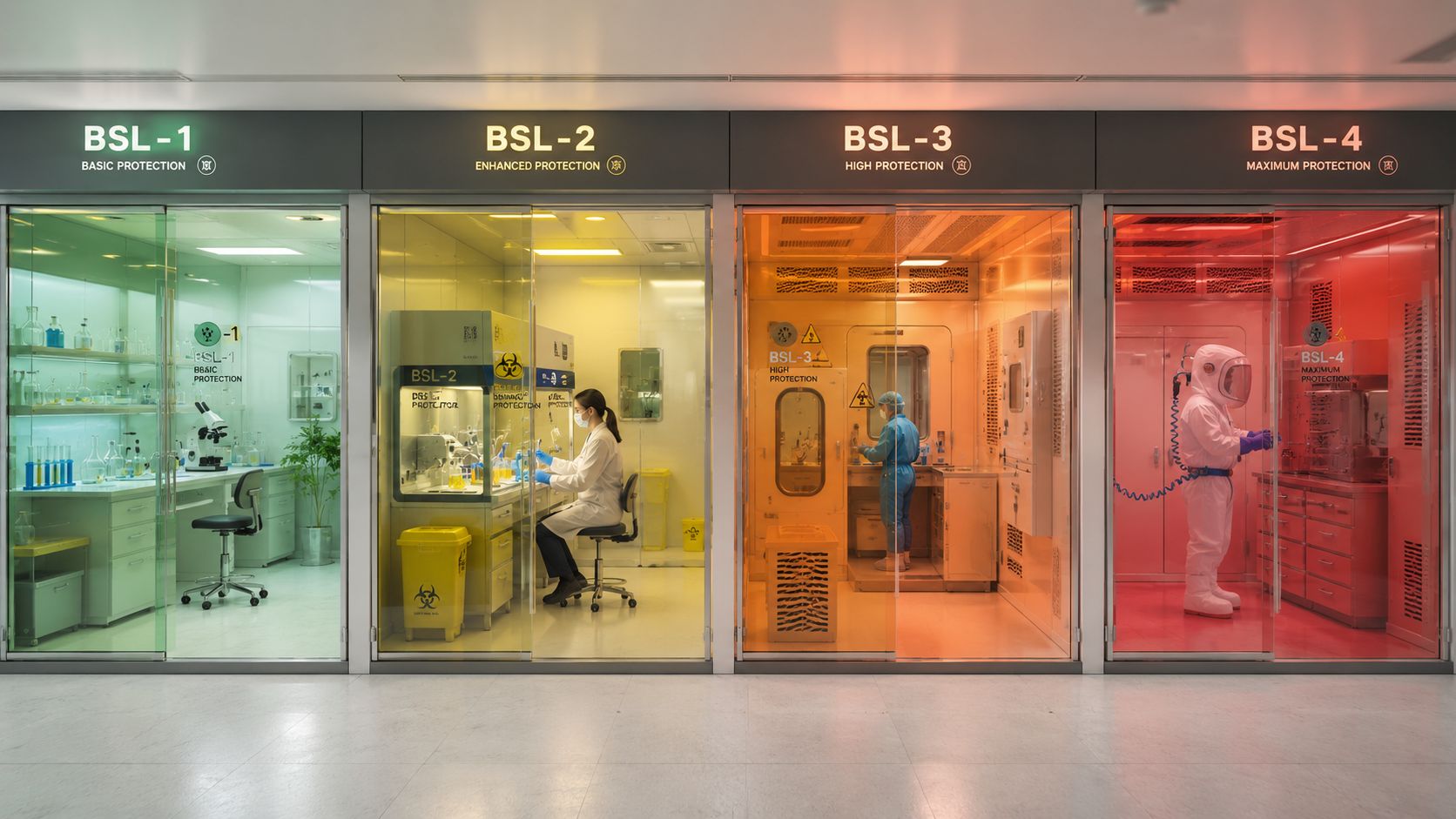
3 to 3.5 laboratory infections per 1,000 laboratory employees per year was the kind of risk signal that forced biosafety to become a formal discipline, not just a matter of good habits. Those older U.S. surveillance surveys from 1978 to 1986 helped drive the modern containment mindset, because they showed that laboratory work can injure the very people doing the science, even when everyone means well and follows routine practice. The answer became the four-level laboratory biosafety system, BSL-1 through BSL-4, a framework now used across CDC, NIH-linked, and WHO-aligned guidance to match risk with controls in a structured way.
Laboratory biosafety levels are not labels for prestige or panic. They're a practical way to combine microbiological practices, safety equipment, and facility design so that the same organism is handled differently depending on the task, the exposure route, and the consequence of a mistake.
Why Laboratory Biosafety Levels Exist
The reason biosafety levels exist is simple, even if the systems around them look complicated. People in labs got sick, and the pattern was serious enough that the field had to stop relying on custom and memory. Historical surveillance found that the annual incidence of laboratory infection was high enough to justify standardized containment, and later reviews kept showing that laboratory-acquired infection never disappeared as a risk, it just became more manageable when labs used formal barriers and procedures (CDC BMBL 6th edition, ISID laboratory areas guide).
The four-tier model is a containment logic, not a ranking of “bad” organisms
BSL-1 sits at the lowest end and fits organisms not known to consistently cause disease in healthy adults. BSL-4 sits at the top and is reserved for dangerous agents requiring maximum containment, including airlocks, shower exits, and specialized waste disposal (CDC BMBL 6th edition). The middle levels fill the everyday space between those extremes.
That structure matters because biosafety isn't just about the microbe. The modern framework combines the organism, the procedure, the route of exposure, and the environment where the work happens. The same biology can demand different containment when someone is doing a simple diagnostic test versus concentrating material, aerosolizing it, or handling sharps.
Practical rule: if the work increases the chance of inhalation, splash, puncture, or uncontrolled spread, the containment level often has to rise with it.
A useful way to think about the system is that it answers one question: what barriers do we need so the work can happen without turning the lab into the exposure site? That is why the four-tier model became the foundation for microbiology and virology labs worldwide, and why it still anchors decisions from teaching labs to maximum containment suites.

How Biosafety Levels Are Selected Through Risk Assessment
A pathogen's name alone doesn't decide the biosafety level. Risk assessment does. CDC and WHO guidance both treat infectivity, disease severity, transmissibility, route of exposure, and the specific work being performed as the decision set, which is why the same organism can land in different containment categories depending on what the staff are doing (CDC biosafety training, BMBL 6th edition).
The agent is only one part of the decision
A lab manager looks at the microorganism, then asks what the procedure changes. Aerosol-generating manipulations, large-volume culture, and sharps use all increase exposure opportunities, so they can push work toward higher containment even when the organism itself isn't the most notorious one in the field. That's why biosafety designations are better understood as a composite risk choice, not a fixed moral category.
A stronger way to make the decision is to ask the same questions every time. What can get into the body. How likely is spread. How severe would disease be if exposure happened. Can the work be done in a cabinet, or does it have to happen on the bench. Does the facility have the controls to support the procedure without improvisation.
For people who want a structured checklist, a practical facility assessment guide can help turn those questions into an orderly review before work starts.
Risk assessment comes first. If that step is weak, the rest of the containment plan is just paperwork.
The consequences of that assessment are concrete. They shape airflow control, access restrictions, decontamination workflows, and PPE requirements. They also influence whether a protocol can be approved at all, because a biosafety decision is really a workflow decision wrapped in safety language. For readers comparing exposure routes and precautions in more detail, this site's overview of airborne vs droplet precautions fits naturally with the way biosafety uses route of exposure as a core input.

BSL-1 and BSL-2 for Everyday Laboratory Work
BSL-1 and BSL-2 are the levels most students, clinicians, and academic staff will meet. They are also where confusion starts, because the difference is not just about “more dangerous bugs.” It is about how much discipline the work needs around handling, access, and protection, and how much the room itself has to help enforce those habits.
BSL-1 is the baseline for routine teaching and low-risk work
BSL-1 fits organisms not known to consistently cause disease in healthy adults, and the setup is intentionally simple. Standard microbiological practices apply, work is usually done on open benchtops, and the focus is on good habits rather than specialized engineering. The lab still needs order, because careless technique can create risk even in a low-containment room.
BSL-2 adds controls for common clinical and research work
BSL-2 is the workhorse level for agents associated with human disease of varying severity when exposure may occur through ingestion, percutaneous injury, or mucous membranes (BSL-2 table, PMC). Its controls are concrete. The lab needs limited access, biohazard warning signs, sharps precautions, a biosafety manual with waste decontamination or medical surveillance policies, laboratory coats and gloves, and Class I or II biosafety cabinets for splash- or aerosol-generating work.
The facility details matter too. BSL-2 includes an open benchtop sink and an autoclave, the kind of requirements that often get left out of oversimplified summaries. Those are not decorative additions. They support routine handwashing, cleanup, and decontamination in the same room where work is happening, which is why containment has to be read as a workflow, not just a room label. In many clinical settings, that workflow is shaped by specimen type and test method, as discussed in this site's laboratory diagnosis of viral infections article.
| Requirement | BSL-1 | BSL-2 |
|---|---|---|
| Pathogen profile | Not known to consistently cause disease in healthy adults | Agents associated with human disease of varying severity |
| Access and signs | Standard microbiological practices | Limited access, biohazard warning signs |
| PPE | Basic lab practices | Lab coats and gloves |
| Engineering controls | Open benchtop work | Class I or II biosafety cabinets for splash- or aerosol-generating work |
| Facility features | Open benchtop setup | Open benchtop sink, autoclave |
| Written controls | Standard procedures | Biosafety manual, waste decontamination, medical surveillance policies |
A table can make the levels look fixed, but the choice is still a risk decision. A teaching strain on an open bench may fit BSL-1, while a routine clinical sample that can splash, aerosolize, or enter through broken skin needs the added controls of BSL-2. That difference is why pharmaceutical HVAC system reliability by Forge Reliability matters in the wider containment conversation, since the room has to support the procedures people are carrying out rather than merely sit around them.
BSL-3 and BSL-4 for High-Consequence Pathogens
As containment rises above BSL-2, the building stops being a simple workroom and becomes part of the safety method itself. Doors, airflow, exhaust, entry routines, and waste handling all have to work together, because exposure control now depends on the room as much as on the hands doing the work.
BSL-3 is built around aerosol risk
BSL-3 applies to agents that can cause serious or potentially lethal disease through aerosol transmission. The containment logic centers on directional airflow, sealed penetrations, double-door entry, and respiratory protection. In practice, the facility is arranged so that staff and the surrounding environment stay protected when the task itself can generate airborne exposure.
The point is not to make every motion feel restrictive. It is to keep aerosols moving in a controlled direction, inside a space that can be cleaned, monitored, and maintained without letting contamination spread beyond the room.
BSL-4 is maximum containment
BSL-4 is reserved for dangerous or exotic agents that pose a high risk of life-threatening disease, are often aerosol-transmitted, and may lack a vaccine or therapy (FAO BSL-4 description). The procedures are stricter still. All work is done in Class III biosafety cabinets or in Class I/II cabinets under the highest containment conditions, staff change clothing before entering, shower on exit, and all material is decontaminated on exit from the facility.
The building itself is part of the barrier. It is typically a separate building or isolated zone with dedicated supply, exhaust, vacuum, and decontamination systems. That separation is what makes BSL-4 qualitatively different from lower levels. The work is contained inside a room, but the room is also contained inside an entire utility system.
A dependable pharmaceutical HVAC system reliability by Forge Reliability resource helps explain why this matters. High-containment biosafety depends on stable airflow, verified service continuity, and systems that keep working the way they were designed to work, even when the stakes are very high.
Training also matters here, because the safest room fails if the people inside it do not follow the protocol. A clear infection control training overview helps show why staff practice, supervision, and repeated verification sit alongside the physical barriers in any high-containment program.

Training and Regulatory Oversight That Keep Labs Compliant
No containment system works if the people inside it improvise. Training and oversight sit on top of the physical barriers because biosafety only becomes real when staff know the protocol, supervisors verify competence, and the institution treats compliance as part of daily operations rather than a one-time orientation.
Human error is the reason training gets so much emphasis
Historical reviews showed that human error accounted for 78% of the underlying causes in LAIs summarized in the classic biosafety literature, and that is the clearest argument for repeating training, checking technique, and reinforcing procedure compliance (ISID laboratory areas guide). The point is not that people are careless by nature. It is that even experienced teams make mistakes when workflows are rushed, unclear, or poorly supervised.
Compliance isn't a binder on a shelf. It is the sequence of hands, eyes, and decisions that happen before, during, and after a task.
Oversight turns policy into practice
Institutional biosafety committees, biosafety officers, and lab leadership help decide whether work can proceed, what training is required, and which controls need verification. CDC and NIH also position biosafety guidance as advisory best practice, which means the institution still has to translate the guidance into local procedures, documentation, and monitoring (CDC BMBL). That local layer matters because a written policy does not stop a spill, but a trained person following a tested protocol often can.
Clinical diagnostic laboratories deserve special attention. Historical summaries show they were responsible for 45% of all LAIs in the ISID review, which is one reason routine labs still need strong safety culture even when the work looks familiar. The practical standard is simple, documented training before work starts, competency checks over time, and a habit of correcting unsafe shortcuts early.
Training also has to match the job. A technician handling primary specimens does not need the same detail as a scientist running concentrated cultures, but both need clear expectations, supervision, and a way to report near misses without fear. Good infection control training helps connect those expectations to daily behavior, so the rules are not just posted, they are practiced.
Evidence Gaps That Still Shape Biosafety Decisions
Biosafety looks precise from the outside, but some of its hardest decisions rest on imperfect evidence. A recent research roadmap identified persistent gaps in route of inoculation and transmission, infectious dose, laboratory-acquired infections, containment releases, decontamination and inactivation, engineering controls, PPE use, diagnostic settings, and occupational health surveillance (biosafety research roadmap). That list matters because it shows where the field still leans on precaution and expert consensus.
What we know is not the same as what we can measure well
For rare pathogens and emerging variants, there often isn't enough direct outcome data to say with full confidence which control matters most in a real-world lab. That doesn't mean the recommendations are weak. It means they're built carefully, with a bias toward preventing harm when evidence is incomplete. In many settings, biosafety guidance has to answer a practical question before it can answer a perfect one.
The result is a field that keeps refining itself. Some controls are well established by experience, others are more convention than proof, and some are still being tested in the literature. That's why honest biosafety writing should separate what is demonstrated from what is prudent.
The better labs don't pretend uncertainty isn't there. They document it, plan for it, and keep reviewing procedures as new evidence appears.
What Biosafety Levels Mean for Public Health and Everyday Prevention
The logic behind laboratory biosafety levels reaches far beyond the lab bench. The same ideas, identify the hazard, match controls to route of spread, and reduce opportunities for exposure, apply to homes, clinics, schools, and workplaces. That's true whether the organism is norovirus, influenza, SARS-CoV-2, hepatitis viruses, herpesviruses, or other agents discussed across VirusFAQ.com.
A kitchen counter doesn't need a BSL label, but it still needs the same kind of thinking. If a surface might carry contamination, clean it. If hands might transfer something to the mouth, wash them. If a material is likely to spread by touch, use the right disinfectant and don't wait until the mess becomes obvious.
For readers who want a practical next step, keep disinfecting wipes in the places where spills and high-touch surfaces happen most often, and pair that habit with hand hygiene and reliable public-health guidance. Biosafety starts in the lab, but the habit of matching the right control to the right risk belongs everywhere.
If you want more clear, evidence-based explanations like this, read the virus prevention guides on VirusFAQ.com, then put the basics into practice today by reviewing your own workspace, restocking disinfecting wipes, and tightening the cleaning habits that protect the people around you.
Leave a Reply