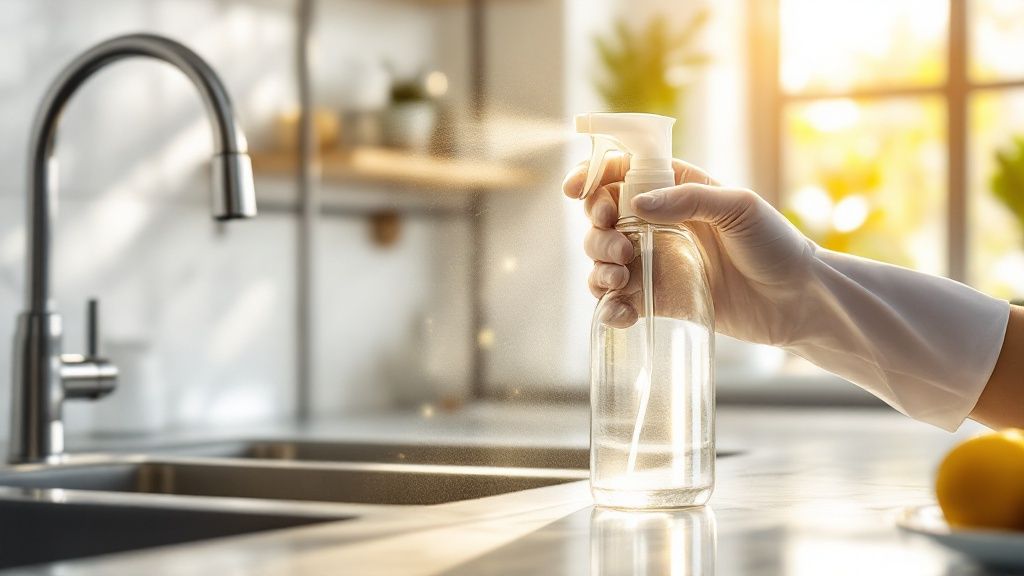
Hypochlorous acid is a game-changer for cleaning. It's an incredibly powerful disinfectant that's also remarkably safe—so safe, in fact, that your own body produces it to fight off infections.
This means you get a solution tough enough for nasty pathogens like Norovirus (Norwalk Virus) and Influenza A Virus (H1N1), but non-toxic and gentle enough to use around your family and pets.
Why HOCl Is a Smarter Way to Clean

When you're standing in the cleaning aisle, it often feels like you have to make a choice: harsh chemicals that kill everything, or a "natural" option that might not pack enough punch. Hypochlorous acid (HOCl) completely sidesteps that compromise.
Think about it—a disinfectant with the killing power of bleach but without the toxic fumes, skin irritation, or damage to your surfaces. That's exactly what you get with HOCl. It's the same substance our white blood cells create to destroy germs, making it a truly bio-friendly way to disinfect your home.
A Proven Yet Gentle Disinfectant
The real magic of hypochlorous acid for cleaning is how quickly and thoroughly it neutralizes a massive range of germs. It’s been proven effective against some of the toughest viruses out there, including small non-enveloped viruses like Norovirus and Rhinovirus Type 14, as well as enveloped viruses like Influenza A (H1N1) and even SARS-Related Coronavirus 2 (SARS-CoV-2).
Because it works so well without being harsh, HOCl is trusted in places where cleanliness is non-negotiable, like hospitals, dental offices, and food processing plants. It's not a new discovery, either. First identified way back in 1834, its use as a disinfectant really took off as healthcare settings needed safer, more effective ways to stop the spread of infections.
One of the biggest wins for HOCl is its neutral pH. This makes it non-corrosive on most surfaces and gentle on skin. Unlike bleach, it doesn't leave behind nasty chemical residues, so you don't even have to rinse it off—not even on food prep counters or kids' toys.
An Ideal Solution for Modern Homes
These days, we're all more conscious of the germs on high-touch surfaces. We also know that different pathogens can stick around for a surprisingly long time. If you're curious, you can learn more about how long viruses live on surfaces.
Using HOCl just makes sense. It simplifies your cleaning routine down to a single, powerful solution that works on almost any surface in your home. It gives you the peace of mind that your home isn't just tidy, but truly, microbiologically safe for everyone in your family.
HOCl vs Traditional Cleaners At a Glance
It can be tough to visualize how different cleaners stack up. This quick comparison shows why HOCl stands out from the old-school options like bleach and quats.
| Feature | Hypochlorous Acid (HOCl) | Bleach (Sodium Hypochlorite) | Quaternary Ammonium Compounds (Quats) |
|---|---|---|---|
| Safety | Non-toxic, no fumes, skin-safe | Toxic fumes, corrosive, skin/eye irritant | Can cause skin/respiratory irritation, leaves residue |
| Surface Compatibility | Safe for most surfaces, non-corrosive | Corrosive to metals, damages fabrics | Can damage some plastics and surfaces over time |
| Residue | No harmful residue, no rinse needed | Leaves a salt residue, requires rinsing | Leaves a sticky residue that can attract dirt |
| Environmental Impact | Breaks down into simple saltwater | Harmful to aquatic life, creates toxic byproducts | Persistent in the environment, contributes to "superbugs" |
| Effectiveness | Kills 99.9% of bacteria & viruses quickly | Highly effective, but requires proper dilution | Effective, but some microbes are developing resistance |
As you can see, HOCl delivers the powerful disinfection you need without the harsh trade-offs of traditional chemicals. It’s simply a smarter, safer way to keep your environment clean.
How to Choose the Right HOCl Product

Jumping into the world of hypochlorous acid can feel a little technical at first, but picking the right product is actually pretty simple once you know what to look for. Your choice really comes down to two paths: buying convenient, ready-to-use solutions or making your own on-demand with an at-home generator.
Pre-made, stabilized HOCl solutions are a lifesaver for busy households. For maximum convenience, consider disinfecting wipes pre-saturated with a stable HOCl solution. They take all the guesswork out of concentrations and are perfect for quick cleanups on high-touch surfaces like doorknobs, light switches, and kitchen counters after handling raw meat.
On the flip side, at-home generators are a fantastic option if you're eco-conscious or want to save money in the long run. These little devices use simple kitchen staples—usually just salt, water, and sometimes vinegar—to whip up fresh batches of HOCl. While you have an initial investment, you can make a powerful, hospital-grade disinfectant for just pennies an ounce, cutting way down on plastic waste from single-use bottles.
Decoding the Product Label
No matter which route you take, reading the label is non-negotiable if you want to be sure you're getting an effective disinfectant. Don't just grab the first bottle or pack of wipes you see. Instead, look for these three key details.
- Concentration (PPM): This stands for Parts Per Million and tells you the strength of the solution. For everyday household disinfecting against viruses like Influenza, a concentration between 100-200 PPM is the sweet spot. Anything stronger is often overkill for daily use.
- pH Level: HOCl is most effective when it has a neutral pH, ideally between 5 and 6.5. Inside this narrow window, the solution maintains its maximum germ-killing power. If the pH drifts too high or too low, the HOCl becomes far less effective at taking out pathogens.
- Shelf Life: HOCl isn't stable forever. It naturally loses its potency over time, especially when exposed to light and air. Always check for a clear expiration date. Stabilized, pre-made solutions and wipes can last for several months, but homemade batches are best used within a week or two to ensure they're still at full strength.
Making the Best Choice for Your Home
So which is right for you? It really just depends on your lifestyle. A busy parent might place a higher value on the sheer convenience of a pre-made spray or disinfecting wipes, while someone focused on sustainability will love the idea of an at-home generator.
The secret is out on HOCl. The market is currently valued between USD 1.2 billion and USD 5.6 billion, a massive range that shows just how fast demand is growing for safer, effective disinfectants. North America is leading the charge, holding about 45.5% of the market share. If you're curious, you can discover more insights about the hypochlorous acid market.
Since HOCl offers such a powerful alternative to harsh traditional cleaners, it’s worth seeing how it stacks up. For a deeper dive, check out our guide on making a bleach disinfectant solution to compare the differences. Ultimately, choosing the right hypochlorous acid for cleaning is about giving yourself the confidence that your home is genuinely clean and safe.
Putting HOCl to Work in Your Home
Okay, you've picked the right hypochlorous acid (HOCl) product. Now for the fun part: actually using it. Theory is one thing, but the real magic of hypochlorous acid for cleaning happens when you see it in action around your house. Let's walk through how this powerful, yet gentle, disinfectant can become your new go-to for keeping your home safe.
We’re not talking about generic instructions here. Think about real-life situations. You’ve just prepared raw chicken on the kitchen counter. Cross-contamination is a serious risk. A quick spray of HOCl at 200 PPM is all it takes to neutralize nasty pathogens like Salmonella and Campylobacter, making your surfaces safe for the next meal prep. And the best part? No rinsing needed.
Your New Disinfecting Routine
One of the best things about using HOCl is how simple it is. You don't need any special gear or complex procedures to get a hospital-grade clean. For most jobs, a good fine-mist spray bottle is your best friend. For even more convenience, pre-saturated disinfecting wipes are perfect for getting even coverage and letting the disinfectant do its work on the go.
When cold and flu season hits, those high-touch spots—doorknobs, light switches, TV remotes—turn into germ highways. A daily wipe-down or spray with HOCl stops viruses like Rhinovirus Type 39 and Influenza A in their tracks. It evaporates cleanly, breaking the chain of transmission without you having to worry about damaging surfaces or breathing in harsh chemical fumes.
This simple breakdown shows just how easy it is to use hypochlorous acid for cleaning your home's surfaces.

As you can see, the key steps are always the same: make sure you have the right concentration, apply it so the surface is visibly wet, and give it enough time to work.
Mastering Different Application Methods
While a spray bottle works for most surfaces, sometimes you need to adapt your technique. Different items and situations call for slightly different approaches.
Here are a few common scenarios:
- Sanitizing Kids' Toys: We all know plastic toys can become a breeding ground for germs. A fine-mist spray of HOCl is perfect here. Just spray them down, let them sit for about a minute, and they’re safe for playtime once dry. No need to rinse.
- Cleaning Bathroom Fixtures: For faucets, handles, and countertops, spray until the surface is completely wet. For tougher grime or more thorough disinfection, you can saturate a cloth or use a disinfecting wipe to cover everything. This ensures you’ve covered every inch and are effectively killing germs like E. coli or Human Rotavirus.
- Deodorizing Fabrics: HOCl is a phenomenal deodorizer because it kills the bacteria that cause odors in the first place. A light mist over couches, pet beds, or that lingering gym bag will neutralize smells without masking them with artificial scents.
Dwell time is a term you absolutely need to know. It’s the amount of time a disinfectant must stay wet on a surface to effectively kill pathogens. For HOCl, this is often just 60 seconds, but always check your product's label for specific kill times against tough viruses like Norovirus or Herpes Simplex Virus 1 (HSV-1).
To give you a quick reference, here’s a simple guide for using HOCl in some of the most common areas of your home.
HOCl Application Guide for Common Household Areas
| Area/Item | Recommended PPM | Application Method | Required Dwell Time |
|---|---|---|---|
| Kitchen Counters | 200 PPM | Fine-mist spray or wipe | 60 seconds |
| Kids' Toys (plastic) | 100-200 PPM | Fine-mist spray | 60 seconds |
| Bathroom Sinks & Faucets | 200 PPM | Spray & wipe or disinfecting wipe | 60 seconds |
| Doorknobs & Light Switches | 200 PPM | Fine-mist spray or disinfecting wipe | 60 seconds |
| Pet Beds & Fabrics | 100 PPM | Light misting | Air dry |
| Cutting Boards (non-porous) | 200-500 PPM | Spray until saturated | 1-2 minutes |
This table should help you feel confident using the right approach for each job.
Getting these little details right is what elevates your cleaning from just tidying up to creating a genuinely healthier space. For a deeper dive, check out our broader guide on effective cleaning and disinfecting practices. By making these simple but powerful techniques part of your routine, you can confidently keep your home disinfected and safe for everyone in it.
Keeping Your Family Safe with HOCl

While the germ-killing power of hypochlorous acid (HOCl) is what gets all the attention, its safety profile is what truly makes it a game-changer for families. It’s the same substance our own white blood cells produce to fight infection, which gives you a level of confidence that other chemical cleaners just can’t match.
What does that mean in the real world? It means you can confidently spray it on the surfaces your little ones touch most. Think high chairs caked in applesauce, pet bowls, or even that pacifier that just took a nosedive onto the kitchen floor.
Best of all, there’s no need to follow up with a water rinse. HOCl simply breaks down into a mild saline solution, leaving nothing toxic behind.
A Few Simple Rules for Smart Usage
To get the most out of your HOCl, there are a couple of best practices to keep in mind. They’re not complicated—just smart habits to make sure this gentle disinfectant stays potent.
First up is storage. Hypochlorous acid is sensitive to UV light, which degrades it and zaps its disinfecting power. Always keep it in an opaque, non-transparent bottle and stash it in a cool, dark place like a cabinet. A sunny windowsill is its worst enemy.
The next rule is critical: never, ever mix HOCl with other cleaning products. It’s incredibly safe on its own, but mixing it with something like bleach or ammonia could create a dangerous chemical reaction. Just let HOCl do its job solo.
Peace of mind comes from knowing exactly what’s in your cleaner. HOCl is a straightforward, single-ingredient solution that effectively kills pathogens like Human Rotavirus and Norovirus (Norwalk Virus) without introducing a cocktail of harsh chemicals into your home environment.
How to Know When Your Solution Is Past Its Prime
Because HOCl isn't shelf-stable forever, you need to know when it’s lost its kick. The easiest way is to just follow the expiration date on any pre-made solutions or disinfecting wipes you buy. If you’re making it at home, it's best to mix smaller batches and plan to use them within one to two weeks.
You can also do a quick "smell test." Fresh, active HOCl has a very faint, clean scent, a bit like a swimming pool. If you can’t smell anything at all, it has likely reverted back to simple saltwater and won't disinfect anything.
Using an old solution isn't dangerous, but it won’t kill any germs, which defeats the whole purpose. Following these simple guidelines ensures you're always cleaning with a fully potent and safe disinfectant.
Common HOCl Cleaning Mistakes to Avoid
Using hypochlorous acid (HOCl) is incredibly straightforward, but I’ve seen a few common slip-ups completely tank its disinfecting power. Think of this as your field guide to make sure you’re getting that hospital-grade clean you expect from every single spray or wipe.
One of the most frequent mistakes is trying to disinfect a surface that’s already dirty. Using HOCl on a countertop covered in crumbs or a greasy stove top is just a waste of a great product. All that organic gunk—the dirt and grime—will neutralize the HOCl on contact, stopping it dead in its tracks before it can ever reach the viruses and bacteria underneath.
Not Respecting the Dwell Time
Another big one? Not waiting long enough after you spray or wipe. Every disinfectant needs a specific amount of time to stay wet on a surface to do its job. We call this dwell time. For many common viruses like Influenza, this might be just 60 seconds, but some tougher germs need a little more time.
If you spray or wipe and immediately dry the surface, you’re removing the HOCl before it can finish working. For a proper kill rate against stubborn viruses like Feline Calicivirus (the scientific stand-in for the notoriously tough Norovirus), the solution has to stay visibly wet for the entire time listed on the product label.
Misinterpreting Strength and Stability
A lot of people think a stronger, chlorine-like smell means the product is working better. But with HOCl, the opposite is true. A fresh, potent batch has a very faint, almost clean scent. A strong, bleach-like odor is actually a red flag that the solution is degrading or has an imbalanced pH, which makes it less effective.
Using an old, degraded solution is another common pitfall. HOCl naturally loses its punch over time, especially when it’s exposed to sunlight and air. If your solution is past its expiration date or has been sitting in a clear bottle on a sunny windowsill, it has likely turned back into simple saltwater and won't disinfect anything.
The buzz around hypochlorous acid for cleaning is undeniable for a reason. The North American market alone was valued at roughly USD 2.7 billion and is on a steady rise. This isn't just a niche product; it's becoming a go-to disinfectant for a huge number of people looking for something that's both non-toxic and incredibly effective.
If you want to dive deeper, you can discover more insights about the hypochlorous acid market and its projected growth. By sidestepping these simple mistakes, you can guarantee you're getting the full, powerful benefits that are driving this impressive market forward.
Let's be honest, you're here because you were looking for a better, safer way to keep your home clean. And now you know the secret: hypochlorous acid gives you that serious disinfecting muscle without the harsh chemicals you've been trying to avoid.
It’s powerful enough to knock out nasty viruses like Influenza A Virus (H1N1) and Norovirus, yet it’s so gentle you don't have to worry about your family or pets. This isn't just about wiping down counters; it's about creating a space where you can actually breathe easier.
When you start using hypochlorous acid for cleaning, you’re making a conscious choice for a healthier home. You're picking a solution that works with your life, not against it.
The real beauty of HOCl is how simple and effective it is. You get hospital-grade results without any of the compromises, and that kind of peace of mind is priceless.
To make things even easier, think about grabbing some ready-to-use disinfecting wipes. They're perfect for hitting all the germ hotspots—doorknobs, faucets, light switches, and the TV remote that everyone touches.
Wipes give you all the power we’ve talked about, just packed into a super convenient format. It means that even on your most chaotic days, keeping your home protected is just a quick wipe away.
Got Questions? We've Got Answers
Even after breaking down the process, you might still have a few questions. That's totally normal. Here are some of the most common things people ask when they start using hypochlorous acid at home.
Is This Stuff Actually Safe Around My Kids and Pets?
Yes, absolutely. This is one of the biggest reasons people switch to hypochlorous acid (HOCl). Think of it this way: your own body's white blood cells produce HOCl to fight off infections. You're essentially cleaning with a substance that's bio-identical to your own immune system's defenders.
That means no toxic fumes and no sticky, harmful chemical residues left behind. You can spray down a high chair tray, kids' toys, or the dog's water bowl and not worry about a toxic film. Once it dries, it simply breaks down into a mild saline (saltwater) solution. No rinsing required.
What Surfaces Can I Use It On?
HOCl is incredibly versatile and plays well with most non-porous surfaces you'll find around the house. It's perfect for:
- Granite and quartz countertops
- Stainless steel appliances and sinks
- Glass, mirrors, and most plastics
- Sealed wood floors and furniture
It's a go-to for disinfecting germ-heavy zones like bathrooms, kitchen prep areas, and playrooms.
That said, you'll want to be a little careful with unsealed or very sensitive materials. Porous stone like marble and certain metals—think copper or brass—can tarnish or show wear with repeated, prolonged exposure. When in doubt, just do a quick spot test on a hidden area first.
How Is Hypochlorous Acid Different from Bleach?
This is a great question. While they’re both chlorine-based, they are worlds apart in terms of chemistry and safety. Bleach (sodium hypochlorite) is a harsh, high-pH (alkaline) chemical. It's corrosive, gives off those intense toxic fumes, and can be a serious irritant to your skin, eyes, and lungs.
Hypochlorous acid, on the other hand, is a weak acid with a neutral pH, making it incredibly gentle on people and surfaces. But here's the kicker: despite being so much milder, HOCl is often a more effective and faster-acting disinfectant against pathogens like the Hepatitis B Virus (HBV) and Herpes Simplex Virus 2 (HSV-2). Its neutral charge helps it penetrate microbial cell walls more easily than the charged particles in bleach.
So, you're getting superior disinfecting power without the harsh, risky trade-offs of traditional bleach. It's a smarter, modern approach to keeping your home healthy.
Leave a Reply